
Game review
Garden Eternal Review
6 / 10
- Developer
- Family Milk
- Publisher
- Family Milk
- Released
- 16 July 2026
- Platforms
- ["Windows"]
- Genre
- Casual
An Idle Game That Refuses to Idle
Garden Eternal bills itself as a cozy idle clicker — tap a glowing Heart, raise bees and buildings, draft cards through the seasons — and that pitch is exactly what draws players in. It's also, according to a sizable chunk of the small review sample it's drawn, not really true. Multiple reviewers report the same core frustration: leave the garden alone for more than about thirty minutes and its health bar collapses to zero, wiping out a chunk of progress and forcing you to more or less restart. For a $4.99 release from solo-adjacent studio Family Milk explicitly tagged "Idler" and "Casual," that's a real mismatch between marketing and mechanics, and it colors nearly every review in the sample, positive or negative.
The Core Loop Has Real Depth Once You Look Past the Tagging
Strip away the idle-game framing and what's actually here is a fairly clever hybrid: click the Heart to generate Growth, spend it on generator buildings with hard caps that you sacrifice and re-buy at higher tiers to keep progressing, and periodically crack open booster packs of cards that slot into a limited hand or deck for passive buffs. One especially detailed review — written by a player who logged over 15 hours and clearly mapped the whole system — calls the card-drafting layer one of the more clever mechanics in the genre, particularly the way each of the four seasons alters hidden base stats, with winter penalizing Growth generation while quietly speeding up Seed production for a separate tech tree. That same reviewer credits a genuinely interesting design: garden visitors who offer trades, a Traveling Merchant who'll strip a full tier of a building in exchange for Seeds, and monster-card intrusions that need repeated clicks to fight off before they wreck your buildings.
The Clicking Requirement Is the Sample's Central Fault Line
Nearly every negative review centers on the same complaint, often in near-identical language: the game cannot be left unattended, full stop. One reviewer calls it "a bit of false advertising" while still praising the cards and mechanics underneath; another goes further, calling out both the "idler" and "casual" tags as actively misleading given how much constant manual input random events and monster attacks demand. A third reviewer is more forgiving, framing the missing idle functionality as a probable bug rather than an intentional choice, though they add the developer doesn't seem to be treating it as urgent. Notably, even reviewers giving the game a thumbs-up acknowledge the same issue rather than disputing it — one bluntly writes "it's false advertised? Yes... but not bad" — which suggests the complaint is accurate rather than a matter of differing expectations.
Presentation Punches Above the Price Tag
Where the sample is unambiguous is on looks and sound. Reviewers repeatedly praise the pixel art, calling out bright neon colors set against a dark background as an effective, easy-to-focus-on palette, and the music and sound design get singled out as "top notch" more than once. The random garden-visitor events are specifically credited with making the pace feel busier and more engaging than a typical incremental game, turning what could be a passive experience into something closer to active puzzle-solving in short bursts.
A Genuinely Short Game, and Reviewers Are Split on Whether That's a Problem
Multiple reviewers note that Garden Eternal ends surprisingly quickly, hitting a hidden content milestone well before every building tier is maxed or the tech tree is fully explored. One reviewer flags this directly as the game's biggest limitation, wishing for enough late-game content to meaningfully push numbers into much larger totals; another calls it "shorter than expected" without much further comment. The most thorough review in the sample contextualizes this generously, though, pointing out the game was barely a month old at the time of writing and noting the developer has already discussed adding more content, including some form of a New Game Plus mode, in future updates.
The Interface Has Concrete, Specific Problems
Beyond the idle-tagging dispute, one detailed negative review lays out a genuine technical complaint: neither the windowed nor borderless display option actually produces a true windowed window, both silently forcing fullscreen instead, and the resolution list only offers 1920×1080, 2560×1440, and 3840×2160 with nothing smaller, which the reviewer notes makes the "windowed" option functionally useless on smaller displays. This is a narrow but very specific and reproducible issue, not a vague complaint, and it's the kind of interface polish gap that's cheap to fix but currently sits unaddressed.
A Responsive Developer Is the Sample's Quiet Bright Spot
Running through several reviews, both positive and negative, is a consistent note that Family Milk is active and responsive on the game's forums, having already shipped at least one resolution-related fix mentioned directly in the patch notes. More than one reviewer explicitly frames their current criticism as provisional, expecting the false-advertising and short-content issues to improve as the small team keeps iterating post-launch. That goodwill doesn't erase the problems in the current build, but it does meaningfully soften how harshly reviewers are willing to judge them.
Verdict
Garden Eternal has a genuinely inventive card-drafting-meets-incremental core hiding under a store-page pitch its own player base says doesn't match the actual experience — this is not the walk-away idle game its tags promise, and reviewers are right to flag that clearly. What's underneath the mislabeling is solid: attractive pixel art, a clever seasonal system, and a responsive small developer already patching real complaints. At $4.99 it's a reasonable gamble for incremental fans who don't mind active clicking, but anyone buying it specifically to leave it running in the background should look elsewhere until the "idle" tag actually means what it says.
Screenshots
-

The garden fills up fast with generator buildings and seasonal effects, but the health bar at the top is what forces constant attention.Image: Family Milk via Steam -
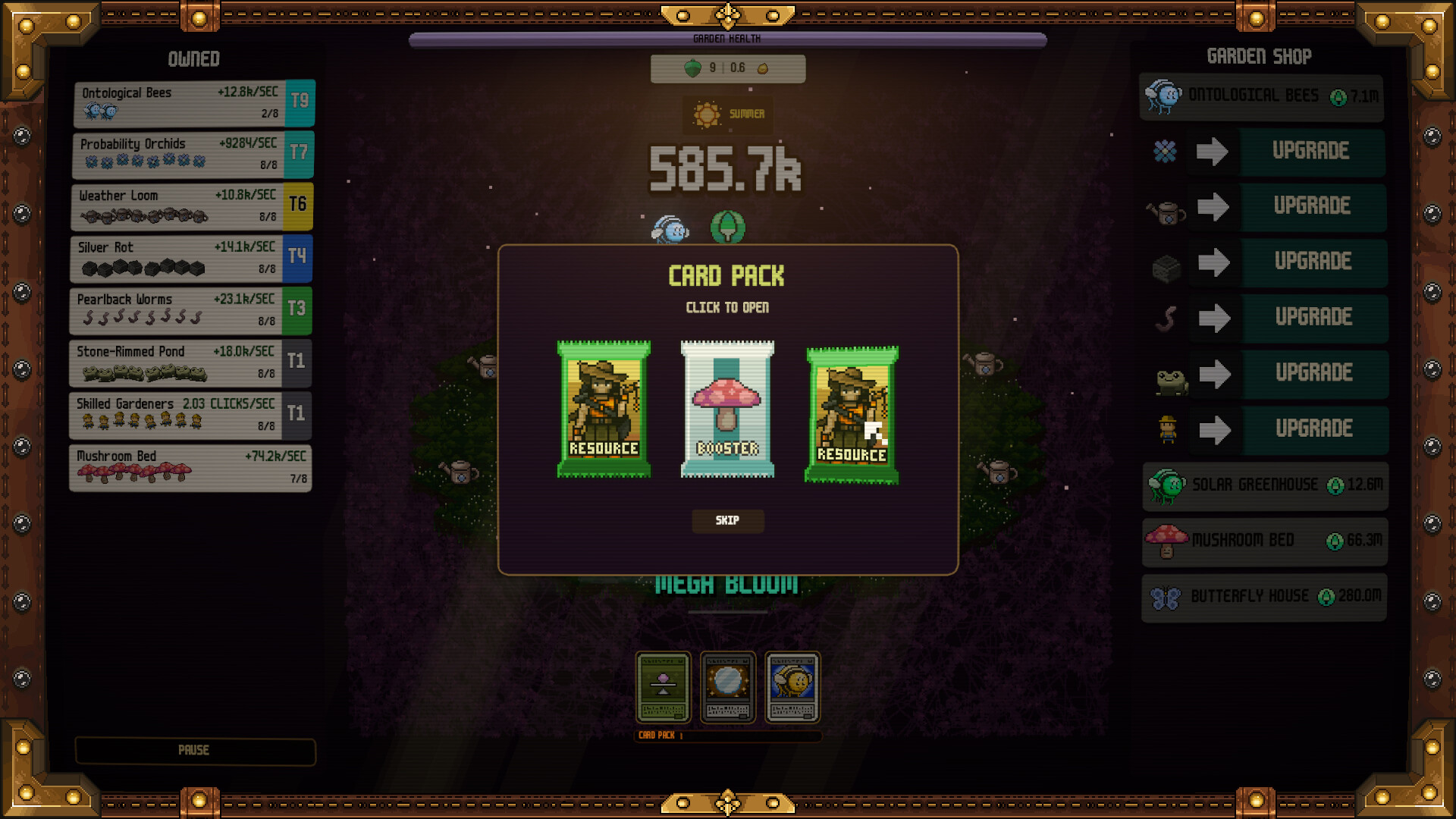
Booster packs like this one are where the card-drafting layer reviewers praised most comes into play.Image: Family Milk via Steam -
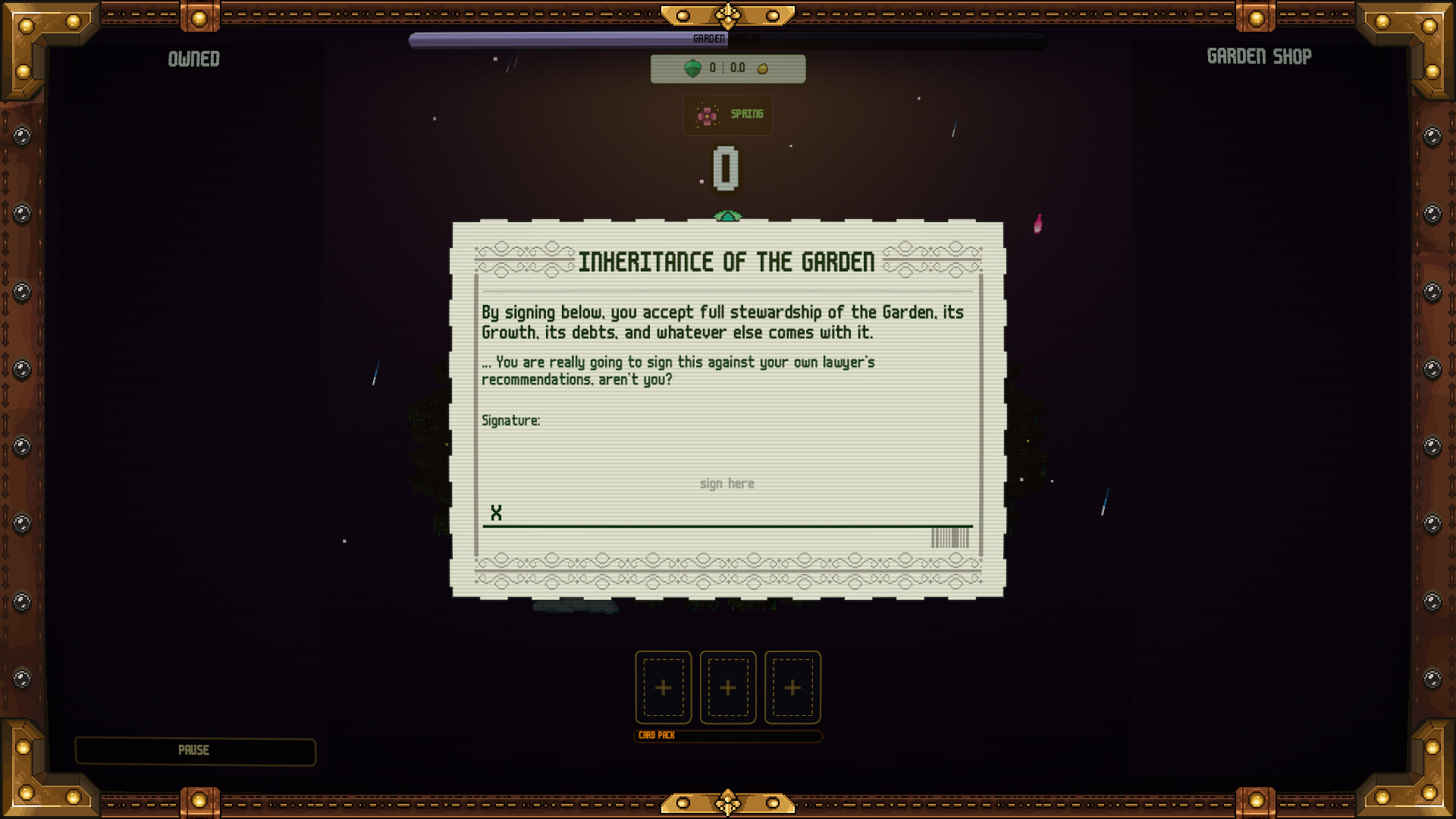
The game's inheritance framing device opens every run, setting up the uncle's garden premise reviewers reference.Image: Family Milk via Steam