Game review
A Game of Thrones: The Board Game - Digital Edition
6.5 / 10
- Developer
- Dire Wolf
- Publisher
- Twin Sails Interactive
- Released
- 6 October 2020
- Platforms
- Windows, macOS
- Genre
- Strategy
- Monetisation
- One-time purchase. Two paid expansion DLCs, A Feast for Crows and A Dance with Dragons, add rules modules and additional playable houses on top of the base game.
- Players
- Online multiplayer for up to six players, with AI able to fill empty seats; single-player against up to five AI opponents. No local/couch multiplayer, despite the store page briefly advertising one at launch.
The short version
A Game of Thrones: The Board Game - Digital Edition is a genuinely faithful port of one of the best strategic diplomacy board games ever printed, and the systems that made the tabletop original special — secret sealed orders, three-way power tracks, a Wall that punishes every house for squabbling too hard among themselves — survive the translation intact. Steam's own numbers back that up: 70.2% positive across 1,037 reviews, "Mostly Positive," with praise for the adaptation's fidelity running through both the positive and negative write-ups.
What keeps it from scoring higher is not the board game underneath, but everything built around it. There is still no enforced turn timer five years after launch, so one AFK player can hold an entire six-person lobby hostage for up to an hour. A "Play Together" local multiplayer option was advertised at launch and then quietly pulled from the store page, which several reviewers call what it is: false advertising. And with the game currently sitting at just a couple of dozen concurrent players, actually finding a full online table — the only way most people can play this at all — is its own obstacle.
Biggest strengths
- A faithful, exceptionally deep translation of one of the best strategic diplomacy board games ever designed, secret sealed orders and all
- Removes the physical game's biggest practical friction: hours of setup, table space for a huge board, and manual combat-resolution arithmetic
- Reviewers single out the tutorial as genuinely teaching the game's unusual systems, not just the rules text
Biggest weaknesses
- No enforced turn timer: an AFK player can freeze an entire multiplayer match for up to an hour, a complaint reviewers have been repeating since shortly after launch
- A local "Play Together" multiplayer option was advertised at launch, then quietly removed from the store page — reviewers explicitly call this false advertising
- AI feedback is sharply inconsistent across reviews, from "ruthless" and punishing to, in one detailed account, too weak to be worth playing against at all
Who it's for: Fans of the physical A Game of Thrones board game who want the depth without the setup time, table space and combat-math arithmetic, and strategy players who enjoy negotiation-heavy multiplayer over pure mechanical optimisation. Less suited to anyone hoping to jump into a quick online match on demand.
Our recommendation: Buy it if you already love the tabletop original or have a regular group willing to schedule sessions and use a Discord to coordinate lobbies. Go in with clear expectations about the AFK problem, and don't buy it expecting the local "Play Together" mode some early store listings promised — it isn't there.
6.5 / 10
A Game of Thrones: The Board Game began life in 2003 as Fantasy Flight Games' adaptation of George R.R. Martin's A Song of Ice and Fire — a licensed strategic diplomacy design that, among tabletop strategy fans, is often ranked alongside Diplomacy itself as one of the great negotiation-heavy war games. This 2020 digital edition, developed by Dire Wolf and currently published by Twin Sails Interactive (an earlier build shipped under Asmodee Digital), is a licensed port of that board game rather than a new interpretation of the setting, and it is worth judging first on how well it carries that source material across, and only after that on what a decade of live-service board game ports usually get wrong.
A faithful, complicated translation
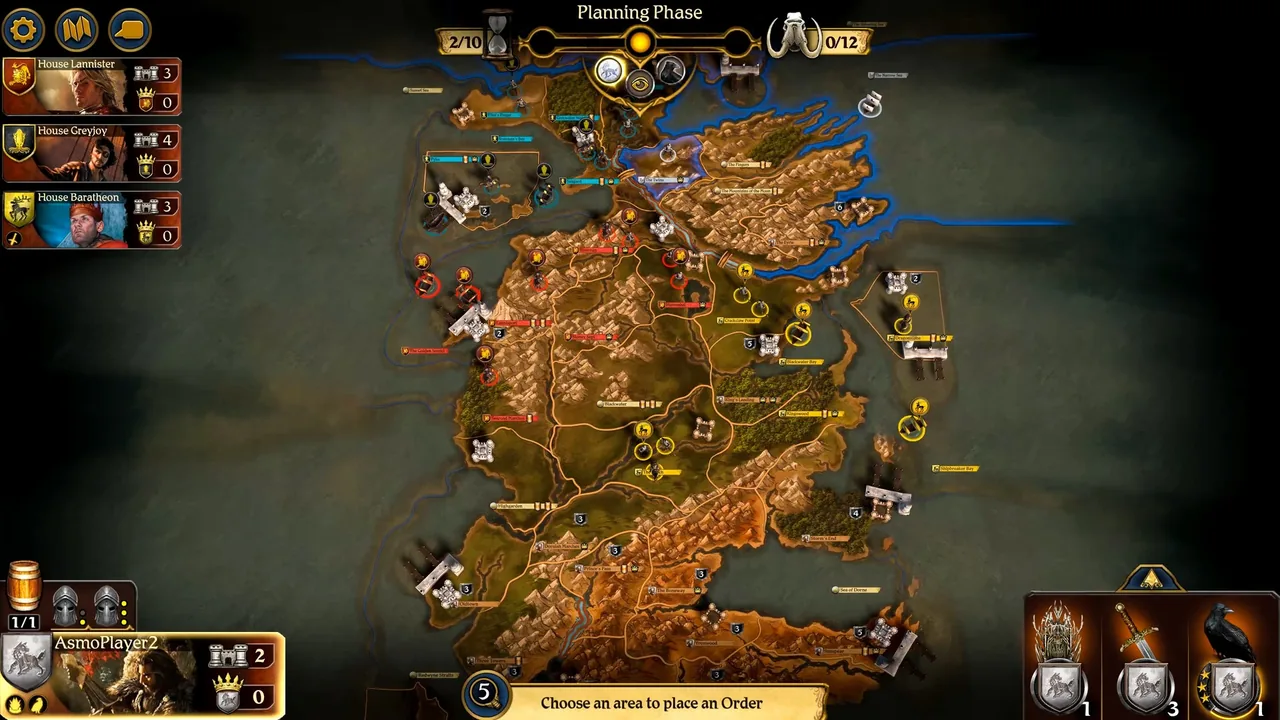
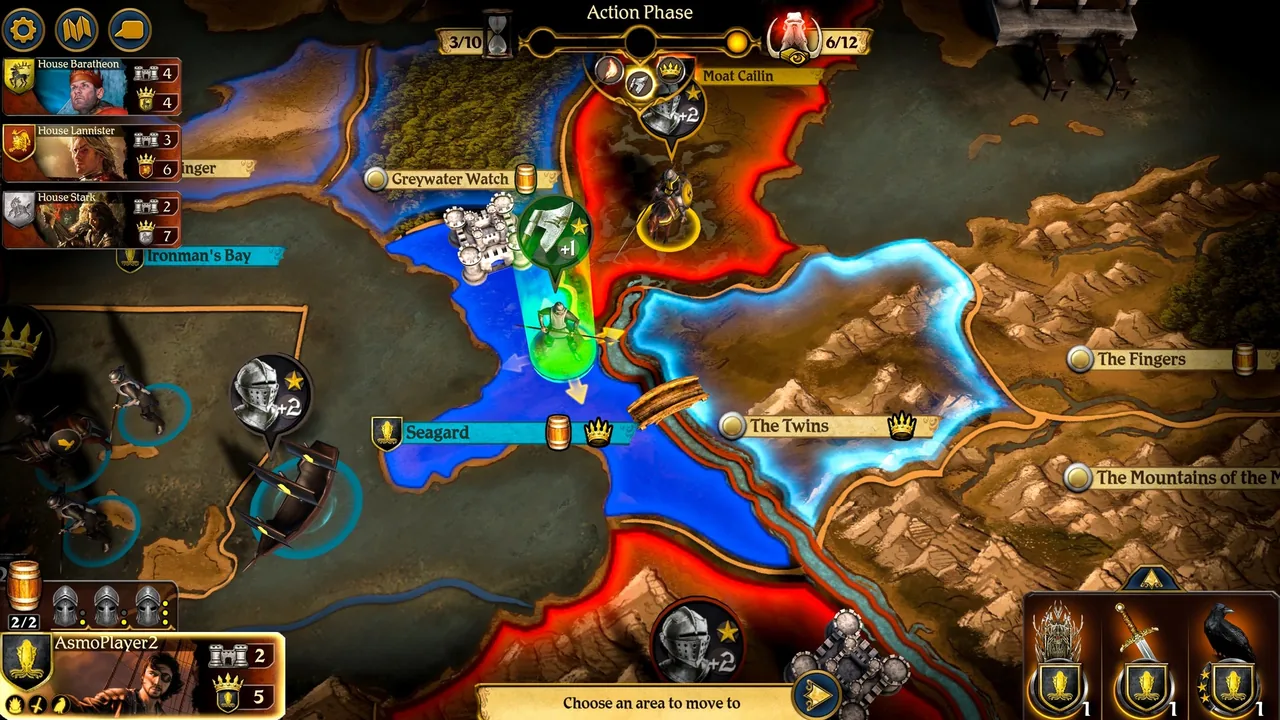
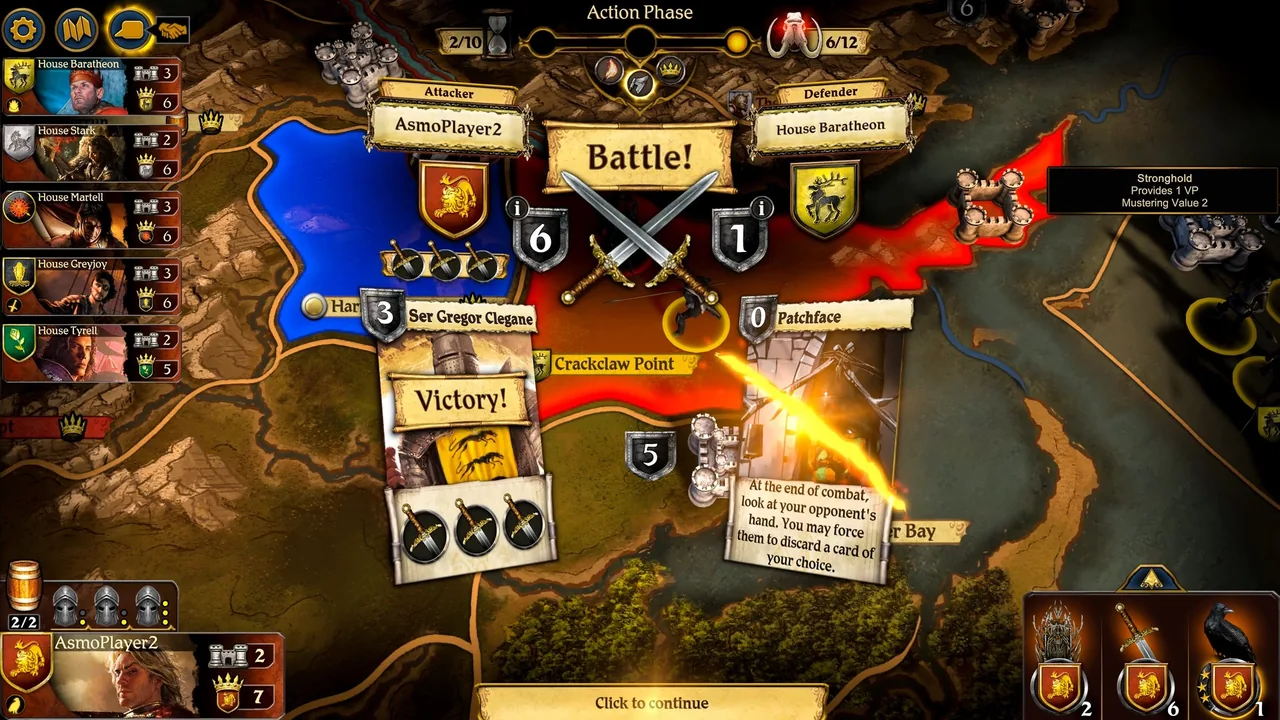
The core structure survives untouched: up to six players take a Great House, secretly assign order tokens to their armies each round — support, raid, march, defend, consolidate power — and reveal them simultaneously, so every round is equal parts military planning and bluff-reading. Three influence tracks (the Iron Throne, the Messenger Raven, and Valyrian steel) grant real strategic leverage to whoever controls them, and the Wall in the north forces every house to periodically stop squabbling and contribute power tokens against the wildlings or suffer a shared, game-wide penalty. It's an unusually elegant design for its complexity, and reviewers across both the positive and negative camps agree the digital edition gets its systems right: "solid adaptation of the physical game," reads one of the more measured reviews, praising the tutorial specifically for teaching rules that are genuinely hard to convey in a rulebook. For anyone who has tried to explain sealed-order combat resolution to five new players around a physical board, having the client enforce every rule automatically is not a small convenience — it removes hours of setup and the tedium of manual combat math without touching what made the design worth playing in the first place.
The AFK problem that never got fixed
The single most repeated complaint across five years of reviews is structural, not cosmetic: there is no enforced turn timer. If one player in a six-person online lobby steps away, the entire match simply stops until they either return or are forcibly removed — a process reviewers describe taking up to an hour. "Afk system is broken," reads one review updated across three separate edits as the issue persisted patch after patch. Another, more measured but no less frustrated: "Enjoyable game but DESPERATELY needs turn timers, 1/2/5 mins per turn. At present there is nothing to stop someone in a multiplayer game from holding the entire game up... It's a ridiculous and poorly thought out system that guarantees time wasting." What makes this land harder than an ordinary UX complaint is the genre: this is a game built entirely around a shared table of real people making simultaneous decisions, and the one thing every other online board game adaptation solves early — a clock — is still absent here.
A vanishing local option
At launch, the store listing indicated support for local "Play Together" multiplayer, letting a group share one screen or one connection the way you would around a physical board. That option was subsequently pulled from the store page entirely after players discovered it didn't function as advertised. "I bought the game in pre-sale because its features included local multiplayer through 'Play Together,'" reads one of the most-upvoted negative reviews on record. "The game came out and after its first hours many people began to complain about having included that option... Fake advertising. If your idea was to buy it to play with friends locally, then don't do it." Anyone buying this specifically to replicate a living-room board game night on one screen should know that option isn't there, whatever an old store description or Steam tag might suggest.
Inconsistent opponents
Feedback on the AI is genuinely split in a way that's worth flagging rather than smoothing over. Some reviewers describe it as punishing: "Seriously... dont expect to win this easily. The AI is ruthless." Others report close to the opposite. One detailed, fairly written review calls the port itself strong — "loads quicker than playing the board game IRL... considerably so" — before landing hard on the same subject: "The big big big drawback is that the AI is so tremendously awful that you literally can't play with it," describing a session with three experienced human friends where the AI simply couldn't offer resistance. The spread likely reflects difficulty settings, patch versions across five years, and the AI's difficulty being far more exploitable once a table understands the game's diplomacy systems — but a prospective buyer relying on AI opponents to learn the game or play solo should expect real variance rather than one settled experience.
A thin population, five years on
This is fundamentally a multiplayer-first design, and Steam's public player-count endpoint currently shows only around two dozen concurrent players. That tracks with what several reviews independently recommend: joining the game's Discord community specifically to organise lobbies, rather than expecting to matchmake into a full six-player table on demand. "I would suggest joining the Discord for looking for online games," reads one review from several months after launch, adding that a game or two is usually findable there even when the in-client matchmaking isn't producing one. Five years on, that's still effectively the intended path to a full match — workable for a dedicated group who schedule sessions, considerably less appealing for anyone hoping to drop in solo and find six strangers.
The achievement curve
The client tracks 22 Steam achievements. The most commonly earned sits above 70% of the playerbase — consistent with an early milestone most buyers reach in their first game or two — while completion drops off sharply from there, with several of the rarer achievements earned by under 10% of players and the single rarest under 5%. That shape is typical of a game whose core loop is genuinely completed by most buyers at least once, but whose deeper conditions — winning specific ways, with specific houses, under specific circumstances — are reserved for the smaller group of players willing to return to it repeatedly, which lines up with a design this dependent on finding a recurring group.
6.5 out of 10. The board game underneath A Game of Thrones: The Board Game - Digital Edition is excellent, and Dire Wolf's port treats it with real respect — automating the tedious parts, preserving the diplomacy, and shipping a tutorial reviewers trust to actually teach it. What holds the digital edition back is everything Fantasy Flight never had to solve on a physical table: no enforced turn timer to stop one absent player from freezing a match, a local multiplayer option that was promised and then quietly withdrawn, and — five years after release — a population thin enough that finding a full table takes more effort than it should. Worth buying for a group that will actually organise around it; a rougher proposition for anyone hoping to click in and play tonight.
Pros and cons
Pros
- A faithful, exceptionally deep translation of one of the best strategic diplomacy board games ever designed, secret sealed orders and all
- Removes the physical game's biggest practical friction: hours of setup, table space for a huge board, and manual combat-resolution arithmetic
- Reviewers single out the tutorial as genuinely teaching the game's unusual systems, not just the rules text
- Full six-player online lobbies with AI able to fill empty seats, plus a five-opponent single-player mode
- Two expansion DLCs (A Feast for Crows, A Dance with Dragons) let invested groups add the physical game's expansion content
Cons
- No enforced turn timer: an AFK player can freeze an entire multiplayer match for up to an hour, a complaint reviewers have been repeating since shortly after launch
- A local "Play Together" multiplayer option was advertised at launch, then quietly removed from the store page — reviewers explicitly call this false advertising
- AI feedback is sharply inconsistent across reviews, from "ruthless" and punishing to, in one detailed account, too weak to be worth playing against at all
- Current concurrent player counts are thin enough that multiple reviews point newcomers toward a community Discord just to find a full lobby
- Recurring reports across the review history of multiplayer matches becoming unresumable after a crash or a long AFK stall, with no in-game recovery
Screenshots
-
A Game of Thrones: The Board Game - Digital EditionImage: Twin Sails Interactive via Steam -
A Game of Thrones: The Board Game - Digital EditionImage: Twin Sails Interactive via Steam -
A Game of Thrones: The Board Game - Digital EditionImage: Twin Sails Interactive via Steam -
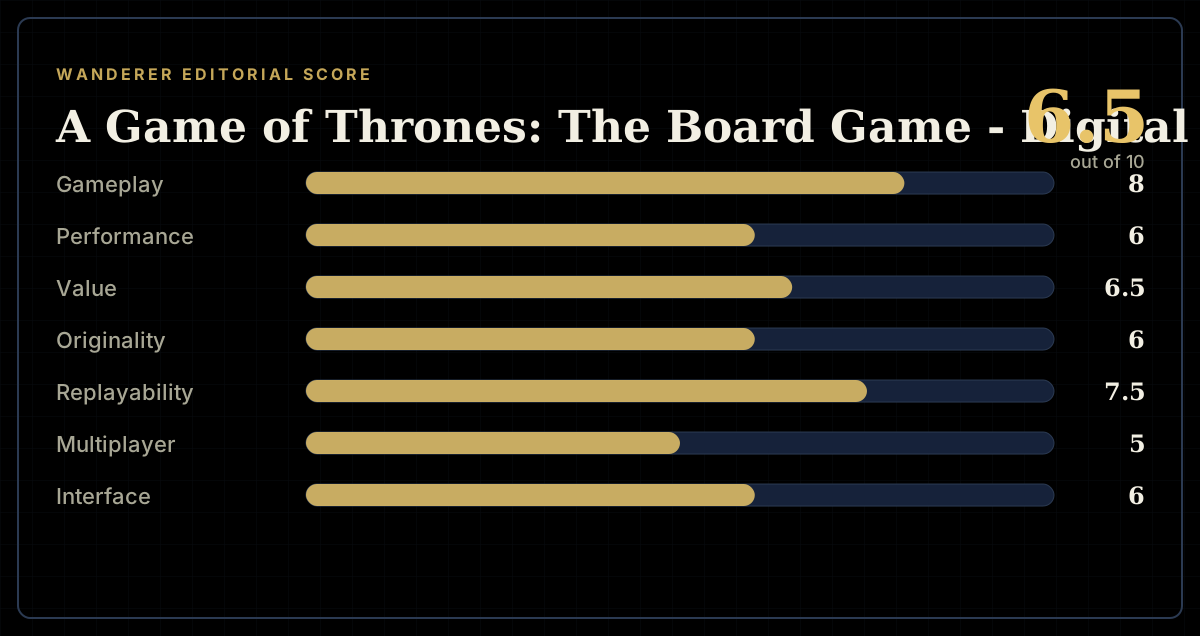
How the review scores each part of the gameWanderer Editorial -
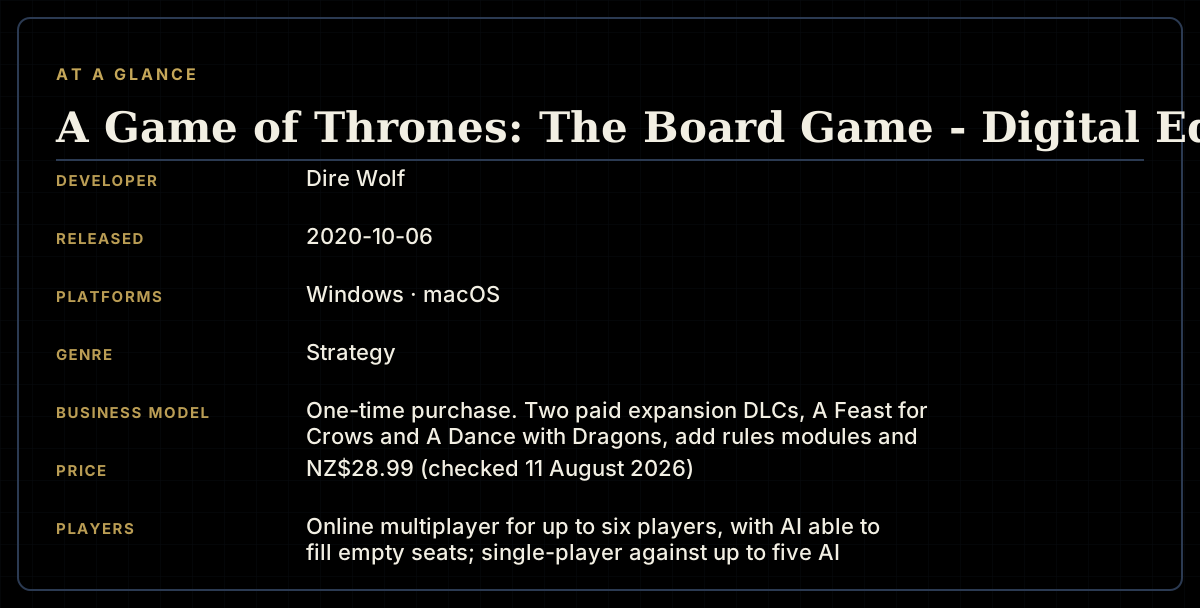
The game at a glanceWanderer Editorial -
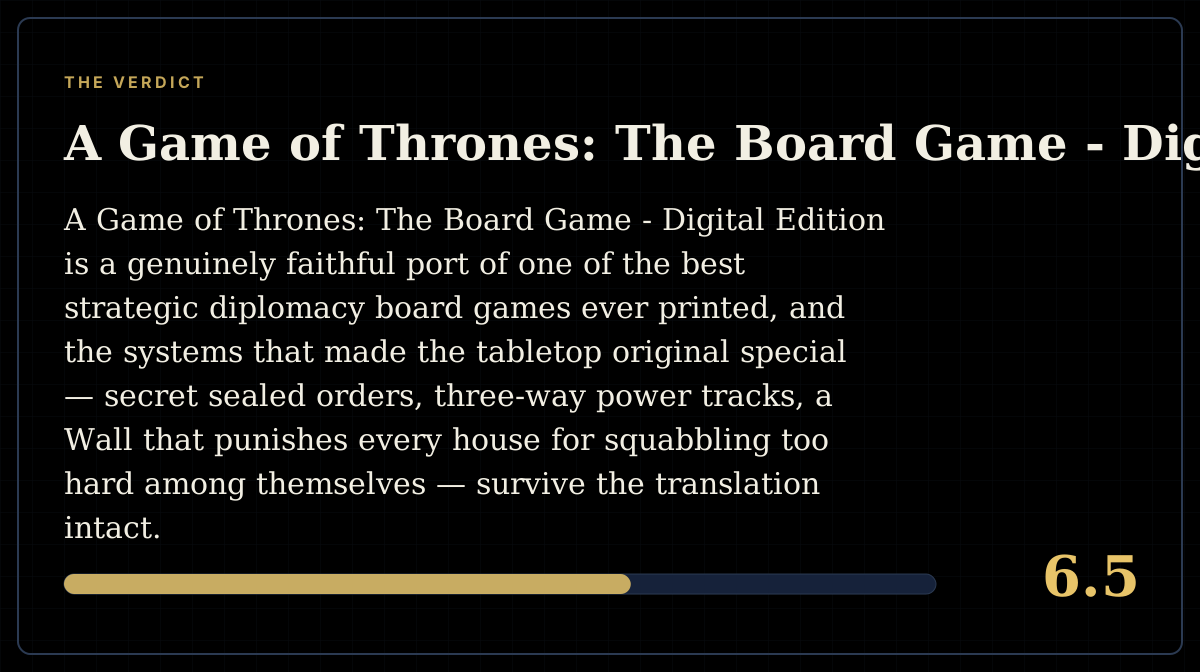
The short versionWanderer Editorial