Game review
Desktop Gremlins
6 / 10
- Developer
- ShuGhost
- Publisher
- ShuGhost
- Released
- 6 August 2026
- Platforms
- Windows
- Genre
- Desktop Pet / Life Simulation
- Monetisation
- One-time purchase, no in-app purchases. Steam Workshop content is free. The developer states the price rises when the game leaves Early Access.
- Players
- None as a live feature. Single-player only, though Steam Workshop lets players publish and download community-made sprite packs for the pet.
The short version
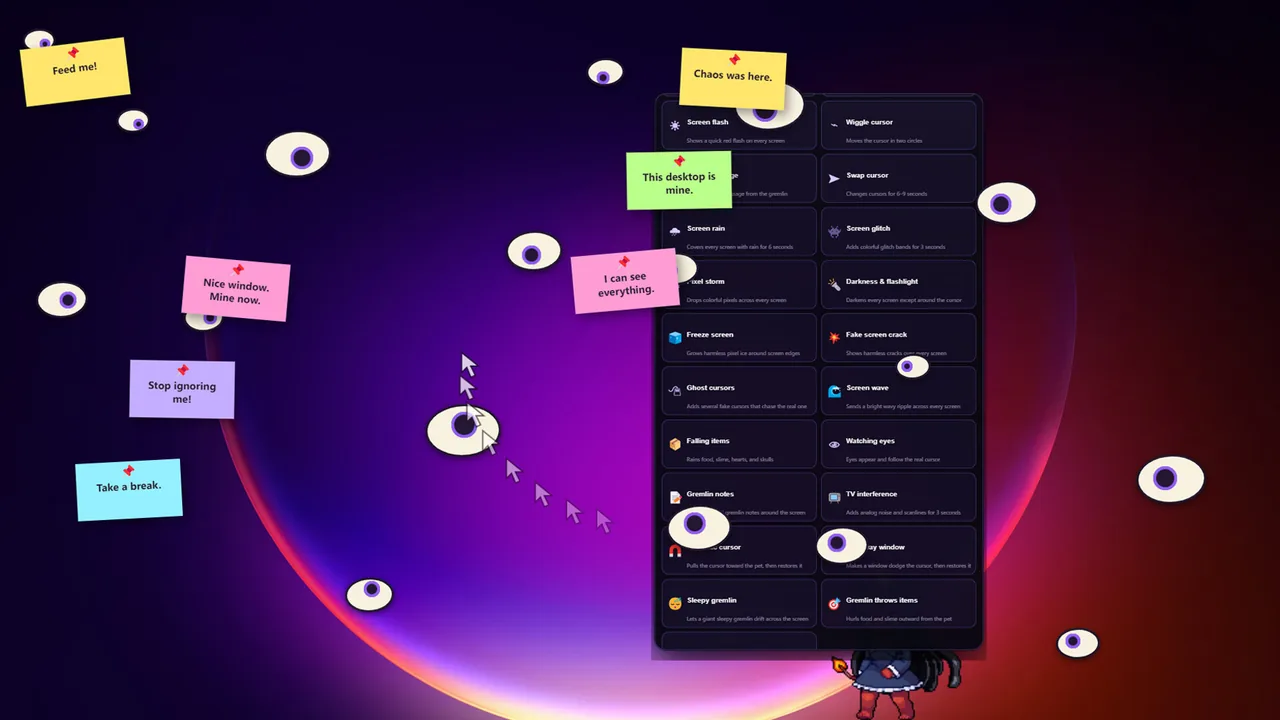
Desktop Gremlins is a transparent, always-on-top pet that lives over your other windows, reacts to the apps you open and the music you play, and levels up from a slime into four more forms — the last one a dark sorceress — as you feed it, pet it, and let it misbehave. Turn on Chaos Mode and it will shake windows, spin your browser, rearrange your desktop icons and flash your taskbar on its own schedule.
This review was written one day after launch, and there is genuinely nothing yet to check the pitch against: Steam records zero user reviews and no news posts, and the global achievement data resolves to exact multiples of one-ninth — a hint that as few as nine Steam accounts have reported stats back at all. What follows is an honest read of a small, cheap, single-developer Early Access release on its own documented terms, set against a genre that already has a free, open-source giant in VPet-Simulator.
Biggest strengths
- A real, if short, progression ladder — feeding and petting grant EXP that visibly changes the pet's form and animations rather than just unlocking a menu
- Reacts specifically to named applications (Steam, Discord, Visual Studio Code, Photoshop) and to music playback, rather than firing on a blind timer
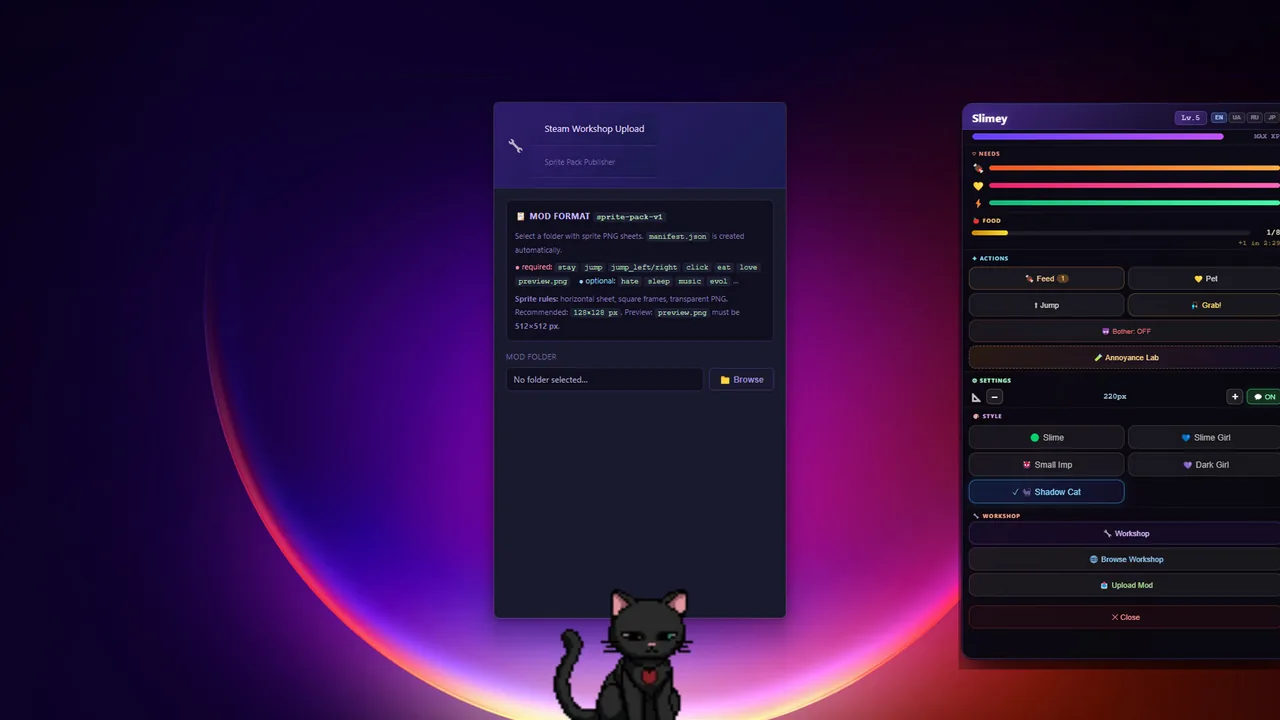
- Steam Workshop support for community sprite packs, plus a built-in tool for creating and publishing your own, from day one
Biggest weaknesses
- Launches with zero Steam user reviews and no track record to weigh the pitch against
- The store's own accounting is inconsistent about how much is actually here on day one — the short description promises five evolution forms, the Early Access Q&A says the current build ships four
- A direct, free, open-source competitor (VPet-Simulator) already offers hundreds of animations and years of community-made Workshop content in the same genre
Who it's for: Anyone who likes the idea of a Tamagotchi that lives on the desktop rather than in a pocket, and doesn't mind an app that occasionally shakes their windows on purpose. A poor fit for anyone who wants a mature, content-heavy pet right now, or who needs the app to never misbehave during a work session.
Our recommendation: At under three dollars it's a cheap thing to try, but this is a one-developer Early Access launch with no track record yet — go in expecting a genuinely small, still-forming app, and check back in a few months to see whether the promised extra characters and community attention actually arrive.
6 / 10
Desktop Gremlins went into Early Access on 6 August 2026, and this review was written the following day, which means it arrives with almost nothing to lean on beyond what the developer, a single person trading as ShuGhost, has put on the store page. Steam's own review system records zero user reviews. The news feed has never posted. The global achievement stats, when you pull the raw numbers, resolve to exact multiples of one-ninth — 88.8%, 77.7%, 55.5%, 44.4%, 22.2%, 11.1%, and two flat 0.0% — which is the kind of pattern you only get from a genuinely tiny reporting sample, plausibly as few as nine Steam accounts with stats tracked so far. That's not a criticism of the game; it's just where a one-day-old release actually sits, and it's worth saying plainly rather than padding the gap with anything that looks like a verdict from experience nobody has had yet.
What is verifiable is the pitch itself, and it's a clean one: a transparent, always-on-top desktop pet that starts life as a slime, reacts to what you're doing on your PC, and evolves as you take care of it — ending, per the store description, as a dark sorceress. It sells for NZ$2.87 on an introductory discount through 13 August, rising to NZ$3.19 after that, and the developer says plainly that the price goes up again whenever the game eventually leaves Early Access.
A pet with an actual endpoint
The thing that separates Desktop Gremlins from the "cute animal wanders your taskbar" school of desktop pet is that it has a stated progression system rather than just a set of idle animations. Feeding it, petting it, and otherwise interacting with it grants experience, and that experience visibly changes what's on your screen: the store page describes the pet moving through several distinct forms, each with its own appearance, animation set, and personality, culminating in the sorceress form promised in the short description. That's a real design decision, not a marketing flourish — it gives an otherwise ambient, always-on app something to work toward, the way a Tamagotchi's life stages give you a reason to keep checking in rather than just tolerating a screen ornament.
It's worth flagging, though, that the store's own accounting of how much of this is actually here on day one isn't fully consistent. The short description promises evolution "through 5 characters." The Early Access Q&A, answering "what is the current state of the Early Access version," says the build ships with four characters with unique animations plus the EXP and evolution system that drives them. Whether that's a rounding difference — the slime counted separately from four further evolutions, say — or whether the fifth, final sorceress form is itself part of what full release adds, isn't something the store page resolves, and it isn't something this review can settle without installing the game. It's a small thing, but it's exactly the kind of small thing worth checking for yourself before buying if the specific promise of a five-stage arc is what's drawing you in.
Eight Steam achievements back the progression up on paper: names like "First Steps," "Dark Side," and the hidden "First Evil" strongly suggest they're pinned to evolution milestones, alongside more open-ended ones — "Music Lover," "App Collector," "Steamer" — that look tied to the reactivity system covered below. That's a reasonable spread for a game this size: enough to mark real progress without turning a desktop companion into a checklist.
Chaos, on a schedule you don't fully control
The feature that separates Desktop Gremlins from a purely decorative pet is Chaos Mode, an opt-in setting the store page describes as giving the gremlin "complete freedom" to shake and move windows, rearrange desktop icons, spin your browser, and flash the taskbar. Paired with that is a more passive reactivity layer that isn't toggled off the same way: the pet is described as dancing to music playback and reacting differently when it detects specific named applications running — Steam, Discord, Visual Studio Code, and Photoshop are the four the store page calls out by name.
That's a more interesting hook than the genre's baseline. Desktop Goose, the best-known reference point for "a creature that messes with your desktop," is built entirely around the joke of being unwelcome — it drags your cursor and leaves virtual mud, and it isn't trying to be a companion you keep around while you work. Desktop Gremlins is explicitly trying to do both jobs: be a pet you feed and evolve, and also occasionally be a gremlin that earns its name. Whether that balance actually lands — whether Chaos Mode feels like a fun surprise or an unwelcome interruption during, say, a video call with Discord open — is a question about tuning and frequency that no store page answers, and it's the single biggest open question a prospective buyer can't check from outside the app.
A small, cheap Early Access title in a genre with a free giant
The honest context for Desktop Gremlins is that "transparent, always-on-top pet with Steam Workshop support" is not a new pitch. VPet-Simulator, reviewed elsewhere on this site, is free, fully open-source, and sits at 98.3% positive across more than 51,500 reviews, with a modding scene that includes an in-app level editor and years of accumulated community sprite packs. Shimeji, the genre's much older reference point, has thousands of community sprite packs of its own, if a fiddlier setup process and none of the newer games' reactivity or progression systems. Desktop Gremlins isn't competing on raw content volume with either of those — it can't, on day one of Early Access, with one developer and eight achievements against a free competitor's years of accumulated Workshop output — and it isn't trying to be free, which is a legitimate choice but does put a small price tag next to a well-established zero-dollar alternative in the exact same genre.
What it's betting on instead is the specific combination nobody else quite offers in one package: a clear evolution arc with a defined endpoint, active application-and-music reactivity rather than ambient idle animation, and an opt-in prank layer with a name and a toggle. That's a reasonable niche to try to claim. Whether it's enough to justify even a NZ$2.87 asking price against a free competitor with a much bigger library is a genuinely open question this review can't answer with authority yet, because nobody has had time to write the comparison from actual use.
What running costs are we actually talking about
Because this is software meant to sit resident on your desktop for as long as you're at your PC, not something you open for a session and quit, its footprint matters more than it would for a normal game. The listed minimum requirements are modest: an Intel Core i3-6100 or AMD FX-6300, an Nvidia GTX 750 Ti or AMD Radeon R7 260X with 2 GB of VRAM, 500 MB of RAM, and 500 MB of storage. Those are years-old, low-end parts by 2026 standards, which is exactly what you want from an app whose entire premise is running in the background indefinitely alongside whatever you're actually doing — a desktop pet with a heavy GPU requirement would defeat its own purpose. There's no way to verify those numbers hold up under Chaos Mode's window-manipulation effects specifically, since that's the part of the app most likely to spike resource use in ways a static requirements line can't capture, but the baseline stated ask is sensible for the category.
The money side, in full
Working through the checklist this site applies to any paid, free-to-play, or live-service release: there's a single upfront cost, no in-app purchase menu, no advertisements, no energy system, no premium currency, and no battle pass. The one DLC-adjacent thing in the picture is Steam Workshop content, and that's free to browse, subscribe to, and apply — the developer isn't gating community sprite packs behind a second purchase, which is worth noting given how easily a smaller studio could have turned character skins into paid add-ons instead. The only monetisation wrinkle to flag plainly is the one the developer has already flagged themselves: the price rises when Early Access ends. That's a common and defensible practice — reward the people willing to buy in early and unfinished — but it means the NZ$2.87 currently on the page, itself a temporary 10%-off introductory rate on an NZ$3.19 base that expires 13 August, is close to the lowest this app will ever cost. There's no pay-to-win question to weigh, because there's nothing to win; it's the cleanest possible monetisation shape a paid Early Access app can have, and the review sample this site would normally lean on to check that claim against player experience simply doesn't exist yet.
What Early Access means here, concretely
ShuGhost's own Q&A answers are unusually direct for a one-person project. Asked why Early Access at all, the answer is to "grow the game alongside our community." Asked how long, the answer is roughly 6 to 12 months. Asked what full release adds, the answer is more characters, each with their own animations and personality — the same four-stage evolution structure, extended rather than reinvented. Asked about pricing, the developer says outright that the price rises once Early Access ends, which at least sets correct expectations rather than promising a permanently low price and walking it back later. Community involvement is planned through Steam discussions and the community hub, which is the standard toolkit and carries no more weight than any other developer's stated intentions until there's a visible pattern of updates to check it against — and right now there isn't one; the news feed for this app has never posted.
One thing that is unusually solid for an app this size and price: the accessibility tagging on the store page. Adjustable text size, camera comfort, adjustable difficulty, and full keyboard-only and mouse-only control options are all listed categories, not review claims — a level of documented accessibility support that plenty of much bigger, much more expensive releases don't bother with. It's a genuine credit to a solo developer's launch checklist, whatever else is or isn't finished underneath it.
The numbers, such as they are
It's worth being explicit about how little there currently is to measure this game against. Steam's review system shows zero submitted reviews in any language — not a low score, not a mixed one, literally none. There's no news history to trace an update cadence from. The achievement percentages, read carefully, look like they're describing single-digit account counts rather than a meaningful population: values that land exactly on multiples of 11.1% are the signature of a denominator around nine, not the smoothly distributed curve you'd expect from even a few hundred players. None of that is a mark against the game — every Early Access release starts here — but it does mean this review is working entirely from the developer's own documented claims rather than from any independent signal about whether those claims hold up in practice, and that's a materially different kind of review from one written even a few weeks from now, once a review corpus and an update history exist to check against.
Final verdict
Desktop Gremlins is a small, cheap, single-developer Early Access bet on a genre that already has a free, extensively modded incumbent. What it offers on top of the baseline "pet lives on your screen" idea is real: a defined evolution ladder with EXP and visible form changes, reactivity tied to named applications and music rather than a blind idle loop, and an opt-in Chaos Mode that tries to earn the "gremlin" in the title rather than just being decorative. The accessibility options are better documented than most software twenty times its price.
Set against that is a launch with zero reviews, no update history, a vague roadmap measured in months rather than milestones, and a store page whose own numbers don't quite agree on how much content ships on day one. None of that makes it a bad app — it makes it an unproven one, priced low enough that trying it is a small bet rather than a real risk. Six out of ten reflects a real, if narrow, idea executed with more care in the small details (the accessibility tagging, the specific app reactions, the honest pricing Q&A) than a three-dollar Early Access launch usually bothers with, weighed against having nothing yet — no reviews, no track record, no evidence the roadmap will land on schedule — to raise that score any further. Worth a look if the idea appeals and the price is pocket change to you; worth waiting on if you want any evidence beyond the developer's own word that what's promised is what arrives.
Pros and cons
Pros
- A real, if short, progression ladder — feeding and petting grant EXP that visibly changes the pet's form and animations rather than just unlocking a menu
- Reacts specifically to named applications (Steam, Discord, Visual Studio Code, Photoshop) and to music playback, rather than firing on a blind timer
- Steam Workshop support for community sprite packs, plus a built-in tool for creating and publishing your own, from day one
- An unusually well-documented accessibility footprint for an app this size: adjustable text size, adjustable difficulty, camera comfort options, and full keyboard-only and mouse-only control schemes are all listed on the store page
- Cheap enough, at under three dollars, that the risk of trying it is genuinely low
Cons
- Launches with zero Steam user reviews and no track record to weigh the pitch against
- The store's own accounting is inconsistent about how much is actually here on day one — the short description promises five evolution forms, the Early Access Q&A says the current build ships four
- A direct, free, open-source competitor (VPet-Simulator) already offers hundreds of animations and years of community-made Workshop content in the same genre
- The Early Access roadmap is vague on specifics — "more unique characters" over an unspecified 6-to-12-month window, with no committed content schedule
- Windows only, no Mac or Linux build, which rules out a chunk of the desktop-pet audience that the free alternatives do reach
Screenshots
-
Desktop GremlinsImage: ShuGhost via Steam -
Desktop GremlinsImage: ShuGhost via Steam -
Desktop GremlinsImage: ShuGhost via Steam -
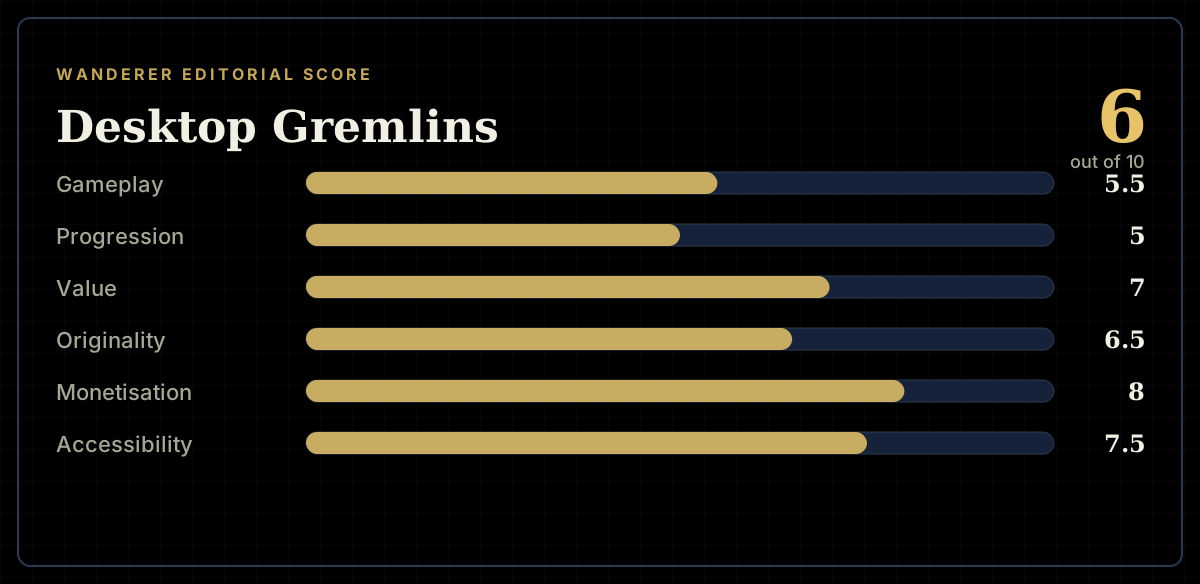
How the review scores each part of the gameWanderer Editorial -
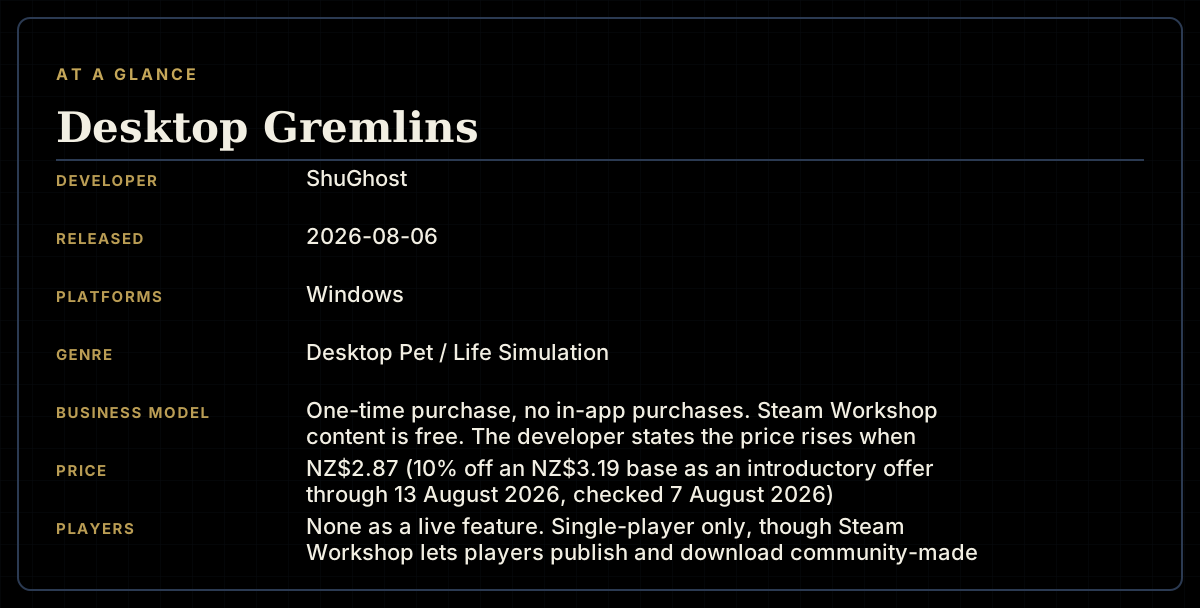
The game at a glanceWanderer Editorial -
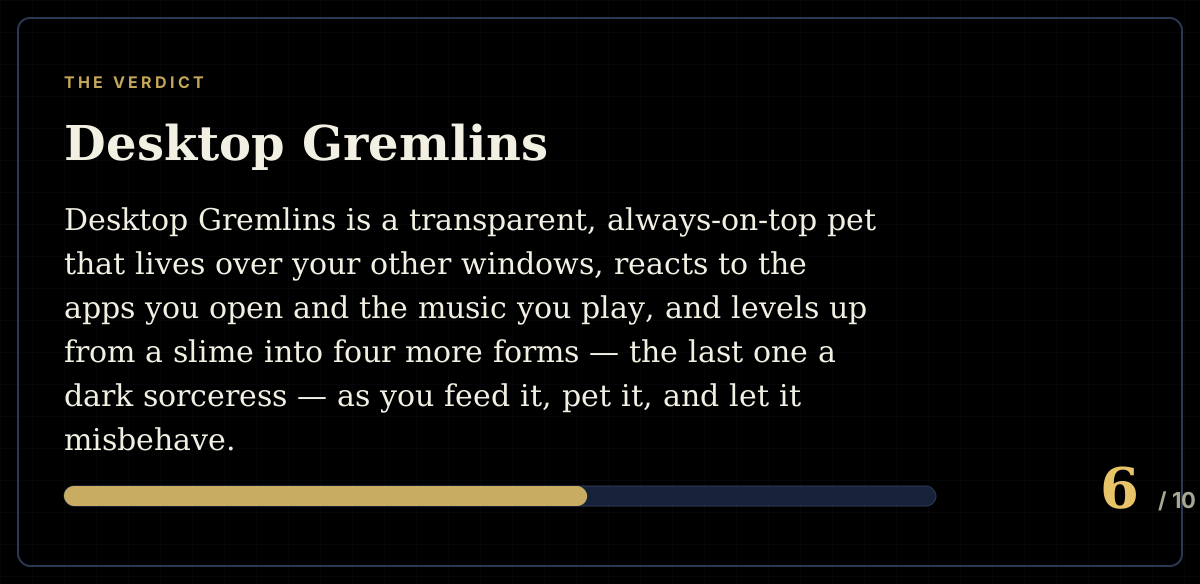
The short versionWanderer Editorial