Game review
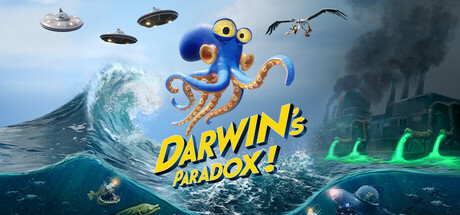
Darwin's Paradox!
5.4 / 10
- Developer
- ZDT Studio
- Publisher
- KONAMI
- Released
- 2 April 2026
- Platforms
- Windows
- Genre
- Cinematic Platformer / Action-Adventure
- Monetisation
- Premium (one-time purchase)
- Players
- false
The short version
Darwin's Paradox! is a confident, visually distinctive debut for ZDT Studio, built around a genuinely fun set of tentacle-based traversal and stealth abilities and a warm, comedic tone that stands out in a genre that often takes itself too seriously. It's undercut, though, by real difficulty-pacing missteps, a short runtime that some will find hard to justify at the asking price, and — most surprisingly for a stylised, cartoonish platformer — persistent performance and optimisation complaints across a wide range of hardware.
Biggest strengths
- Genuinely funny, warm tone and strong visual/animation direction throughout
- Creative use of the octopus's abilities (camouflage, ink, wall-climbing, tentacle grabs) across varied, rarely-repetitive puzzle setups
- Chapter select and consistent, learnable enemy patterns reward mastery and completionist replays
Biggest weaknesses
- Widely and specifically reported performance/optimisation issues, even on capable hardware and at reduced settings
- Short main-campaign length (roughly 5-6 hours) that several reviewers feel is hard to justify at full price
- No option to disable film grain or motion blur, a real accessibility gap for players sensitive to those effects
Who it's for: Fans of narrative-driven, puzzle-lite cinematic platformers in the vein of Little Orpheus or American Arcadia, and anyone who wants a single-sitting, comedic action-adventure rather than a long-haul commitment.
Our recommendation: Recommended for genre fans who can tolerate some rough edges and trial-and-error sections, especially if picked up on sale or after trying the demo — less compelling at full price for players sensitive to short runtimes or performance issues.
5.4 / 10
What Is Darwin's Paradox!?
Darwin's Paradox! casts you as Darwin, an octopus whose memory has been wiped by mysterious aliens, forced to rediscover his own abilities — swimming, wall-climbing, ink-shooting, camouflage, and tentacle-based object manipulation — one by one while escaping a strange industrial facility. It's a cinematic action-adventure platformer in the tradition of games like Little Orpheus or American Arcadia: heavily scripted, visually led, comedic in tone, and built around a relatively linear progression of set-piece puzzle rooms rather than open exploration. Published by KONAMI under an original IP rather than one of the company's legacy franchises, it's been received warmly by its player base — 87% positive across 841 reviews — with several reviewers explicitly framing it as an encouraging sign that Konami is willing to back small, original studios again.
The tone is a genuine standout in a genre that tends toward melancholy or self-serious atmosphere. Reviewers repeatedly single out the comedy and presentation, with one noting they'd only be able to compare its lighthearted approach to a couple of other titles in the entire cinematic-platformer space, and another praising "funny visual storytelling" and animation so expressive that "an octopus could die in so many creative and comical ways" without the game losing its charm. That distinct personality is doing a lot of work to separate Darwin's Paradox! from its more po-faced genre peers.
Creative Ability Use Carries the Puzzle Design
The core gameplay loop revolves around gradually unlocking and combining Darwin's octopus abilities — sticking to surfaces, grabbing objects with tentacles, dash-swimming against currents, blinding enemies with ink, and camouflaging into the environment — to solve environmental puzzles and evade threats. Multiple reviewers praise how consistently fresh this stays across the campaign: "the gameplay makes great use of all his unique abilities... these mechanics open up a wide range of creative puzzle solutions that never feel repetitive," as one detailed review puts it, going on to note that levels frequently mix stealth, platforming and puzzle-solving rather than settling into a single repeated pattern.
That said, the difficulty curve draws real criticism. A recurring complaint is that certain sections lean on trial-and-error deaths rather than fair, readable challenge — "brutal" is how one reviewer describes the difficulty spikes, paired with "jerky camera tracking" that doesn't help matters. One more critical review goes further, describing entire stretches as more tedious than difficult: having to repeat already-solved puzzle segments after an unrelated insta-death, purely because checkpointing doesn't account for it, with "legit nothing to do except walk/swim in one direction" until you reach the actual point of failure again. A separate structural complaint many reviewers raise concerns the opening hours specifically: the tutorial has you watch a companion character demonstrate camouflage and ink-shooting, only for the actual playable campaign to strip those abilities away again and force you to "relearn" them through near-identical cutscenes — a strange, redundant pacing choice for a game that otherwise moves briskly.
Not every reviewer sees the difficulty as a flaw, though — several defenders argue the challenge is fair once you learn enemy and hazard patterns, and that some criticism reflects unfamiliarity with the genre's traditions rather than a real design problem. One completionist reviewer, after finishing 100% of the achievements, specifically pushed back on "unfair difficulty" complaints, arguing "every enemy and moving obstacle follows consistent, predictable patterns" and that mastery through repetition is simply how the genre is meant to work. Where you land on this likely depends heavily on your prior experience with cinematic platformers and your tolerance for trial-and-error sequences within an otherwise short game.
Performance Is the Review Sample's Loudest Complaint
The single most consistent, specific criticism across the review sample — more than difficulty, more than length — is performance. This is notable precisely because Darwin's Paradox! is not a graphically demanding-looking game; its art style is stylised and cartoonish rather than photorealistic, which makes the reported frame-rate and optimisation problems more surprising. Multiple reviewers report struggling to hit a stable 60fps even on high-end hardware at high settings, with one specifically noting they were "barely hitting 60FPS on high settings with a 9070XT," and another reporting the game "struggling" even with DLSS Quality enabled at 4K. Complaints about persistent blurriness regardless of sharpening settings, and specific frustration directed at Unreal Engine 5's Lumen lighting system causing shimmering, unstable shadows, appear across multiple independent reviews spanning launch week through several months later — this isn't a launch-day bug that got patched out, but an ongoing pattern.
Related to this, several reviewers flag the absence of toggles to disable film grain and motion blur as a genuine accessibility gap, specifically warning that players sensitive to those effects should "play in little sessions" or avoid the game entirely until the options are added. For a visually led, presentation-focused game like this one, that's a meaningful oversight — the cinematic camera work and set-piece direction are frequently cited as one of the game's biggest strengths, which makes it more frustrating that a subset of players can't fully engage with that strength comfortably.
A Short, Linear Experience — Value Depends on Expectations
Darwin's Paradox! is consistently described as short, with most reviewers reporting completion times in the 5-6 hour range for a full playthrough, including one who called it "quite short at around 5.5 hours." Reactions to that length split cleanly along expectations. Several reviewers frame the brevity as a genuine strength — "the game's shortness worked in its favour for me... finally, a game I actually finish!" — and appreciate that the game doesn't overstay its welcome or pad itself out with filler. Others are more hesitant given the NZ$42.94 asking price, with one reviewer noting plainly that "considering the price some may find it hard to digest" despite otherwise enjoying the experience. Chapter select unlocks after a first playthrough, giving completionists a clean way to mop up collectibles and remaining achievements, which somewhat extends the game's useful life for players who care about 100% completion.
The consensus advice across the sample, repeated by multiple reviewers independently, is to try the free demo before buying — a sensible recommendation given how much the value proposition depends on both your tolerance for the game's length and pacing, and on whether your specific hardware runs into the performance issues that dominate the more critical end of the review spread.
Final Verdict
Darwin's Paradox! is an impressive, characterful debut let down by execution gaps that feel avoidable rather than fundamental. The creative use of an octopus's abilities across varied, well-designed puzzle sequences, combined with genuinely funny writing and strong visual direction, make a real case for this as an instant favourite for cinematic-platformer fans specifically. But a short runtime at a mid-range price, real difficulty-pacing missteps early on, and — most damagingly — a pattern of performance complaints that has persisted well past launch, keep it from being an easy recommendation for anyone outside its core audience. Try the demo first; if the tone and puzzle design click for you, the full game is very likely to deliver on that promise, provided your hardware cooperates.
Pros and cons
Pros
- Genuinely funny, warm tone and strong visual/animation direction throughout
- Creative use of the octopus's abilities (camouflage, ink, wall-climbing, tentacle grabs) across varied, rarely-repetitive puzzle setups
- Chapter select and consistent, learnable enemy patterns reward mastery and completionist replays
- A confident, well-reviewed debut original IP from a small studio under a major publisher
Cons
- Widely and specifically reported performance/optimisation issues, even on capable hardware and at reduced settings
- Short main-campaign length (roughly 5-6 hours) that several reviewers feel is hard to justify at full price
- No option to disable film grain or motion blur, a real accessibility gap for players sensitive to those effects
- A handful of trial-and-error sections and an early pacing misstep around re-teaching abilities the tutorial already covered
Screenshots
-
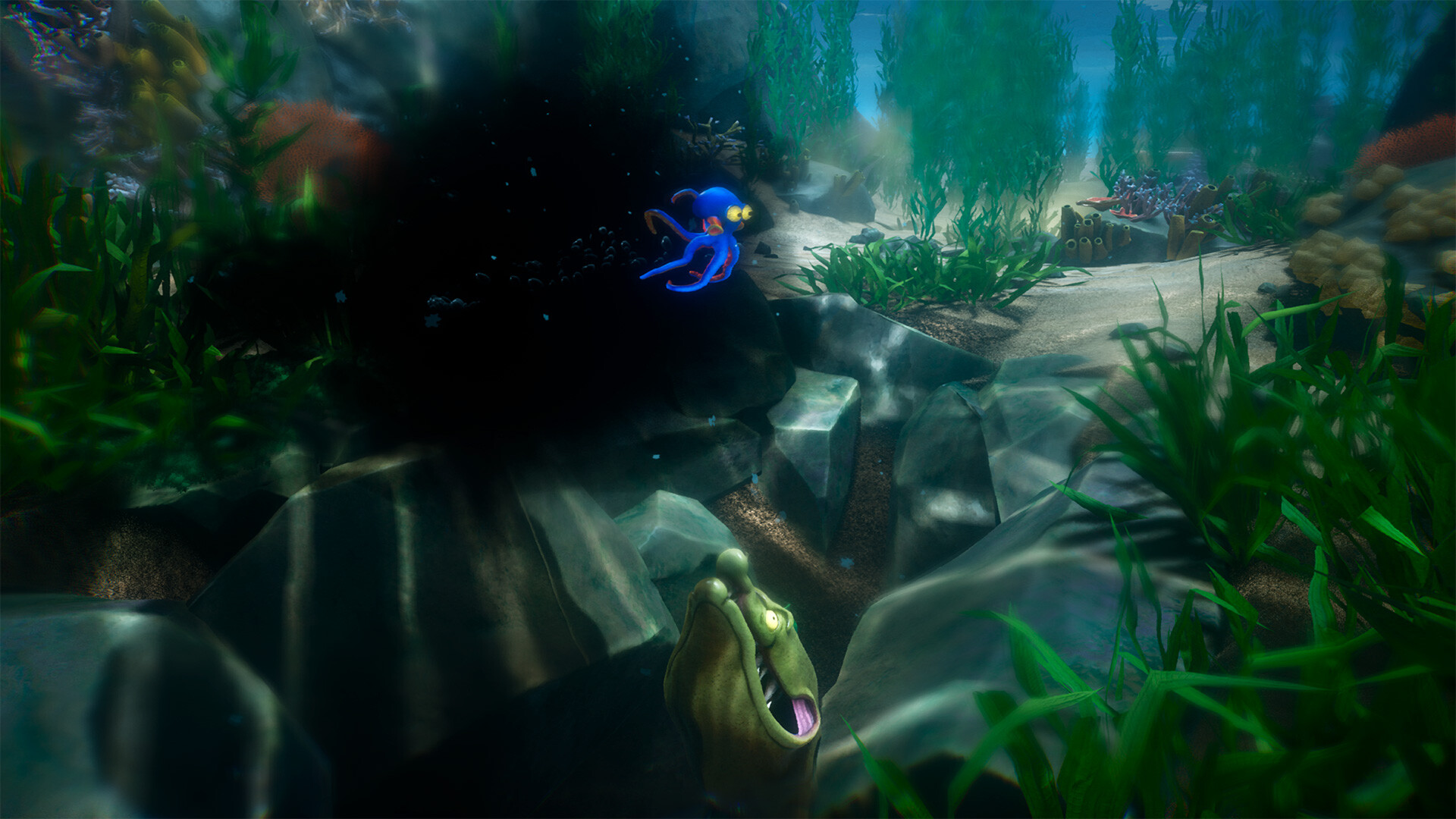
Underwater sections mix exploration with stealth around dangerous wildlifeKONAMI -
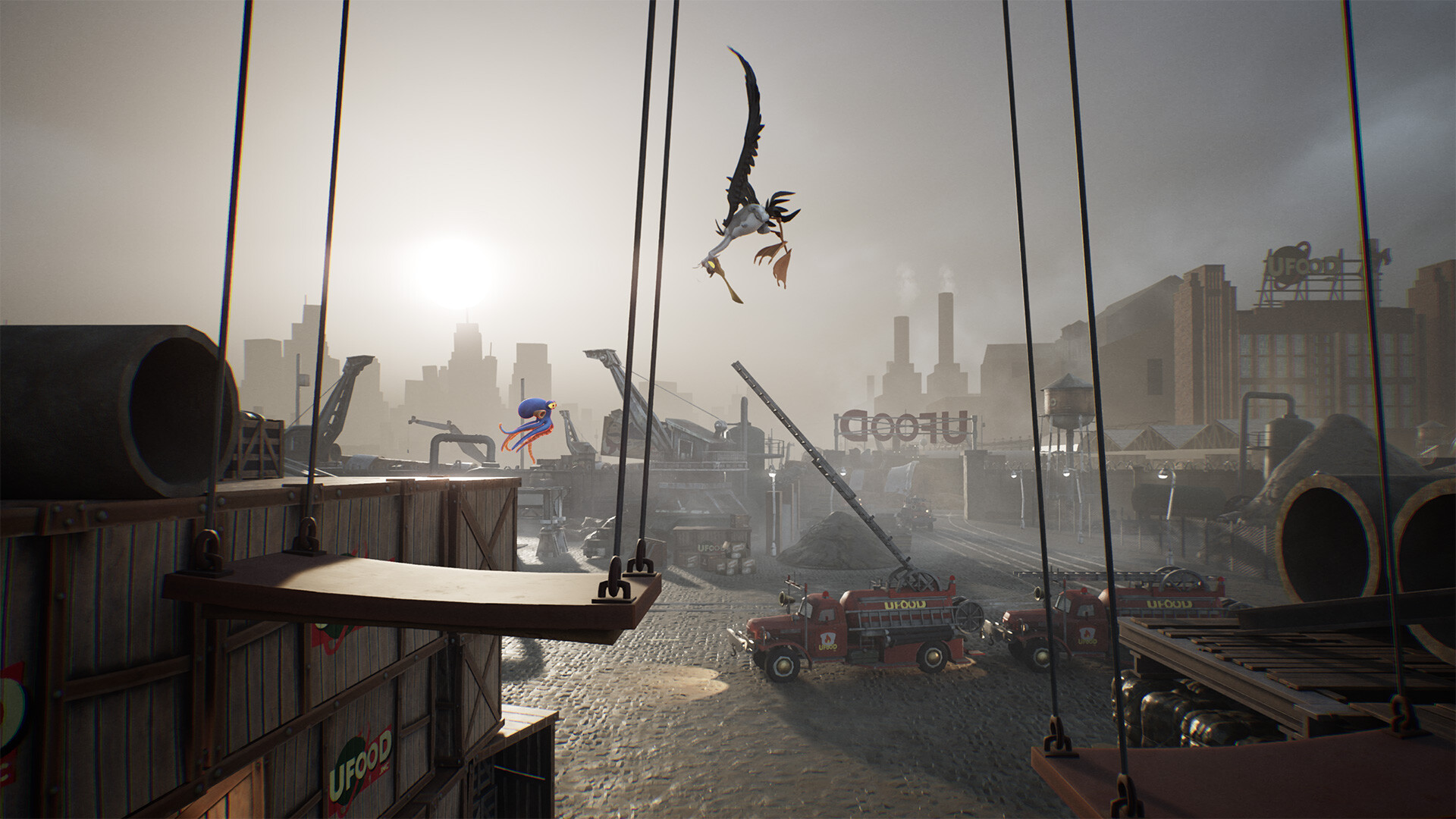
The game's industrial setting, with cinematic set pieces like this bird chaseKONAMI -
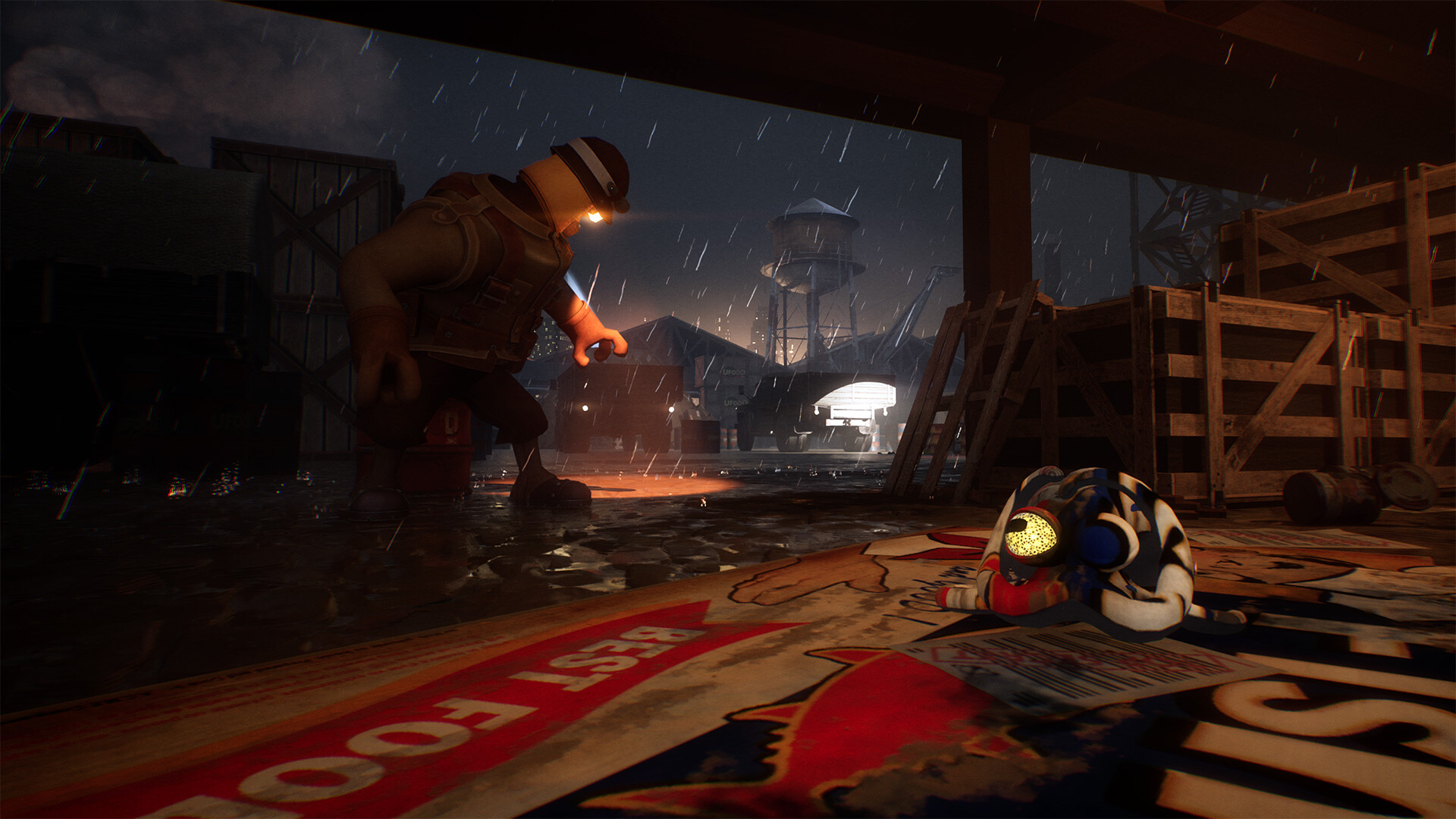
Camouflage lets Darwin blend into his surroundings to avoid detectionKONAMI -
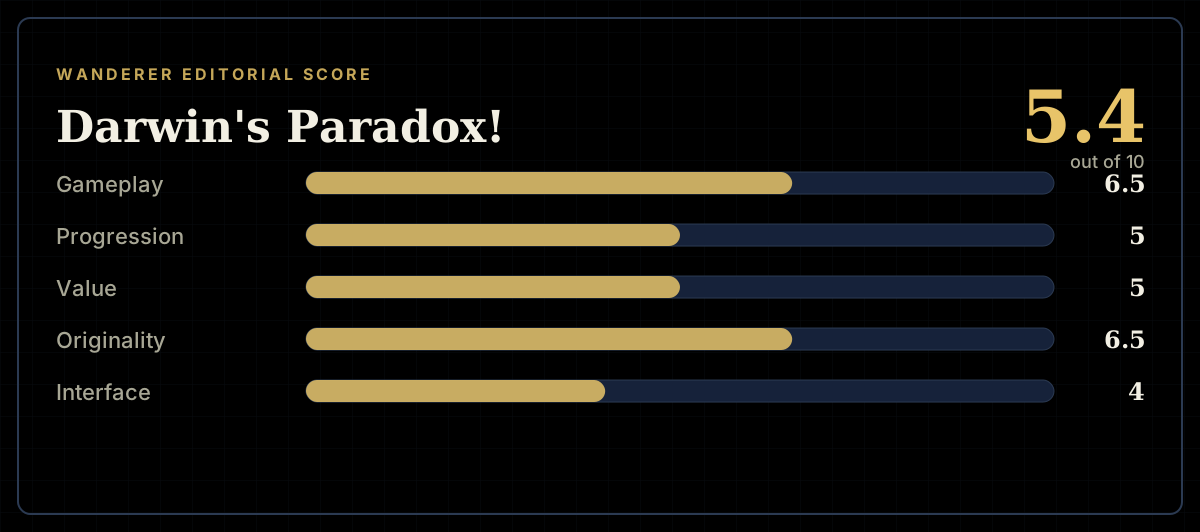
How the review scores each part of the gameWanderer Editorial -
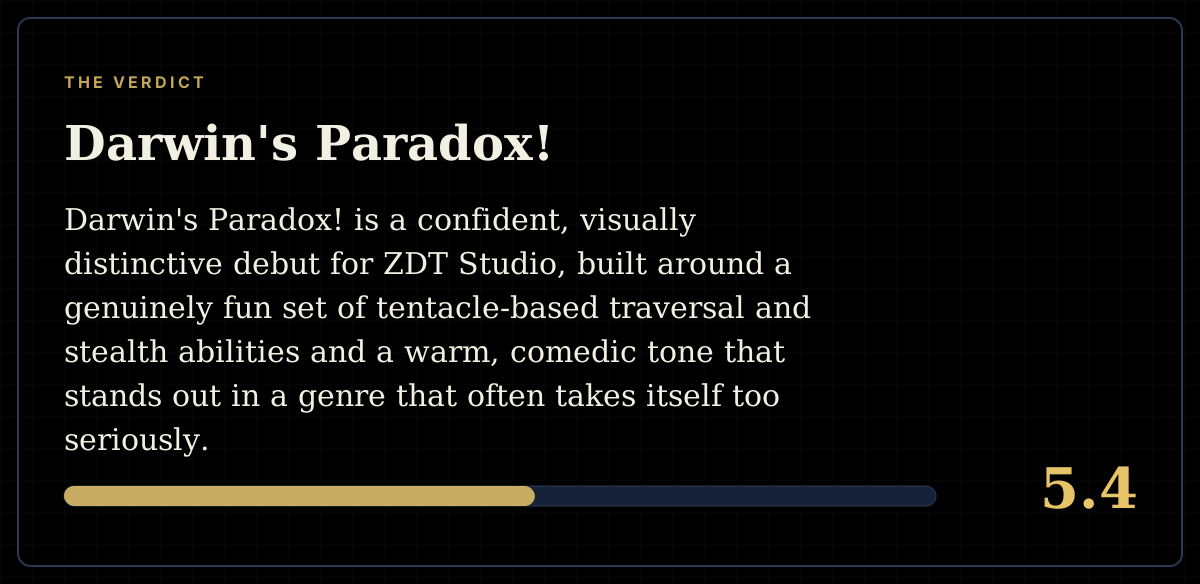
The short versionWanderer Editorial