Game review
Crystaria Online
6.9 / 10
- Developer
- Crystaria Team
- Publisher
- Crystaria Team
- Released
- 19 August 2026
- Platforms
- Windows
- Genre
- RPG
Zero Reviews for a Solo-Built Homage to Text-Based MMORPGs
Crystaria Online launched on Steam on 19 August 2026 from a solo developer working under the name Crystaria Team, and at the time of writing it has no user reviews at all, so everything below reflects the store page's own description of the game rather than any confirmed player experience. The pitch is explicit and unusually specific about its lineage: a "living, text-based MMORPG built as an homage to the greats of the late 90's and early 00's," the kind of browser-and-forum era genre that has mostly disappeared from the modern Steam storefront in favor of graphical MMOs. It's free to play, with the store page emphasizing an especially low barrier to entry — players can "jump in as a guest — no signup — and convert to a full account when you're hooked," a genuinely frictionless onboarding pitch that's rare even among other free-to-play MMOs, most of which still gate the first few minutes behind account creation.
Eighteen Classes and a Combat System Built Around Reading the Fight
Where Crystaria Online tries to distinguish itself from typical browser-MMO shovelware is in the depth of its character-building claims. The store page names 18 classes spanning from a straightforward Fighter to an Astromancer, each with "its own resource loop, weapon artes, spells and signature ultimates," and layers additional customization on top through Attunements, Mastery tiers, set relics, and an Ascension system, all pitched as letting players "tune every part of your character." That's a genuinely ambitious build-crafting matrix for a solo-developed, text-based game, and the specific naming of a resource loop per class (rather than a single shared mana bar) suggests real mechanical differentiation between classes rather than reskinned stat blocks. Combat itself is framed around three named systems — Elements, Signs, and Resonance — that the store page says "reward reading the fight," with the additional claim that "every one of the dungeons carries an identity that changes every time you descend into them," implying some degree of procedural or randomized dungeon variation layered on top of a fixed class-and-stat foundation. The 84-entry Steam achievement list gives some real, checkable texture to how far that build-crafting and leveling curve is meant to stretch: names like "Journeyman," "Veteran," and "Champion" read as sequential rank milestones, "Halfway to a Thousand" and "Four Digits" strongly suggest a leveling or currency-accumulation curve stretching into the thousands, and "Roof of the World" alongside "Throne of the First" and "The Throne of Nothing" (the last marked hidden) point toward a late-game or superboss-tier endpoint well beyond a typical MMO's opening zone. A live character-sheet screenshot confirms that scale directly and then some: a level 10,516 "Warborn Gladiator" with six-figure Strength, Accuracy, and Spirit stats, over 5.8 billion gold on hand plus 38.6 billion banked, and encounter cards listing enemies with HP pools over a million apiece — numbers that put Crystaria Online's actual progression curve much closer to the huge, escalating figures idle and incremental RPGs traffic in than to the comparatively modest stat ranges most text-based MMORPGs of its stated late-90s inspiration ever reached. The same screenshot confirms the Elements combat system is a real, functioning mechanic rather than flavor text: each enemy card lists a specific elemental weakness (Earth, Light, Fire, Lightning across the two encounter screenshots gathered here), giving the player concrete, actionable information before choosing which fight to engage.
An Ever-Expanding World With a Never-Ending Delve
The world structure follows a vertical, tiered escalation — an overworld, a "corrupted Underworld" descent, and an ascent to a sky region — rather than the flat, sprawling map many MMOs default to, and the store page frames the whole thing as "ever expanding," implying ongoing content additions post-launch rather than a fixed, finished map at release. The standout systemic hook, though, is the Shifting Labyrinth: a "classical looking maze which stretches into the far beyond," where buffs are selected on each floor and progress saves only every five floors, explicitly framed as "a never-ending delve." That's a meaningfully different structure from most MMO dungeon content, which is typically finite and repeatable rather than an open-ended endurance run, and the five-floor checkpoint interval suggests a deliberate risk-and-commitment rhythm rather than a purely casual, drop-in-drop-out design. Whether the Labyrinth's floor generation stays interesting over a genuinely long delve, or whether it thins out into repetition after the first few dozen floors, is exactly the kind of claim that can't be judged from a store page alone and would need real player data to confirm. A screenshot from inside the Labyrinth confirms it's a real, first-person maze rendered in a simple green-walled corridor style rather than an abstract text list, tracked on Floor 41 with an active "Sign of Wind" buff and a minimap charting the explored layout so far — and the same screen's sidebar shows a level-1500 "Crystaria's Shadow" World Boss directly engageable from the Labyrinth interface, confirming that world-boss content exists as a concrete, findable target rather than a vague endgame promise. Separately, a sky-region encounter screenshot reveals a punishing environmental hazard not mentioned on the store page at all: an "Aether-burn" meter that drains a flat 6,437 HP per step once it fills, with the game warning the player to "reach a Sky Anchor to moor" — a real time-pressure mechanic layered on top of the vertical world structure that adds genuine risk to exploring the sky tier, beyond what the "ascend to a sky" store-page line lets on. It's also worth correcting an impression the store page's own "text-based MMORPG" framing might create: every screenshot gathered here shows a clean, fully graphical web-style interface — stat bars, a minimap, encounter cards, and a first-person maze render — rather than a wall of scrolling text, closer in presentation to a browser strategy game than to the link-and-menu text MUDs the "late 90's and early 00's" pitch might evoke.
Guilds, Weekly Realm Events, and a Shared Realm Goal
The social layer is where Crystaria Online leans hardest into its "living world" framing: guilds can claim territory, raise a floating "Skyhold," and formally declare war on rival guilds, with resource collection feeding directly into bolstering a guild's weapons and defenses — a genuinely more structured guild-conflict system than the loose, cosmetic-only guilds many MMOs ship with. Layered on top of that is a weekly cadence of Realm Events that rotate the entire world's bonuses, alongside a shared Realm Goal that the store page says the whole player base works toward together, with a successful clear making "everyone [start] next week stronger" — a cooperative, server-wide progression layer distinct from and running alongside the individual guild-war structure. That combination of competitive guild warfare and cooperative server-wide goals within the same week-to-week loop is a genuinely interesting design tension, though as with the Labyrinth, its real success depends entirely on active player population — a guild-war system with too few active guilds, or a shared Realm Goal that a thin launch population can't realistically clear, would undercut the pitch considerably, and there's no way to confirm population health from the store page alone.
Price, Scope, and What a Solo-Developed MMO Can't Promise
As a free-to-play title with no signup required to try it, Crystaria Online carries essentially zero upfront risk for players curious about its retro-MMORPG pitch, and the accessibility footprint — adjustable text size, color alternatives, playable at the player's own pace, and playable without timed input — is a sensible fit for a text-heavy genre that doesn't demand reflex-based combat. It's Windows-only, English-only, and lists no DLC or additional purchases on its store page, meaning its actual monetisation model beyond the free base game isn't spelled out anywhere visible, worth flagging directly for players wondering how a solo developer sustains ongoing weekly content for a genuinely free MMO. The larger, unavoidable caveat with any MMO — and especially a solo-developed one — is that its entire pitch of guild wars, weekly Realm Events, and a shared server-wide goal depends on sustained population and long-term development support neither of which a zero-review, brand-new launch can yet demonstrate; a text-based MMO in particular lives or dies on whether enough players stick around to make its social systems function as designed. That's no longer purely a hypothetical risk, either: every screenshot gathered for this review shows the in-game chat sidebar reading "Online — 1," with the visible chat log limited to a developer-account "ADMIN" posting drop-rate announcements and bug-fix notes rather than any player conversation. A single screenshot can't prove the server is this quiet at all hours, and it's entirely possible these captures were taken by the developer during otherwise-off-peak testing, but it's still the only concrete population data available, and it points toward exactly the kind of thin-launch risk that a guild-war and shared-realm-goal design depends on avoiding.
Verdict
Crystaria Online is an ambitious, genuinely distinctive pitch: a free-to-play, text-based MMORPG built solo as a deliberate throwback to a nearly extinct genre, with 18 classes and a deep Attunement/Mastery/Ascension build system, a never-ending Shifting Labyrinth for endurance-focused players, and a guild-war-plus-shared-realm-goal social layer that's more structured than most MMOs bother to offer at launch. The zero-friction guest-account onboarding makes it essentially free to try, and an 84-achievement list backs up the store page's claim of real long-term depth. But every one of its standout systems — the Labyrinth's floor variety, the guild wars, the weekly Realm Events — depends entirely on an active, sustained player population that a brand-new, zero-review launch hasn't yet proven it has, and its actual long-term monetisation and development-support model remain unstated. For fans of old-school text MMORPGs willing to accept genuine population risk, it's a fascinating, low-cost experiment worth trying; for anyone wanting confirmation the social systems actually work as promised, that evidence doesn't exist yet.
Screenshots
-
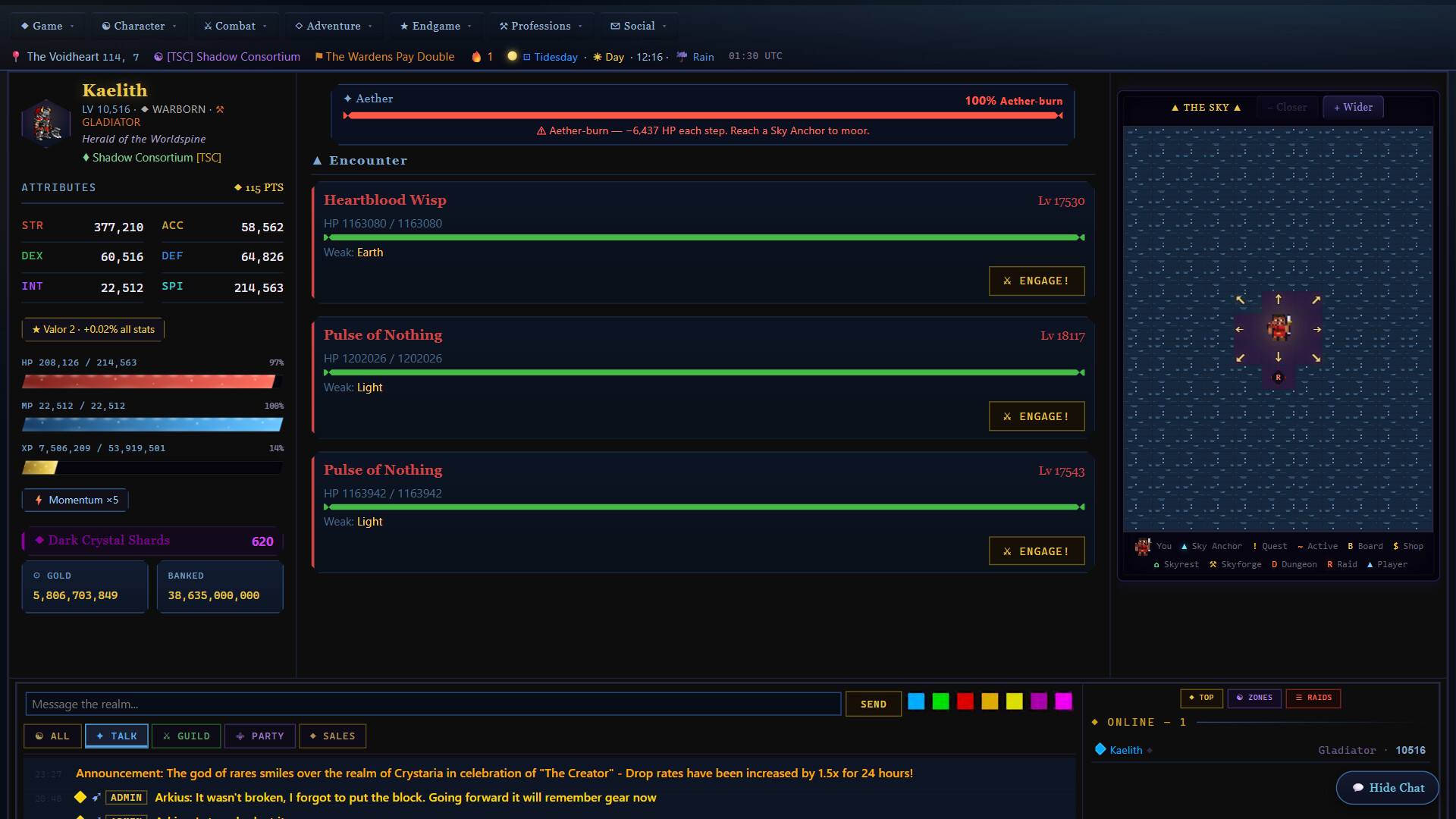
The character and encounter screen in the sky region, showing the game's huge idle-RPG-scale numbers, an elemental weakness system, and a chat sidebar reading Online — 1 at the time of capture.Steam store page -
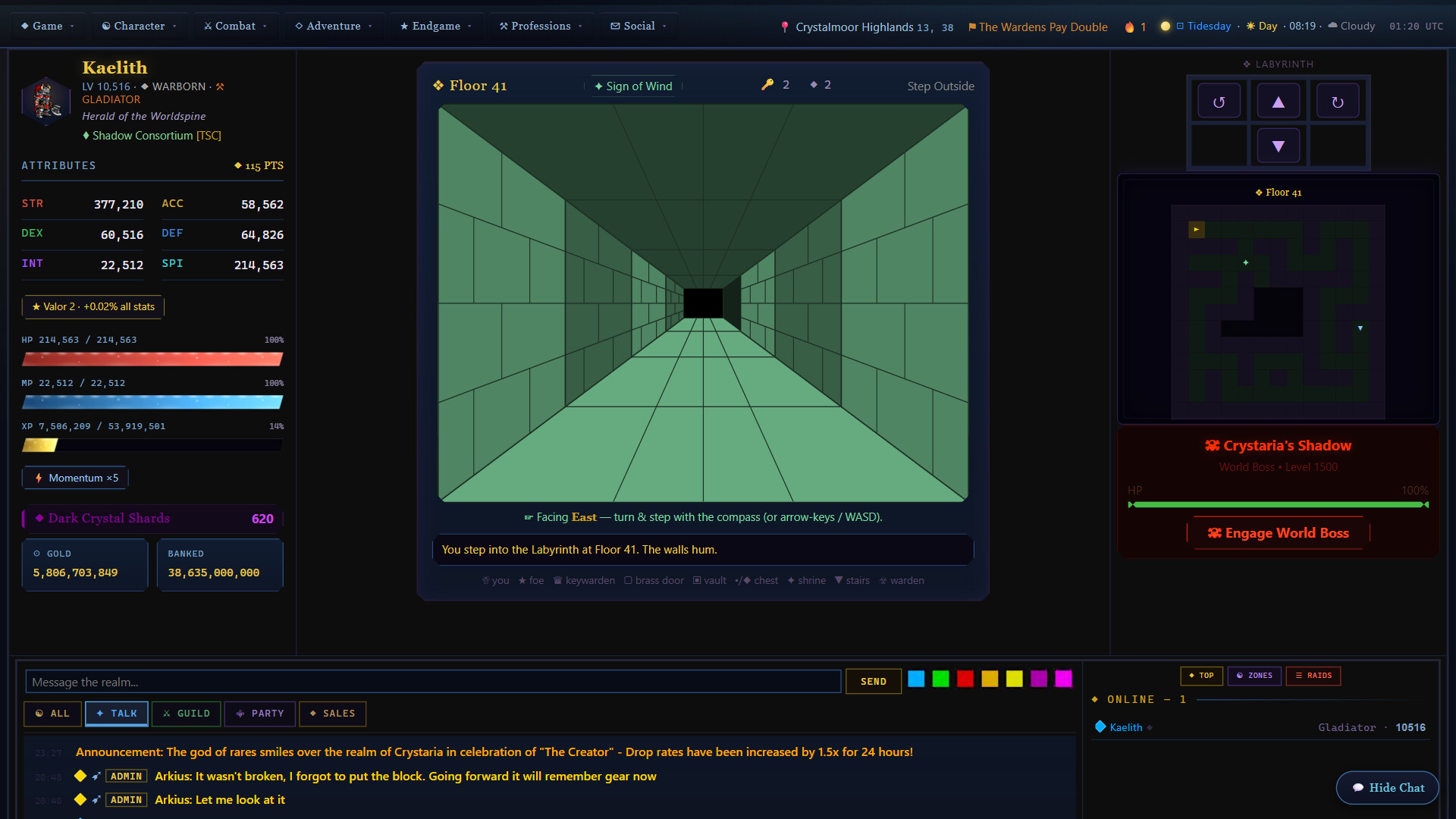
The Shifting Labyrinth in practice: a first-person maze view on Floor 41, with a level-1500 World Boss trackable from the sidebar.Steam store page -
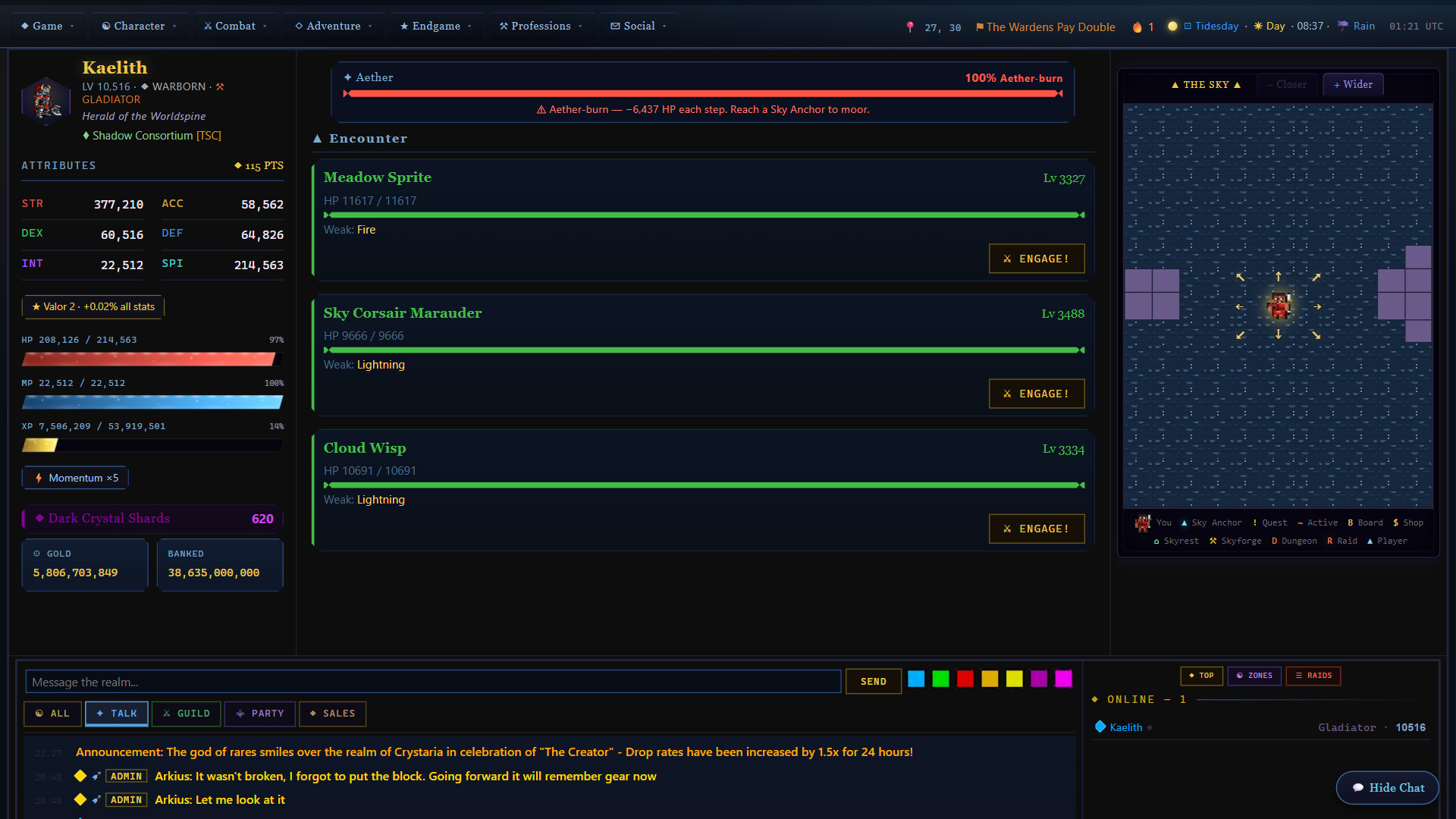
A different sky-zone encounter, with a fresh set of named enemies and elemental weaknesses, and the sky region's distinct floating-island minimap.Steam store page