Game review
Creeper World 3: Arc Eternal
8.5 / 10
- Developer
- Knuckle Cracker
- Publisher
- Knuckle Cracker
- Released
- 27 March 2014
- Platforms
- Windows, macOS, Linux
- Genre
- Strategy
- Monetisation
- One-time purchase. No DLC, no in-game purchases, no ads.
- Players
- Single-player only; Steam Remote Play Together for shared-screen sessions
The short version
Creeper World 3 replaces the enemy army in a tower-defense game with a slow-moving fluid — a cellular-automata simulation that pools in valleys, climbs terrain under pressure and floods through any gap in your line. There's no pathing, no aggro range, nothing resembling a unit AI: just physics, and your job is to hold it back, then push it back, one carefully placed reactor and mortar at a time.
This review worked from the complete lifetime Steam review corpus (4,817 reviews, 96% positive), the full 100-review negative sample and the 100 most recent English reviews (92% positive), plus the game's own store description and global achievement statistics. The pattern that emerges is unusually consistent for an 11-year-old game: an opening hour that critics and fans describe in nearly identical language as thrilling, a mid-campaign that a large minority calls a grind once the defensive perimeter stabilises, and a modding-and-map-generation layer so deep that several of the game's most negative reviewers have logged hundreds or thousands of hours anyway.
Biggest strengths
- A genuinely novel enemy: a fluid simulation with no scripted AI, whose threat comes entirely from terrain, pressure and your own gaps rather than from unit behaviour
- An enormous, still-active user-generated layer — a built-in map editor, a random map generator (the Dial Map Device) and a full scripting language (CRPL) that together dwarf the 23-mission campaign in total content
- A one-time NZ$21.99 purchase with no DLC and no IAP, which reviewers with four- and five-figure hour counts repeatedly call absurd value
Biggest weaknesses
- A large, consistent share of negative reviews describe the same shape of complaint: an exciting early scramble followed by a mid-to-late campaign that becomes "grind and push the perimeter out," with victory functionally guaranteed once your base is stable
- The creeper has no reactive behaviour of its own, which several detailed reviewers argue removes strategic tension once new mechanics stop being introduced
- Three independent reviewers, across different years, single out the same late-campaign mission ("Farbor") by name for demanding an unfamiliar, unforgiving playstyle with no difficulty option
Who it's for: Strategy and automation fans who like optimisation puzzles more than twitch combat, and anyone who enjoys a game whose real content is what the community builds on top of it rather than what ships in the box.
Our recommendation: Buy it, especially at its modest one-time price — but go in expecting the campaign itself to flatten out in its middle third, and treat the built-in map editor and CRPL scripting language as the actual reason people still play this in 2026, not an optional extra.
8.5 / 10
Most tower-defense games give you an enemy with a route, a health bar and a spawn timer. Creeper World 3 gives you an enemy with a density. The creeper is a slow-moving fluid that behaves like water under simulated physics: it pools in low ground, climbs when there's enough of it pressing from behind, and pours through any hole in your line the instant one opens. There's no pathfinding, no aggro range, no script deciding when it attacks — just cellular automata reacting to the terrain and to whatever you've built on it. This review worked from Steam's full lifetime review corpus, its complete negative sample and its 100 most recent English reviews rather than from a play session, and found a game whose reputation is genuinely earned in its first hour and genuinely contested in its middle third.
The core loop is automation wearing a tower-defense costume
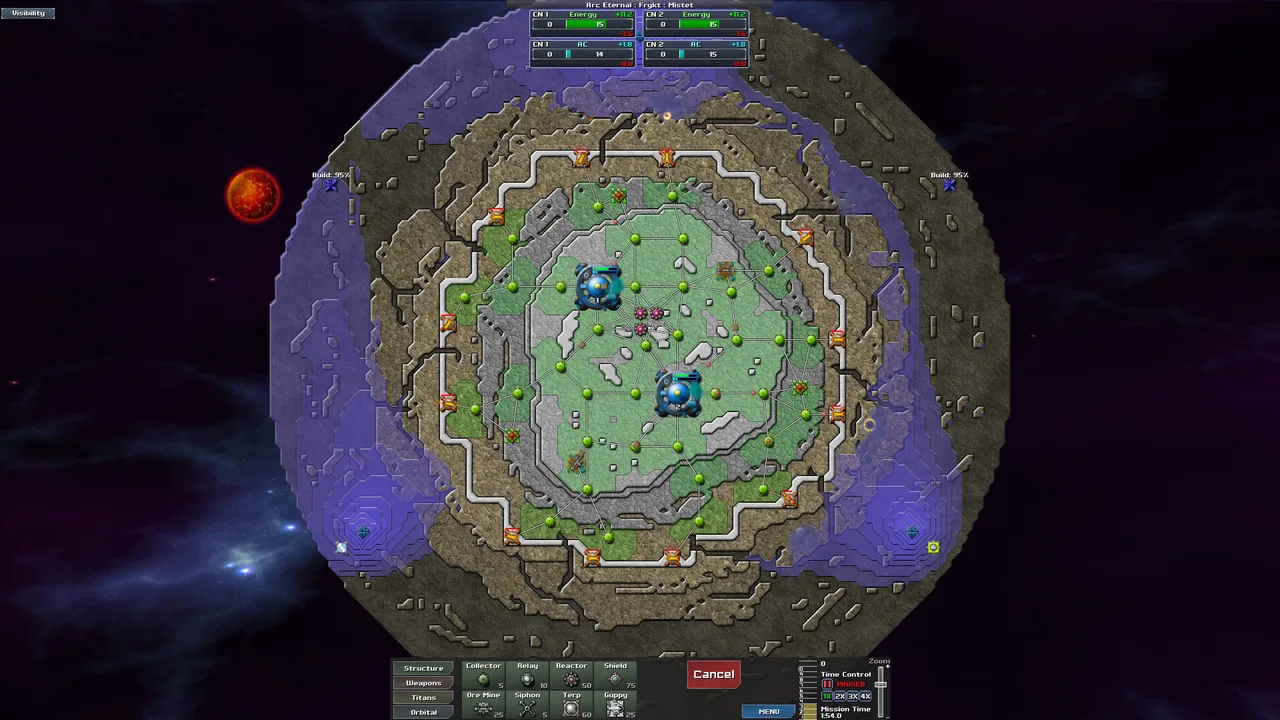
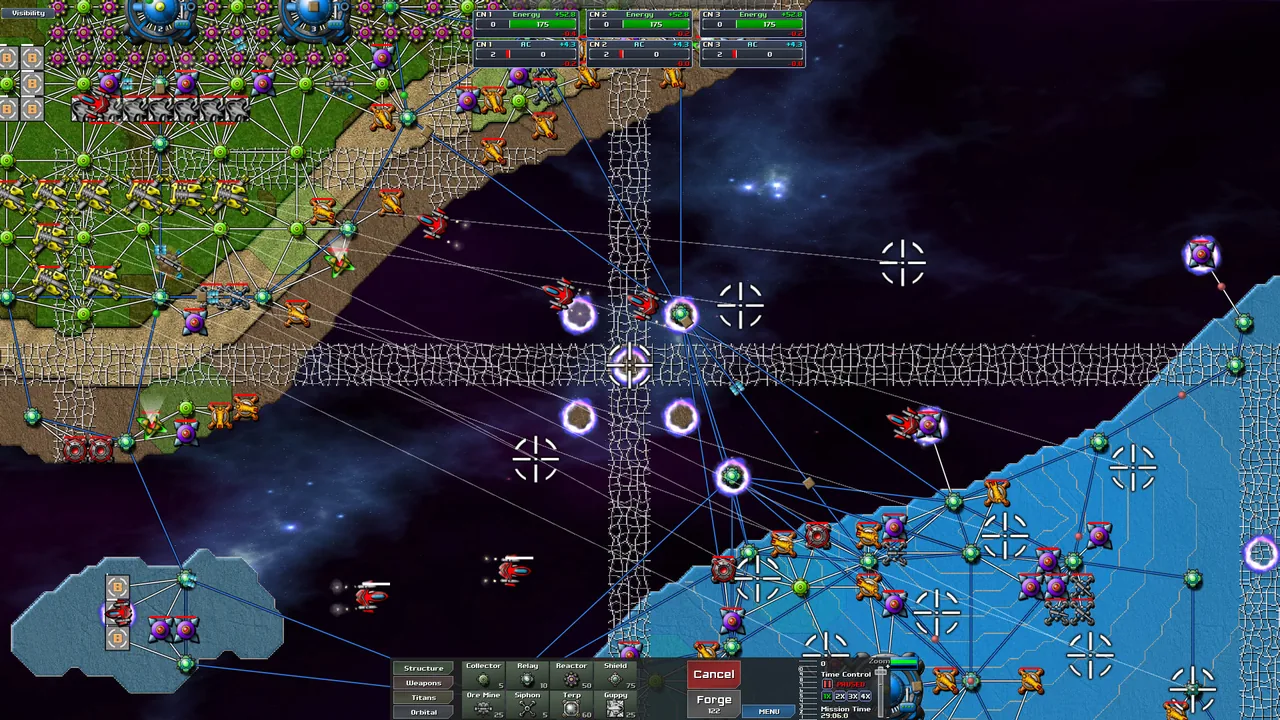
Strip away the "defense" framing and Creeper World 3 plays like a supply-chain puzzle. Reactors generate energy, energy powers mortars and collectors, collectors extend your reach, and every building you place has to be connected back through a network that the creeper is actively trying to flood. One reviewer with 39 hours logged put it plainly: it's "one of my favorite strategy games because it cares more about logistics than twitch or line graphs." That's the game's real appeal to an automation-minded audience — you're not aiming reticles, you're balancing throughput against a slowly rising tide, deciding whether the next reactor goes toward more mortar fire or toward pushing your collector network further into unclaimed territory.
The terraforming layer deepens this further than a typical TD's static map. You can raise and lower terrain mid-mission, digging trenches to slow the creeper's advance or building ramps to take high ground your weapons need. It's a small mechanic that pays off constantly: a level's difficulty often comes down to reading its terrain correctly in the first ninety seconds, not to reflexes later on.
Two separate progression tracks, and they teach different lessons
It's worth being precise about what "the campaign" actually is here, because Creeper World 3 splits progression into two distinct tracks rather than one linear curve, and reviewers routinely blur them together. The Alpha Sector is the hand-crafted story campaign — 23 missions, built by the developer, each introducing a specific new building, weapon or enemy type in a fixed order, from your first reactor-and-mortar perimeter through to nullifiers, snipers, Thor cannons and eventually the Bertha siege gun. This is where the tech-tree pacing is at its best: for the first dozen or so missions, each level genuinely does teach something new, and the difficulty curve tracks the toolset you're being handed reasonably closely. It's also where the flattening described below sets in once the tree is mostly unlocked and every subsequent mission becomes an application of tools you already understand rather than a new lesson.
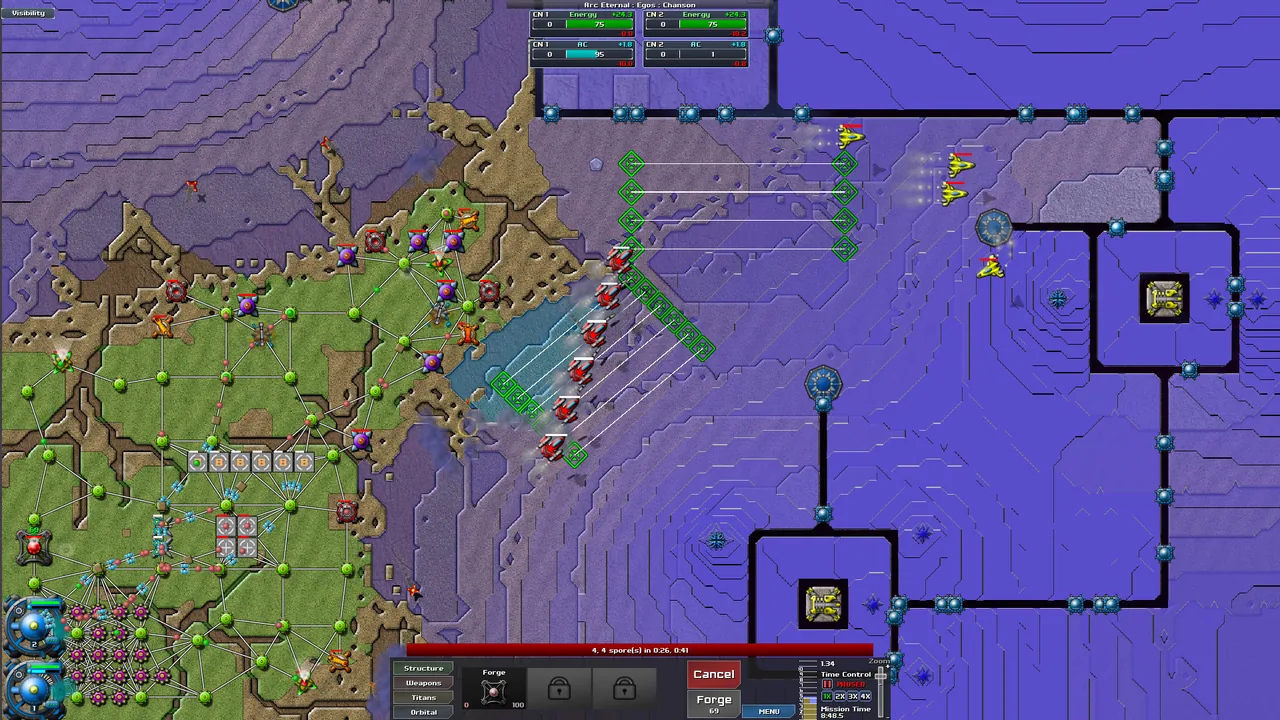
The second track, Prospector, is where the game's progression model stops being a curve at all and becomes a dial. Using the in-game DMD, players generate one of an effectively unbounded number of procedural worlds from a numeric seed, tune constraints like map size and creeper aggression, and play missions with no story attached and no fixed order. There's no "next tier" waiting at the end of a Prospector run — you set your own difficulty and stop when you're satisfied, which is a genuinely different progression philosophy from the Alpha Sector's authored escalation. Several long-playtime reviewers describe treating Prospector as the actual game and the Alpha Sector as an extended tutorial for it, which reframes the "campaign gets predictable" complaint below: for those players, it's not that the game runs out of escalation, it's that the authored escalation was always meant to end at mission 23, with the dial-driven mode picking up the difficulty curve from there.
Where the campaign's own progression breaks down
Here's where the honest part of this review starts. Reading the full 100-review negative sample turns up the same complaint, worded differently, again and again: the opening minutes of a mission are a genuine scramble, and then the game settles into what one reviewer bluntly called "a grind of gaining ground slowly" once the defensive perimeter is stable. Another, at 92 hours played — clearly not someone who bounced off it early — wrote a detailed, structured critique arguing that "once you know what's going on, if you can build a stable base in the beginning, you have already won the map," and that the only real challenge left is how quickly you win rather than whether you win. A third, with 264 hours, is more blunt still: "there isn't any AI to speak of. The enemy is a mindless blob of watery goo... it was fun at first but quickly became a grind."
The mechanical reason this happens is worth naming, because it's the actual design lesson rather than a vague "gets repetitive" complaint. The creeper has no counter-strategy of its own — it doesn't reinforce a breach, doesn't target your weak point, doesn't escalate in response to how well you're doing. Once a player's production loop outpaces the creeper's pressure, the fight stops being adversarial and becomes closer to an idle-game curve: keep building, keep expanding the perimeter, and the outcome was decided the moment your economy stabilised. Several reviewers are careful to say this isn't inherently a flaw — a slow, inevitable siege has its own kind of appeal, and it's exactly the "just one more turn" quality that shows up constantly in the positive reviews too. But it does mean the mid-campaign runs on momentum rather than tension, and that's a real cost for players who came in expecting an escalating fight.
It also means the few missions that do break the pattern land disproportionately hard. Three separate reviewers, spread across different years, single out one specific late-campaign mission by name — Farbor — for imposing a short, unforgiving time limit with no difficulty option, after twenty missions of teaching a patient, build-up playstyle. "The entire game teaches you to play one way, then decides at the end of the story campaign to say 'forget everything you thought you knew,'" one put it. Whether or not Farbor is a good mission on its own terms, the consistency of the complaint — three strangers, years apart, naming the same level — says something about the cost of breaking your own established rhythm without warning the player it's coming.
The escape valve: DMD, the map editor and CRPL
What keeps this from reading as a simple "flattens out and stays flat" verdict is that Knuckle Cracker built an unusually complete answer to it, and it's baked into the box rather than sold separately. The Dial Map Device generates effectively unlimited random missions from a shareable numeric seed. The built-in map editor lets anyone build and publish their own. And CRPL — the game's own scripting language, Creeper Reversed Polish Language — exposes hundreds of engine commands, meaning every story mission in the game was itself built using tools available to any player. The store page isn't exaggerating when it calls the total mission count effectively unbounded; the campaign is 23 missions, and the community layer on top of it is measured in the thousands.
This matters for the exact complaint above. A design that gets less varied as the base game ages is usually a dead end — more content added to a fixed system just means more of the same grind. Creeper World 3 instead hands the tools to the players, which is the difference between a game running dry and a game that keeps generating its own difficulty. It shows up directly in the review sample: the same players complaining that the story campaign becomes predictable are frequently the ones with absurd playtime totals, because the actual long-term game is player-authored maps and player-written enemies, not the missions Knuckle Cracker shipped. One reviewer with 5,364 hours opens their review "I hate this game. You should never get it. Seriously. Once you have this, it will be a time sink forever" — meant, and read, as the highest compliment the review section offers. Another puts the number at 13,768 hours.
Presentation and story are where the age shows
Nobody is buying Creeper World 3 in 2026 for its visuals, and the game doesn't pretend otherwise — it's a 2014 release with simple, low-resolution art built around clear silhouettes rather than detail. That's a reasonable trade for a simulation running potentially thousands of automaton cells at once, and it doesn't come up as a complaint nearly as often as the pacing does. The story fares worse. Even reviewers who otherwise enjoyed the campaign single it out specifically: one 130-hour player called the dialogue "a pain," citing "weird and useless names that make no sense" and text that's "very hard to follow." The framing device — a lone ship captain waking from cryo-sleep to a galaxy the creeper has already consumed — is serviceable as a reason to keep pressing forward, but it isn't why anyone recommends this game, and the review sample agrees.
Value, and who this is actually for
At NZ$21.99 with no DLC, no in-game store and no subscription of any kind, the value case here isn't really in dispute — it shows up as one of the most consistent themes across both positive and negative reviews, including from players who otherwise disliked the pacing. The achievement list backs up how much game is actually here: 139 achievements, with a top cluster over 90% completion for anyone who finishes the early campaign, tapering into a long tail under 5% that almost certainly reflects the harder optional systems and community content rather than a game people abandon early. This is not a live-service product asking for continued spending — it's a fixed purchase whose real lifespan is set by how deep a given player wants to go into its editor and scripting layer, and for the right audience that lifespan is measured in years.
Final verdict
Creeper World 3: Arc Eternal earns its 96% positive rating honestly rather than by accident. The core idea — a tower-defense enemy that's a physics simulation instead of a unit roster — is still genuinely novel more than a decade later, and the terraforming and logistics-focused build order reward the kind of patient, systems-first thinking this audience specifically enjoys. It doesn't score higher because the campaign's middle section runs on momentum rather than tension once your base stabilises, because the creeper's total lack of a counter-strategy removes real stakes from the second half of most missions, and because at least one late mission breaks its own rules hard enough that three unconnected reviewers, years apart, complained about the exact same level by name.
What saves it from being a game whose central loop simply wears thin is that Knuckle Cracker shipped the tools to keep generating new challenges alongside the challenges themselves — the Dial Map Device, the editor and CRPL turn "the campaign gets predictable" from a dead end into a footnote. Buy it for the campaign's opening hours and the genuinely clever central mechanic; stay, if it grabs you, for a community layer that's kept players logging thousands of hours over eleven years and counting.
Pros and cons
Pros
- A genuinely novel enemy: a fluid simulation with no scripted AI, whose threat comes entirely from terrain, pressure and your own gaps rather than from unit behaviour
- An enormous, still-active user-generated layer — a built-in map editor, a random map generator (the Dial Map Device) and a full scripting language (CRPL) that together dwarf the 23-mission campaign in total content
- A one-time NZ$21.99 purchase with no DLC and no IAP, which reviewers with four- and five-figure hour counts repeatedly call absurd value
- Terraforming and unit placement genuinely reward planning over reflexes, appealing directly to players who prefer logistics puzzles to combat
- A responsive, small developer whose achievement and content ecosystem has clearly kept expanding for over a decade
Cons
- A large, consistent share of negative reviews describe the same shape of complaint: an exciting early scramble followed by a mid-to-late campaign that becomes "grind and push the perimeter out," with victory functionally guaranteed once your base is stable
- The creeper has no reactive behaviour of its own, which several detailed reviewers argue removes strategic tension once new mechanics stop being introduced
- Three independent reviewers, across different years, single out the same late-campaign mission ("Farbor") by name for demanding an unfamiliar, unforgiving playstyle with no difficulty option
- The story and dialogue draw specific, pointed criticism even from players who otherwise enjoyed the campaign, and the low-resolution 2014-era visuals are plain by modern standards
- No difficulty settings on the base campaign missions, so a level that clicks badly with your playstyle has no adjustable fallback beyond restarting
Screenshots
-
Creeper World 3: Arc EternalImage: Knuckle Cracker via Steam -
Creeper World 3: Arc EternalImage: Knuckle Cracker via Steam -
Creeper World 3: Arc EternalImage: Knuckle Cracker via Steam -
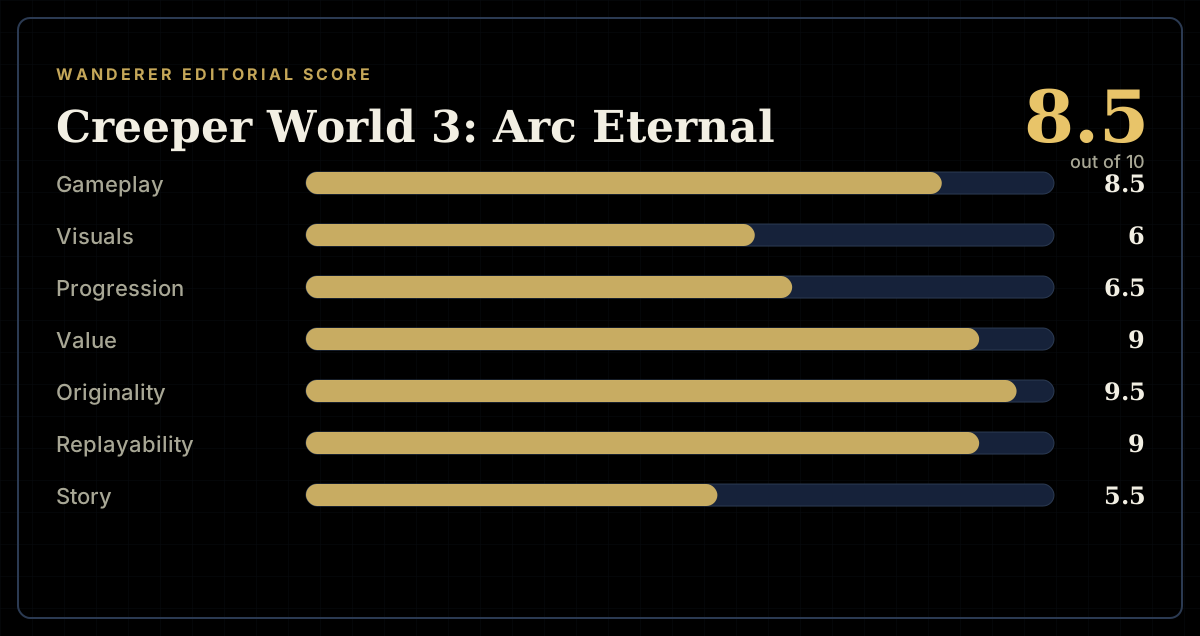
How the review scores each part of the gameWanderer Editorial -
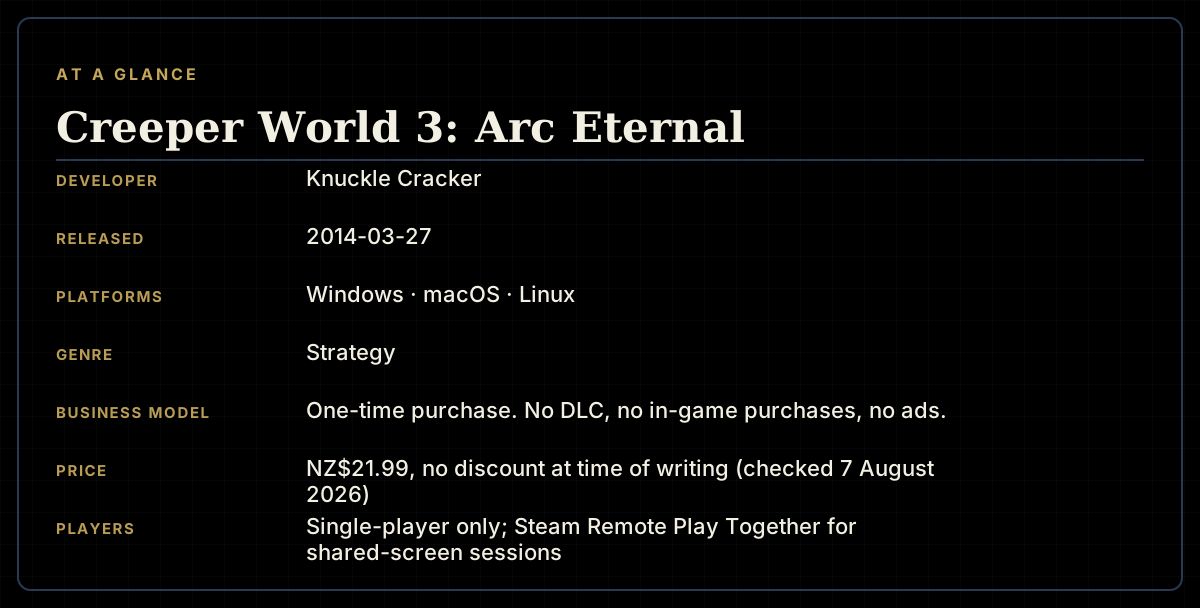
The game at a glanceWanderer Editorial -
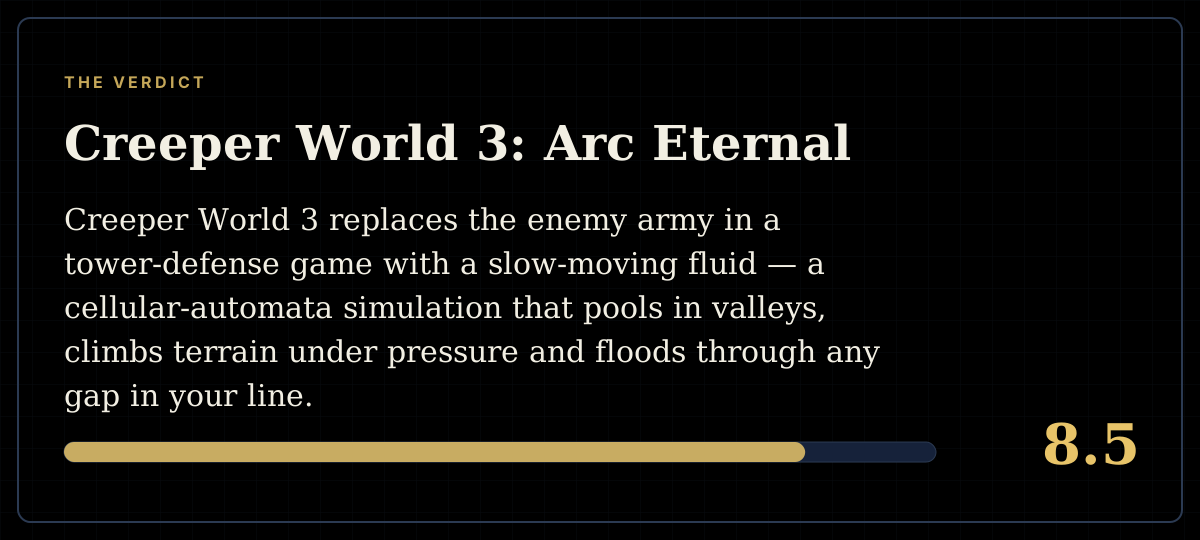
The short versionWanderer Editorial