
Game review
Cinema Simulator 2025
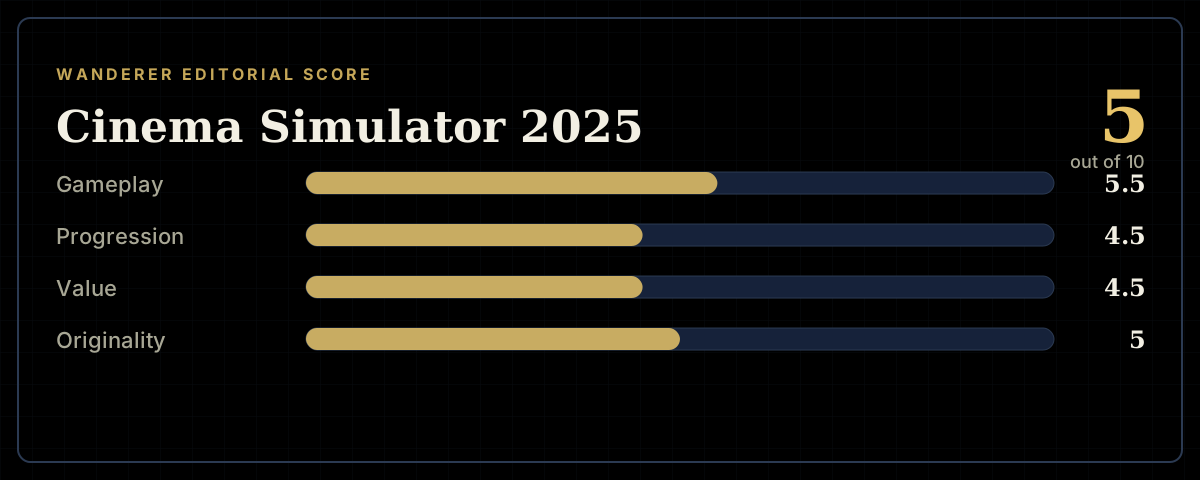
5 / 10
- Developer
- HOGO Games
- Publisher
- HOGO Games
- Released
- 17 February 2025
- Platforms
- Windows
- Genre
- Simulation
- Players
- Single-player
The short version
Biggest strengths
- A genuinely satisfying, well-balanced core economy loop for many players while the novelty lasts, with real management decisions across staffing, concessions, and theater upgrades
- A notably fast, community-responsive developer, having added the ability to import real personal movie files and custom posters within days of a community suggestion
- Real variety of content and systems even in its current Early Access state, according to several reviewers who found plenty to do while it was fresh
Biggest weaknesses
- Uses AI-generated movies and posters for the fictional films shown in-game, a directly observable feature that at least one detailed reviewer cites as their specific, sole reason for a negative recommendation despite otherwise enjoying the genre
- Significant automation bugs, with cashiers and other upgraded staff reportedly ceasing to function correctly after a few in-game days
- Theater seating capacity is widely described as too low relative to customer demand, creating a cascade of avoidable negative in-game reviews and frustrated customers
5 / 10
Running a movie theater, one AI-generated blockbuster at a time
Cinema Simulator 2025 puts players in charge of growing a small movie theater into a full-blown cinema empire, managing staff, concessions, ticket sales, and theater upgrades along the way. Based on the available English-language review sample of 236 reviews — 179 positive, 57 negative, landing at an overall Mostly Positive rating — the core management loop draws genuine, specific praise from a meaningful share of players. "Solid gameplay mechanics, well-balanced economy, and a genuinely fun loop—kudos to the dev team," one reviewer writes, while a separate reviewer frames similarly positive enthusiasm around the game's Early Access potential: "The gameplay is truly enjoyable, offering a variety of engaging content. Even in its current state, it's a great experience, and I can only imagine how much more exciting it will be in the full release!"
The developer also draws specific, credible praise for responsiveness to player feedback. "The dev's added the ability to add your own movies to the Cinema and they play! You can also add a poster too. I didn't expect them to add this so fast after the community suggested it. Very cool to be able to back up my dvds/blurays and play them," one reviewer writes, describing a genuinely fast turnaround from community request to shipped feature — a positive signal about the team's active engagement with its player base.
A specific, directly observable AI-content problem
The single most pointed and consequential complaint in this review sample concerns a directly verifiable feature of the shipped game rather than an unverified allegation. "I can't recommend this game with a clear conscious, it's a great premise I am a sucker for these business simulators but this one revolves around the AI generated movies and posters this really just rubs me the wrong way and can't play anymore," the most heavily upvoted review in the entire sample states. It's worth being precise about why this complaint carries more weight than similar AI-content concerns raised elsewhere in this lane's coverage: the AI-generated movies and their promotional posters are a core, front-and-center part of the actual gameplay experience — they're what players spend the entire game selling tickets to — rather than a background asset like a soundtrack or a UI icon. That makes this a directly observable design choice rather than something requiring speculation or investigation to identify, and it's the specific, stated reason this particular reviewer, who explicitly says they love the genre, cannot bring themselves to recommend the game.
Automation bugs and a venue that's too small for its own customers
Beyond the AI-content complaint, this review sample raises real, specific technical and design issues. "After a few in-game days, your cashiers will stop selling tickets and just stand there. It seems as though upgrading anyone other than the cashiers has no effect," one detailed reviewer writes, describing a genuine automation failure that undermines a core progression system — paying to upgrade staff so they work more efficiently, only for that upgraded staff to stop functioning correctly after a short time. A separate reviewer identifies a related structural design problem: "There are very few seats per theater for the audience, and they fill up very quickly, causing them to leave annoyed and leaving bad reviews. It should be like a real movie theater that has many seats per theater." That's a specific, fixable balance issue rather than a matter of taste — a seating capacity mismatched to the customer volume the game itself generates, creating a cascading, largely avoidable failure state.
A separate reviewer raises a specific layout complaint affecting basic playability under time pressure: "Could barely get through the first day, all the rooms you want to access are super far apart from each other making it near impossible to sell tickets, clean the waiting area, address any issues inside the theatre and check your computer for things. Customer patience runs out extremely fast, time moves fast in general."
Short content, and a review sample some reviewers question directly
Length draws consistent, specific criticism, with reviewers citing concrete hour counts. "Takes about 4 hours to max out the game - a lot of just waiting for the day to be over (like real life) - also not an expensive game, though still too expensive for what you get," one reviewer writes, while a separate reviewer confirms a similar timeline: "I just got all upgraded. Played for 5 hours. Hope more will come, or else this game is way too easy." A third reviewer specifically flags the lack of a time-acceleration option as compounding the problem: "The game is ok, but you quickly run out of things to do plus there is no way to speed up time so you end up just waiting for the day to end in game."
One especially pointed review raises a meta-level concern about the honesty of this game's own overwhelmingly positive review base, worth reporting attributively rather than as settled fact. "The 'over the top' positive reviews, not correct. Current reviews are not truly honest because they do not address fundamental issues with this game. Has to be internal or people just being nice to get some review understanding. We are here to save your money and interest," this reviewer writes. This review has no independent way to verify that specific accusation, and it should be weighed as one reviewer's suspicion rather than an established fact — but it's included here because it's a direct, pointed claim about the review sample's own integrity, which readers deserve to know exists within the data this assessment draws from.
The achievement data offers a useful, corroborating picture of the reported short playtime: across 16 total achievements, most milestones sit comfortably in the 45-70% range, with only the hardest late-game or hidden-content achievements — including one cryptically named "rat" achievement — falling to under 5%. That's consistent with a game whose core content most buyers can substantially complete within a single extended session or two.
Where this leaves it
Cinema Simulator 2025 delivers a genuinely satisfying core management loop for a meaningful share of its players, backed by a notably responsive developer who has already shown willingness to ship community-requested features quickly. Its most serious, directly verifiable problem is its use of AI-generated movies and posters as the central content players spend the entire game selling — a specific, observable design choice that at least one reviewer names as their sole dealbreaker despite loving the genre otherwise — compounded by real automation bugs, an undersized theater layout relative to customer demand, and a short overall runtime. Worth a cautious look for management-sim fans specifically willing to overlook the AI-generated content at its core; a clearer pass for anyone who finds that specific choice a dealbreaker in the way the most upvoted review in this sample plainly does.
Pros and cons
Pros
- A genuinely satisfying, well-balanced core economy loop for many players while the novelty lasts, with real management decisions across staffing, concessions, and theater upgrades
- A notably fast, community-responsive developer, having added the ability to import real personal movie files and custom posters within days of a community suggestion
- Real variety of content and systems even in its current Early Access state, according to several reviewers who found plenty to do while it was fresh
Cons
- Uses AI-generated movies and posters for the fictional films shown in-game, a directly observable feature that at least one detailed reviewer cites as their specific, sole reason for a negative recommendation despite otherwise enjoying the genre
- Significant automation bugs, with cashiers and other upgraded staff reportedly ceasing to function correctly after a few in-game days
- Theater seating capacity is widely described as too low relative to customer demand, creating a cascade of avoidable negative in-game reviews and frustrated customers
- Poor room layout and UI design make multitasking across the venue difficult under the game's own time pressure
- Very short overall content, with most reviewers reporting they max out available progression within four to seven hours, and no way to speed up time to skip tedious waiting periods
- At least one pointed reviewer alleges the review base skews artificially positive relative to the game's real, fundamental issues — reported here attributively as one reviewer's claim, not independently confirmed
Screenshots
-

Cinema Simulator 2025Image: HOGO Games via Steam -

Cinema Simulator 2025Image: HOGO Games via Steam -

Cinema Simulator 2025Image: HOGO Games via Steam -
How the review scores each part of the gameWanderer Editorial -
The short versionWanderer Editorial