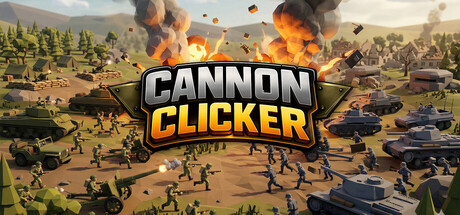
Game review
Cannon Clicker
6.9 / 10
- Developer
- Ritual Interactive
- Publisher
- Ritual Interactive
- Released
- 19 August 2026
- Platforms
- Windows
- Genre
- Simulation
Eight Reviews, Mostly Glowing, One Genuine Warning
Cannon Clicker launched on Steam on 19 August 2026 from solo Polish developer Ritual Interactive, and at the time of writing it has eight user reviews — six positive, two negative, a 75% approval rate. That's a small but usefully varied sample: several reviewers have logged meaningful time (656, 510, 385, and 243 minutes among the positives) and write in detail about specific systems rather than offering one-line praise, which lends real weight to the positive consensus. One of the negative reviews is a blunt "avoid at all costs" from a player who logged 219 minutes before souring on it entirely, arguing it should have been "a free mobile game with ads" rather than a paid title — a genuinely useful counterpoint to weigh against the enthusiasm elsewhere. The second negative review, in French and much shorter, reports a performance problem: "not opti, cpu or gpu 100%," a specific and checkable complaint about the game pinning a core resource at full utilization, worth taking at face value rather than dismissing as vague griping.
A WWII Tug-of-War Between Two Clicking Armies
The core loop, per the store page and confirmed in detail by the reviews, is a real-time tug-of-war: player and enemy forces push toward each other's base along a scrolling battlefield, and the match ends when either base falls or time runs out for a "tactical draw." One of the two longest reviews, from a player with 510 minutes logged, describes the fundamental tension well: "each battle is a classic tug-of-war, with the frontline constantly shifting back and forth as both sides send more units into the fight," and specifically praises that "the order in which units are spawned — and when you spawn them — actually matters" rather than the game rewarding simple mass-deployment. The same reviewer notes clickable battlefield objects add a layer beyond pure army management: basic chests offer a quick clicking bonus, while mines and health chests introduce real strategic choices, since a well-placed mine "can eliminate a dangerous group of enemies at exactly the right moment," with random mine placement adding replay variety across attempts at the same level. A second detailed reviewer, writing in Polish, independently confirms this tension between simplicity and depth, noting the game "quickly becomes clear that it gives players plenty of freedom to develop their own strategies" through unit choice, skill investment, and deployment timing together, rather than any single axis alone.
Three Currencies and a Skill Tree That Punishes Auto-Pilot Spending
The store page's "three currencies, one goal" pitch — Ammo earned every match even in defeat, Medals for a level's first win, and Fuel to unlock advanced units — maps directly onto what reviewers describe as a genuinely considered upgrade structure rather than a simple linear power curve. Screenshots confirm all three currencies are tracked simultaneously on the in-match HUD, each with its own per-second income readout, alongside a running troop count and a deployment bar along the bottom of the screen where unlocked units sit next to greyed-out, padlocked slots — visible, checkable proof that unit unlocks happen progressively within a match rather than being decided entirely up front. Across three separate battle screenshots, that deployment bar noticeably fills in: an early jungle skirmish shows just four units unlocked with two still locked, while a later farmland battle shows a mortar and an aircraft newly available in previously-locked slots, matching the reviews' description of a skill tree that keeps unlocking meaningfully new options as a run progresses. One rougher edge is visible in that same jungle screenshot: a debug text overlay reading "Anim_Rifle_Idle_Aiming" and "Set_Anim_Set CALLED," the kind of developer debug logging that's normally stripped before release — a minor but concrete sign of lingering launch polish issues, and one that lends some credibility to the French-language reviewer's separate performance complaint. The 510-minute reviewer specifically credits the pacing: "the costs and benefits are balanced in a way that makes the progression feel slow but steady," while the Polish reviewer goes further, describing moments where "you need to unlock a skill or purchase an upgrade that previously seemed completely unnecessary, only for it to turn out to be the missing piece you need to win a more difficult battle" — meaning progression, per this account, resists the pure "buy everything eventually" pattern that flattens a lot of incremental games' decision-making into a formality. A named unit roster backs up the store page's "full arsenal" claim with specifics: six infantry types (Rifleman, SMG Soldier, MG Gunner, Anti-Tank, Sniper, Mortar), two vehicles (Armored Vehicle, Tank), and two aircraft (Bomber, Fighter), each independently upgradeable for Health, Damage, and Speed — a properly granular unit-comp system for a game at this price rather than a token roster padded out for the store page.
Six Terrain Types and Small, Deliberate Environmental Jokes
Both detailed positive reviews single out the variety of battlefield environments as a standout, and independently — not just echoing store-page copy. The store page names six terrain types (forests, farmlands, cities, mountains, deserts, swamps), each with a stated difficulty and strategic demand, and the 510-minute reviewer's account backs that up with specifics beyond the marketing list, describing "deserts dotted with ancient Egyptian temples" and "wonderfully atmospheric swamps," while separately calling out small environmental vignettes — a pianist playing calmly mid-battle, a couple picnicking, a man fishing "as if absolutely nothing were happening around him," and, in a spoiler-tagged aside, "a freaking guy opening the toilet door and closing it" — as evidence of genuine level-design attention rather than reused, generic battlefield tiles. The Polish reviewer separately names specific favorite locations (Molinara, Desheret, Paludes, Verdalia), which corroborates that the terrain variety is real and distinct enough for players to develop individual preferences among the maps, not just a difficulty-scaling gimmick.
Price, Scope, and a Real Performance Complaint
At NZ$9.59, Cannon Clicker is priced modestly, and several reviewers explicitly frame it as strong value at that price — one calling it "perfect... at this price point," another comparing it favorably to "the price of a beer." It's Windows-only, single-player, English-only with no other listed language support, and carries no controller-support flag or accessibility category tags beyond basic Family Sharing — a narrow footprint worth flagging plainly. Two structural concerns emerge directly from the reviews rather than speculation: one player reports the campaign felt "too short" despite enjoying it and hopes for content updates, and the French-language negative review's "cpu or gpu 100%" complaint is a specific, plausible performance issue for a real-time battlefield sim with many independently-animated units on screen at once — the kind of claim that deserves to be weighed seriously rather than waved off as an outlier, even against six positive reviews that don't mention performance problems at all. Notably, the game has no listed Steam achievements, leaving scope questions about total content — how many maps, how deep the skill tree ultimately goes — without the usual achievement-list cross-reference this genre often provides.
Verdict
Cannon Clicker takes the well-worn incremental-clicker shell and layers on a genuinely considered WWII tug-of-war structure: a three-currency economy, a per-unit skill tree that reviewers say resists mindless spending, six distinct terrain types with real environmental character, and a full ten-unit roster spanning infantry, armor, and air power. Six substantive positive reviews, several with hours logged and detailed praise for specific systems, make a real case for it at NZ$9.59 — but a legitimate performance complaint about CPU/GPU load, a "too short" campaign concern, and one player's blunt rejection of the whole package are worth weighing against that enthusiasm rather than dismissing outright. For clicker and light-strategy fans drawn to the WWII framing, the evidence so far points toward a solid, if unspectacular, value pickup rather than a must-own standout.
Screenshots
-
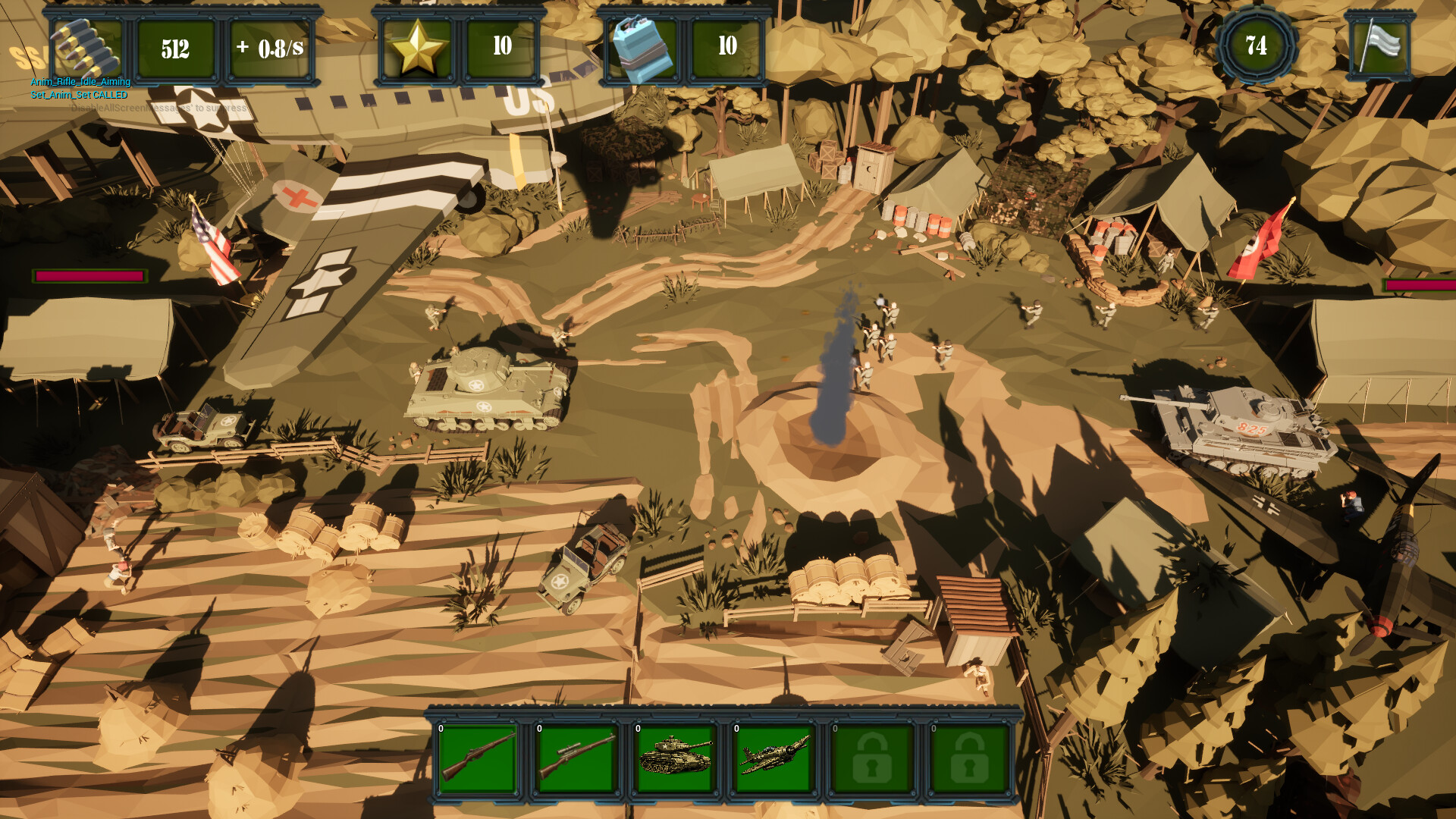
A jungle skirmish with the three-currency HUD (Ammo, Medals, Fuel) visible, alongside a debug text overlay left on in this build.Steam store page -
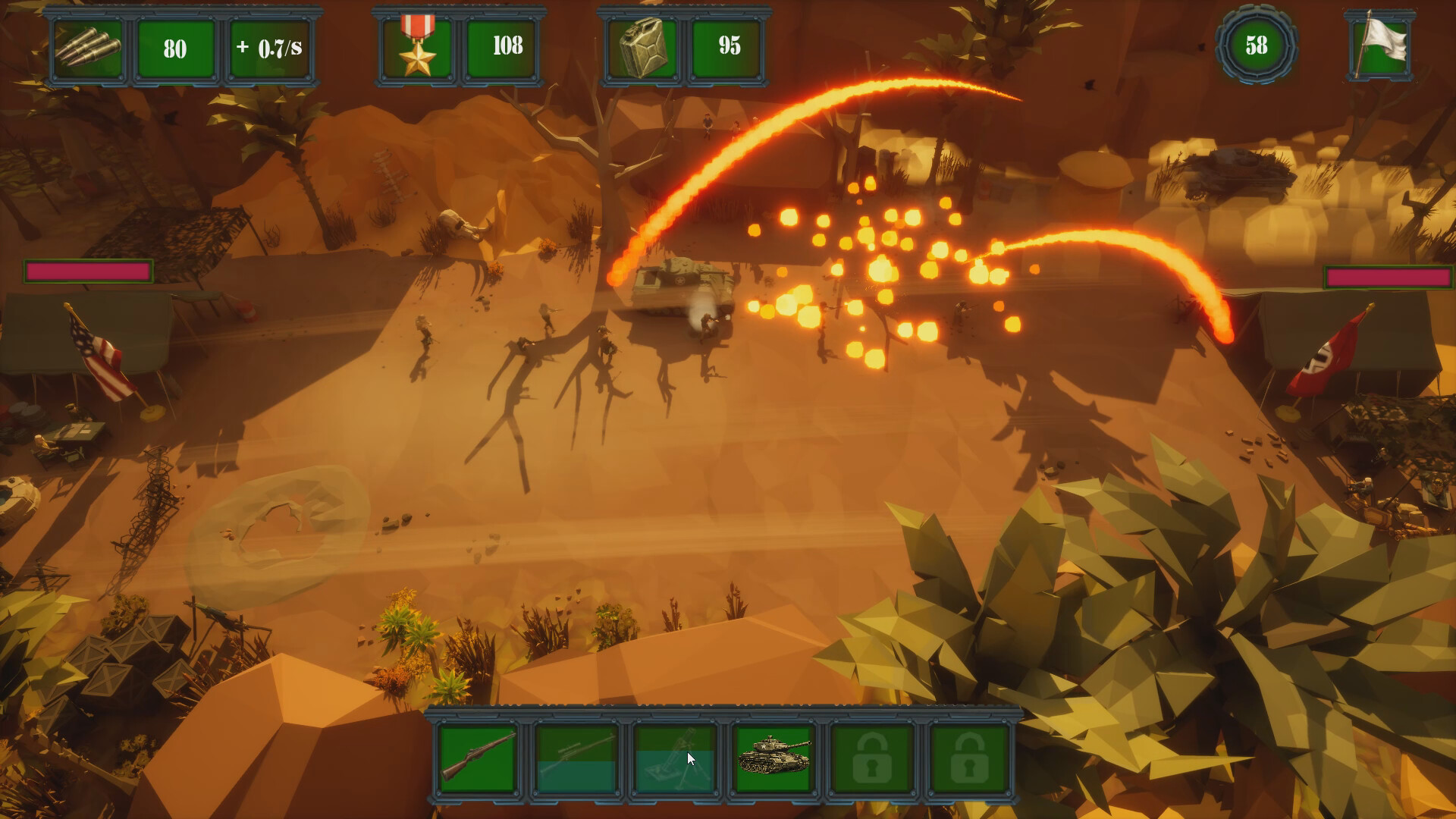
A desert skirmish mid-mortar-barrage, with base health bars flanking the field and two unit slots still locked on the deployment bar.Steam store page -
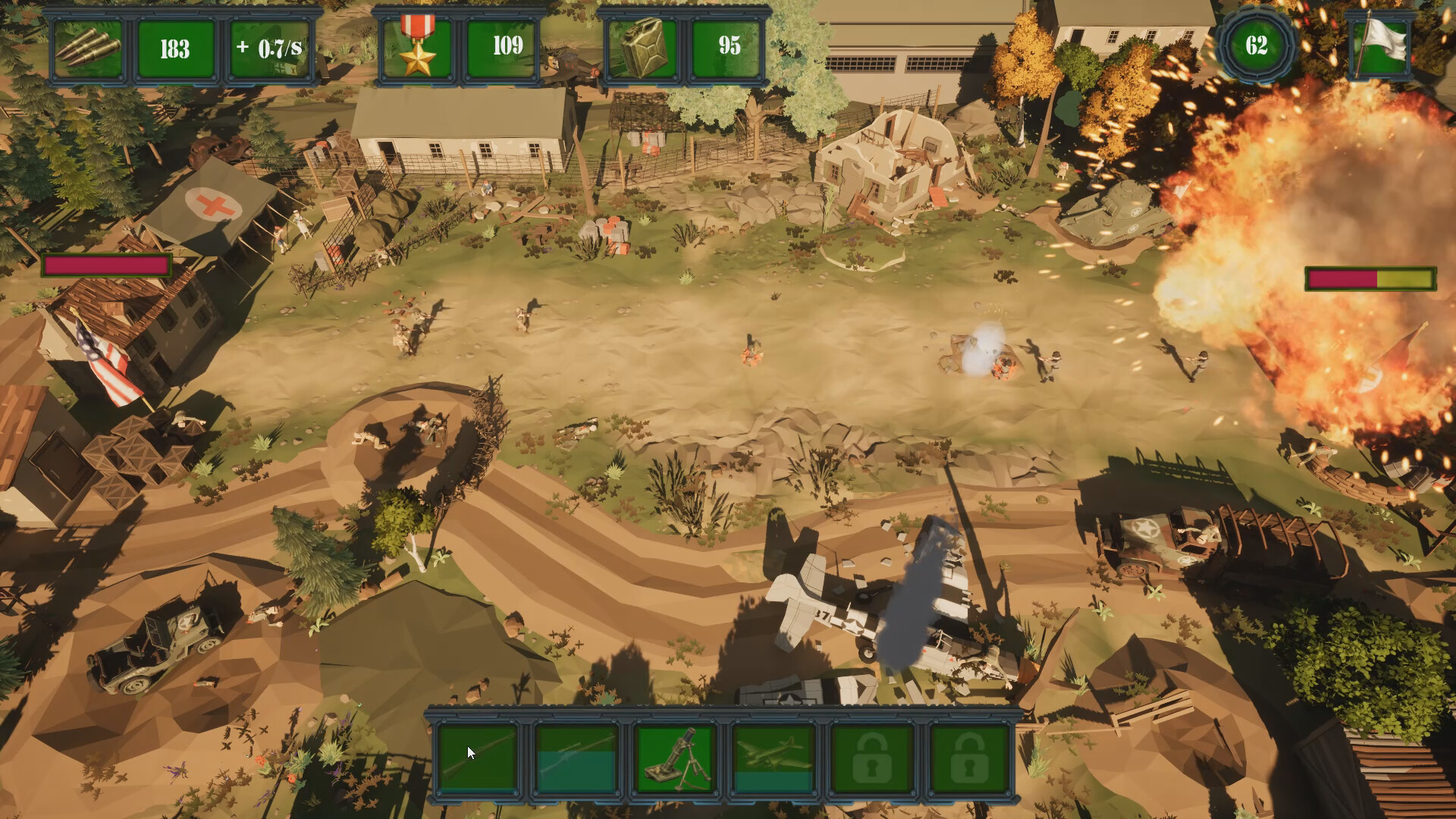
A farmland battle with a burning building and a downed aircraft, and the unit bar showing a mortar and plane newly unlocked.Steam store page