Game review
ZERO_FILL
6.6 / 10
- Developer
- Catoio Software
- Publisher
- Catoio Software
- Released
- 6 March 2026
- Platforms
- Windows
- Genre
- Puzzle
- Monetisation
- Premium
- Players
- Single-player
The short version
ZERO_FILL is a $1.99 game from developer Catoio Software, released 6 March 2026, a minimalist logic puzzle where players click grid tiles to reduce every numbered square to zero, with each click also affecting neighboring tiles. This review's small, unanimous 2-review sample praises the game's clean, distraction-free design and a difficulty curve that builds gradually without ever feeling unfair.
Biggest strengths
- This review's sample includes a detailed reviewer describing the core mechanic directly, reducing every numbered tile to zero by clicking squares that also affect their neighbors, and calling the design 'a simple but surprisingly clever concept' that evolves from an apparently easy task into genuine forward-planning
- This review checked the store's own detailed description and confirmed a substantial content package for the price: a 75-board handcrafted campaign, a board creator with shareable codes, and an infinite random-board generator for after the campaign ends
- This review's sample includes a reviewer specifically praising the difficulty curve as 'natural and carefully considered,' noting the game remains approachable for newcomers early on while still introducing enough complexity to keep experienced puzzle players engaged later
Biggest weaknesses
- This review's sample is very small, just two total reviews, both unanimously positive, meaning this review has no negative perspective at all to weigh against the praise and can't speak to how the game holds up for players who bounce off its minimalist approach
- This review checked the developer's partner-events feed and found a full campaign walkthrough posted just one day after launch, a fast turnaround this review reads as circumstantial evidence that at least some early players needed outside help clearing the main 75-board campaign
- This review's sample notes the game's presentation is deliberately bare-bones, 'almost 80s aesthetics,' language that accurately signals this is not a game aimed at players who want visual spectacle alongside their puzzles
Who it's for: Fans of numerical and logic puzzle games who want a stripped-down, cerebral challenge without narrative padding or unnecessary systems layered on top.
Our recommendation: A confident recommendation for puzzle fans at a very low price, especially for players who want a large amount of content, campaign, sharing, and generation tools, for the money.
6.6 / 10
Click a tile, watch its neighbors shift, and try to bring an entire grid down to nothing. ZERO_FILL is a $1.99 game from developer Catoio Software, released 6 March 2026. This review draws on the game's full 2-review sample, unanimously positive.
A simple rule that gets genuinely deep
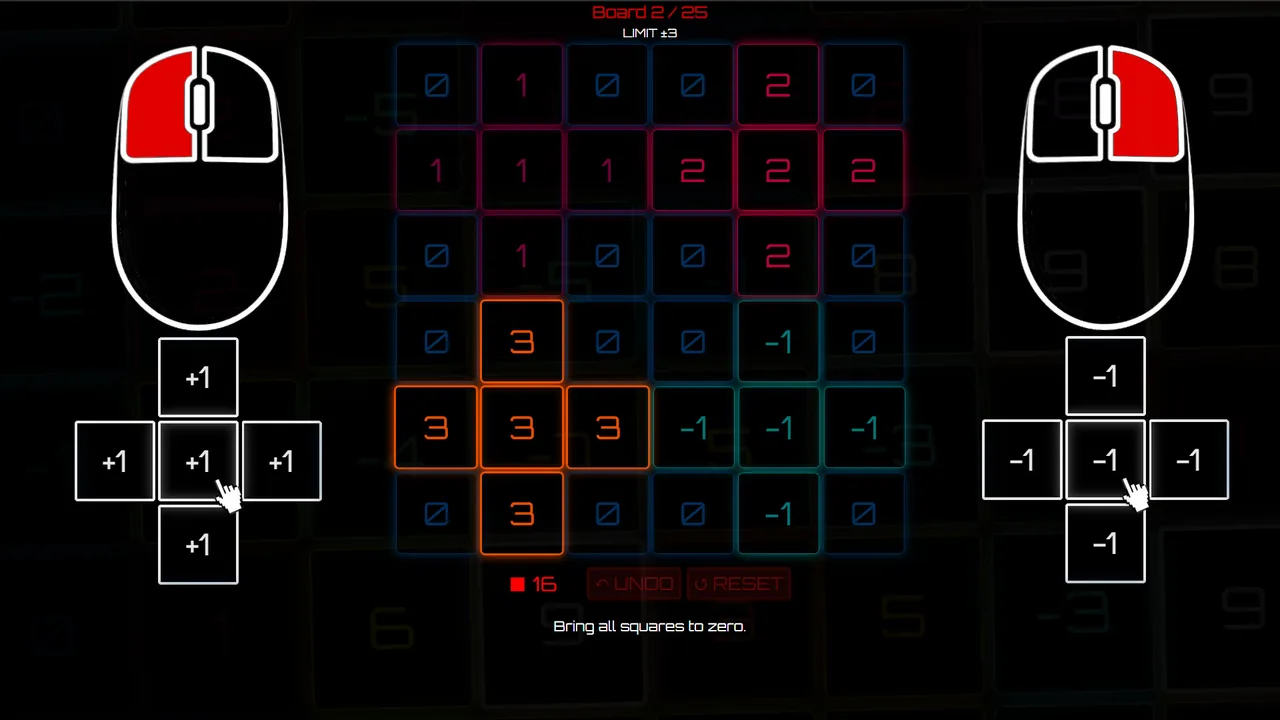
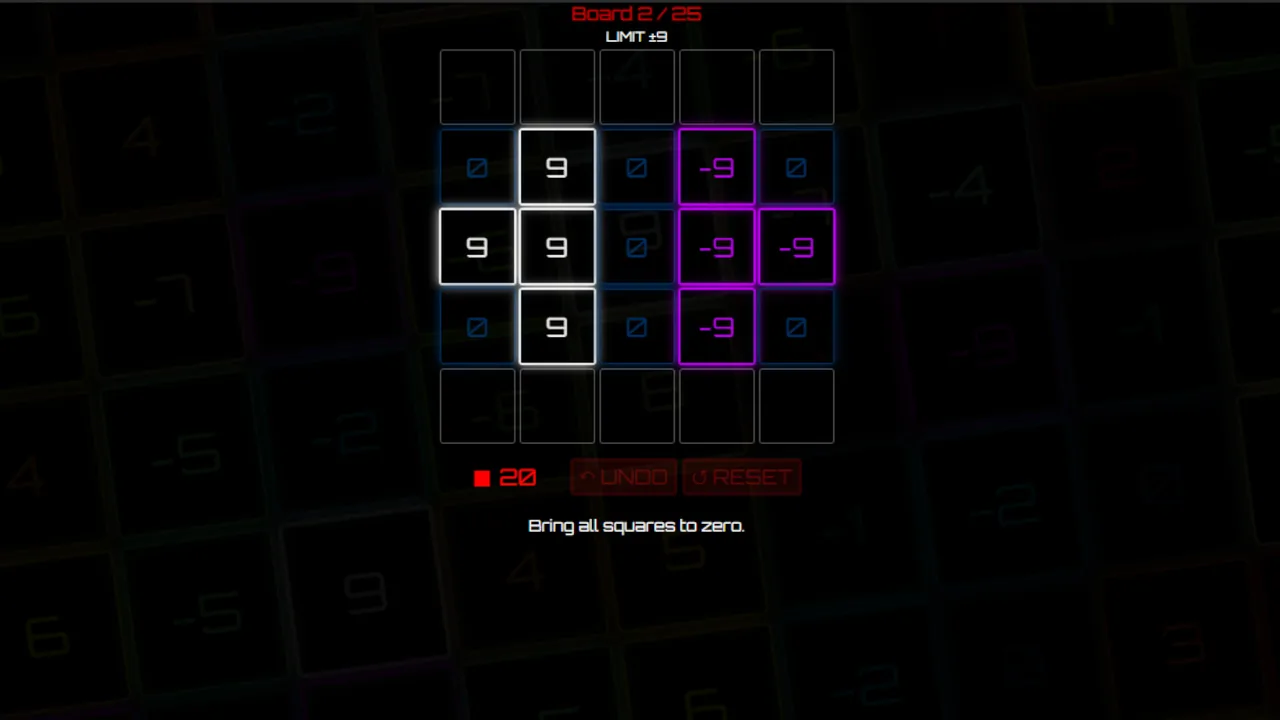
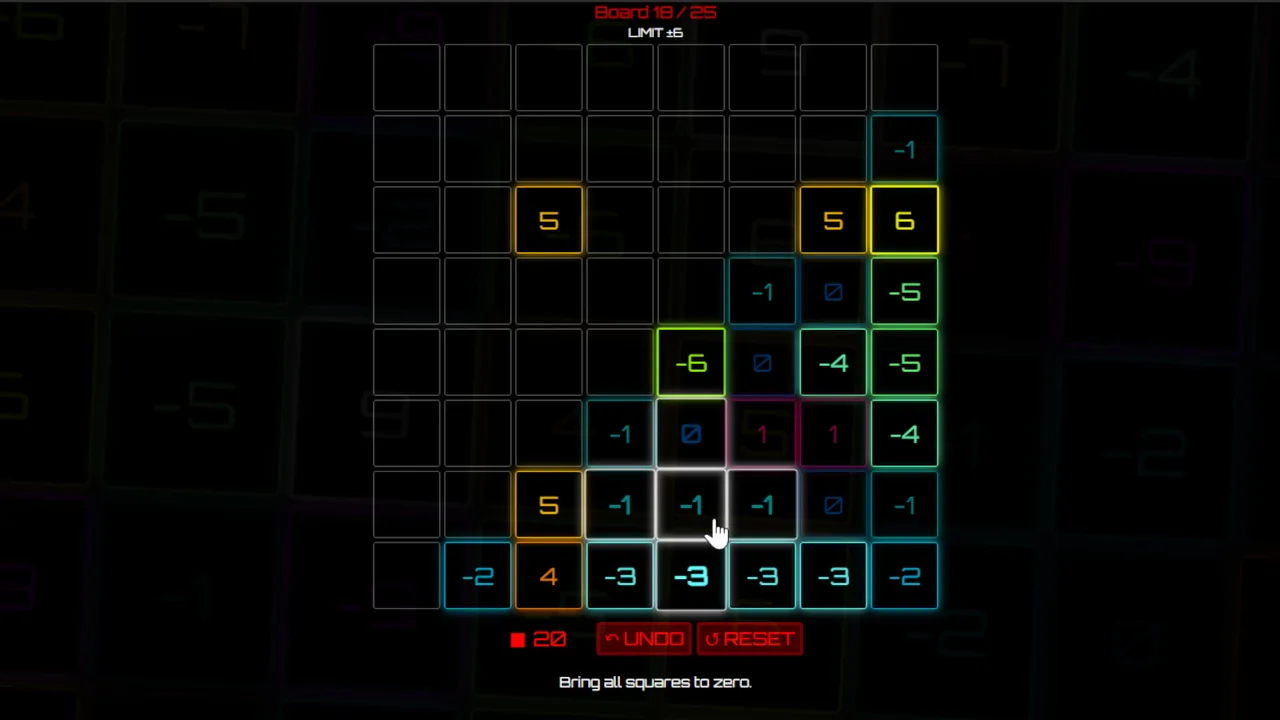
This review checked the store's own description alongside its sample and found the core mechanic consistently and clearly explained: clicking a numbered tile raises or lowers its value while also affecting its immediate neighbors, and the goal is to bring every tile on the board to zero within a limited number of moves. One reviewer described the concept as "a simple but surprisingly clever" hook that "quickly evolves into a thoughtful exercise in planning, pattern recognition, and strategic decision-making," specifically praising how the game forces players to think several moves ahead rather than relying on trial and error. The other reviewer echoed that read directly, describing 90 boards of "growing difficulty" and recommending the game specifically to players "into numerical puzzles."
Real content for a very low price
At $1.99, ZERO_FILL's feature list is worth spelling out plainly. This review checked the store's detailed description and confirmed a 75-board handcrafted campaign as the core offering, backed by a board creator that lets players build and share their own puzzles via share codes, plus an infinite random-board generator for use once the campaign is finished. That combination gives the game a real case for long-term engagement well beyond its low upfront cost, a point echoed directly by one reviewer's sample, who noted a "generator of random boards" becomes available once the base game's boards are cleared.
A difficulty curve reviewers specifically praised
This review's sample singles out pacing as a particular strength. One reviewer wrote that the game "balances accessibility and challenge" well, describing the basic objective as understandable "within moments," while later stages introduce enough complexity to keep experienced players engaged without becoming "overwhelmingly difficult too quickly." That same reviewer called the resulting learning curve "natural and carefully considered," language that reads as a specific, deliberate design compliment rather than generic praise.
A deliberately bare presentation
Neither reviewer treats ZERO_FILL's visuals as a selling point, and this review's evidence backs that read directly. One reviewer described the game's look as "very basic graphics (almost 80s aesthetics)," paired with "subdued but pleasant music." The other reviewer framed the same minimalism as a deliberate strength rather than a shortcoming, writing that the clean presentation "ensures that players can focus entirely on the puzzle mechanics without unnecessary distractions," and that the interface stays "straightforward and functional, making it easy to understand the state of each board at a glance." Shoppers expecting visual spectacle should look elsewhere, but this review's sample suggests that's a deliberate trade-off in service of the puzzle-solving itself, not a resourcing shortfall.
What the achievement data adds
This review checked the Steam achievement API and found a fairly gentle, gradual drop-off across seven tracked achievements: 90.9 percent of players earn a first-win achievement, dropping only to 51.5 percent for beating a randomly generated board, and settling around 21 to 24 percent for clearing later campaign worlds. That's a notably smoother curve than several other small puzzle and strategy titles this review has covered recently, and it corroborates this review's sample's praise for a difficulty curve that ramps gradually rather than spiking sharply. This review also checked the developer's partner-events feed and found a full campaign walkthrough posted the day after launch, a detail worth flagging directly, since it suggests at least some early players wanted help with the main campaign even if the broader achievement data doesn't point to a steep wall.
Accessibility options above average, with one notable gap
This review checked the store's accessibility feature-flag block directly and found seven of nineteen tracked flags true: color alternatives, camera comfort, mouse-only and touch-only control options, save-anytime support, a quicktime-event-free design, and a dedicated playable-at-your-own-pace flag. That's a stronger showing than most small-scale puzzle titles this review has covered this window. One clear gap stands out, though: no keyboard-only option is flagged, worth noting directly for players who rely on keyboard navigation, since ZERO_FILL's entire interaction model runs through clicking individual tiles.
A tag list that fits its own description
This review checked the store's own tag list against what this review's sample and description describe, and the match here is close and honest. "Puzzle," "Logic," "Minimalist," "Strategy," and "Level Editor" all track directly to features and design choices both reviewers explicitly describe. "Difficult" is a fair, if relative, description given the achievement data's drop toward the low twenties for later campaign worlds, and "Relaxing" fits the calm, distraction-free tone both reviewers praised even as the puzzles themselves grow more demanding. "Tutorial" is listed as a tag as well as being borne out directly by this review's sample, which describes an approachable, easy-to-grasp opening that builds gradually rather than throwing players into complexity immediately.
A quiet but tidy launch
This review checked the developer's partner-events feed in full and found a modest, tidy footprint: a pre-launch release-date announcement, the launch-day post itself, and the campaign walkthrough posted the following day, three posts total across a short, focused window rather than a long marketing runway. That's consistent with a small, solo-scale release rather than a heavily resourced launch, and it lines up with the game's own minimalist design philosophy, a developer putting its effort into the puzzles themselves rather than an extended promotional campaign.
Verdict
ZERO_FILL is a small, focused puzzle game that does exactly what it sets out to do, and does it well according to this review's unanimous, if very small, sample: a clever, easy-to-learn core mechanic that deepens meaningfully across a genuinely substantial 75-board campaign, backed by real replay value through its board creator and random generator. At $1.99, with a difficulty curve both reviewers specifically praised as fair and well-paced, this is an easy recommendation for logic-puzzle fans, tempered only by the thinness of the evidence available and a presentation that makes no attempt to be anything more than clean and functional.
Pros and cons
Pros
- This review's sample includes a detailed reviewer describing the core mechanic directly, reducing every numbered tile to zero by clicking squares that also affect their neighbors, and calling the design 'a simple but surprisingly clever concept' that evolves from an apparently easy task into genuine forward-planning
- This review checked the store's own detailed description and confirmed a substantial content package for the price: a 75-board handcrafted campaign, a board creator with shareable codes, and an infinite random-board generator for after the campaign ends
- This review's sample includes a reviewer specifically praising the difficulty curve as 'natural and carefully considered,' noting the game remains approachable for newcomers early on while still introducing enough complexity to keep experienced puzzle players engaged later
- This review checked the store's accessibility feature-flag block directly and found seven of nineteen tracked flags true, including color alternatives, camera comfort, mouse-only and touch-only control options, save-anytime support, and a dedicated playable-at-your-own-pace flag, a strong showing among this review's recent coverage
Cons
- This review's sample is very small, just two total reviews, both unanimously positive, meaning this review has no negative perspective at all to weigh against the praise and can't speak to how the game holds up for players who bounce off its minimalist approach
- This review checked the developer's partner-events feed and found a full campaign walkthrough posted just one day after launch, a fast turnaround this review reads as circumstantial evidence that at least some early players needed outside help clearing the main 75-board campaign
- This review's sample notes the game's presentation is deliberately bare-bones, 'almost 80s aesthetics,' language that accurately signals this is not a game aimed at players who want visual spectacle alongside their puzzles
- The store's own accessibility flags show no keyboard-only option and no narrated-menu or text-to-speech support, a real gap for a game whose entire interaction model runs through clicking tiles
Screenshots
-
ZERO_FILLImage: Catoio Software via Steam -
ZERO_FILLImage: Catoio Software via Steam -
ZERO_FILLImage: Catoio Software via Steam