Game review
Uptime: A Cloud Provider Sim Review
7.5 / 10
- Developer
- RubyRack Games
- Publisher
- RubyRack Games
- Released
- 17 July 2026
- Platforms
- ["Windows"]
- Genre
- Simulation
From Garage Rack To Hyperscaler, One Cable At A Time
Uptime: A Cloud Provider Sim is a $14.99 first-person infrastructure sim from solo Australian-style indie outfit RubyRack Games, released into Steam Early Access on July 17, 2026 as v0.1.10. A June 22, 2026 playtest announcement and a July 6, 2026 free demo preceded the launch, but neither opened as a purchasable build, so the July Early Access release is the clean original release. The premise is unusually specific: you build and run a cloud provider from the ground up, buying servers, carrying them to the rack, seating them, running the network cable yourself off the spool, and powering everything on before signing your first customer. Underneath the first-person busywork is a genuine simulation, ports, power budgets, cooling, fault domains, RSTP, BGP, and virtual machines all behave as modeled systems rather than set dressing. Two months in, the reception is remarkably lopsided: 39 of 40 English reviews recommend it, a Positive rating that sits even higher than most Early Access darlings, though the pool that drives that number skews heavily toward players who already know or want to learn real networking and IT infrastructure.
A Simulation That Rewards Actually Knowing (Or Learning) Networking
The single most consistent praise in the review pool is that Uptime models real infrastructure concepts rather than faking them. One reviewer summed up the appeal directly: "You actually have to think about available resources, network connections, customer requirements, overcommitment and how you want to expand your infrastructure," adding that it's "very faithful too with things like placement, overcommit, MLAG, SFP breakouts, varied workloads." Another reviewer working in the industry vouched for the realism from professional experience: "I'm an IT engineer and can vouch for the enjoyment of racking up server equipment," while a different player who does similar work informally wrote, "As someone who does this for friends on a small scale, and has wanted to make their own business doing this very thing, this has scratched an itch I've had for over a decade." The comedy of life imitating the sim shows up repeatedly too, with one reviewer joking after a real 9-hour shift, "Fix DNS again (It's always DNS)... Start playing this game. 10/10 doing my day job in game," and another admitting, "normal people play games to escape work. I play games where I get to do my job but without the tickets." For players who want that specific, hands-on infrastructure fantasy, nothing else in the genre reviewers mention comes close.
The Learning Curve Is A Genuine Wall For Newcomers
That same depth is a double-edged sword for anyone who isn't already networking-literate. One reviewer who stuck with it anyway put it plainly: "The learning curve is quite steep, especially if you have no previous knowledge of networking. It would be helpful if the game provided new players with more information about what the different products and features do and when they are needed. At the moment, it feels like you can find better help online than within the game itself." A player who logged a full week's worth of hours agreed the early game is slow to click: "the money flow isn't spectacular, and you have to move location in order to get a quick cash injection," while another newcomer described the frustration of pure waiting: "there's not much outside the whole rack building and hosting, some sort of time skip might be nice as I spent most my time waiting for money." One reviewer's revised take is instructive: they initially thought the game had roughly 10 hours of content, then corrected themselves, "It's about 10 hours before you're done with the tutorial and the real fun kicks in when you try to do all of what you just learned, but scale it up." The game clearly has legs for players willing to push through that wall; it's just an honest, real wall, not a small one.
The UI Has Real, Corroborated Rough Edges
Where the review pool turns genuinely critical is the interface, and the complaints are specific enough to trust. The pool's lone negative review catalogs a long list: "UI elements are strange, with toggles in places no human would think to put them. Font sizes are mostly random. Everything resizes as you click around for no apparent reason... Interfaces don't refresh when events happen until you close and reopen the interface. Objectives get stuck and randomly unstick themselves." Multiple otherwise-positive reviewers independently flag overlapping problems: one wrote "the game constantly tells me to expand storage next, when I get a new prospect, my storage is nowhere near capacity... the capacity page is not accurate at all," another wanted better customer-request visibility ("there's no real signal telling you 'hey, can I get more VMs in 7 days?'"), and a third asked for search and grouping tools once a save fills up with customers: "creating groupings/VLANs becomes quite a pain with many customers." One player separately reported a bug where "hardware disappears when trying to work on it" and the management console window would drop out mid-session. None of these sink the game, most reviewers pair the complaint with continued enthusiasm, but they're consistent enough across independent reviews to be a real, current weak point rather than isolated bad luck.
A Notable, Corroborated Flag About The Writing
Two independent reviewers, one of the game's few negative reviews and one of its more detailed positive ones, separately raised the same specific concern about Uptime's in-game text. The negative reviewer wrote, "All of the text in this game feels unnatural to the point of being a distraction. Once you notice the 'it's not X, it's Y' writing patterns you won't unsee it... I'm fairly certain this one is mostly just vibe coded." A separate 23-hour reviewer, writing an otherwise strongly positive review, flagged the identical pattern independently: "A lot of the text feels translated or written by GenAI - 'It's not X it's Y' and very unnatural flow." Two reviewers converging on the same specific stylistic tell, in reviews written independently of each other, is worth flagging plainly rather than dismissing as one person's pet peeve, even though neither reviewer treats it as disqualifying on its own.
Development Pace Is Doing A Lot Of Heavy Lifting
If there's one thing that shows up in nearly every review, positive or mixed, it's that RubyRack Games is patching at an unusually aggressive pace for a solo-attributed Early Access project. "Updates have been released literally daily, sometimes they fix an annoying bug, and sometimes they add a completely new feature that players have been requesting," wrote one reviewer who revised their score upward as a result, and another reported, "4 updates in one day from a small developer is insane." A reviewer who wrote a follow-up review a week after launch noted, "On early access release day the game was fun but... it had issues. Bugs, unimplemented features and hidden mechanics that didn't get properly explained... In just a week my experience with the game has become significantly better." Several reviewers explicitly credit this pace, plus an active Discord community, as the reason they're comfortable recommending a rough-edged Early Access build today rather than waiting.
Verdict
Uptime: A Cloud Provider Sim is a genuinely unusual, deeply modeled simulation that delivers exactly what it promises to the audience it's built for: people who want to feel the weight of running real infrastructure, cable by cable, port by port, rather than clicking through an abstracted spreadsheet. The 39-of-40 Positive reception is real, but it's driven substantially by IT-literate players and networking enthusiasts who find the depth its own reward; newcomers face a legitimately steep learning curve, a UI with corroborated bugs and rough edges across multiple independent reports, and an early game several reviewers describe as slow before it opens up. Two reviewers independently flagged the same odd "it's not X, it's Y" writing pattern as feeling AI-generated, worth knowing going in even though it didn't stop either of them from rating the game fairly. What tips this toward a genuine recommendation is the development pace: daily patches, fast bug fixes, and a developer visibly incorporating player feedback in real time, exactly the trajectory you want to see two months into an Early Access launch. Networking-curious players and anyone who has ever wanted to run their own data center should buy in now; players looking for a polished, low-friction tycoon experience should wait for a few more months of that same rapid iteration to smooth out the interface.
Screenshots
-
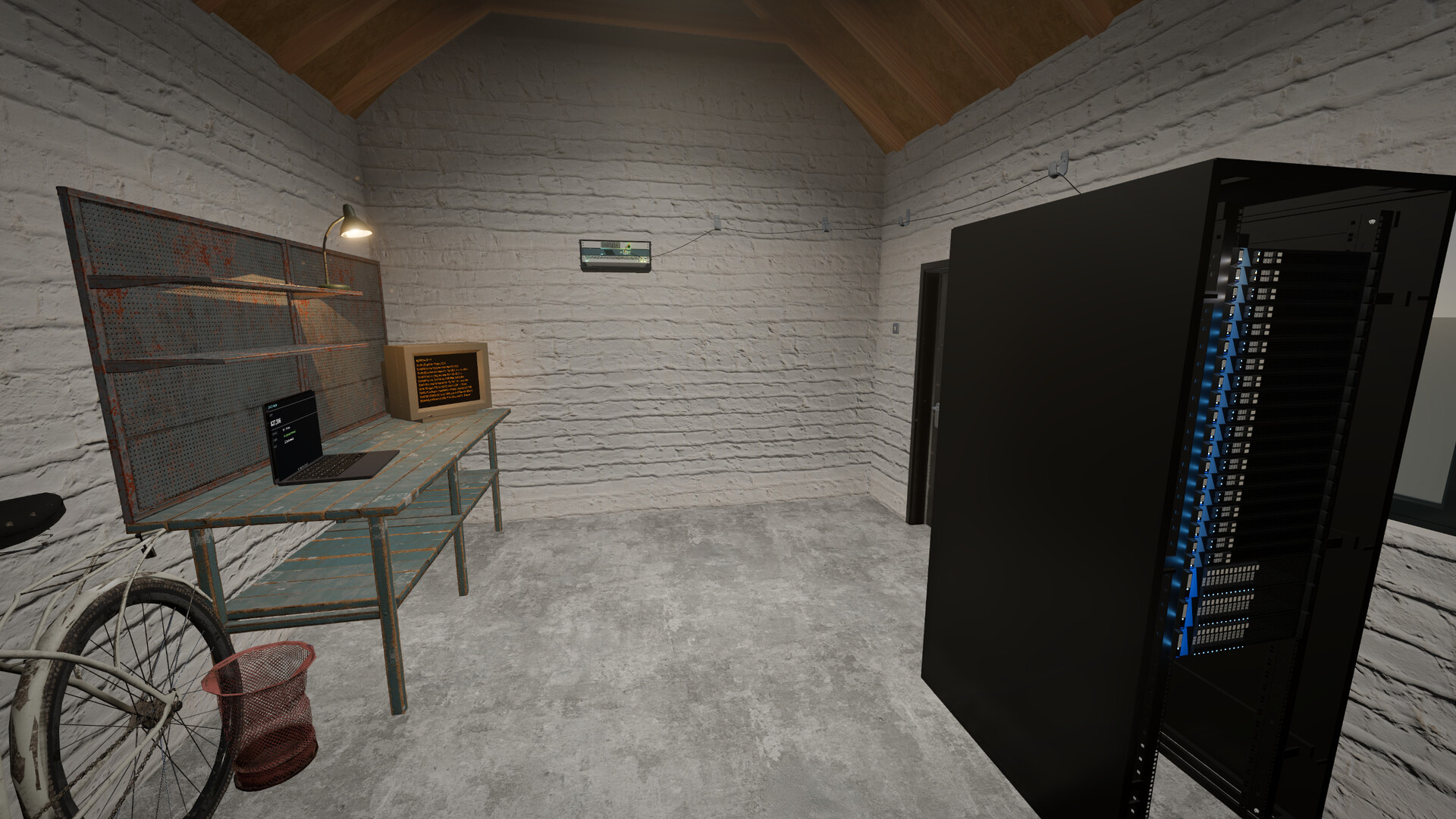
The game starts small: a single rack wired up in a cluttered garage, laptop and terminal monitor doubling as the control desk.Image: RubyRack Games via Steam -
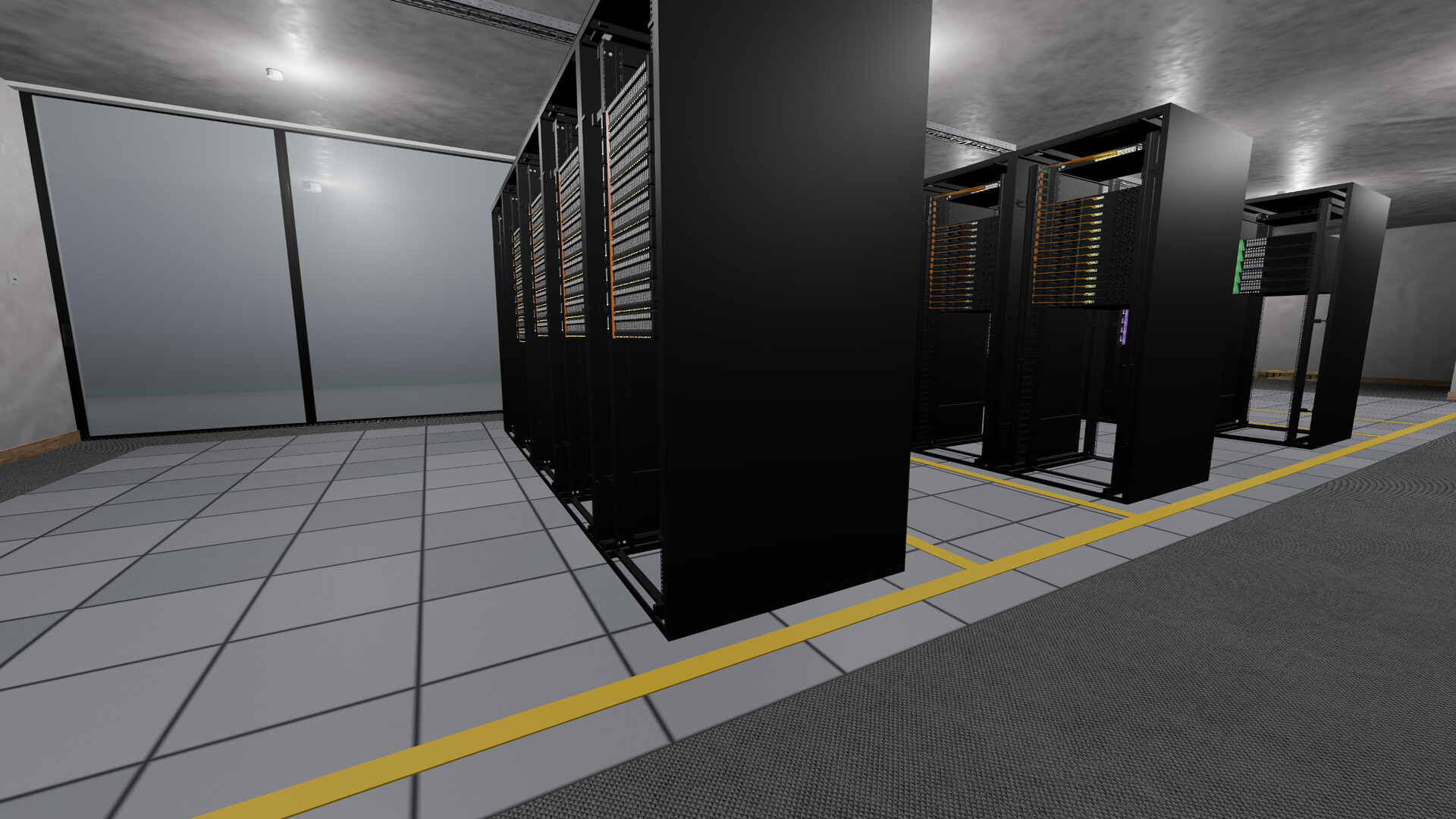
Scale up far enough and the garage gives way to a proper raised-floor data center aisle lined with racks.Image: RubyRack Games via Steam -
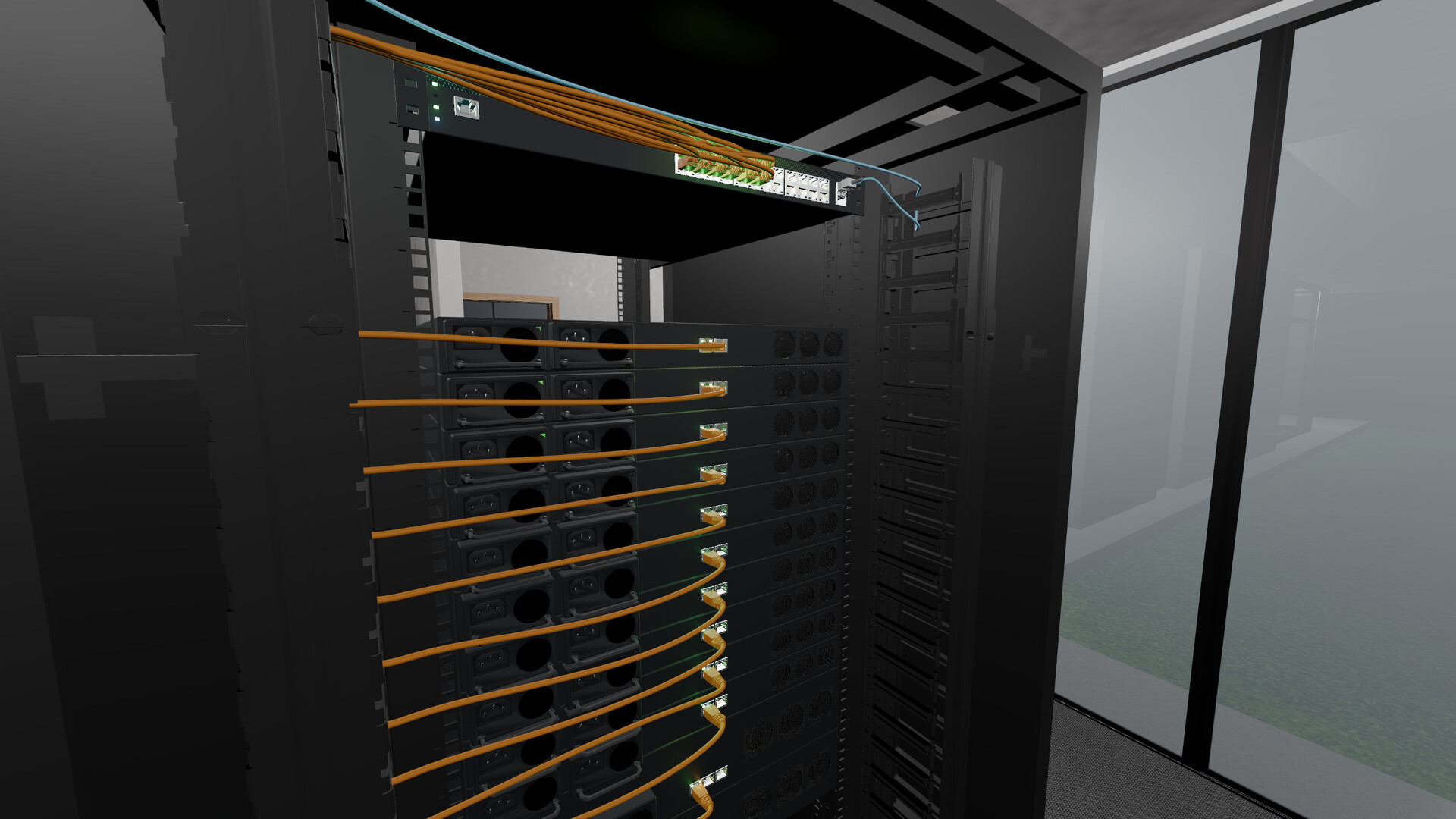
The first-person cabling is not for show: every one of those orange patch cables is a real connection the network simulation routes traffic across.Image: RubyRack Games via Steam