
Game review
Turing Testimony Review
6.5 / 10
- Developer
- Why_Studio
- Publisher
- Why_Studio
- Released
- 8 September 2026
- Platforms
- ["Windows"]
- Genre
- Adventure
Wake Up With No Memory, Then Talk Your Way Through a Murder Every Week
Turing Testimony opens on a genre-familiar setup: the player wakes up in an unfamiliar campus with fragmented memories, surrounded by ten equally disoriented strangers, before a host named Kris appears to lay out the rules of a closed-room "death game." Across five in-game weeks, one resident becomes a killer and takes one life per week; when a body turns up, everyone else has a set window to gather evidence and vote on a suspect. Vote correctly and the killer is removed and the game continues; vote wrong and, in a deliberately harsher twist on the Danganronpa formula this game clearly draws from, everyone dies and the run ends rather than merely sliding into a bad ending. What sets Turing Testimony apart from its genre ancestors, and what its own marketing leans on hardest, is that every suspect is a character whose dialogue and behavior is generated live by AI rather than written into fixed branching trees, which lets the player type free-form questions instead of picking from a menu of canned lines, and means the murder cases themselves are AI-authored and can, in principle, vary between playthroughs. Developed and published solo-studio by Why_Studio, it launched free-to-play into Early Access on September 8, 2026, with roughly the first hour playable for free before continuing requires a paid in-game "invitation" purchase, and the store page is upfront that its art was created with AI assistance and that cases are planned and carried out autonomously by AI running against a live internet connection.
A Modest, Mostly Positive Early Access Launch Built Almost Entirely on Word of Mouth
Turing Testimony has drawn 65 reviews at the time of writing, 51 positive and 14 negative, landing in Steam's "Mostly Positive" tier. The review pool is overwhelmingly Simplified Chinese, unsurprising for a game whose title and marketing lean into that audience first, and reviewers write at real length, this is a pool of people who played several hours and have detailed, specific opinions about what works and what doesn't, rather than one-line impressions.
Reviewers Praise a Genuinely Novel Interrogation Loop and a Tense, Punishing Structure
The praise across the pool centers on the free-text questioning system actually delivering on its premise. One reviewer, who joined an earlier closed test before launch, describes choosing a "smooth-talking detective" background and finding the AI-driven characters, the game's core marketed feature, genuinely reactive rather than gimmicky, singling out host character Kris as a compellingly cruel, theatrical presence who can freeze time mid-scene for dramatic effect. Another reviewer frames the underlying design as closer to a tabletop investigation game than a traditional visual novel, noting that dialogue success is gated by stat checks rather than binary choice trees, so how a player spends their limited daily time working, shopping, socializing, each with its own resource payoff, concretely determines how strong their evidence and social standing are once a body actually turns up; that reviewer specifically praises the escalating time pressure as making every early decision feel consequential rather than cosmetic. Several reviewers highlight replayability as a real strength, describing multiple playthroughs producing meaningfully different case content and endings, with one calling an unexpectedly dark late-game twist a genuine surprise and noting the AI-generated cases avoid feeling like the same story on repeat. A few reviewers also point to unusually elaborate, if slightly absurd, systems layered onto the core loop, one specifically enjoys being able to have interrogation "tools" custom-fabricated through the AI system, calling the creative freedom bold even while joking about the more lurid uses players find for it.
A Real Paywall, an Unforgiving Save System, and AI Logic That Sometimes Breaks
The negative reviews are specific and largely consistent. The most common complaint is the monetization structure: after roughly an hour of free content, continuing requires purchasing an "invitation" priced in the neighborhood of $5 to $7 per playthrough, and multiple reviewers call that steep for what amounts to a single run, with one calculating that the cumulative cost across paid tiers felt disproportionate to the content on offer. A closely related and more emotionally charged complaint concerns permadeath: the game wipes the entire save on a failed run rather than allowing a retry, and several reviewers describe real frustration at losing hours of built-up character affection and progress to a single wrong guess late in a run, with one bluntly asking why the game doesn't just uninstall itself after a failed ending given how completely it erases what came before. On the game's signature feature itself, the most detailed critical review argues the AI-driven premise is oversold: that reviewer found the scripted main plot largely unaffected by day-to-day conversations with characters, creating jarring disconnects where a character's stated plans in a cutscene bear no relation to anything discussed with them directly, and compares the implementation unfavorably to AI-NPC systems in other released games, calling it closer to a marketing hook than deep AI-driven storytelling. Multiple other reviewers report the AI-generated murder cases themselves can be logically inconsistent, contradictory testimony, staged evidence that doesn't hold up to scrutiny, undermining the deduction gameplay the whole structure is built around. Smaller complaints round out the pool: no achievements or cloud saves, UI and character art with room to improve, and dice-based checks that some reviewers feel are poorly balanced in the game's early hours.
Verdict
Turing Testimony's core idea, dropping AI-driven suspects into a Danganronpa-style closed-room murder mystery and letting players interrogate them in their own words instead of picking from a dialogue tree, is genuinely novel, and enough of its detailed, largely Chinese-language review pool backs that up to make it more than a gimmick on paper. The tension of its harsher-than-usual failure state, whole-group death on a wrong accusation, gives its weekly murder loop real stakes that reviewers consistently credit for keeping them engaged. But the substance doesn't fully match the pitch yet: a save-wiping permadeath system that erases hours of relationship progress on a single mistake, a paywall that kicks in after roughly an hour of free content, and AI-generated cases that can produce contradictory, illogical evidence all draw real, repeated frustration from the same audience praising the concept. This is worth trying for the free hour alone if AI-driven mystery games interest you at all, but go in aware that Turing Testimony is still closer to a promising, occasionally broken proof of concept than a fully realized version of the game its marketing describes.
Screenshots
-

The free-text conversation interface, letting players type their own questions instead of picking from a menuImage: Why_Studio via Steam -
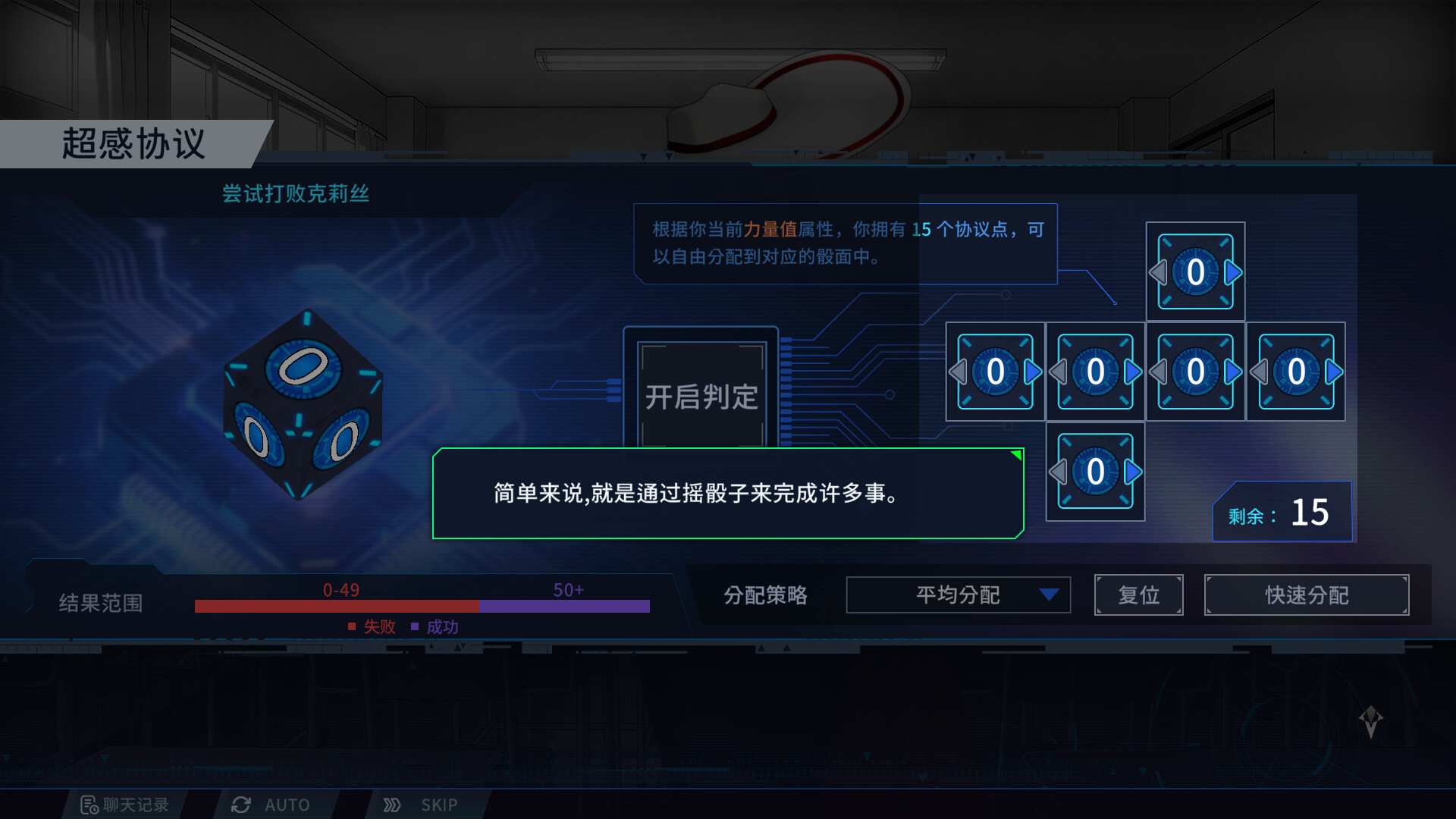
The dice-and-stat-point check system used to resolve interrogation and confrontation attemptsImage: Why_Studio via Steam -

A character profile and story scene, one of the game's AI-authored cast introduced mid-plotImage: Why_Studio via Steam