
Game review
Trailer Park Tycoon: Raccoon Ranch Review: A Charmingly Grubby Shop Sim With Sticky Customer AI
5.6 / 10
- Developer
- Yuliy Oneshko, S-Grade
- Publisher
- Yuliy Oneshko, S-Grade
- Released
- 15 September 2025
- Platforms
- ["PC"]
- Genre
- Simulation
- Monetisation
- Paid
- Players
- false
The short version
Trailer Park Tycoon: Raccoon Ranch hands players a rundown store, a hospitalised grandmother, and a deadpan raccoon protagonist named Cooper, then asks them to build a supply chain of dubious wine, tobacco and "medicinal" goods to sell to a cast of trailer park misfits. The writing is the game's clear strength, reviewers repeatedly single out Cooper's dry one-liners and the neighbors' petty, often absurd side quests, wrapped around a craft-and-sell loop that several describe as a faster, funnier cousin of games like Travellers Rest and the developer's own earlier Dog Brew. That loop is satisfying for the first several hours, refining raw resources into higher-value products, upgrading workstations, discovering hidden recipes by combining items directly in the inventory, but reviewers converge on two real problems: customer pathfinding that clusters shoppers into "ratking clumps" around inconvenient shelves or leaves them frozen at the register indefinitely, and a difficulty curve that goes slack once the economy is mastered, at which point only the remaining side quests keep players logging in. It's a scrappy, likeable game held back by rough edges its solo-adjacent team has been visibly working to sand down since launch.
Biggest strengths
- Cooper's deadpan writing and the trailer park neighbors' quest lines are repeatedly praised as genuinely funny and well-observed, elevating a familiar craft-and-sell loop
- The production chain, from raw resource to refined goods across multiple upgradable workstations, plus 21 discoverable secret recipes found by combining items directly in the inventory, is described as satisfying to master
- A distinctive, unapologetically adult setting, alcohol, tobacco, gambling, a raccoon protagonist selling to hyenas and wolves, sets it apart from the genre's usual wholesome farm-shop template
Biggest weaknesses
- Customer pathfinding is a recurring complaint: shoppers cluster around shelves in immovable clumps, wander into the warehouse and never leave, or stand frozen at the till for hours of in-game time until manually checked out
- Several reviewers report the economy solves itself within a few in-game days, after which there are no shop upgrades of real consequence and quests become the only remaining goal, leaving the mid-to-late game repetitive
- Movement and controls draw specific complaints: no toggle-run option forces constant shift-holding, the controller scheme is reportedly unresponsive for running, and the keybind menu is described as dense, text-only and hard to parse
Who it's for: Fans of quirky, story-driven shop sims like Travellers Rest or the developer's own Dog Brew, who don't mind some jank and want dark comedy rather than a cozy, family-friendly tone.
Our recommendation: Recommended for shop-sim fans who want strong writing and a satisfying early crafting loop, with the caveat that customer AI bugs and a shallow late game hold it back from greatness.
5.6 / 10
Trailer Park Tycoon: Raccoon Ranch casts players as Cooper, a teetotal city raccoon guilt-tripped into taking over his hospitalised grandmother's rundown store in a trailer park full of outcasts, thugs and a handful of genuinely charming neighbors. The pitch is a shop-and-craft sim with a dark comic streak: instead of wholesome produce, Cooper farms and refines alcohol, tobacco, energy drinks and other "dubious" goods, stocking shelves and running a storefront while untangling his neighbors' petty feuds along the way. Solo-adjacent developer and publisher Yuliy Oneshko and S-Grade released it on 15 September 2025, and it currently sits at 92% positive across 142 Steam reviews, one of the stronger scores this desk has seen in the genre this year. The 16-review sample gathered for this piece, spanning the top-rated and most-recent queues, paints a consistent picture: a game whose writing and crafting loop are genuinely well-liked, undercut by customer AI bugs and a curve that goes slack once the economy is solved.
The Writing and Crafting Loop Carry the Game
The single most consistent point of praise in the sample is Cooper himself and the trailer park cast around him. One detailed review calls him "dead inside and over it, but genuinely trying to help his neighbors," quoting a line where Cooper admits, "Honestly, I don't really know how to support anyone and I just said the therapist thing to check a box," as representative of the game's deadpan tone. Another reviewer with over nine hours logged sums the whole experience up as "10/10 america simulator," and a third calls it "fun and silly" with "business tycoon with minor mystery aspects" and praise for the art style. The same detailed review explicitly traces the game's lineage to the developer's earlier title Dog Brew, describing Raccoon Ranch as "the natural evolution" with "similar gameplay, visuals, characters, and humor, but a little more of everything," a comparison echoed by a Russian-language reviewer who says it "feels like the vibe of Dog Brew" with interesting and funny quests. Underneath the jokes, the crafting system itself draws real praise: resources are farmed and refined through a chain of upgradable workstations, pumping water into trees, harvesting produce, juicing it, fermenting it, with the same reviewer comparing the pacing favourably to the slower life-sim Travellers Rest, "but at warp speed." A separate system lets players discover 21 secret recipes by combining items directly in their inventory, a small touch multiple reviewers call a fun bit of experimentation layered on top of the main loop.
A Well-Liked Setting That Isn't for Everyone
Reviewers are consistently upfront that this isn't a cozy, family-friendly shop sim. One reviewer explicitly frames it as "the 'mature' version of shop-keeping games," noting the player sells "booze, tobacco, and drugs" with in-game gambling on top, and credits the developer for "taking liberties in making a game that is a little bit edgy" without it feeling gratuitous. The same review highlights a smaller detail multiple players seem to appreciate: NPCs have distinct voice textures tied to their species and personality, a twangy banjo voice for the player character, a gruff bark for the dog and wolf neighbors, a "deranged creature" register for the hyena, adding character to the trailer park's cast beyond the writing alone. Elsewhere, one detailed reviewer flags the tone directly as a buying consideration, recommending the game to fans of "Dog Brew or South Park" but suggesting it's worth skipping "if you're looking for something family friendly, or are sensitive to content involving eating disorders or addiction," a specific content note worth passing on given how central the trailer park's rougher edges are to its humor.
Customer AI and Controls Are the Game's Weakest Point
Set against that praise, the sample converges hard on one specific technical complaint: customer pathfinding. One reviewer describes shoppers clustering "in ratking clumps" around whatever shelf or object offends their pathing, some wandering into the warehouse and never leaving, others "standing at your register after you close shop" and staying there, unmoved, until the player returns "infinite hours later" to check them out. A separate, shorter Not Recommended review corroborates the same category of issue from a different angle, reporting "a lot of lag too every time some npc appear" despite a capable PC, adding that "something is wrong with the game" on that front. Controls draw a second cluster of complaints: one reviewer says the game badly needs a toggle-run option since holding shift constantly to move at a reasonable pace becomes tedious, and that running isn't available at all on a controller, while a separate detailed review notes the game is "best on keyboard + mouse" and that its Xbox controller support requires deciphering "a hella dense text-only control menu." None of these issues are described as game-breaking, and one reviewer explicitly notes daily post-launch updates squashed "most issues mentioned in the discussions" within days, but pathfinding in particular still shows up as an active complaint in reviews posted months after that patch cycle, suggesting it was reduced rather than eliminated.
A Curve That Flattens Once the Economy Clicks
The other recurring critique concerns pacing rather than bugs. One reviewer notes plainly that "you soon can make enough in one day to last you the rest of the game if you want," adding "there are no shop upgrades or anything like that" beyond cosmetic flooring and wallpaper changes, and that the in-game customer rating system on Cooper's computer "didn't matter" since the store always drew plenty of customers regardless. A second, more recent review echoes the same shape of complaint from a different angle: "after unlocking everything, there is not much to keep you going but the little quests that the different NPCs have," though this reviewer still recommends it on the strength of the time they spent. A third reviewer who logged over ten hours makes a related point about reward pacing, noting that side quests hand out crafting materials like teeth and fur that only end up used "maybe 3 times," leaving some of that quest reward structure feeling underbaked relative to the effort of the writing wrapped around it. Taken together, the sample suggests Cooper's story and the early crafting ramp are the main event, and that Raccoon Ranch is best approached as a focused eight-to-fifteen-hour experience built around finishing the plot and side quests, rather than an open-ended tycoon sim meant to be played indefinitely.
Value and Final Verdict
At around NZ$17, with most reviewers in the sample logging somewhere between eight and fifteen hours and several describing that as a satisfying, complete arc, Trailer Park Tycoon: Raccoon Ranch reads as solid value for what it sets out to be: a darkly comic, writing-forward shop sim rather than a deep, endlessly scalable tycoon game. Its strongest asset by a wide margin is Cooper and the trailer park cast around him, consistently singled out as funny, well-observed and worth the price of admission on its own. Its weakest points are concrete and specific rather than vague: customer pathfinding bugs that create real friction during shop management, and an economy that stops presenting a challenge well before the story does. Reviewers who came in expecting a cozy, endlessly replayable management sandbox are more likely to bounce off the flattening curve; those drawn in by the premise and the developer's prior work on Dog Brew are, by the sample's own account, more likely to find a scrappy, likeable game that's still being actively patched and improved.
Pros and cons
Pros
- Cooper's deadpan writing and the trailer park neighbors' quest lines are repeatedly praised as genuinely funny and well-observed, elevating a familiar craft-and-sell loop
- The production chain, from raw resource to refined goods across multiple upgradable workstations, plus 21 discoverable secret recipes found by combining items directly in the inventory, is described as satisfying to master
- A distinctive, unapologetically adult setting, alcohol, tobacco, gambling, a raccoon protagonist selling to hyenas and wolves, sets it apart from the genre's usual wholesome farm-shop template
Cons
- Customer pathfinding is a recurring complaint: shoppers cluster around shelves in immovable clumps, wander into the warehouse and never leave, or stand frozen at the till for hours of in-game time until manually checked out
- Several reviewers report the economy solves itself within a few in-game days, after which there are no shop upgrades of real consequence and quests become the only remaining goal, leaving the mid-to-late game repetitive
- Movement and controls draw specific complaints: no toggle-run option forces constant shift-holding, the controller scheme is reportedly unresponsive for running, and the keybind menu is described as dense, text-only and hard to parse
Screenshots
-
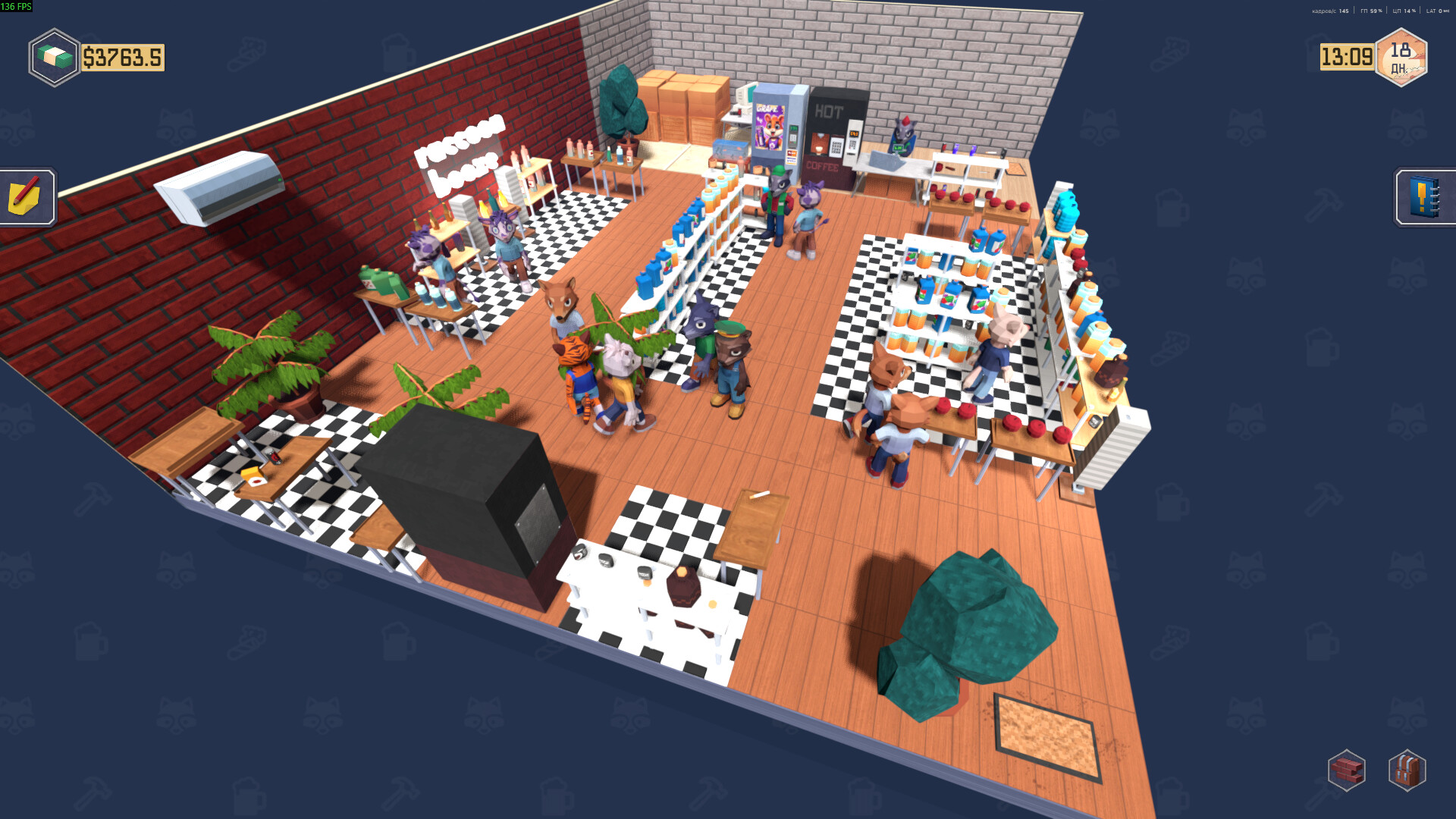
Stocking shelves and managing a shop full of trailer park regularsYuliy Oneshko -
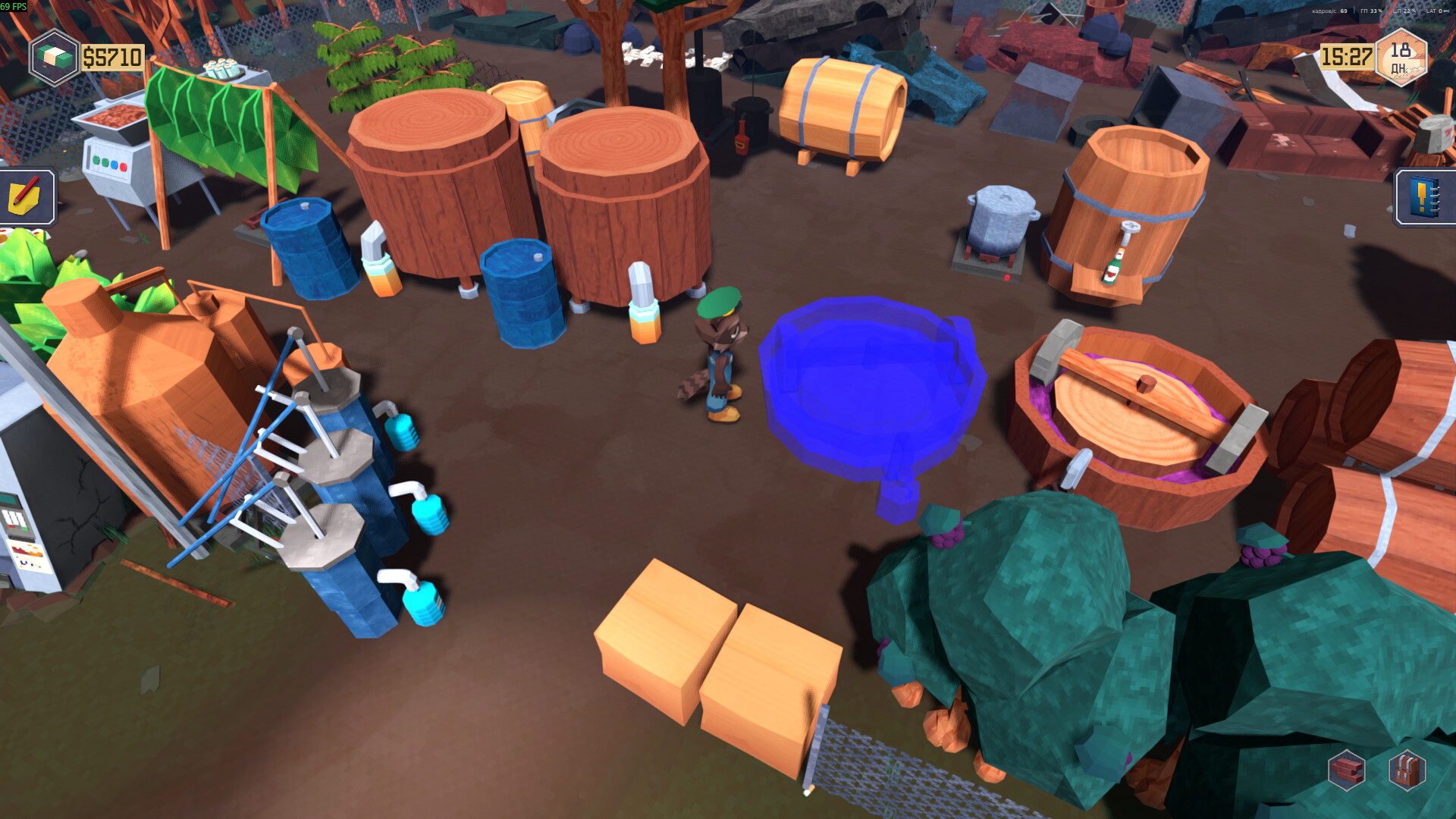
The outdoor production chain, refining raw resources into sellable goodsYuliy Oneshko -

A side-quest conversation with one of the trailer park's neighborsYuliy Oneshko -
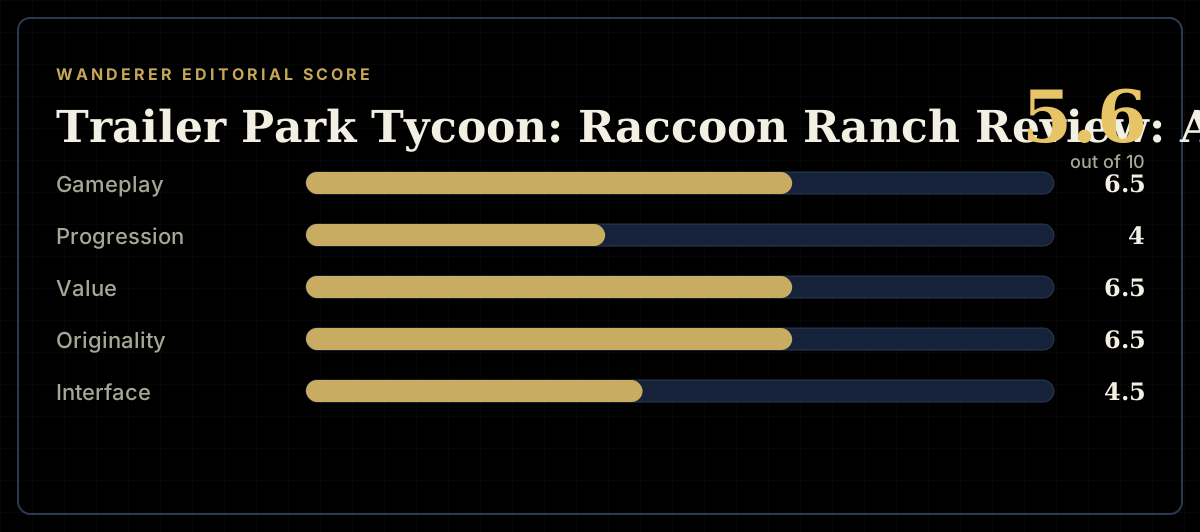
How the review scores each part of the gameWanderer Editorial -
The short versionWanderer Editorial