Game review
Touhou Defense Tale ~ AI Test in Touhou ~
6 / 10
- Developer
- 식신공방
- Publisher
- 식신공방
- Released
- 27 June 2026
- Platforms
- Windows
- Genre
- Casual, Indie, Strategy, Free To Play
- Monetisation
- free
- Players
- false
The short version
Biggest strengths
- A genuinely strategic character-merging and fusion system, layered through EX, PH, and Arcana tiers, that gives long-term progression real depth beyond simple tower placement
- RTS-style manual control, repositioning units and choosing targets mid-battle, that reviewers said makes fights feel more active than typical tower defense
- A bullet-hell-inspired visual chaos that reviewers said fits the Touhou source material's energetic tone
Biggest weaknesses
- A late game that reviewers described as confusing and visually overwhelming once most systems and characters are unlocked
- Limited structural variety, essentially the same wave format repeated with the goal of a better clear time rather than story or exploration
- Randomized elements in unit selection and merging that at least one reviewer felt undermined the ability to plan ahead
Who it's for: Touhou fans and free-to-play tower-defense players curious about a character-merging fusion system, who don't mind a busy, occasionally confusing late game and are comfortable with a project that discloses some AI-assisted asset production
Our recommendation: recommended with caveats
6 / 10
More than a standard tower defense
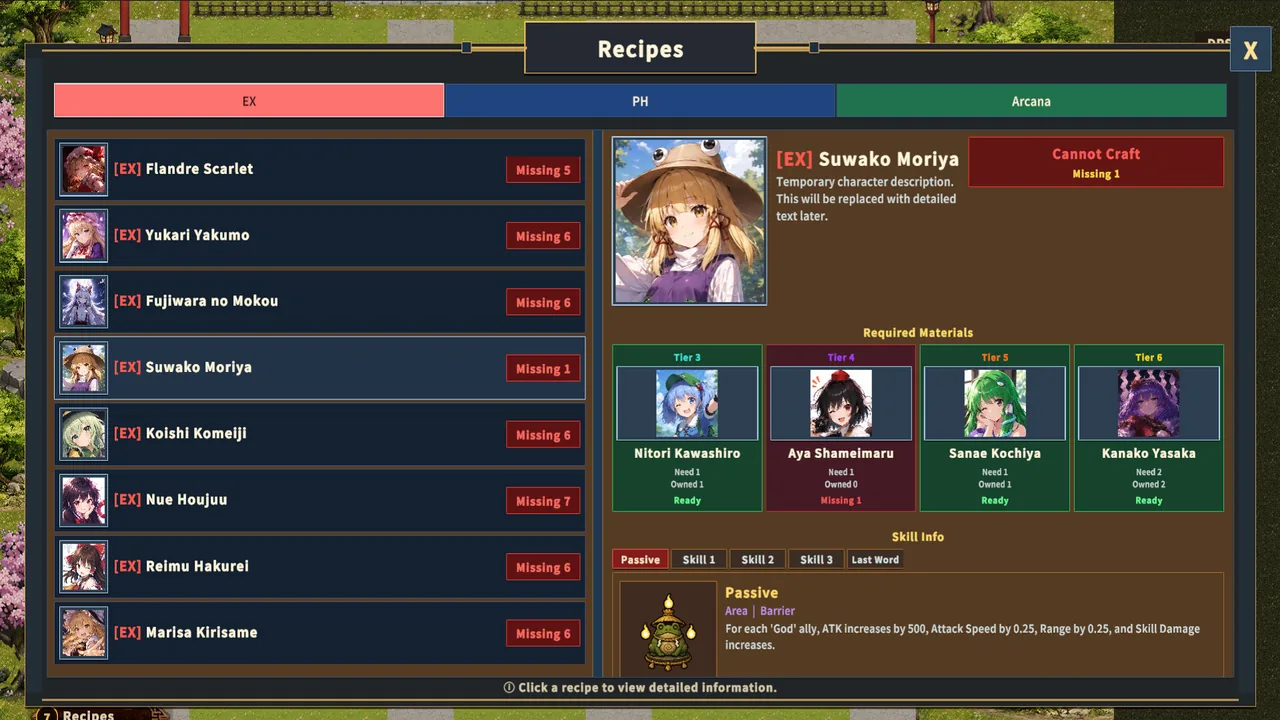
Touhou Defense Tale reshapes the Touhou Project's cast into a free tower-defense hybrid built around defending a shrine's offertory box across 80 waves, but its most distinctive addition is a character-merging system layered on top of standard unit placement. One detailed reviewer explained the core loop: "Instead of simply placing characters and watching them automatically handle incoming enemies, players are encouraged to manage their forces throughout each battle, reposition units when necessary, select important targets, and continually strengthen their formation as the opposition becomes more dangerous... Units can be combined to create stronger versions, making merging an essential part of long-term progression." Another reviewer described the deeper fusion layers that build on that foundation: "The merging system is probably the most interesting part. We can combine characters to make stronger versions and eventually use different fusion systems called EX, PH and Arcana. Working out which characters to merge and when to keep certain units around gives us something to think about beyond just making the strongest tower available."
RTS control adds real weight to battles
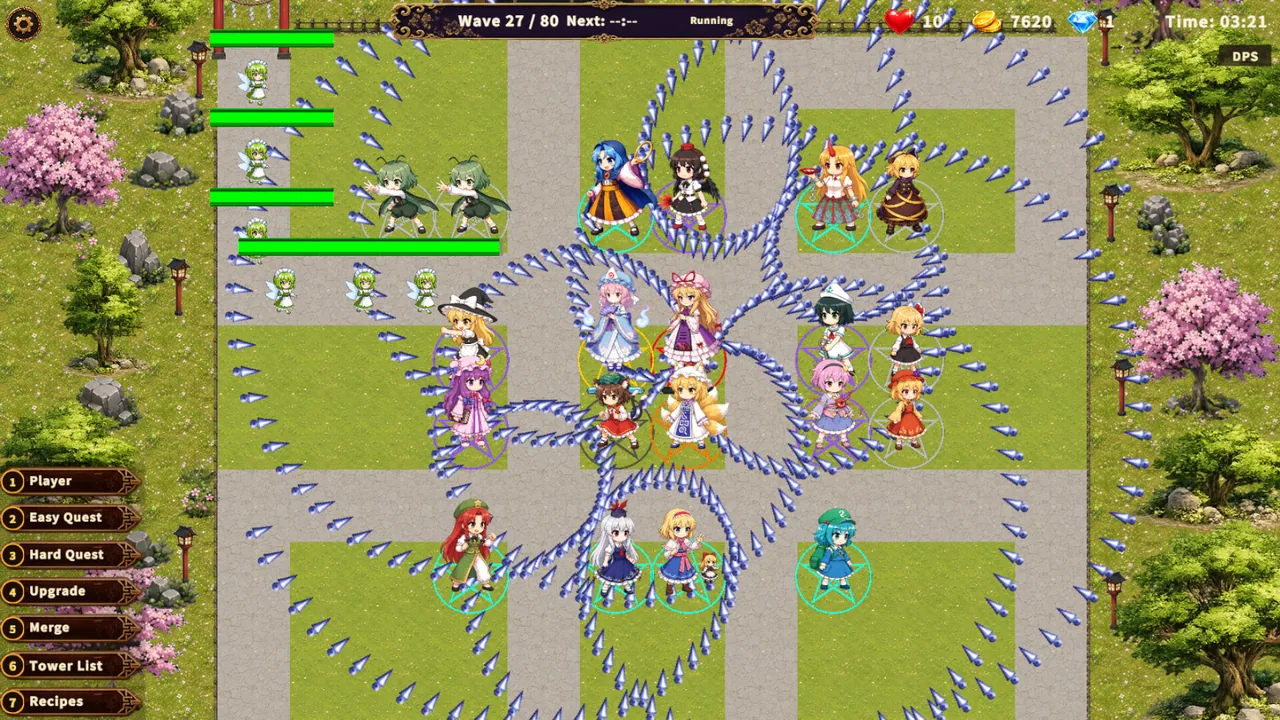
Both detailed positive reviews singled out the game's manual, RTS-influenced control scheme as a meaningful departure from typical tower-defense passivity. One wrote, "Characters are not necessarily static defenses that become irrelevant once positioned. Players can move units around and influence their targeting, providing additional control when specific enemies become dangerous... Concentrating attacks against a priority target at the right moment can prevent a defensive line from collapsing, while repositioning characters can compensate for weaknesses that might otherwise require restarting an entire attempt." The same reviewer connected the game's visual chaos directly to its source material: "Its Touhou influence becomes especially apparent when battles grow crowded with attacks and visual effects. The action can develop into something resembling a defensive interpretation of bullet hell... This creates an energetic atmosphere that fits the source material well."
A late game that can overwhelm
That same visual intensity becomes a genuine drawback once the game's systems fully open up. The reviewer who praised the bullet-hell chaos also flagged its cost: "The downside is that readability can suffer when too many effects overlap. Players who prefer restrained strategy interfaces may find the battlefield visually overwhelming." A second reviewer made a nearly identical point from a different angle: "The biggest problem is that the game can become quite confusing once everything is unlocked. There are a lot of characters, fusion options and things to keep track of, and it can take some trial and error before we understand which combinations are actually worth using. The screen can also get pretty busy during later waves, which makes it harder to follow every attack." The same reviewer also flagged a lack of structural variety beyond the core loop: "We are mostly replaying the same wave based format and trying to improve our setup or clear time. That works well for an arcade style tower defense game, but there is not much story or exploration to break up the battles."
A sharper critique of the merge system's randomness
Not every reviewer found the merge system's depth rewarding. One brief but pointed negative review compared it unfavorably to a genre staple: "As a tower defense, or, for legal reasons, 'Touhou Defense', placing and merging characters into random things is weird. You can't easily plan ahead because of this. I wasn't even sure what the characters were doing because I had no input in which ones were chosen... In short, this is Bloons TD 6 if the style was inconsistent, the characters were random, and the music was annoying." That's a meaningfully different read on the same merge mechanic the pool's more detailed positive reviews praised for strategic depth, suggesting the system's randomness lands very differently depending on how much control a player expects to have over their army composition.
An easy entry point that gets more demanding over time
Reviewers agreed the game's learning curve starts gentle before ramping up considerably. One wrote, "The game is also easy to pick up at first because the basic idea is straightforward, even though the more advanced fusion systems take longer to understand." That same reviewer still landed on a positive overall verdict despite the late-game complexity: "Overall, Touhou Defense Tale is a pretty good little tower defense game with a more interesting combat system than we might expect. The merging, manual targeting and fusion mechanics give us enough to experiment with, while the 80 waves and time attack focus give the game some replay value. It is not deep enough to be one of the best strategy games we have played, and the amount of systems can get messy, but the core gameplay is solid and the fact that it is free helps a lot." That reviewer's final score, 7/10, tracks closely with the broader pool's split between enthusiasm for the mechanical depth and frustration with how cluttered that depth can become.
Disclosed AI-assisted production, openly noted by the developer
One detail worth flagging directly: according to information on the game's own Steam page, AI-assisted tools were used during parts of development, including character illustrations, interface elements, effects, some audio material, and portions of the game's code. Reviewers who mentioned it treated it as a fact worth knowing rather than a dealbreaker in itself; one wrote plainly, "The game also openly uses AI generated material for some artwork, effects, sound and parts of its code, which is worth knowing because it can affect how we feel about the presentation." A separate, much shorter negative review reacted more pointedly to a specific piece of character art it identified as AI-generated, suggesting reactions to the disclosure vary considerably across the small review pool.
Verdict
Touhou Defense Tale is a free fangame with more mechanical ambition than its genre suggests, its merge-and-fusion system and RTS-style manual control give battles real strategic texture, and its bullet-hell presentation captures the source material's energetic chaos well. Its systems can become genuinely overwhelming once fully unlocked, its structure doesn't offer much beyond repeated wave clears, and its disclosed use of AI-assisted art, audio, and code in parts of production is worth knowing going in even though it doesn't appear to have derailed the core gameplay for most reviewers. At zero cost, Touhou fans and tower-defense players curious about a deeper merge system have little to lose by trying it.
Pros and cons
Pros
- A genuinely strategic character-merging and fusion system, layered through EX, PH, and Arcana tiers, that gives long-term progression real depth beyond simple tower placement
- RTS-style manual control, repositioning units and choosing targets mid-battle, that reviewers said makes fights feel more active than typical tower defense
- A bullet-hell-inspired visual chaos that reviewers said fits the Touhou source material's energetic tone
- Completely free, with a Time Attack leaderboard and 24 Steam achievements giving replayability beyond a single clear of its 80 waves
Cons
- A late game that reviewers described as confusing and visually overwhelming once most systems and characters are unlocked
- Limited structural variety, essentially the same wave format repeated with the goal of a better clear time rather than story or exploration
- Randomized elements in unit selection and merging that at least one reviewer felt undermined the ability to plan ahead
- Openly disclosed use of generative AI tools in parts of the game's character art, interface, effects, audio, and code, which some reviewers said affected how they felt about the presentation
Screenshots
-
Touhou Defense Tale ~ AI Test in Touhou ~Image: 식신공방 via Steam -
Touhou Defense Tale ~ AI Test in Touhou ~Image: 식신공방 via Steam -
Touhou Defense Tale ~ AI Test in Touhou ~Image: 식신공방 via Steam