
Game review
Tilt It! Golf
7 / 10
- Developer
- Kautki Cave
- Publisher
- Untold Tales
- Released
- 15 June 2026
- Platforms
- Windows
- Genre
- Action, Indie, Sports
- Monetisation
- paid
- Players
- false
The short version
Biggest strengths
- A simple, well-executed core mechanic, tilting the entire course rather than controlling a club, that reviewers consistently compared to childhood wooden labyrinth toys and found genuinely satisfying once the physics click
- 300 courses across 15 biomes deliver strong value for a sub-five-dollar price, with multiple reviewers reporting an easy, unexpectedly addictive 'one more level' loop
- Runs smoothly on modest hardware including the Steam Deck, with several reviewers specifically confirming no performance issues on handheld
Biggest weaknesses
- Multiple independent reviewers reported the game controls noticeably worse on keyboard than controller, with one describing abrupt board jitter during the small, frequent adjustments keyboard input demands
- A locked framerate and the resulting jerky tilt motion was independently linked by two reviewers to real headaches and mild motion sickness
- A near-total absence of settings, no gamepad sensitivity slider, no separate music and sound-effect volume controls, and reportedly no way to remap to a second analogue stick
Who it's for: Fans of tilt-maze labyrinth toys and bite-sized physics puzzlers looking for a cheap, controller-friendly time-killer, not recommended for players wanting deep difficulty, a smooth keyboard experience, or robust settings
Our recommendation: recommended
7 / 10
Tilt It! Golf released in full on Steam on June 15, 2026, from developer Kautki Cave and publisher Untold Tales, a cheap, physics-based puzzle game that swaps traditional mini-golf club controls for tilting the entire course to guide the ball home across 300 short levels. Its English review pool is thin but substantive at 17-18 reviews, Positive at roughly 83%, and the reviews describe a simple, well-worn concept, the tilt-maze labyrinth toy, executed with real polish on the controller and undercut by rougher edges everywhere else.
The core idea draws the pool's most consistent nostalgia and praise. One reviewer described it as bringing back memories of "these little maze games where you had to tilt the board and guide a tiny ball to the finish" from childhood, calling it "a nice little trip down memory lane." Another compared it directly to "the classic wooden box labyrinth game with metal ball," a comparison echoed closely enough by multiple reviewers that it's clearly the frame most players are bringing to the game rather than one this review is imposing on it. Several reviewers reported losing more time to it than expected, with one describing "totally locked in" flow that carried them to a full completion in under 80 minutes, and another admitting "OK, one more level" quickly turned into ten.
Controller support versus keyboard input is where the pool's clearest, most repeated complaint sits. Multiple reviewers independently recommended a controller as close to mandatory, with one noting the keyboard makes fingers "secretly enjoy suffering" by comparison, and a more detailed review going further, describing how the small, frequent corrections keyboard play demands make the board "move abruptly," calling it "annoying" and noting "someone said it gave them headaches, i kind of felt that too." A separate, shorter negative review corroborated the same physical discomfort independently, citing "the way the board tilts gives me a headache" as directly tied to the game's locked framerate. Two independent reviewers connecting the same specific technical cause, a capped framerate feeding into jerky tilt motion, to real physical discomfort is a legitimate and fairly serious accessibility concern rather than a stylistic complaint.
The game's settings menu, or lack of one, is a second corroborated weak point. One detailed reviewer, noting they'd received a review key directly from the developer, laid out a specific list of missing options: no gamepad sensitivity slider, no way to use a second analogue stick, and no separate volume controls for music versus sound effects, adding they weren't even sure sound effects existed given how little they stood out. A separate negative review made close to the same complaint independently, confirming "no way to adjust gamepad sensitivity" and no separated audio controls, while also noting the individual courses finish in "10-15 seconds" with a star-based time grading system that, combined with oversized UI elements, gave the whole package "the feel of a mobile port."
Content volume drew the most positive consensus in the pool, tempered by some reviewers wanting more structural variety within it. One reviewer broke down the headline "300 courses" figure usefully, noting they're grouped into 60 effective levels across five-zone biomes, each taking 30 to 90 seconds to clear, and wished for "more difficult/bigger levels" alongside timer-based or speedrun-style modes to extend replay value. That same reviewer praised the physics directly, writing that "movement of the ball felt amazing" and that mistakes "always felt like my mistake rather than a game issue," a sentiment echoed by a separate reviewer who called the gameplay "smooth as butter" and confirmed it "would run on a potato."
Difficulty ceiling and content repetition drew a smaller but real cluster of complaints. One reviewer wished the difficulty ramped up further, noting it "was all very chill" when they expected more expert-level challenge late on. A more critical review went further, describing "samey backgrounds, re-use of backgrounds for night levels, repetitive music," and singling out sound effects that didn't match the game's tone, alongside a specific, concrete usability gripe about being forced to manually reselect the next level with the mouse rather than simply continuing.
One further, slightly harder-to-verify review is worth flagging separately rather than relying on. The pool's single longest entry reads as unusually polished, structured, marketing-copy-adjacent prose, using phrases like "the game's greatest strength lies in how effectively it develops its central idea" and closing with a formal numeric score, without a single personal detail, bug report, or specific level referenced anywhere in it. That pattern, generically glowing, structurally uniform, and stripped of any hands-on specifics, is consistent enough with the session's established skepticism toward possibly AI-generated reviews that it's been deliberately excluded from direct quotation here, even though its overall verdict happens to line up with the more clearly hands-on reviews elsewhere in the pool.
It's also worth noting how quickly the pool's negative reviews still tend to land on "recommend with reservations" territory rather than outright dismissal, a distinction the star rating alone doesn't fully capture. Even the developer-key reviewer who listed the most detailed list of missing settings closed by saying they'd still suggest the game, citing its low price, permissive time targets for earning three stars, and suitability for a relaxed Steam Deck session as reasons it's worth the ask despite the rough edges. That pattern, real criticism paired with a continued recommendation, runs through most of the pool's negative-leaning feedback and suggests the underlying mechanic is strong enough to survive its presentation problems for most players.
Taken together, Tilt It! Golf is a well-priced, genuinely charming tilt-maze puzzler whose central mechanic clearly works, especially on a controller or Steam Deck, but whose keyboard support, settings menu, and overall technical polish lag noticeably behind its core idea. Reviewers who bought it expecting exactly what the trailer shows, a cheap, chill, physics-driven time-killer, largely came away satisfied; anyone sensitive to motion sickness or planning to play primarily on keyboard should weigh the corroborated framerate and jitter complaints before buying.
Pros and cons
Pros
- A simple, well-executed core mechanic, tilting the entire course rather than controlling a club, that reviewers consistently compared to childhood wooden labyrinth toys and found genuinely satisfying once the physics click
- 300 courses across 15 biomes deliver strong value for a sub-five-dollar price, with multiple reviewers reporting an easy, unexpectedly addictive 'one more level' loop
- Runs smoothly on modest hardware including the Steam Deck, with several reviewers specifically confirming no performance issues on handheld
- Fast, low-stakes restarts make failure feel like a fair prompt to retry rather than a punishment
Cons
- Multiple independent reviewers reported the game controls noticeably worse on keyboard than controller, with one describing abrupt board jitter during the small, frequent adjustments keyboard input demands
- A locked framerate and the resulting jerky tilt motion was independently linked by two reviewers to real headaches and mild motion sickness
- A near-total absence of settings, no gamepad sensitivity slider, no separate music and sound-effect volume controls, and reportedly no way to remap to a second analogue stick
- One detailed review described the UI scale, star-based time grading, and short 10-15 second course lengths as feeling distinctly like a mobile port carried over without adaptation
- Several reviewers wanted the difficulty curve to escalate further, describing the toughest courses as merely repeated precision checks rather than genuinely harder puzzles, with biome backgrounds and music also criticized as repetitive by more than one reviewer
Screenshots
-
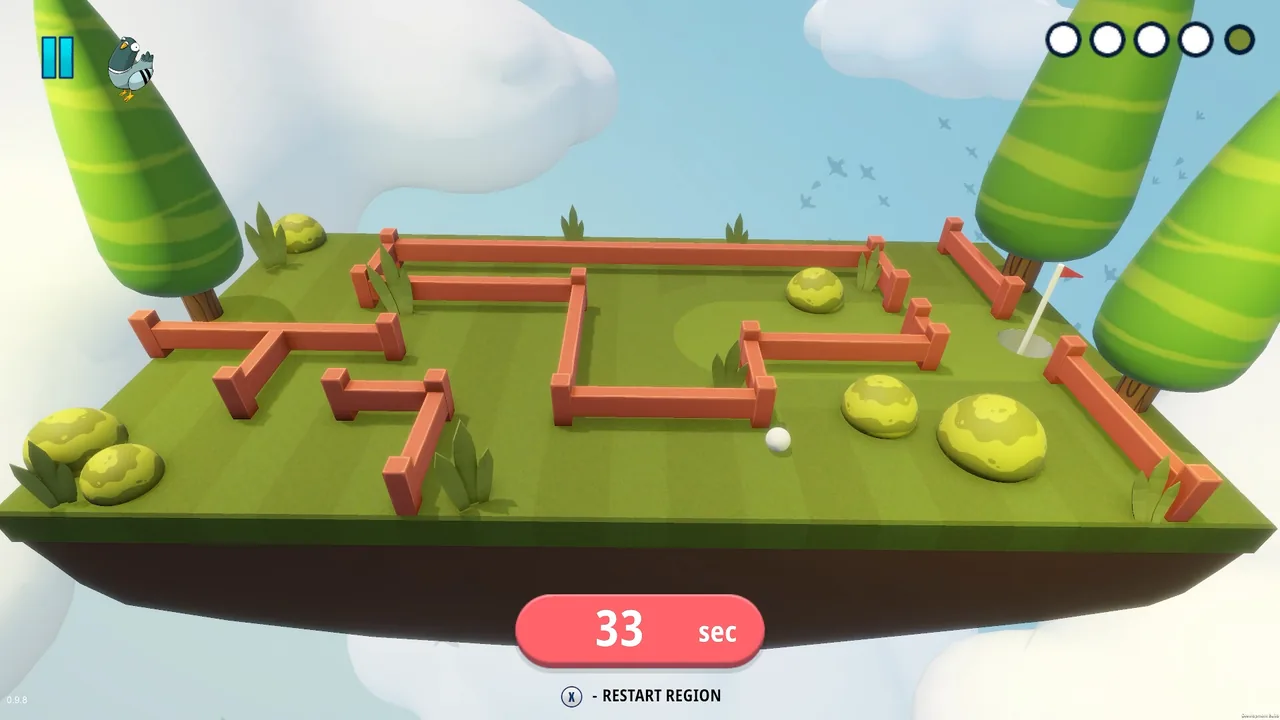
Tilt It! GolfImage: Untold Tales via Steam -
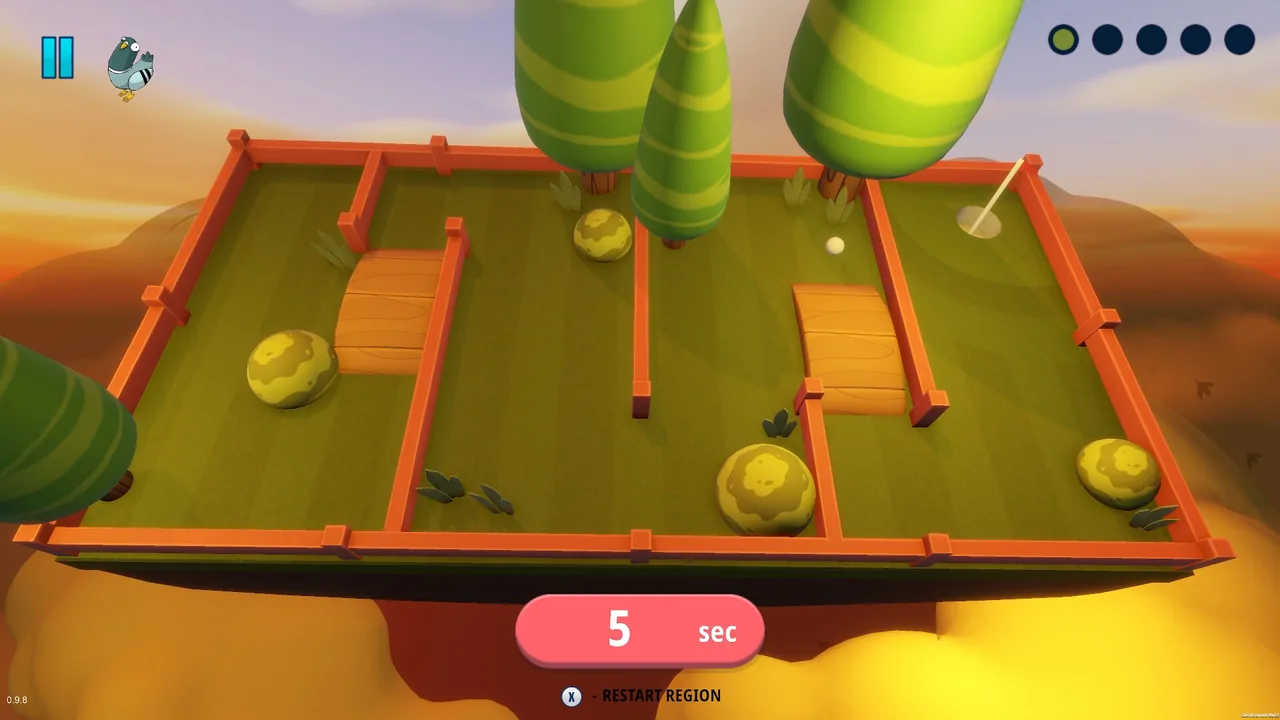
Tilt It! GolfImage: Untold Tales via Steam -
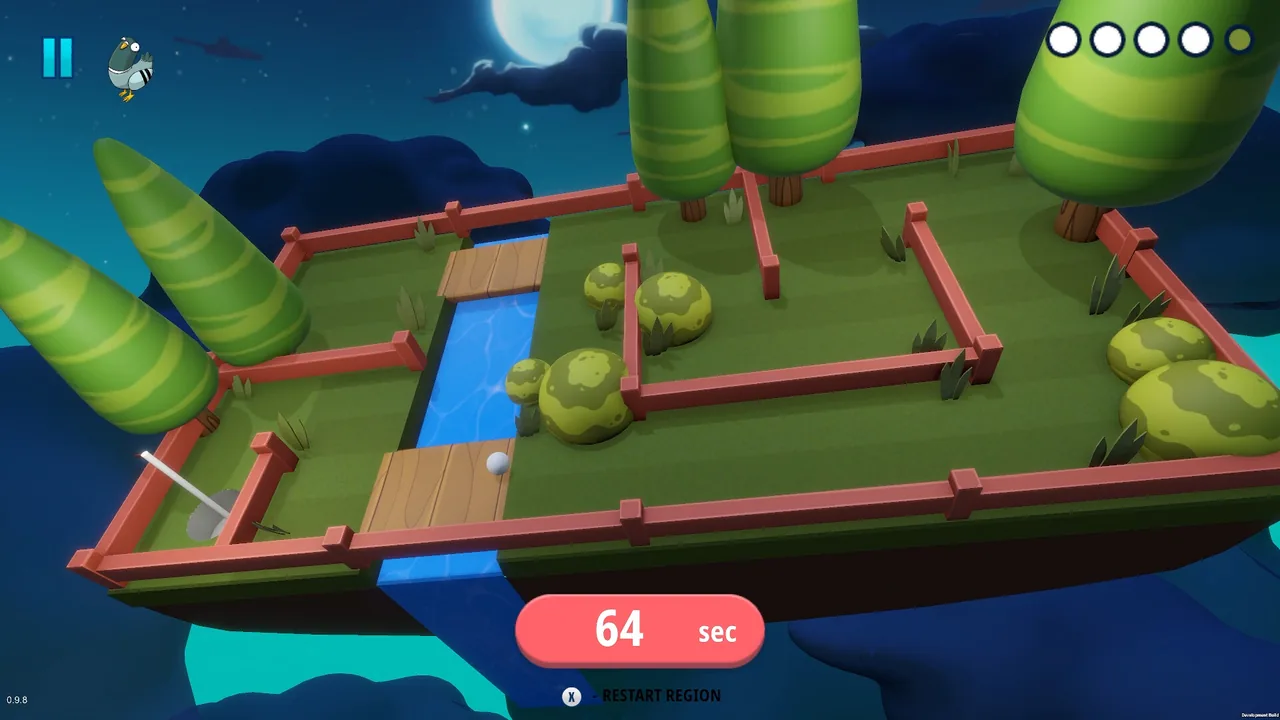
Tilt It! GolfImage: Untold Tales via Steam