
Game review
The Church in the Darkness
4.5 / 10
- Developer
- Paranoid Productions
- Publisher
- Fellow Traveller
- Released
- 2 August 2019
- Platforms
- Windows
- Genre
- Action
- Monetisation
- Paid, no in-app purchases found
- Players
- false
The short version
The Church in the Darkness sends a lone infiltrator into Freedom Town, a South American jungle commune clearly modeled on Jonestown and the Peoples Temple, to find a missing nephew and uncover the truth about its charismatic leaders. Its premise and genuine procedural variety across 19 possible endings draw real interest, and the top-down stealth presentation has its fans. But a large, detailed share of its review corpus argues the game's controls are clunky enough to undermine basic play, and that the actual moment-to-moment gameplay — reduced to a simple hide-or-shoot loop — falls well short of the roleplaying, persuasion-driven cult-infiltration experience many buyers expected from the premise and marketing.
Biggest strengths
- A genuinely distinctive, historically grounded premise drawing clearly on the Jonestown tragedy and Peoples Temple, appealing directly to players with an existing interest in cult history
- Real procedural variety across playthroughs, with randomized objective locations and up to 19 different possible endings depending on player choices
- A pleasing top-down art style and atmosphere that several reviewers specifically enjoy, along with solid voice acting and background environmental details worth discovering
Biggest weaknesses
- Widely and specifically criticized controls, with multiple detailed reviewers reporting the character walks out of rooms unintentionally, struggles navigating stairs, and takes unreasonably long to enter buildings
- A dominant complaint that the actual gameplay is far shallower than the premise suggests — reduced to basic hiding, knockouts or shooting, without the roleplay, persuasion, or cult-conversion mechanics that several reviewers specifically expected from the marketing and setting
- A very short overall runtime, with multiple reviewers reporting completion in under two hours including time spent learning the game's mechanics and restarting after early deaths
Who it's for: Players fascinated by cult history and 1970s American cult tragedies specifically, willing to accept shallow, sometimes clunky stealth mechanics in exchange for a genuinely distinctive setting.
Our recommendation: Only worth it on a very steep discount for the setting and premise alone — go in expecting a short, mechanically thin stealth game rather than the roleplay-driven cult-infiltration experience its marketing implies.
4.5 / 10
What it is
The Church in the Darkness sends a lone infiltrator into Freedom Town, a South American jungle commune run by a charismatic couple whose radical religious movement carries unmistakable echoes of Jim Jones and the Peoples Temple, to track down a missing nephew and uncover what's really happening inside the compound. Developed by Paranoid Productions and published by Fellow Traveller, it released on 2 August 2019 at NZD 28.99, built around top-down stealth infiltration with procedurally varied objectives and story elements that change across playthroughs, culminating in one of 19 possible endings.
Its review corpus, while smaller than most titles this lane covers at 76 English reviews, sits at a genuinely divided Mixed 56.6% (43 to 33), and the reviews themselves are unusually detailed and substantive on both sides — worth taking seriously despite the smaller sample size.
A distinctive, historically grounded premise
The game's central hook draws real, specific interest from reviewers already fascinated by its inspiration. "I have a fascination with contemporary 'cults': Jim Jones, David Koresh, et al... imagine my delight, then, when I heard about the [premise]," writes one detailed reviewer. Another notes the game's own reticence about its clear inspiration: "found it strange that the developers were avoiding discussing the obvious inspiration of Jonestown, but whatever" — an observation echoed by several others who nonetheless recognize the connection immediately from the setting and details. One more positive reviewer highlights the presentation specifically: "the graphics I feel are pleasing to look at, the top down view is a favorite of mine. The artwork is nice, the atmosphere of different playthroughs" adds real variety to repeated attempts.
A dominant, specific complaint about clunky controls
The single most consistent, detailed criticism in this corpus concerns basic character control. "I had the highest hopes for this game; but now I see it is just an unpolished stealth game," writes one of the most-upvoted reviews, elaborating specifically: "the pc is very hard to control, walks out of rooms, although you didn't intend to do anything, takes forever to enter a building, often he falls down at the side of the stairs — yes, really awful controls!" A separate reviewer independently confirms the same category of issue: "you'd think the game had been created in the early 2000s for how clunky it is to move around (and to be ho[nest])." That's a specific, repeated, mechanically grounded complaint rather than a vague dismissal — multiple independent reviewers describe the same category of basic movement problems in similar detail.
A large gap between marketed depth and actual gameplay
Beyond controls, a substantial share of this corpus argues the core gameplay loop falls well short of what the premise implies. "I thought this game will be an infiltration, light-rpg where you could be part of the sect, talk to people, convince them about the true nature of the cult and maybe even become cult leader at one point," writes one detailed, disappointed reviewer. "And what we got instead [was] a visual cone avoidance game with running from guards with a dash of awful controls." Another reviewer frames the same disappointment in blunter terms: "the gameplay is limited to a basic hide and seek or slaughter everyone game with very little interaction." A third, especially thoughtful review puts it precisely: "the narrative elements seem interesting, but this game is mechanically very weak... the foundation for delivering any of the potentially high quality narrative content is just not here at all."
A short runtime that compounds the disappointment
Several reviewers specifically flag how little content the game actually delivers per playthrough. "You can also beat the game within 1.5 hours. And this 1.5 hours includes learning the mechanics of the game, dying 3-4 times and starting over from the beginning," writes one reviewer, while acknowledging genuine randomization in objective locations across attempts. A separate, more measured review frames this as a real but survivable flaw: "there are multiple ways to end it so, a lot of replayability but in the same time, it becomes quickly repetitive... on an extremely good sale you can give it a try and finish it once in a couple of hours. At full price, it is definitely not worth it."
A fair, defensible positive case
It's worth including the corpus's genuine defenders directly. "I absolutely love this game... it's so much fun sneaking around like Metal Gear Solid," writes one enthusiastic reviewer, specifically enjoying the different-endings structure tied to the Jonestown history. Another reviewer engaged more deeply reports real enjoyment finding creative ways "to sow chaos, take a guard out here, disrupt a meeting and freak everyone out," treating the shallow mechanics as a feature for improvisational play rather than a limitation. These accounts suggest the game can work well for players who approach its systems playfully rather than expecting the deeper roleplay experience its premise might otherwise promise.
What the achievement data confirms
The Church in the Darkness's achievement curve shows a fairly steep decline typical of a short game: the most-earned achievement sits at 51.1%, dropping through the 15-20% range for story-progression milestones, and falling to under 2% for the hardest specific-condition achievements (finishing without a gun, surviving certain endurance challenges). That's consistent with a short game many players try and complete at least once, without necessarily returning for the deeper systemic exploration its replayability is built around.
Verdict
The Church in the Darkness pursues a genuinely distinctive, historically resonant premise that a real audience finds compelling on concept alone. But a large, detailed share of its own reviewers argue the actual controls and gameplay depth fall well short of what that premise and its marketing promise, leaving a short, sometimes clunky experience that undersells genuinely serious source material. Worth a try only at a steep discount, and best approached as a light, improvisational stealth toy rather than the deep cult-infiltration roleplaying game its premise suggests.
Pros and cons
Pros
- A genuinely distinctive, historically grounded premise drawing clearly on the Jonestown tragedy and Peoples Temple, appealing directly to players with an existing interest in cult history
- Real procedural variety across playthroughs, with randomized objective locations and up to 19 different possible endings depending on player choices
- A pleasing top-down art style and atmosphere that several reviewers specifically enjoy, along with solid voice acting and background environmental details worth discovering
- Genuine replay incentive for players who enjoy experimenting with different approaches (stealth, direct confrontation, or a mix) across short, repeatable runs
Cons
- Widely and specifically criticized controls, with multiple detailed reviewers reporting the character walks out of rooms unintentionally, struggles navigating stairs, and takes unreasonably long to enter buildings
- A dominant complaint that the actual gameplay is far shallower than the premise suggests — reduced to basic hiding, knockouts or shooting, without the roleplay, persuasion, or cult-conversion mechanics that several reviewers specifically expected from the marketing and setting
- A very short overall runtime, with multiple reviewers reporting completion in under two hours including time spent learning the game's mechanics and restarting after early deaths
- Sparse, underdeveloped world-building and a bare-bones interface that several reviewers say fails to deliver the narrative depth the premise's subject matter deserves
- A specific, recurring disappointment from reviewers who came to the game for its historical cult-tragedy angle specifically, finding the shallow mechanics a poor match for genuinely serious source material
Screenshots
-

The Church in the Darkness ™Image: Fellow Traveller via Steam -

The Church in the Darkness ™Image: Fellow Traveller via Steam -

The Church in the Darkness ™Image: Fellow Traveller via Steam -
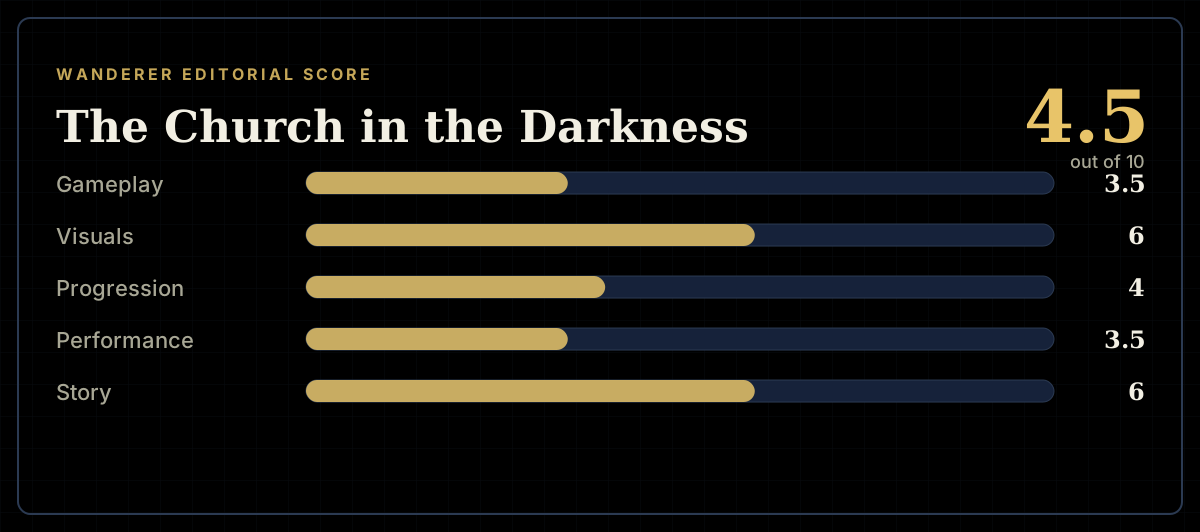
How the review scores each part of the gameWanderer Editorial -
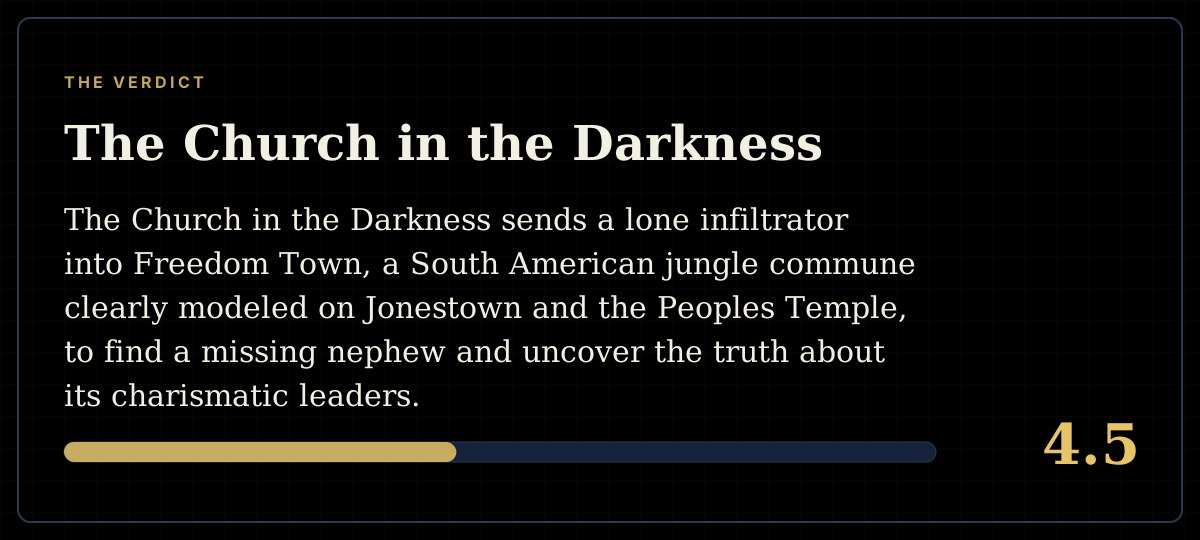
The short versionWanderer Editorial