Game review
Swan Song
7.5 / 10
- Developer
- Business Goose Studios
- Publisher
- Business Goose Studios
- Released
- 4 June 2026
- Platforms
- Windows
- Genre
- Casual, Indie
- Monetisation
- paid
- Players
- false
The short version
Biggest strengths
- An inventive core mechanic, composing melodies from musical notes to physically alter puzzle environments, that reviewers said stays fresh across all 108 puzzles
- A restrained, sensitively written story about family illness and grief that most reviewers found emotionally effective without feeling manipulative
- Handcrafted, colorful isometric presentation and an excellent soundtrack that reviewers consistently praised
Biggest weaknesses
- A notably easy opening stretch, with several reviewers saying the first two to four chapters feel like they're on "autopilot" before real challenge appears
- A vocal minority found the story's emotional beats arrive too quickly relative to the easy early puzzles, describing the pacing as an unearned "gut punch"
- At least two reviewers felt the music-box theming is mostly cosmetic, with the actual puzzle logic amounting to standard move/turn/jump sequencing regardless of the musical dressing
Who it's for: Fans of narrative-driven, low-stress puzzle games in the vein of cozy story adventures, who want a quiet, emotionally serious story and don't need every puzzle to be difficult from the outset
Our recommendation: recommended
7.5 / 10
A music box as both mechanic and metaphor
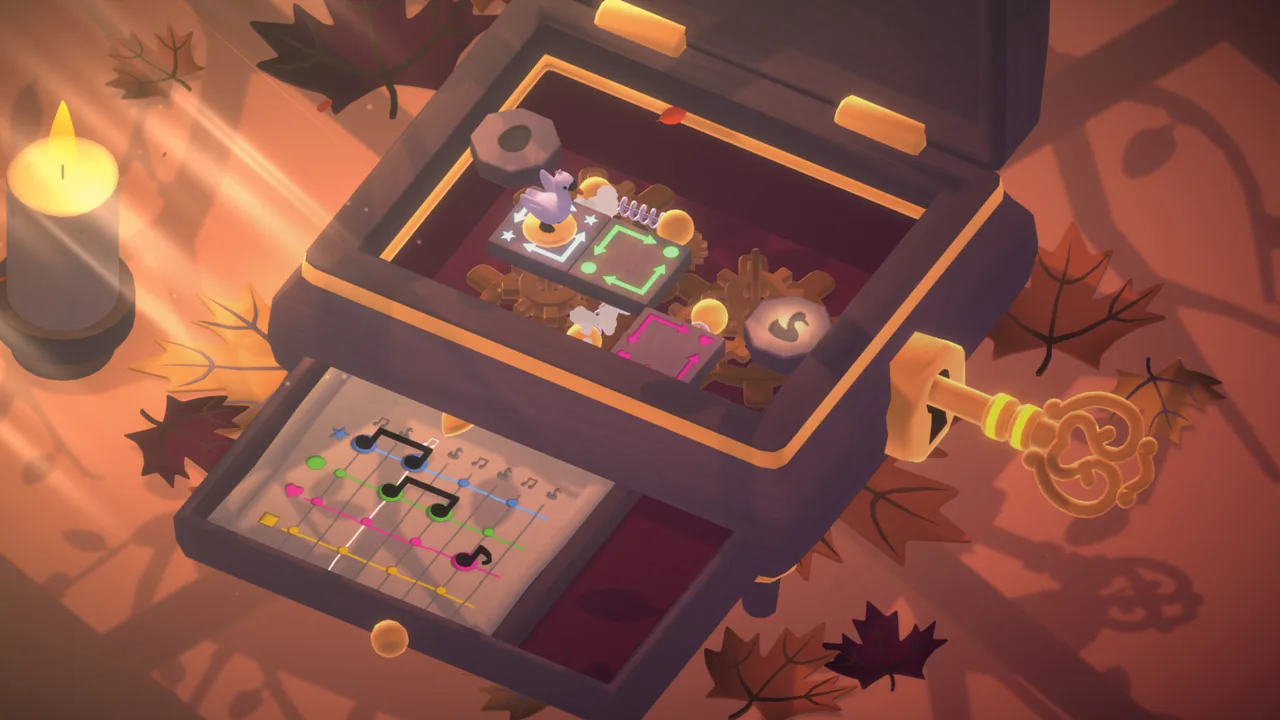
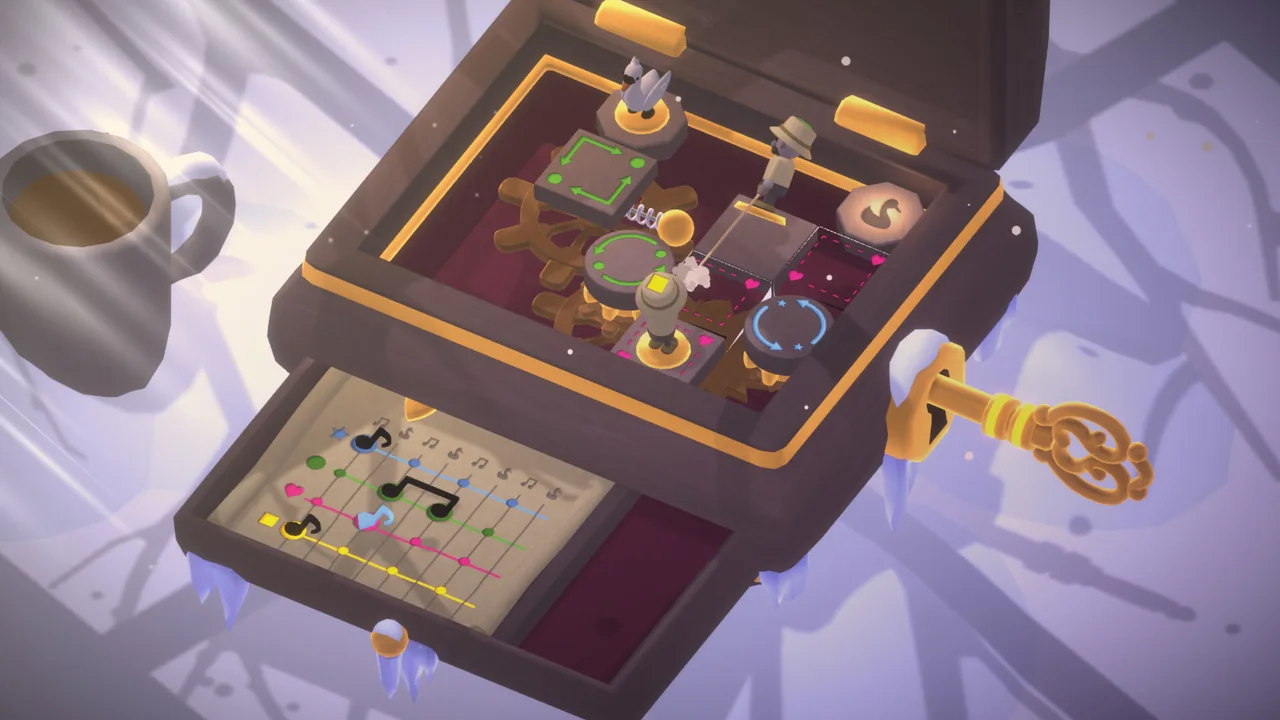
Swan Song sets its 108 puzzles inside an enchanted music box, asking players to guide a small wooden swan to safety by placing musical notes on a scale and turning a key to set the resulting composition in motion. One detailed reviewer laid out why the idea works as more than a gimmick: "The heart of the experience lies in its inventive puzzle design. Players are tasked with arranging musical notes along a scale, effectively composing melodies that alter the environment once the music box is activated. Platforms move, paths emerge, and obstacles shift according to the rhythm of the player's creation." Another reviewer distilled the same appeal more bluntly and memorably: "Swan Song is what would happen if somebody looked at a child's shape sorter puzzle and thought, 'What if this made people really, really sad?'"
A restrained, effective story about loss
Delivered gradually across nine chapters through collectible artifacts and voiced sequences, the game's story follows a family coping with terminal illness and grief. Reviewers consistently praised the writing for avoiding cheap sentimentality. One wrote, "The story tackles difficult subjects, including illness and grief, but it does so with sensitivity and restraint. There is an authenticity to its writing that makes the emotional beats land effectively, particularly because the game never forces sentimentality onto the player. Instead, it trusts the audience to connect the pieces themselves." Another reviewer, who identified personally with the story's themes, wrote, "This cozy and cute game takes you through the before and after of loved ones passing away. In my opinion, Swan Song is a beautiful representation of cherishing the memories of loved ones who have passed, accompanied by cute musical puzzles," adding that they'd since learned the game is based on a true story and that it made them think of their own late grandmother. A third reviewer called the excellent voice acting and quiet music standout elements even in an otherwise mixed review.
An opening stretch several reviewers found too easy
The pool's most consistent criticism concerns pacing, specifically how long it takes for the puzzles to present real challenge. One reviewer wrote, in an otherwise sympathetic, conditionally negative review, "It takes 3-ish chapters of the 9 chapter game to start giving you puzzles that don't feel like you're on autopilot, and while I actually heavily sympathize with the story of the game... I really feel like it was told in an order that lessens the emotional impact." That reviewer elaborated on the specific structural issue: because the first two chapters are extremely easy and immediately introduce the mother's terminal illness, "you don't have enough time to build up a fondness for the characters. It feels cheap, like its trying to gut punch you without winding up." A more sharply critical reviewer used similar language, calling the early puzzles' pairing with heavy subject matter "the thickest past of sadness porn with barely any subtlety," and specifically noted disappointment that "music does not play any role into the gameplay, it is just theming," reducing the puzzles to standard sequencing logic underneath the musical presentation.
Where the difficulty curve does pick up
Notably, even reviewers frustrated by the slow start acknowledged the puzzles improve as the game progresses. The same conditionally negative reviewer wrote, "Halfway through the game I started to like it more and thought the puzzles were okay, but overall I would call the game middling, especially if you are someone who REALLY likes puzzles. If you want a casual puzzle game with a sad story and don't mind it being easy, then its perfect. If you want something more, go look somewhere else tbh." That's a useful, specific framing: the criticism isn't that the puzzles never get interesting, but that a demanding-puzzle audience specifically will likely bounce off the opening hours before the design fully opens up.
Craft that most reviewers found hard to fault
Beyond the story and puzzle design, reviewers were near-unanimous in praising the game's presentation. One wrote, "Presentation is another area where the title excels. Its colorful isometric visuals give the impression of a handcrafted toy world, lending warmth to an otherwise bittersweet story. The environments are varied and detailed, helping each chapter maintain its own identity." Another reviewer specifically highlighted the pacing of new mechanics as a strength rather than a weakness: "Gotta love a simple, self-contained idea that gets progressively taken through a bunch of clever iterations and variations. Games that do this can sometimes get a little tedious if you don't jive with some of the mechanics that are introduced or if they get a little too clever for their own good, but I didn't find that to be the case here at all," directly countering the minority view that the mechanics stay too simple throughout. That same reviewer noted an isolated difficulty spike around chapter five or six before the later chapters settled back into a comfortable rhythm.
Verdict
Swan Song pairs an inventive, well-sustained music-composition puzzle mechanic with a restrained, emotionally honest story about family and loss, and the overwhelming majority of its review pool found that combination genuinely moving. Its most credible criticism, a slow, easy opening stretch that introduces heavy subject matter before players have had time to grow attached to the characters, is worth taking seriously for players who want their puzzle difficulty and emotional weight to escalate together. For anyone drawn to narrative-first, low-stress puzzle games, it's an easy recommendation; players specifically chasing a hard puzzle challenge from the outset should know the real test doesn't arrive until a few chapters in.
Pros and cons
Pros
- An inventive core mechanic, composing melodies from musical notes to physically alter puzzle environments, that reviewers said stays fresh across all 108 puzzles
- A restrained, sensitively written story about family illness and grief that most reviewers found emotionally effective without feeling manipulative
- Handcrafted, colorful isometric presentation and an excellent soundtrack that reviewers consistently praised
- Secret stages and a steady stream of new mechanical twists that keep the puzzle design evolving through all nine chapters
Cons
- A notably easy opening stretch, with several reviewers saying the first two to four chapters feel like they're on "autopilot" before real challenge appears
- A vocal minority found the story's emotional beats arrive too quickly relative to the easy early puzzles, describing the pacing as an unearned "gut punch"
- At least two reviewers felt the music-box theming is mostly cosmetic, with the actual puzzle logic amounting to standard move/turn/jump sequencing regardless of the musical dressing
- Limited difficulty ceiling overall for players specifically seeking a demanding puzzle challenge rather than a narrative-first experience
Screenshots
-
Swan SongImage: Business Goose Studios via Steam -
Swan SongImage: Business Goose Studios via Steam -
Swan SongImage: Business Goose Studios via Steam