
Game review
STICKER/BALL
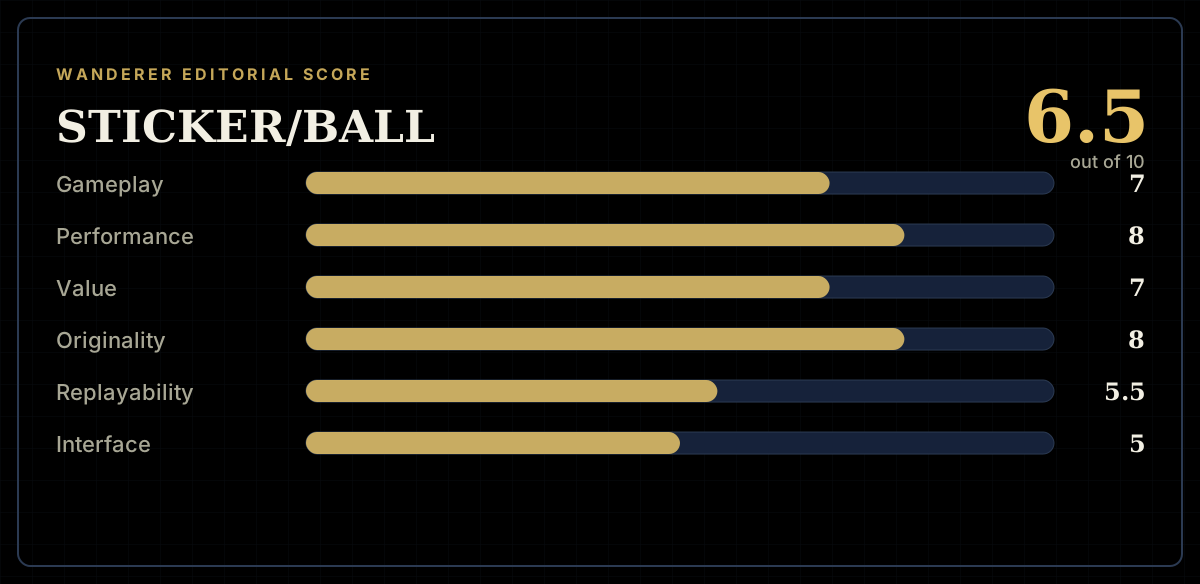
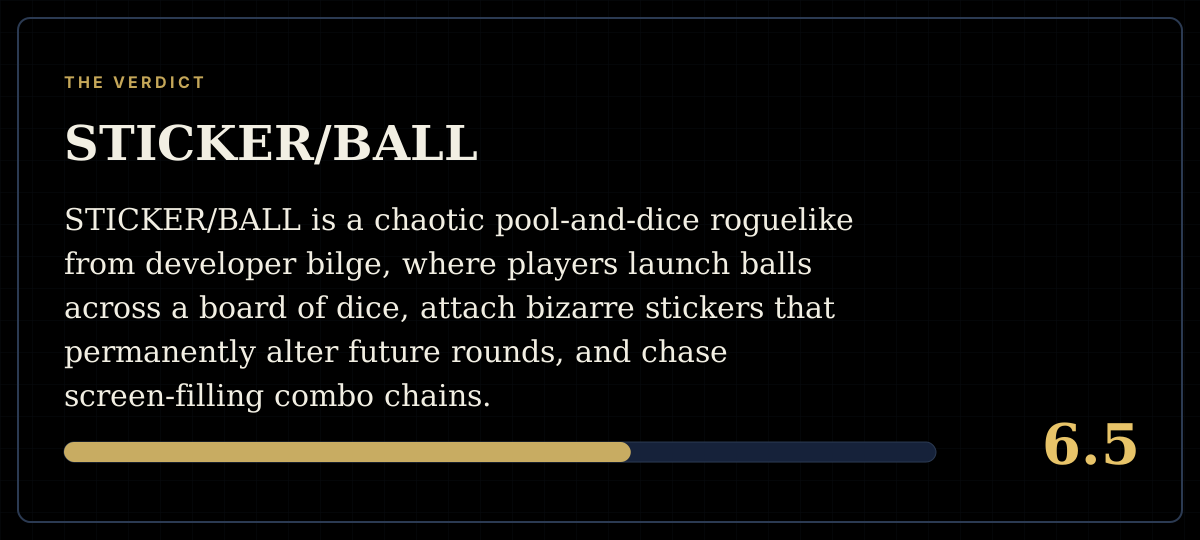
6.5 / 10
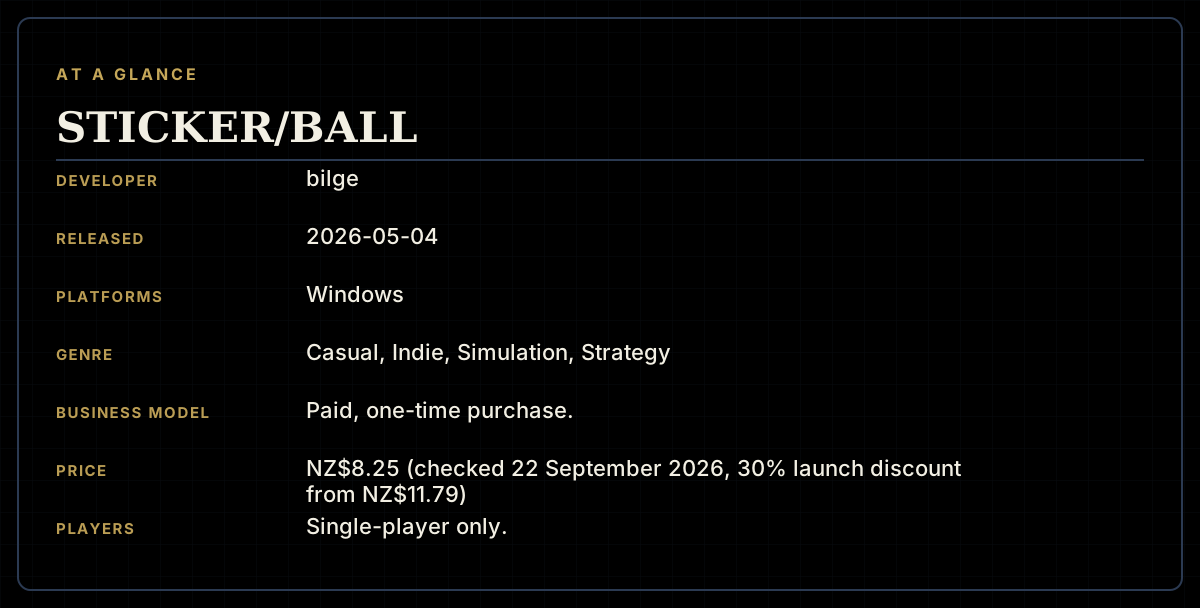
- Developer
- bilge
- Publisher
- Future Friends Games
- Released
- 4 May 2026
- Platforms
- Windows
- Genre
- Casual, Indie, Simulation, Strategy
- Monetisation
- Paid, one-time purchase.
- Players
- Single-player only.
The short version
STICKER/BALL is a chaotic pool-and-dice roguelike from developer bilge, where players launch balls across a board of dice, attach bizarre stickers that permanently alter future rounds, and chase screen-filling combo chains. Its English review sample rates it Very Positive, praising an addictive, overstimulating combo-building loop and distinctive Y2K aesthetic, tempered by fair, corroborated complaints about unclear item descriptions and an overwhelming sticker pool that undermines deliberate build strategy.
Biggest strengths
- Praised repeatedly for a genuinely addictive, dopamine-driven combo-chasing loop, with multiple reviewers describing themselves as unable to put the game down once its systems click.
- Praised for a distinctive Y2K-inspired aesthetic and quirky humour, with reviewers crediting flashy colours, minimalist graphics, and the developer's own playful presence in the game.
- Praised for satisfying sound design and music, with one detailed reviewer specifically crediting how rewarding it feels to pull off a complex sticker-synergy interaction.
Biggest weaknesses
- A fair, corroborated complaint from multiple reviewers is that item descriptions are unclear, leaving players to guess at how stickers interact rather than making informed build decisions.
- A fair, corroborated complaint from several reviewers, including one who compares it directly to Balatro, is that the sheer volume of possible stickers makes deliberately building toward a specific synergy unreliable, especially compared to an earlier, more focused version of the game.
- A fair, corroborated complaint from multiple reviewers is that once its systems are learned, runs become too easy and start to feel repetitive, with several specifically requesting an endless mode or additional run modifiers.
Who it's for: Fans of chaotic, physics-driven roguelikes and combo-building games like Balatro who enjoy discovery-driven, RNG-heavy synergy hunting; players wanting a game that clearly explains its systems, or reliably lets them build toward a specific strategy, should temper expectations.
Our recommendation: An addictive, distinctively styled combo-chaos roguelike, let down by unclear systems and a sticker pool too large for consistent build strategy.
6.5 / 10
Fire balls, hit dice, add stickers, enjoy the chaos
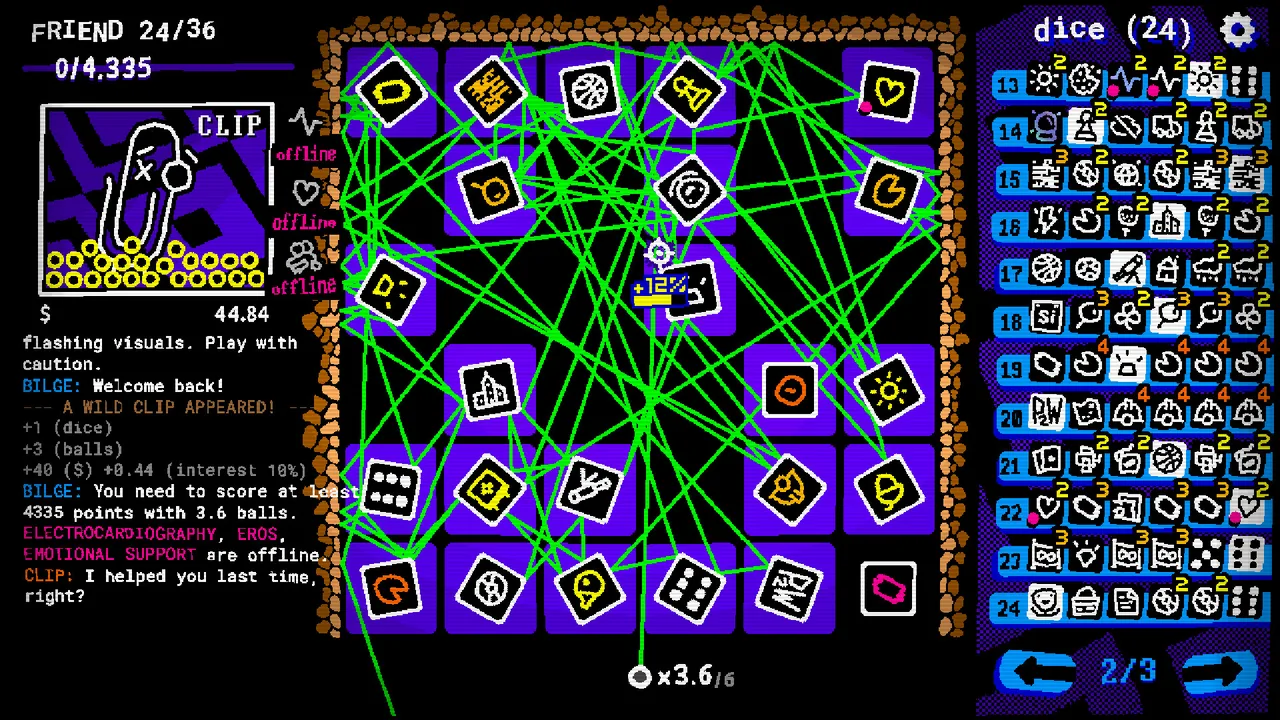
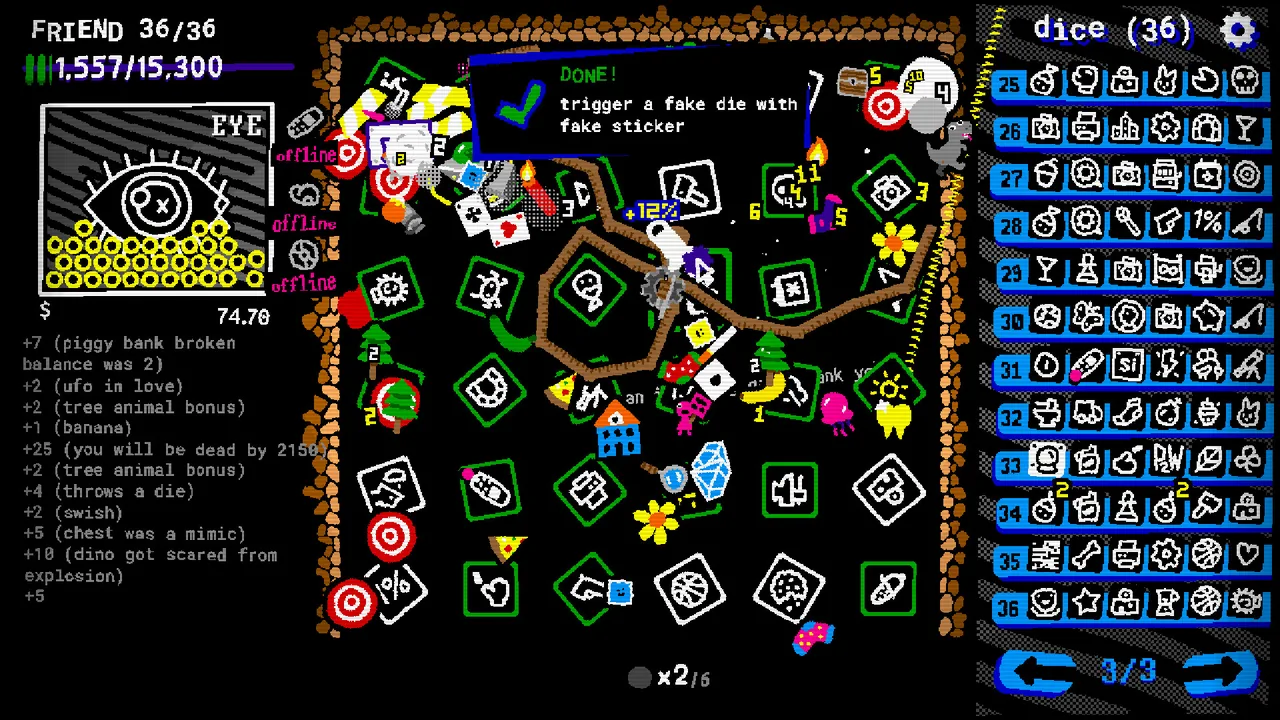
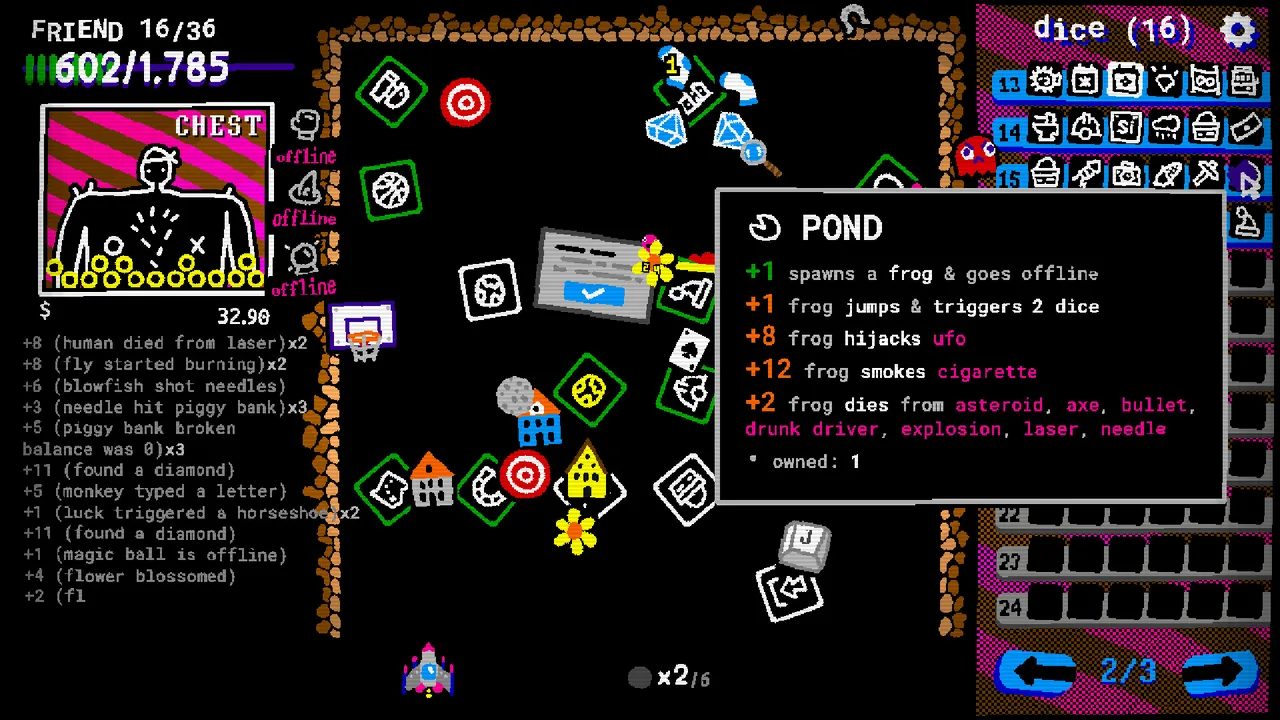
STICKER/BALL is a pool-and-dice roguelike from developer bilge, published by Future Friends Games. Players launch balls across a board scattered with dice, earning points through ricochets and repeated hits, then attach stickers between rounds that permanently modify future turns, some spawning creatures, hazards, or additional projectiles that interact with each other in escalating, chaotic combos. This review draws on an English review sample, 88 reviews at the time of research, rated Very Positive overall.
Praised repeatedly for an addictive, overstimulating combo loop
The sample's most consistent theme is how genuinely compelling the game's escalating chaos becomes once its systems click. "Pure dopamine drip of a game while it lasts. The actual process of learning about different synergies between stickers is a lot of fun," reads one review. A separate reviewer independently reports the same pull despite initial confusion: "I was so damn confused at what the hell to do at first... I'm glad I've stuck with it a little, and have yet to beat this. But the sheer volume of things to do and how you end up snowballing later into a run" kept them hooked. This review treats that convergence as fair and meaningful: multiple reviewers independently describing a steep but rewarding learning curve that ultimately produces a genuinely addictive loop is credible evidence of strong core design, even amid acknowledged confusion.
Praised for a distinctive aesthetic and quirky humour
Reviewers also specifically credit the game's presentation and comic voice. "The aesthetic is absolutely eye candy, it's got that quirky little Early Windows/Y2K style with flashy colors & minimalist graphics... it also has quite a bit of quirky humor as well, even as far as the developer putting himself into the game to help you," reads one review. A separate reviewer independently praises its sound design: "The sound design is extremely satisfying, and the music is delightful." This review treats that as fair: reviewers repeatedly crediting a distinctive visual identity and satisfying audio feedback, on top of the core gameplay, is a credible sign of considered overall craft.
A fair, corroborated complaint about unclear systems and item descriptions
Set against that praise, this review found a specific, recurring complaint about how poorly the game explains itself. "Looks nice and fun, but it's yet another of those games that for some absolutely absurd reason think that not explaining how a game works technically is the same as the fun of discovery. No, figuring out what your sloppy item descriptions actually mean is not fun," reads one detailed review. A separate reviewer independently reports similar confusion: "You probably will be very confused with the item descriptions." This review treats that as fair: multiple reviewers independently identifying unclear or insufficient in-game explanations as a genuine usability problem, not just a personal preference for less hand-holding, is a credible interface complaint.
A fair, corroborated complaint about an overwhelming sticker pool
This review also found a specific, well-qualified complaint from a reviewer with direct experience of an earlier version of the game. "I put tons of hours into it on itch over the last few months and was excited for all the new stuff being added for the full release. Unfortunately, the increase in amount of stickers just feels like it floods the pool too much, removing the ability of putting any sort of 'build' together, which I never had an issue with in the demo," reads that detailed review, which goes on to compare the problem directly to Balatro. A separate reviewer independently reaches a similar conclusion: "The upgrades are a little too random to allow you to make any kind of 'build' consistently." This review treats that as fair and worth flagging directly: a reviewer with a clear before-and-after point of comparison reporting that added content actively undermined deliberate strategy is a credible, specific design concern.
A fair, corroborated complaint about declining challenge and replay value
This review also found a related complaint about the game's longer-term staying power. "Once you get a few runs under your belt, you get a good idea of how to structure what you want to focus on and it becomes way too easy to get consistent wins. I wish there was either an endless mode or maybe some round modifiers," reads one review. This review treats that as fair: a reviewer who otherwise enjoyed the game specifically identifying a lack of difficulty-scaling options as a limit on its long-term replay value is a useful, credible observation for prospective buyers.
Achievement data shows a steep, gradual completion curve
This review's own check of Steam's global achievement data, across 25 tracked milestones, shows a smooth but steep drop-off from an early milestone reached by 38.9% of players down to a long tail of harder achievements sitting below 5%. That gradient is broadly consistent with reviewer accounts of an accessible, quickly graspable early game that becomes meaningfully harder to fully master, though the game's unlabelled achievement names limit how precisely this data can be tied to specific in-game challenges.
Final verdict
STICKER/BALL is an addictive, distinctively styled combo-chaos roguelike that earns real credit for its overstimulating, dopamine-driven core loop and a genuinely memorable Y2K aesthetic backed by satisfying sound design. This review found that praise tempered by fair, corroborated complaints about unclear item descriptions and a sticker pool that several reviewers, including one with direct before-and-after experience, feel has grown too large for deliberate build strategy, plus a related complaint about declining challenge once its systems are learned. For fans of chaotic, discovery-driven roguelikes willing to embrace some confusion, it's a solid recommendation; players wanting clear systems or reliable, buildable strategy should weigh those gaps before buying.
Pros and cons
Pros
- Praised repeatedly for a genuinely addictive, dopamine-driven combo-chasing loop, with multiple reviewers describing themselves as unable to put the game down once its systems click.
- Praised for a distinctive Y2K-inspired aesthetic and quirky humour, with reviewers crediting flashy colours, minimalist graphics, and the developer's own playful presence in the game.
- Praised for satisfying sound design and music, with one detailed reviewer specifically crediting how rewarding it feels to pull off a complex sticker-synergy interaction.
- This review's own check of achievement data shows a smooth, steep completion gradient across 25 tracked milestones, corroborating an accessible early game that gets meaningfully harder to fully master.
Cons
- A fair, corroborated complaint from multiple reviewers is that item descriptions are unclear, leaving players to guess at how stickers interact rather than making informed build decisions.
- A fair, corroborated complaint from several reviewers, including one who compares it directly to Balatro, is that the sheer volume of possible stickers makes deliberately building toward a specific synergy unreliable, especially compared to an earlier, more focused version of the game.
- A fair, corroborated complaint from multiple reviewers is that once its systems are learned, runs become too easy and start to feel repetitive, with several specifically requesting an endless mode or additional run modifiers.
- A fair observation from this review's own assessment is that the overwhelming volume of stickers and effects can make individual runs feel visually and mechanically incomprehensible, even to reviewers who otherwise enjoyed the game.
Screenshots
-
STICKER/BALLImage: Future Friends Games via Steam -
STICKER/BALLImage: Future Friends Games via Steam -
STICKER/BALLImage: Future Friends Games via Steam -
How the review scores each part of the gameWanderer Editorial -
The specs at a glanceWanderer Editorial -
The short versionWanderer Editorial