
Game review
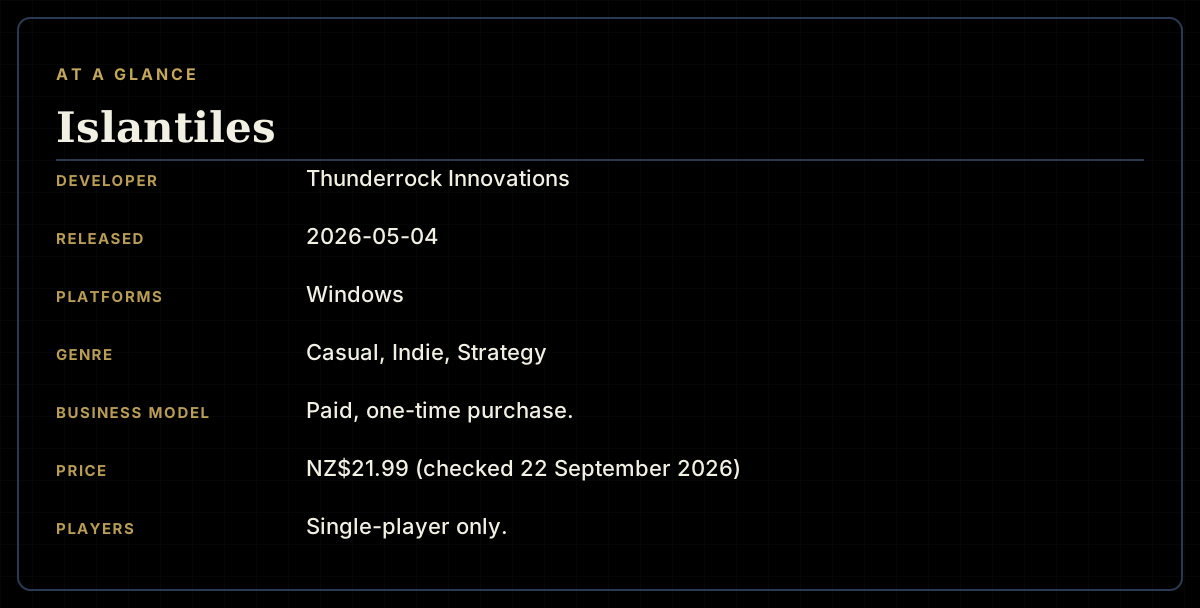
Islantiles
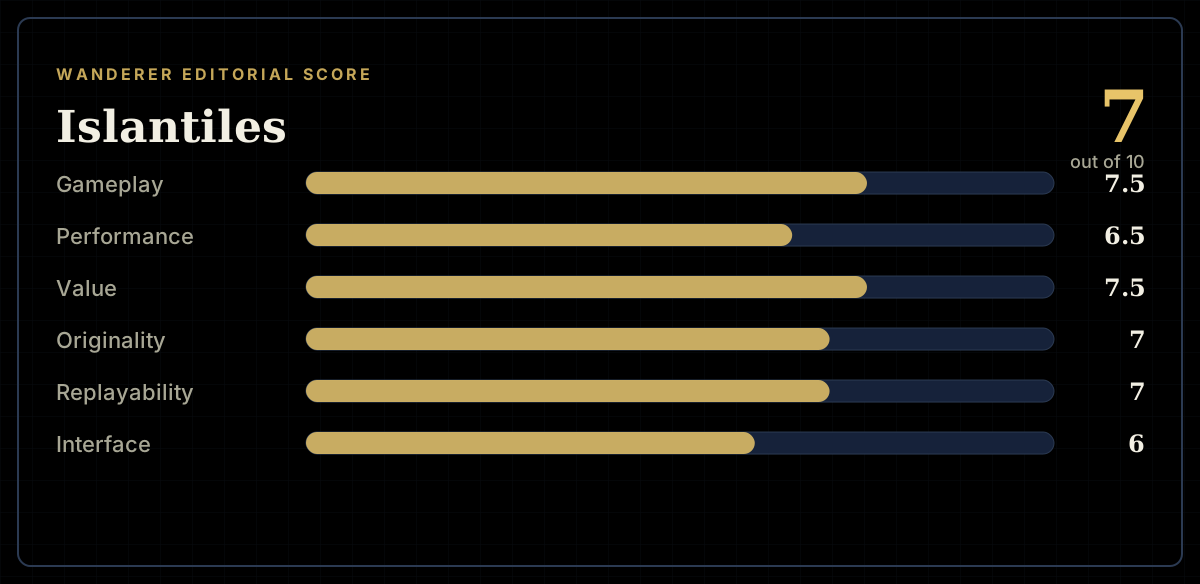
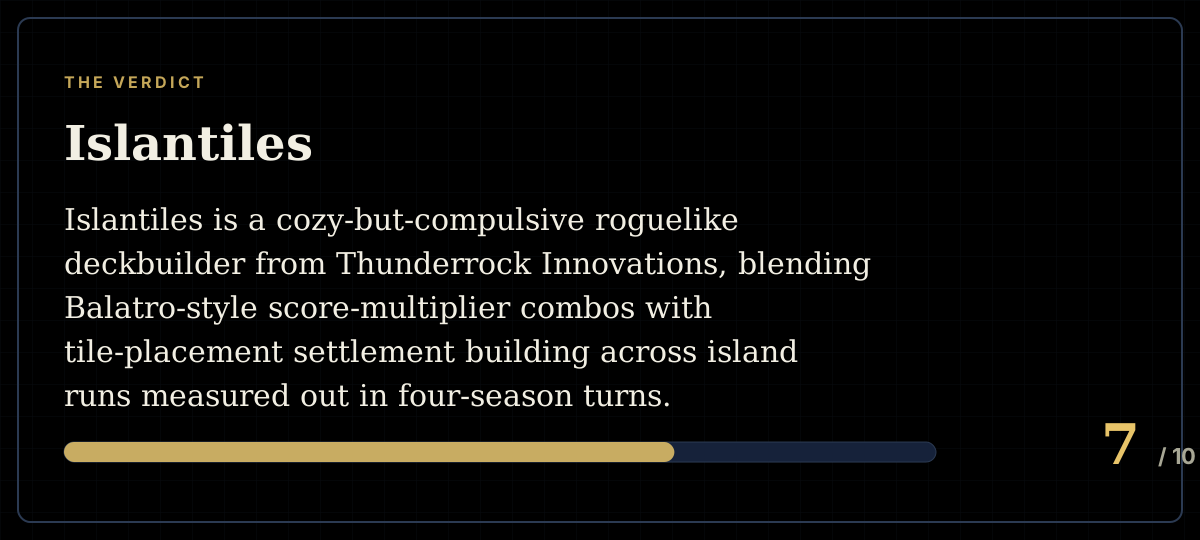
7 / 10
- Developer
- Thunderrock Innovations
- Publisher
- Thunderrock Innovations
- Released
- 4 May 2026
- Platforms
- Windows
- Genre
- Casual, Indie, Strategy
- Monetisation
- Paid, one-time purchase.
- Players
- Single-player only.
The short version
Islantiles is a cozy-but-compulsive roguelike deckbuilder from Thunderrock Innovations, blending Balatro-style score-multiplier combos with tile-placement settlement building across island runs measured out in four-season turns. Its English review sample rates it Positive, praising addicting, deep strategy, tempered by fair, corroborated complaints about score-multiplier balance and unclear scoring rules.
Biggest strengths
- Praised repeatedly for an addicting "one more island" loop, with multiple reviewers logging dozens of hours and describing the blend of tile-placement and combo-building as a fresh, distinctive mix of genres.
- Praised for genuine strategic depth that rewards learning, with reviewers crediting technologies that meaningfully change how you play rather than simply increasing numbers.
- Praised for a responsive developer, with multiple reviewers reporting the team actively listening to feedback and fixing bugs, including a leaderboard submission issue, shortly after being reported.
Biggest weaknesses
- A fair, corroborated complaint from multiple reviewers is that score-multiplier balance is uneven, with runs feeling too similar as players are funnelled toward the same small set of dominant multiplier strategies, with one reviewer describing it as still feeling like it "hasn't really been balanced yet."
- A fair, corroborated complaint from multiple reviewers is that the scoring system and season goals aren't explained clearly enough, leaving players unsure how specific mechanics interact.
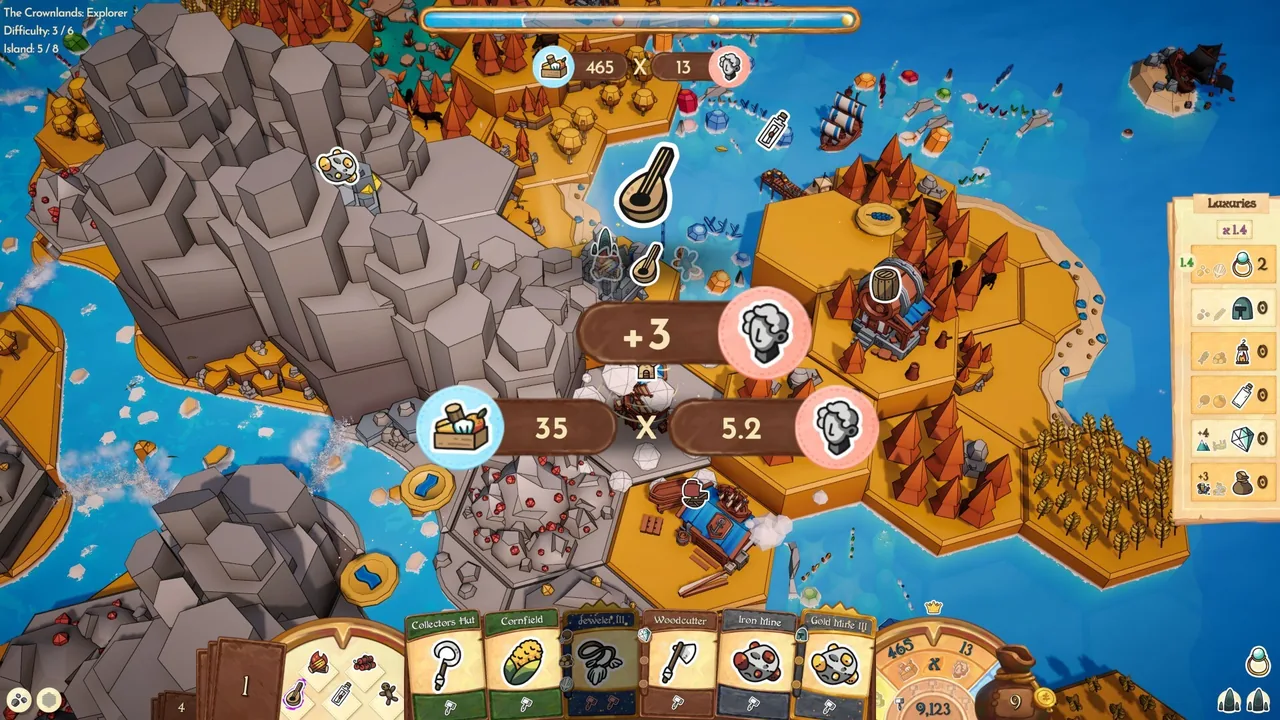
- A fair, corroborated complaint from two reviewers is that visual clarity suffers amid the game's art and icons, making it harder than it should be to read available resources at a glance.
Who it's for: Fans of roguelike deckbuilders like Balatro and cozy tile-placement games like Dorfromantik or Islanders looking for a bite-sized blend of the two with genuine long-term depth; players wanting a fully balanced, clearly explained experience at launch should temper expectations.
Our recommendation: An addicting, genuinely deep cozy roguelike deckbuilder, let down by score-multiplier balance issues and unclear scoring rules.
7 / 10
Cozy tile-placement meets combo-chasing roguelike
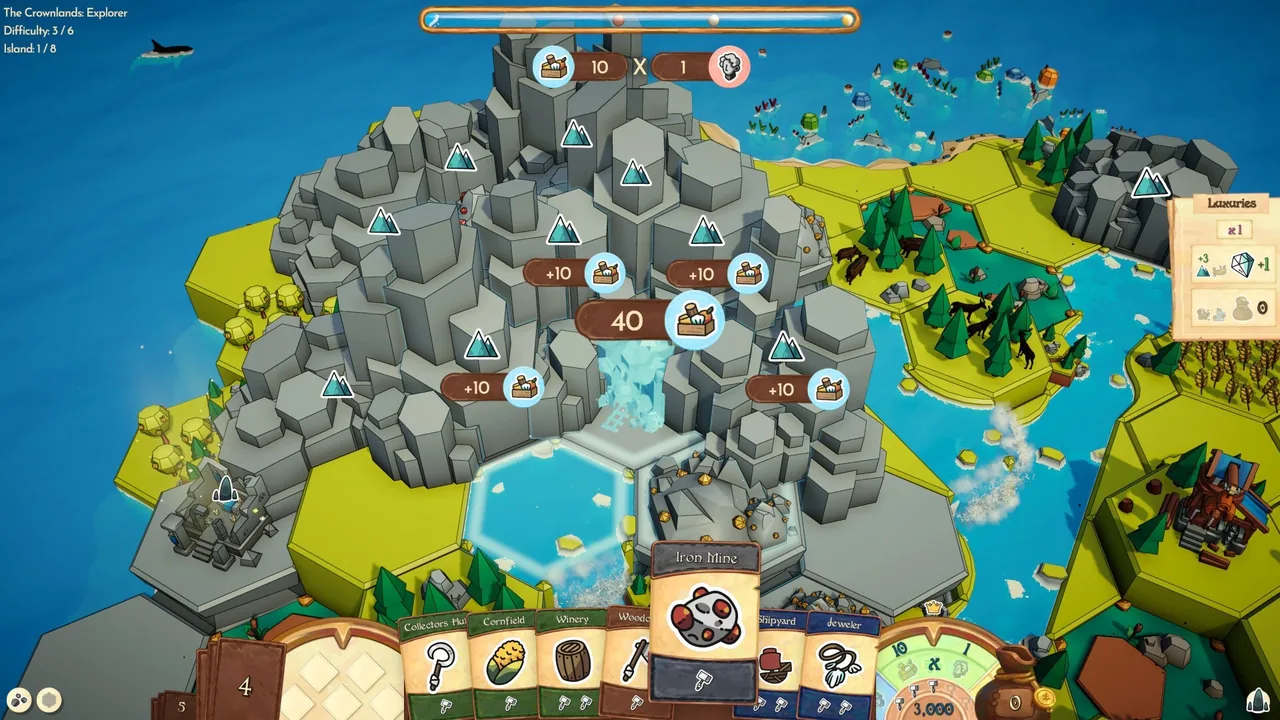
Islantiles is a roguelike deckbuilder from Thunderrock Innovations that fuses Balatro-style score-multiplier combos with tile-placement settlement building. Players place technology cards onto islands to gather resources, combine them into luxury goods for score multipliers, and race to hit a target score within four seasons before unlocking new civilizations, technologies, and difficulty tiers for future runs. This review draws on an English review sample, 38 reviews at the time of research, rated Positive overall.
Praised repeatedly for an addicting core loop
The sample's most consistent theme is how compulsively playable reviewers find the run-to-run loop. "Islantiles nails that rare sweet spot between relaxing and genuinely strategic. You start with one simple technology... and before you know it you're deep in a web of combos and synergies," reads one review. A separate reviewer independently reports losing hours to it: "Fantastic game. It takes a quick bit to grok what is going on, but this is one addicting deck builder... I still really suck, but I'm having a blast sucking and trying to get better scores," logging almost 12 hours in a single sitting. A third reviewer, with over 35 hours played across multiple difficulty tiers, independently confirms the same pull: "It's a pretty nice game, and it has plenty of replay value." This review treats that convergence as fair and meaningful: reviewers independently logging many hours while describing the same "one more island" pull is credible evidence of a genuinely compelling core loop.
Praised for genuine strategic depth
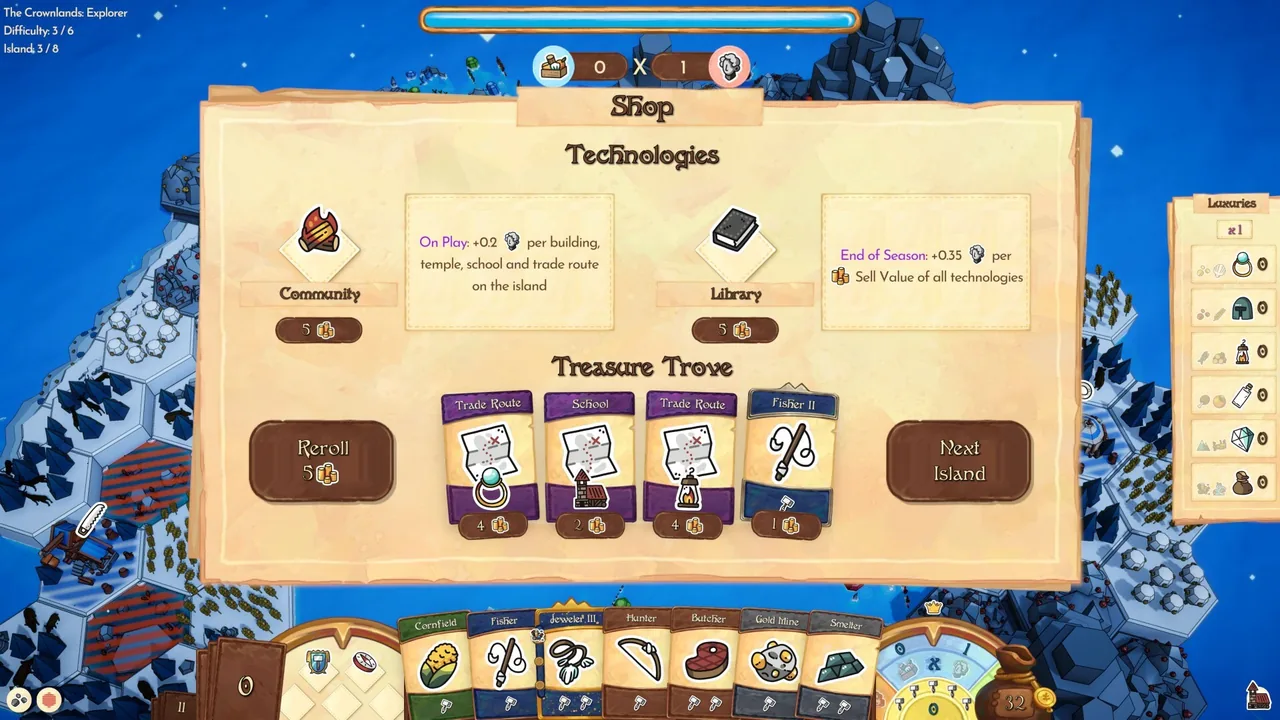
Reviewers also specifically credit how meaningfully the game's systems evolve as you unlock more of them. "The minimalist art is cute and gorgeous and the way technologies don't just increase the numbers but actually change the way you play keeps every run feeling fresh," reads one review. A separate reviewer independently agrees, despite being new to the genre: "The complexity, strategies and variations of every run make the game really fun; it gives nice replayability. I'm nowhere near to understand what strategies are the most efficient, but that's the charm of the game." This review treats that as fair: reviewers repeatedly crediting technologies that qualitatively change strategy, rather than simple numerical upgrades, as a genuine source of long-term depth.
Praised for a responsive developer
This review also found specific, credible praise for the developer's post-launch support. "The devs listen to feedback, are very friendly and really take care of their game," reads one review. A separate reviewer independently confirms a specific fix: "Something is wrong with the high score not submitting to the leader boards, but hopefully the developers will figure that out. [Update] After much persistence on their and my parts, the developers have fixed the high score bug. It works fine now." This review treats that as fair: a reviewer's own before-and-after account of a specific bug being fixed is credible, direct evidence of active developer support.
A fair, corroborated complaint about score-multiplier balance
Set against that praise, this review found a specific, recurring complaint about how the game's difficulty and strategy are currently balanced. "Like Balatro, though, you will be unable to complete the game if you don't find a multiplicative score multiplier quickly... Each run, therefore, feels a little too similar: find a multiplier, and upgrade the one card that feeds into that multiplier," reads one detailed review, which goes on to say "the game feels Early Access - like it hasn't really been balanced yet." A separate reviewer independently reports a related frustration with the game's island variety: "The game clearly doesn't randomly generate the islands... that does mean that the number of island 'shapes' you will get is limited." This review treats that as fair: multiple reviewers, including one with dozens of hours invested, independently identifying the same funnelling toward a narrow set of dominant strategies is a credible, corroborated balance complaint, even though Steam's own listing does not classify this as an Early Access release.
A fair, corroborated complaint about unclear scoring rules
This review also found a related complaint about how well the game explains itself. "It feels like the rules are not explained well in the scoring system. I feel like I am often trying to figure out how to reach season goals and find myself often having questions of how things interact with a lack of explanation," reads one review. A separate reviewer independently reports similar visual clarity issues: "It can be hard to see all the resources with the art and the icons everywhere." This review treats that as fair: multiple reviewers independently identifying unclear rules explanation and visual clutter as genuine friction points is a credible, corroborated interface complaint.
Achievement data corroborates deep, long-term difficulty scaling
This review's own check of Steam's global achievement data, across 20 tracked milestones, shows 86.1% of players beating the easiest island but only 0.6% and 0.5% clearing the hardest difficulty tiers of its two advanced modes, with the highest score milestone and full technology completion both sitting at effectively 0%. That steep gradient is consistent with reviewer accounts of a deceptively cozy-looking game that hides genuinely demanding, long-term mastery goals beneath its relaxing surface.
Final verdict
Islantiles is a genuinely addicting cozy roguelike deckbuilder that earns real credit for blending Balatro-style combo-chasing with tile-placement settlement building into something that feels fresh rather than derivative, backed by a responsive developer actively fixing issues after launch. This review found that praise tempered by fair, corroborated complaints about score-multiplier balance funnelling runs toward similar strategies, and unclear scoring rules that leave some season goals feeling opaque. For fans of roguelike deckbuilders and cozy tile-placement games alike looking for a fresh combination of the two, it's a strong recommendation; players wanting a fully polished, clearly explained experience should weigh those rough edges before buying.
Pros and cons
Pros
- Praised repeatedly for an addicting "one more island" loop, with multiple reviewers logging dozens of hours and describing the blend of tile-placement and combo-building as a fresh, distinctive mix of genres.
- Praised for genuine strategic depth that rewards learning, with reviewers crediting technologies that meaningfully change how you play rather than simply increasing numbers.
- Praised for a responsive developer, with multiple reviewers reporting the team actively listening to feedback and fixing bugs, including a leaderboard submission issue, shortly after being reported.
- This review's own check of achievement data shows a steep drop-off across escalating difficulty tiers, corroborating reviewer accounts of a deceptively challenging, deeply scaling roguelike beneath its cozy surface.
Cons
- A fair, corroborated complaint from multiple reviewers is that score-multiplier balance is uneven, with runs feeling too similar as players are funnelled toward the same small set of dominant multiplier strategies, with one reviewer describing it as still feeling like it "hasn't really been balanced yet."
- A fair, corroborated complaint from multiple reviewers is that the scoring system and season goals aren't explained clearly enough, leaving players unsure how specific mechanics interact.
- A fair, corroborated complaint from two reviewers is that visual clarity suffers amid the game's art and icons, making it harder than it should be to read available resources at a glance.
- This review's own check of achievement data shows the game's highest score milestones and full technology completion sitting at effectively 0%, suggesting very long-term mastery goals that only the most dedicated players will ever reach.
Screenshots
-
IslantilesImage: Thunderrock Innovations via Steam -
IslantilesImage: Thunderrock Innovations via Steam -
IslantilesImage: Thunderrock Innovations via Steam -
How the review scores each part of the gameWanderer Editorial -
The specs at a glanceWanderer Editorial -
The short versionWanderer Editorial