
Game review
Sparky's Escape
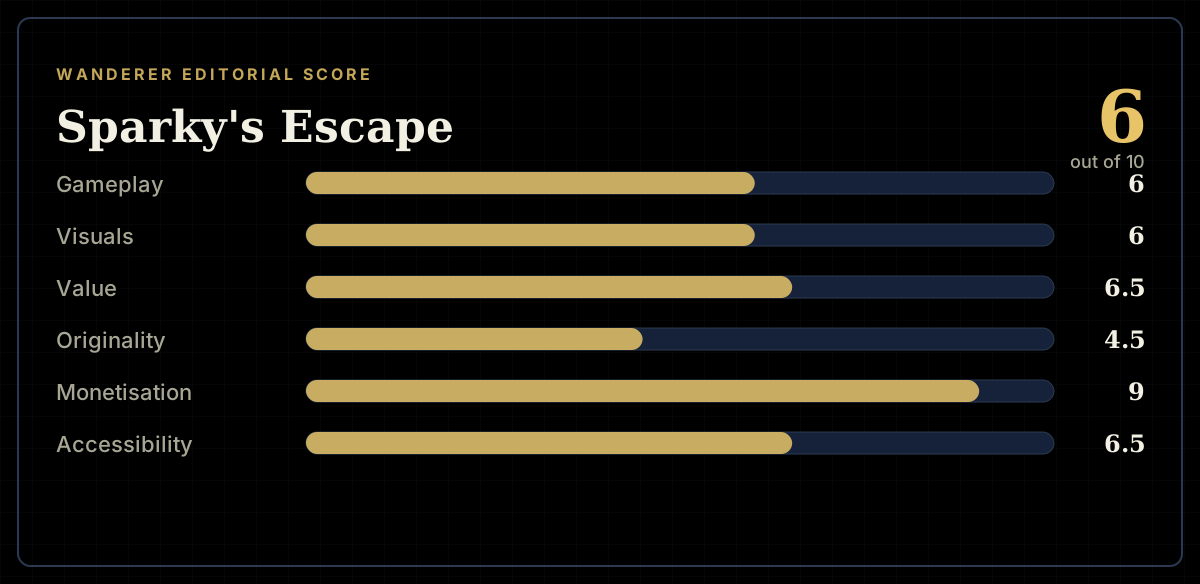
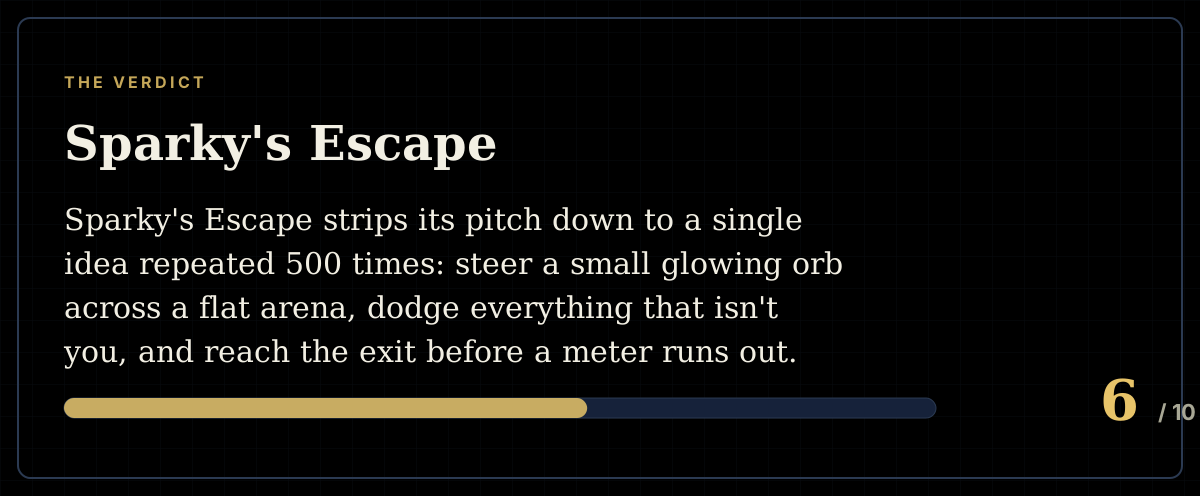
6 / 10
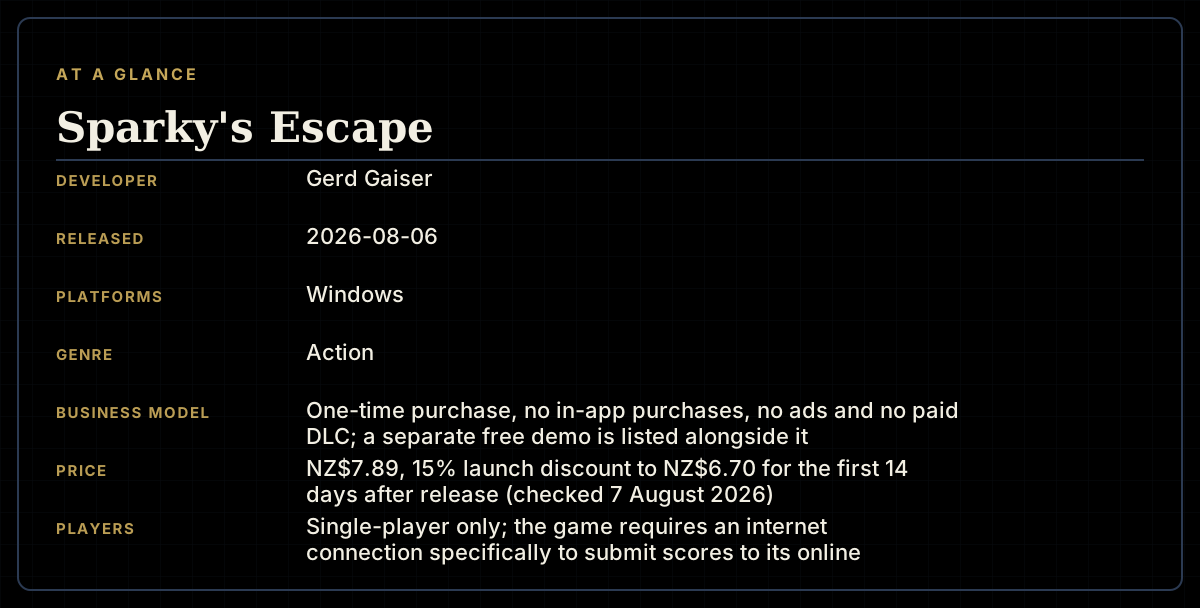
- Developer
- Gerd Gaiser
- Publisher
- Gerd Gaiser
- Released
- 6 August 2026
- Platforms
- Windows
- Genre
- Action
- Monetisation
- One-time purchase, no in-app purchases, no ads and no paid DLC; a separate free demo is listed alongside it
- Players
- Single-player only; the game requires an internet connection specifically to submit scores to its online Hall of Fame leaderboard
The short version
Sparky's Escape strips its pitch down to a single idea repeated 500 times: steer a small glowing orb across a flat arena, dodge everything that isn't you, and reach the exit before a meter runs out. It's an old arcade shape — closer to a modern take on a bullet-dodging avoider than anything narrative — executed by a solo German developer who put a free public demo out almost a month before launch, which is more real-world testing than most day-one indie releases get. What it doesn't have yet is any outside confirmation that the 500 levels and the harder Hell Mode actually hold together under pressure: Steam shows zero user reviews and no press coverage at the time of writing, so everything here is read from the store page, the developer's own patch history, and the screenshots themselves rather than from anyone who has judged it.
Biggest strengths
- A free playable demo was live for roughly four weeks before launch, which is a real pre-release testing step most solo indie releases skip entirely
- Clean one-time pricing with no in-app purchases, no ads and no paid DLC listed anywhere on the store page
- Full controller support, including a specific "Playable without Timed Input" accessibility category on the store listing itself, unusual for a game marketed around split-second reflexes
Biggest weaknesses
- Zero Steam user reviews and no press coverage exist at the time of writing, so nothing about difficulty balance, level variety or bugs has been checked by anyone outside the developer
- No Steam achievements at all, an odd absence for a game whose entire structure is levels, a score counter and an online Hall of Fame that would normally pair with a completion ladder
- Requires an internet connection purely to post scores to the leaderboard, adding always-online friction to what is otherwise a single-player offline-shaped game
Who it's for: Score-attack and reflex-arcade players who like short, replayable dodge-and-survive loops such as classic avoider games, and who are comfortable buying on a demo and a clean one-time price rather than a track record.
Our recommendation: The free demo removes most of the risk here, so try that first; the full game's price is low enough that the main open question isn't value, it's whether 500 levels of one mechanic stay interesting without the achievement structure or leaderboard depth a game built around score-chasing usually leans on.
6 / 10
Sparky's Escape reduces itself to one sentence on its own store page: guide a small character named Sparky safely through a time portal while everything else on screen tries to stop that from happening. There's no story beyond that single line, no dialogue system, no menu of complicated options to learn before the first level loads. It's a shape genre veterans will recognize instantly — a top-down avoider where the whole game is reading a cluttered field of hazards fast enough to thread a path through it — done by a solo German developer, Gerd Gaiser, working under the small-studio name TripleG Games. What separates this launch from a lot of one-person day-one releases isn't the concept, which is deliberately plain, but the fact that a free public demo of the game was already live on Steam for about a month before the full release went up. That's a real pre-launch testing window most solo developers skip, and it's the strongest piece of evidence available that this wasn't rushed out untested.
The dodge, the orb, and what the screenshots actually show
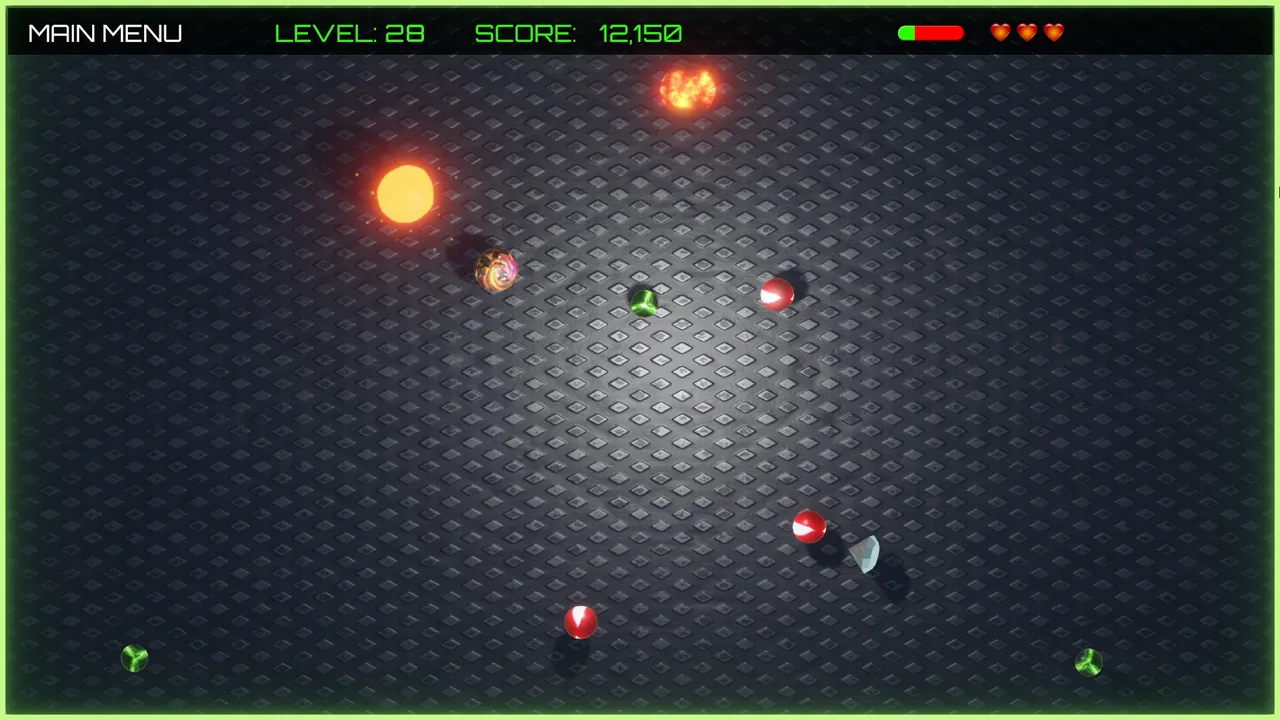
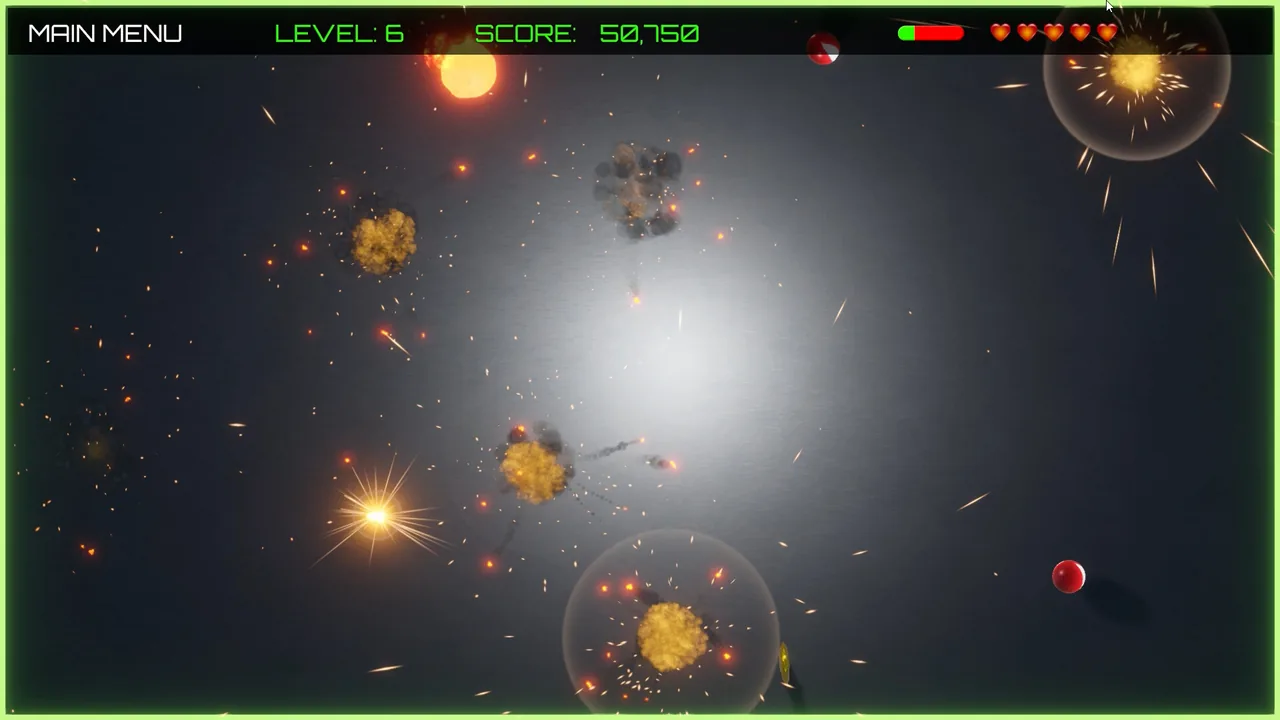
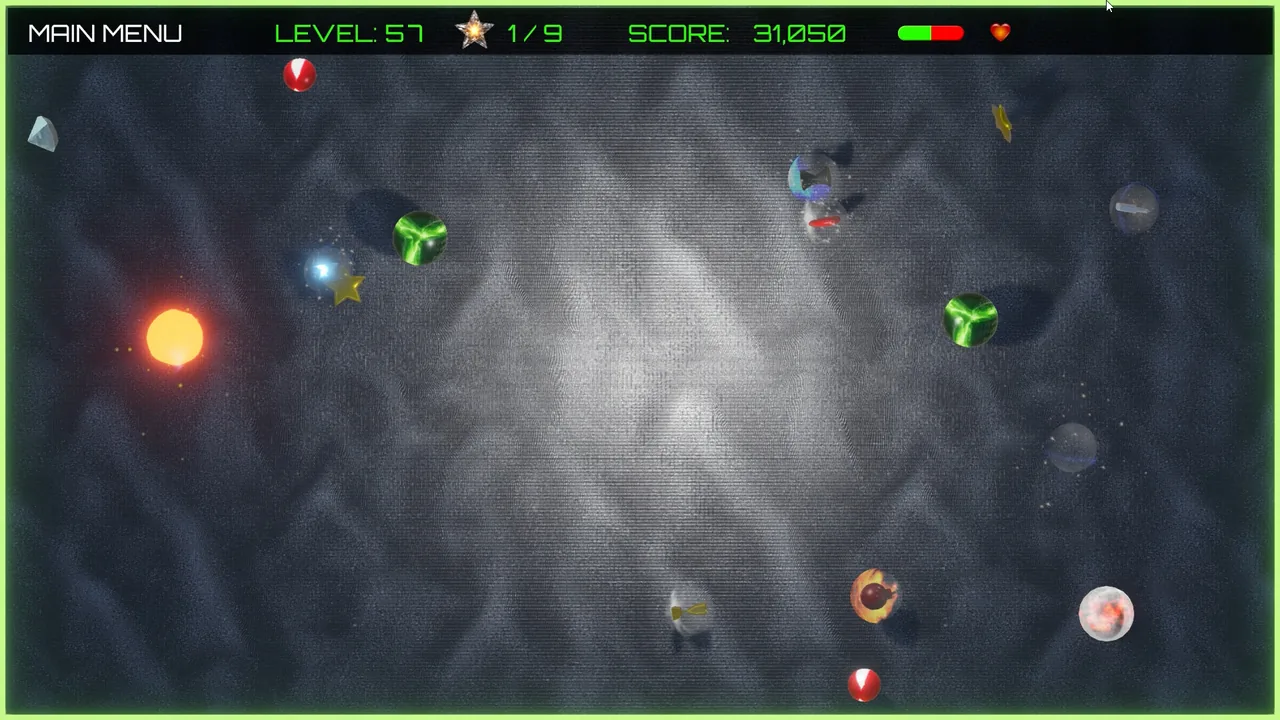
The store's own screenshots are the clearest source of information available before any outside player has weighed in, and they're consistent with each other: a flat, diamond-plate metal arena viewed from directly above, populated with glossy 3D spheres in a handful of readable colors. A green, lightning-textured orb — almost certainly Sparky, or the pickup Sparky is built around, given the character's namesake — sits distinct from red-and-white striped balls that read as mobile hazards, glowing orange spheres that behave like stationary fire hazards, and small crystalline shapes scattered as obstacles. A top bar tracks level number, score and a row of heart icons that varies in count between screenshots, suggesting lives or hit points that scale with progress or power-ups collected. It's a legible visual language in the calmer shots. In one screenshot clearly captured mid-explosion, though, the same arena fills with fire, smoke and debris particles thick enough to genuinely compete with the hazards themselves for the player's attention — worth knowing going in if what you want from an arcade dodge game is clean sightlines under pressure, since at least some of Sparky's Escape is deliberately not that.
Content structure and the achievement gap
Five hundred hand-built levels is a real number, not a marketing rounding-up of a level generator's theoretical output, and the store page frames Hell Mode explicitly as a separate, harder way to replay the same content rather than just a late-game difficulty spike. Paired with an online score leaderboard — the "Hall of Fame" — that's a structure built for players who like chasing a number across hundreds of short attempts rather than clearing content once and moving on. What's missing is the piece that usually reinforces exactly that kind of structure: Sparky's Escape ships with no Steam achievements at all. Games built around repeated short runs and a public leaderboard typically pair that with a completion ladder — clean-run badges, milestone counts, per-level challenges — and the total absence of one here is a genuine, checkable gap rather than a stylistic choice the store page explains.
Pricing, platform and the online requirement
At NZ$7.89, currently discounted 15% to NZ$6.70 for the first two weeks after launch, the asking price sits comfortably in small-indie territory, and the business model around it is about as clean as this library sees: one purchase, no in-app store, no advertising, no paid DLC anywhere on the listing. The free demo removes most of the remaining risk, since anyone unsure whether the dodge-and-collect loop feels good under their own hands can find out before spending anything. Two limitations are worth flagging plainly. The game is Windows-only, with no Mac or Linux build listed anywhere in its system requirements. And despite being built and marketed as a solo single-player experience, it requires an internet connection specifically to submit runs to its online leaderboard — a small but real piece of always-online friction bolted onto a game that otherwise has no multiplayer or social component to justify it.
One smaller detail is worth a mention less for its weight than for what it says about polish: the store page's own key-features section refers to the game as "Spark's Escape," missing the y, consistently across multiple sentences, despite the storefront listing and character both using "Sparky." It doesn't affect anything about how the game plays, but it's the kind of proofreading slip that suggests the store copy didn't get quite the same attention as the four weeks of public demo testing did.
Final verdict
Sparky's Escape isn't trying to reinvent the dodge-'em-up, and it doesn't claim to on its own store page. What it offers instead is a workmanlike execution of an old idea, backed by real pre-release testing, an unusually clean monetisation model for a paid arcade game, and a genuine accessibility option — full controller support alongside a listed "Playable without Timed Input" category — that a game built around split-second reactions didn't have to include. What keeps the score from climbing further is that none of the actual level design, difficulty curve or Hell Mode balance has been tested by anyone but the developer and his demo players yet, and the absence of any achievement structure is a real, avoidable gap in a game whose whole design is built around replaying short levels for score.
If you already know you like the classic avoider-arcade shape, the demo is the right place to start, and the full price is low enough that a good demo experience should settle the purchase decision on its own. Everyone else should give it a week or two and see what the first wave of user reviews says about whether 500 levels stays interesting for that long.
Pros and cons
Pros
- A free playable demo was live for roughly four weeks before launch, which is a real pre-release testing step most solo indie releases skip entirely
- Clean one-time pricing with no in-app purchases, no ads and no paid DLC listed anywhere on the store page
- Full controller support, including a specific "Playable without Timed Input" accessibility category on the store listing itself, unusual for a game marketed around split-second reflexes
- 500 hand-built levels plus a separate, explicitly harder Hell Mode gives the score-attack loop real breadth on paper before a single review has weighed in
- Store screenshots show a consistently legible top-down layout, with the player's spark-textured green orb reading clearly against duller hazard shapes even in busier scenes
Cons
- Zero Steam user reviews and no press coverage exist at the time of writing, so nothing about difficulty balance, level variety or bugs has been checked by anyone outside the developer
- No Steam achievements at all, an odd absence for a game whose entire structure is levels, a score counter and an online Hall of Fame that would normally pair with a completion ladder
- Requires an internet connection purely to post scores to the leaderboard, adding always-online friction to what is otherwise a single-player offline-shaped game
- Windows only, with no Mac or Linux build listed
- The store page's own description text repeatedly calls the game "Spark's Escape," dropping the y from its own title throughout the key features section, a small but real proofreading lapse
- The core loop — dodge hazards, collect power-ups, reach an exit — is a well-worn arcade formula, and nothing in the public material demonstrates a distinct mechanical hook beyond volume of content and execution
Screenshots
-
Sparky's EscapeImage: Gerd Gaiser via Steam -
Sparky's EscapeImage: Gerd Gaiser via Steam -
Sparky's EscapeImage: Gerd Gaiser via Steam -
How the review scores each part of the gameWanderer Editorial -
The game at a glanceWanderer Editorial -
The short versionWanderer Editorial