
Game review
SPACEPLAN
8 / 10
- Developer
- Jake Hollands
- Publisher
- Devolver Digital
- Released
- 3 May 2017
- Platforms
- Windows, macOS, iOS, Android
- Genre
- Incremental
- Monetisation
- One-off paid download on every platform, no ads and nothing sold inside; an optional soundtrack DLC is the only add-on
- Players
- Single-player
The short version
SPACEPLAN uses the idle genre's core trick — a resource that fills while you're not looking — as a metronome for a story rather than a hook to keep you opening the app. Every new timer, every slow-charging battery, exists to make you wait exactly long enough for the next line of dialogue to land, and the whole thing is built toward a real ending rather than an infinite tail.
It's also over quickly, has nothing to do once the credits roll, and asks almost nothing of you mechanically beyond patience and the occasional click. At the price it charges, none of that reads as a complaint.
Biggest strengths
- The idle timers are tuned to the pace of the writing, not the other way around, so waiting never feels like a wall
- The potato-power premise stays consistently, specifically silly instead of leaning on one joke twice
- Logan Gabriel's soundtrack does real work signalling when a story beat is about to land
Biggest weaknesses
- Once you've clicked through the resource loop once, there is nothing pulling you back for a second run
- The mechanical layer underneath the writing is thin even by clicker standards, and it knows it
- A handful of stretches ask you to sit and wait with nothing new to read, which tests patience the writing hasn't earned yet
Who it's for: Incremental fans who want a clicker with a beginning, middle and end; anyone curious what an idle game looks like when the timers exist to serve a joke instead of a business model.
Our recommendation: Play it in a couple of sittings rather than one long session — the pacing rewards letting the timers actually run out between check-ins. It works fine on a phone in short bursts, but the writing lands a little better with the sound on and a screen you're not glancing at between other apps.
8 / 10
Most idle games treat the wait as a leash. You start a timer, you close the tab or the app, and the whole design exists to get you to open it again later — a notification, a login streak, a reason to keep the number climbing indefinitely. SPACEPLAN starts from the same mechanical building blocks as every clicker on Steam and points them at a completely different job. Here, the timer you're staring at is doing narrative pacing. It's making you wait the length of one paragraph, or one joke, before the next line arrives. That's a small distinction on paper and a genuinely unusual one in practice, and it's the reason a three-hour potato-themed clicker built by one designer in his spare time is still worth talking about most of a decade after Devolver Digital put it on Steam.
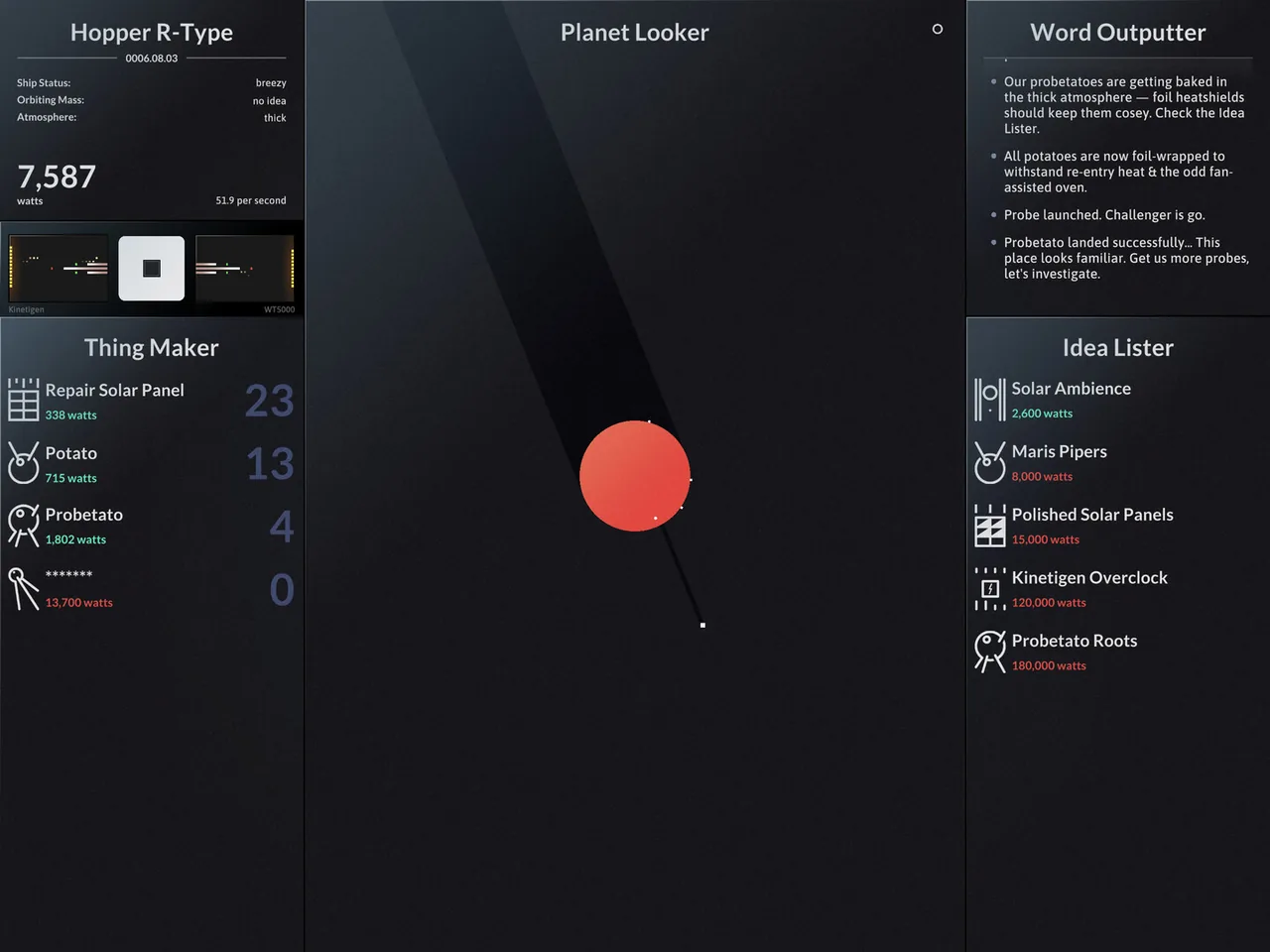
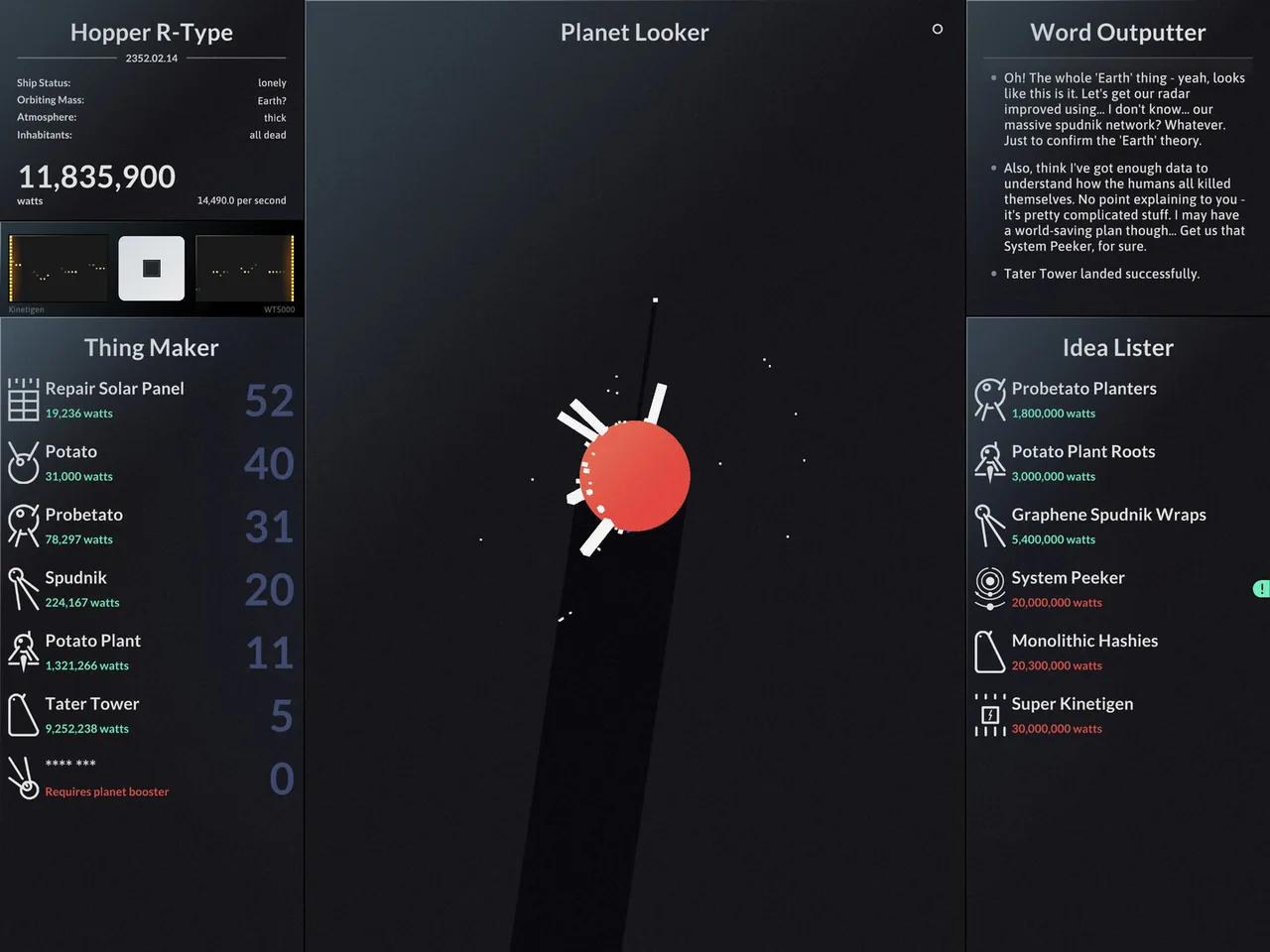
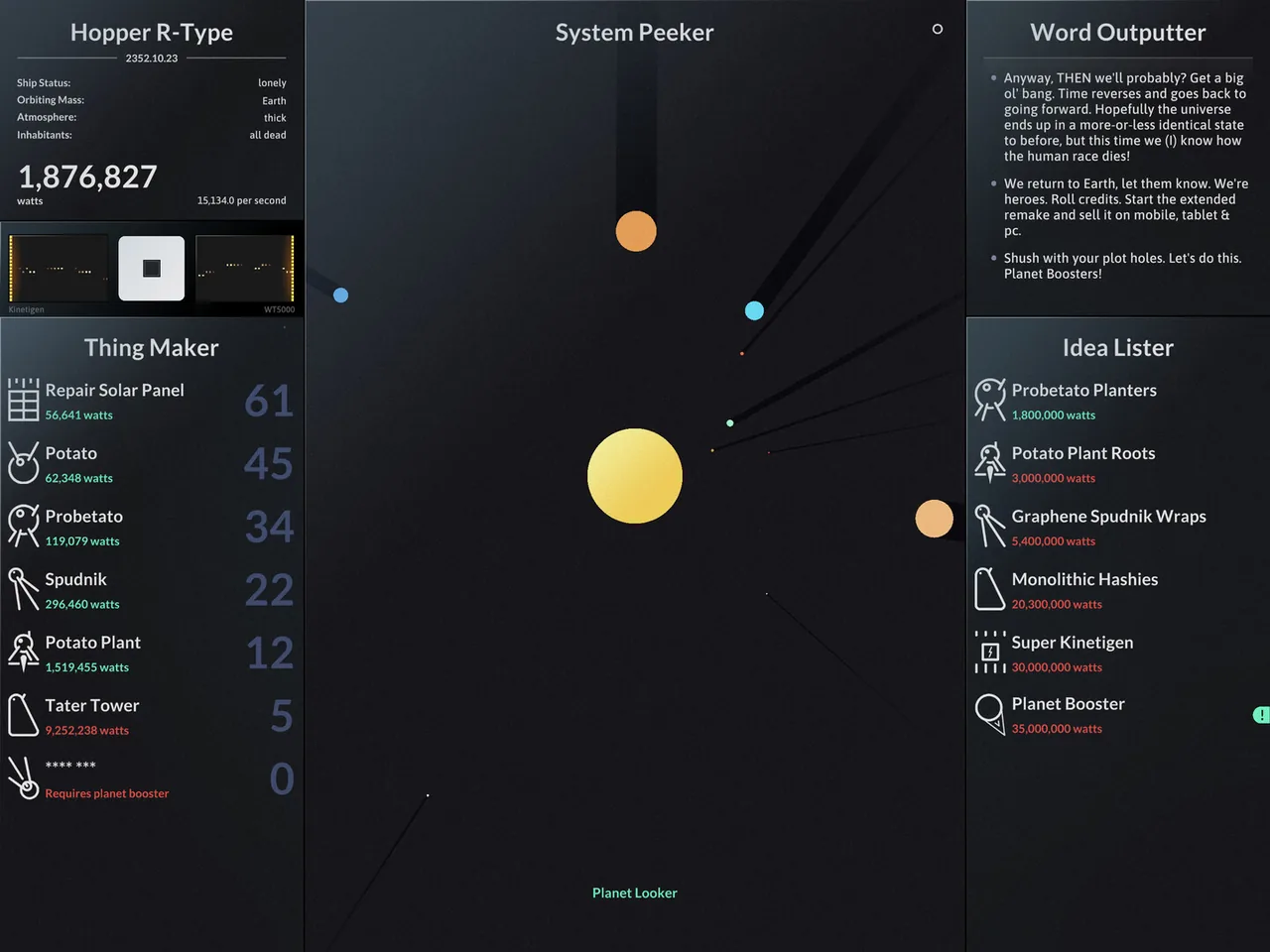
The premise is exactly as strange as it sounds. You're aboard a satellite in orbit around an unfamiliar planet, your systems are dead, and the only power source you have left is a potato hooked up to some improvised electrodes. From that one absurd image the game builds an entire progression ladder: charge the potato, power a scanner, unlock a new component, build the next device, repeat — each tier stranger and more ambitious than the last, all of it narrated with a dry, self-aware sense of humour that treats its own premise as seriously as it deserves, which is to say not very.
The idle curve as a story clock, not a leaderboard
What SPACEPLAN gets right that a lot of the genre still doesn't is restraint. The numbers here never get large enough to stop meaning anything — there's no moment where you're managing a resource counted in scientific notation for its own sake. Instead, each new tier of potato-derived technology is gated behind a wait just long enough to make the next revelation feel like it was worth earning, and short enough that you're rarely bored before it lands. The design isn't asking "how do we keep this player engaged for a hundred hours." It's asking "how long should the reader wait before the next page turns," and building the mechanical layer to answer that question instead of a retention one.
That distinction matters because it changes what you're actually doing during the idle stretches. In most incrementals, the correct play during downtime is to go do something else and come back to a bigger number. In SPACEPLAN, the downtime is short enough, and specific enough to what's about to happen next, that closing the game and forgetting about it means missing the rhythm the writing is built around. It's a clicker where paying attention to the wait is closer to the intended experience than tuning it out.
The trade-off is that the mechanical layer underneath all of this is genuinely thin. Strip away the writing and you're left with a fairly conventional gather-and-unlock loop: charge a resource, spend it on the next item, watch a new timer start. There's no meaningful decision-making, no branching strategy, nothing resembling the tournament sub-game that makes something like Universal Paperclips work as a systems puzzle in its own right. SPACEPLAN doesn't pretend otherwise, and it doesn't need to — the mechanics exist to serve the pacing, not to be interesting on their own — but it's worth being honest that judged purely as a clicker, there isn't much game here without the words wrapped around it.
Writing that stays odd instead of running out of ideas
The tone is the part that has to carry the whole experience, and it mostly does. The dialogue treats a potato-powered space probe with a completely straight face, mining a fair amount of comedy from the gap between the mundane object doing the work and the increasingly large-scale things it ends up doing. New devices and discoveries keep introducing fresh angles on the joke rather than repeating the same beat, which is the main reason the opening hour holds up as well as it does — the writing earns its own premise instead of just restating it.
It cools a little as the story moves into more serious territory later on, which is a fair trade rather than a flaw: a game this committed to a real narrative arc has to let the tone shift when the stakes do, and SPACEPLAN handles that shift without losing the reader's goodwill. What's worth flagging honestly is pacing rather than tone — a few stretches ask for a wait with nothing new to read at the end of it, and those moments test patience the writing hasn't fully banked yet. They're the exception rather than the rule, but they're there.
Sound doing more work than the visuals
Visually, SPACEPLAN is plain by design — a handful of clean, sparse illustrations of the satellite, the planet and the devices you build, with none of the ambition to look like more than it is. Sound is where the presentation earns its keep. Logan Gabriel's soundtrack, sold separately as an optional DLC for anyone who wants to keep it, is doing real work signalling tone shifts and pacing the quieter stretches between story beats — it's the kind of score that makes a genuine difference to how the waiting periods feel, and playing with it muted loses something the visuals alone don't replace.
Desktop, phone, and what changes between them
SPACEPLAN launched simultaneously on Steam, iOS and Android in May 2017, alongside a free browser prototype Jake Hollands had already put online the previous year — the mobile and desktop releases are the same expanded, narrative-complete version of that idea rather than separate products. On desktop it's a mouse-and-click experience with no controller support at all, which barely matters given how little precision the game ever asks of you. On phone, the short idle intervals and single tap-to-progress interactions suit the format naturally — this is closer to a game designed for picking up between other things than one that wants your full attention for a sitting. The one caveat is that a phone screen makes it easier to treat the waiting periods as genuinely idle time, which is exactly the instinct the pacing is trying to work against.
Value
At its discounted NZ$1.48, this isn't really a purchasing decision worth agonising over — it's three to five hours of a specific, well-executed idea for less than the price of a coffee. Even at its undiscounted list price of NZ$4.49 the arithmetic barely changes. What you're not getting is anything resembling replay value: there's no branching path, no faster second run with carried-over bonuses, nothing to optimise once the story has told itself. That's a real limitation, not a rounding error, and anyone buying this expecting a long-tail incremental to sink hours into over weeks is buying the wrong game. Buying it for a handful of short sessions and a story with an actual ending is buying exactly what's on the label.
Verdict
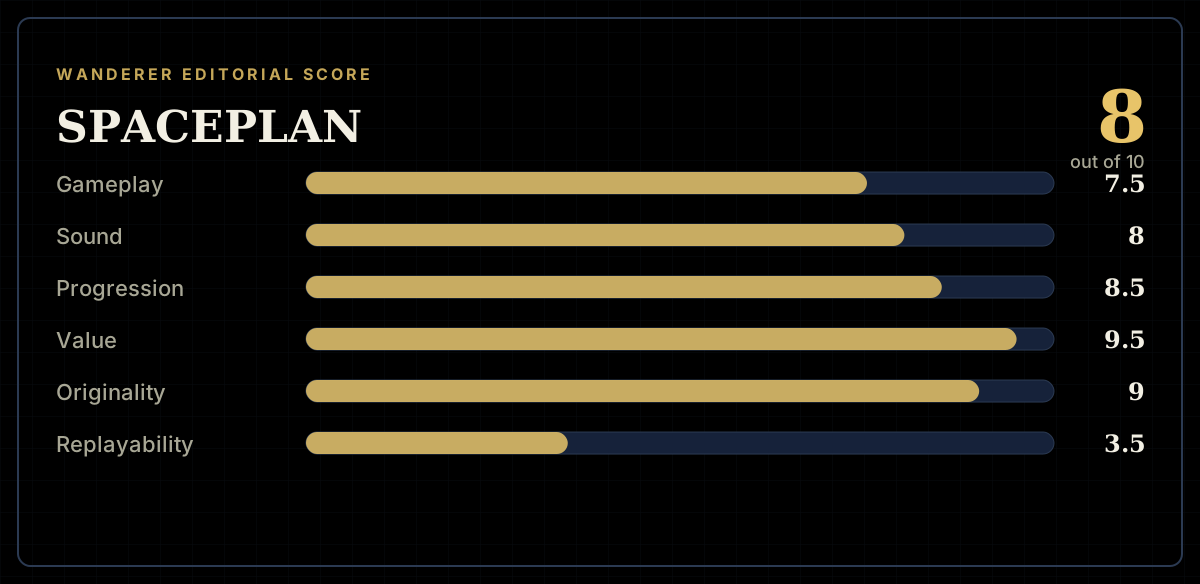
An 8.0 for a game built around a joke premise and a genuinely thin mechanical layer is a claim that needs defending, and the defence is simple: SPACEPLAN understood something about idle design that most of the genre still avoids, which is that the wait itself can be an authored experience rather than a monetisation lever. It doesn't ask for your attention across weeks or months. It asks for a few short sessions, tells a strange, specific story at exactly the pace it wants to tell it, and then stops — commitment that's rarer in this space than it should be.
It doesn't climb higher because there simply isn't much game here once the writing is set aside, and because a game this short leaves no room to earn back a slower stretch or two along the way. Anyone who likes watching small systems keep ticking over on their own terms, the way Wanderer's gathering loops run between sessions, will recognise the appeal of a timer that's actually going somewhere.
Pricing and Steam review data checked 30 July 2026.
Pros and cons
Pros
- The idle timers are tuned to the pace of the writing, not the other way around, so waiting never feels like a wall
- The potato-power premise stays consistently, specifically silly instead of leaning on one joke twice
- Logan Gabriel's soundtrack does real work signalling when a story beat is about to land
- It commits to an actual ending rather than trailing off into a bigger number for its own sake
- Extremely cheap for three to five hours of content with no ads, IAPs or account requirements anywhere
Cons
- Once you've clicked through the resource loop once, there is nothing pulling you back for a second run
- The mechanical layer underneath the writing is thin even by clicker standards, and it knows it
- A handful of stretches ask you to sit and wait with nothing new to read, which tests patience the writing hasn't earned yet
- No controller support and nothing beyond touch or a mouse to interact with
- The joke-per-minute rate that carries the opening hour cools off somewhat once the story gets serious
Screenshots
-
SPACEPLANImage: Devolver Digital via Steam -
SPACEPLANImage: Devolver Digital via Steam -
SPACEPLANImage: Devolver Digital via Steam -
How the review scores each part of the gameWanderer Editorial -
The short versionWanderer Editorial