
Game review
Sim: Heavyweight Boxing Champion Review: 146 Years of Boxing History, Told in Text
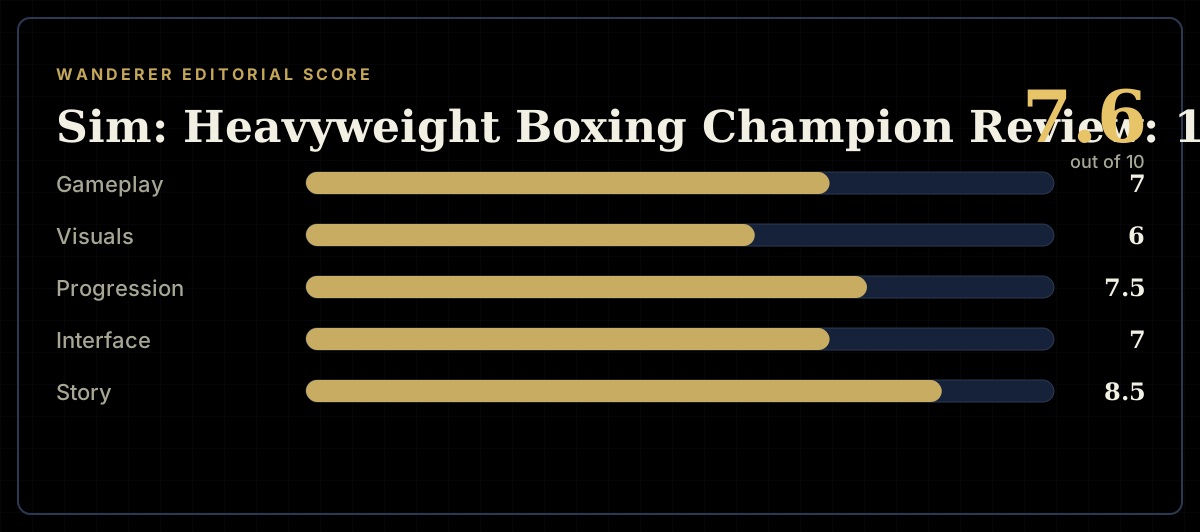
7.6 / 10
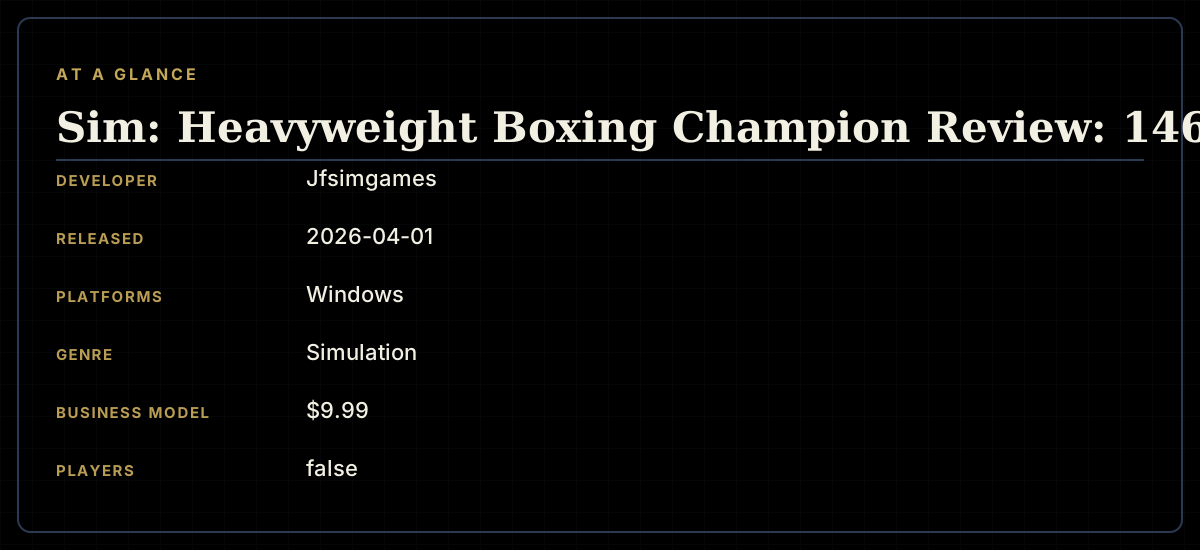
- Developer
- Jfsimgames
- Publisher
- Jfsimgames
- Released
- 1 April 2026
- Platforms
- Windows
- Genre
- Simulation
- Monetisation
- $9.99
- Players
- false
The short version
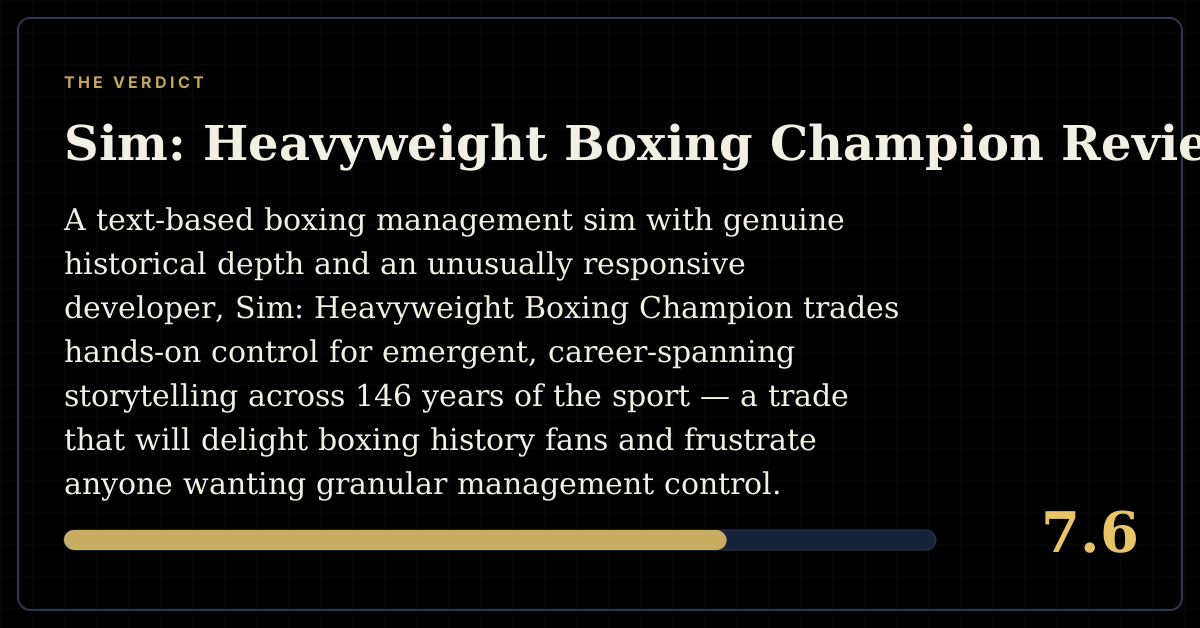
A text-based boxing management sim with genuine historical depth and an unusually responsive developer, Sim: Heavyweight Boxing Champion trades hands-on control for emergent, career-spanning storytelling across 146 years of the sport — a trade that will delight boxing history fans and frustrate anyone wanting granular management control.
Biggest strengths
- Genuine historical depth: 2,500 real heavyweight fighters spanning 1880 to 2026, era-accurate title rules, sanctioning bodies, venues, and purse sizes that reviewers say create real emergent storylines and rivalries
- An unusually responsive, actively updating developer that reviewers repeatedly single out by name for quickly acting on community feedback and shipping frequent, substantial content updates since launch
- Well-formatted, color-coded text-based fight commentary that multiple reviewers say genuinely captures the drama and pacing of a real bout despite having no visual fight representation
Biggest weaknesses
- Very limited direct player control: training is fully automatic with no ability to specify focus areas, and in-round tactics are reduced to picking a broad strategy rather than granular decisions
- The in-game economy exists but multiple reviewers note money has little practical purpose to spend on, even after a later update added finances, trainers, and investments
- Heavyweight division only at launch, with the developer having discussed but not yet added other weight classes
Who it's for: Boxing history buffs and fans of classic text-based sports sims like Title Bout who want emergent career storytelling across real eras and fighters; not for players who want deep tactical training control or a visually driven presentation.
Our recommendation: Buy it
7.6 / 10
Every era of boxing, from bare knuckles to Riyadh
Sim: Heavyweight Boxing Champion's core promise is scope: pick any starting year from 1880 to 2026 and build a heavyweight's career inside a world that evolves authentically around them. Title fight rounds shrink from 25 to 12 as the sport modernizes, sanctioning bodies appear in their real historical years (a single world title until 1963, then the WBC, IBF in 1983, and WBO in 1988), venues shift from Yankee Stadium to Caesars Palace to Riyadh's Kingdom Arena, and purse money grows from thousands of dollars to tens of millions. Reviewers consistently point to this era-accurate framing as the game's biggest strength — not just a boxing sim, but a genuine simulation of how the sport itself changed over 146 years.
Play as yourself, or as 300 of the greatest ever
Alongside a fully custom career, the game lets players step directly into the careers of 300 real all-time-great heavyweights, starting each at their authentic overall rating, real fighting style, hometown, and the exact age they turned professional — Mike Tyson from his 1984 debut, Muhammad Ali from his 1960 Olympic gold medal turn pro. Players can also drop any legend into a different era entirely to see how they'd fare against a different generation of champions. One detailed review describes exactly this kind of emergent storytelling: starting a fighter in 1935 alongside a historically-accurate Joe Louis, building a genuine rivalry and trilogy of fights, deliberately delaying a unification bout for financial reasons in a way that echoes real-world boxing politics — the kind of organic narrative multiple reviewers say the game generates without ever scripting it directly.
Text-based fights that reviewers say actually work
With no visual fight representation, the entire combat experience runs through color-coded, well-formatted text commentary, and it's a design choice reviewers repeatedly credit with succeeding on its own terms. Several draw a direct lineage to the classic "Title Bout" series, with one calling this "much improved" over that lineage and praising how easy the color-coded text is to follow round by round. Playback speed is adjustable, letting players watch every blow-by-blow moment or skip straight to a summary — though one reviewer notes the fastest setting becomes unreadable, a real limitation for anyone managing a large simulated universe of fighters and wanting to blow through non-priority bouts quickly.
Where player agency runs thin
The recurring, most substantive criticism across the review sample is how little direct control players actually have. Training happens fully automatically with no way to specify what a fighter focuses on, and in-round strategy is limited to selecting a broad approach rather than granular tactical decisions. One reviewer frames this explicitly as a trade-off: "it is a blast watching the world play out," but acknowledges "you don't get to control much." A separate detailed review goes further, noting that despite an update adding finances, trainers, stock and bond investments, and even marriage and legacy mechanics, "in between fights, you don't really do anything" beyond selecting the next bout and advancing time — a genuine simulation of a career more than a hands-on management game.
An economy that still doesn't have much to spend on
Multiple reviewers flag the same specific gap: money exists in the game and purses grow substantially as a career progresses, but there's remarkably little to actually spend it on. One reviewer lists this directly as a con even after acknowledging the developer's frequent updates, writing "money means nothing" and expressing uncertainty about how it could be fixed without compromising the game's deliberate simplicity. This is presented less as a bug than as an open design question the community and developer are still actively working through together.
A developer reviewers trust to keep building
An unusually consistent thread across nearly every review, positive or mixed, is direct praise for the developer's responsiveness. Reviewers describe the developer as "very responsive," "super responsive and alert for imperfections," and quick to act on both bug reports and feature requests — one review explicitly notes major updates adding an entire financial and family-legacy system arrived within months of launch. Several reviewers frame their positive scores as much about trust in the game's trajectory as its current state, a reasonable read given the pace of documented post-launch content already shipped by September 2026, five months after the April 1 debut.
Is a $9.99 text-based sim worth it
At $9.99, reviewers broadly agree the price matches what's on offer: a deep, historically grounded simulation engine with real replay value for boxing and sports-sim fans, sold with the caveat that it's an intentionally simple, mostly hands-off experience rather than a deep tactical management game. The one clearly negative review in the sample offers no specific complaints beyond calling it "one of the worst boxing games" played, an outlier unsupported by detail against 17 other reviews that engage substantively and mostly positively with the game's specific strengths and gaps.
A world that keeps running whether you watch or not
One structural detail that comes up repeatedly is how the simulation treats every other fighter in its universe, not just the player's own. The 2,500-strong historical roster and any generated fighters continue their own careers, records, and rivalries in the background month over month, whether or not the player ever checks in on them. One reviewer describes deliberately setting the game to generate entirely random fighters rather than sticking to the historical roster, and still following along with what other boxers were doing purely out of curiosity about how the simulated world was unfolding. That persistence is part of what several reviewers cite as the game's replay hook: retiring a fighter doesn't end anything, since the same living universe carries over into the next career a player starts.
Verdict
Sim: Heavyweight Boxing Champion succeeds by leaning fully into historical scope and emergent storytelling rather than granular management control, and its review sample backs that approach up with unusually specific, engaged praise alongside fair, constructive criticism of its thin economy and limited tactical depth. For boxing history fans willing to accept a mostly hands-off, text-based experience, it's an easy recommendation, backed further by a developer reviewers trust to keep expanding it.
Pros and cons
Pros
- Genuine historical depth: 2,500 real heavyweight fighters spanning 1880 to 2026, era-accurate title rules, sanctioning bodies, venues, and purse sizes that reviewers say create real emergent storylines and rivalries
- An unusually responsive, actively updating developer that reviewers repeatedly single out by name for quickly acting on community feedback and shipping frequent, substantial content updates since launch
- Well-formatted, color-coded text-based fight commentary that multiple reviewers say genuinely captures the drama and pacing of a real bout despite having no visual fight representation
- Flexible pacing: fights can be sped up, slowed down, or skipped to a results summary, letting players choose how hands-on they want to be with any given match
Cons
- Very limited direct player control: training is fully automatic with no ability to specify focus areas, and in-round tactics are reduced to picking a broad strategy rather than granular decisions
- The in-game economy exists but multiple reviewers note money has little practical purpose to spend on, even after a later update added finances, trainers, and investments
- Heavyweight division only at launch, with the developer having discussed but not yet added other weight classes
- Purely text-based presentation with no visual fight representation, and one reviewer notes the fastest playback speed becomes unreadable
Screenshots
-
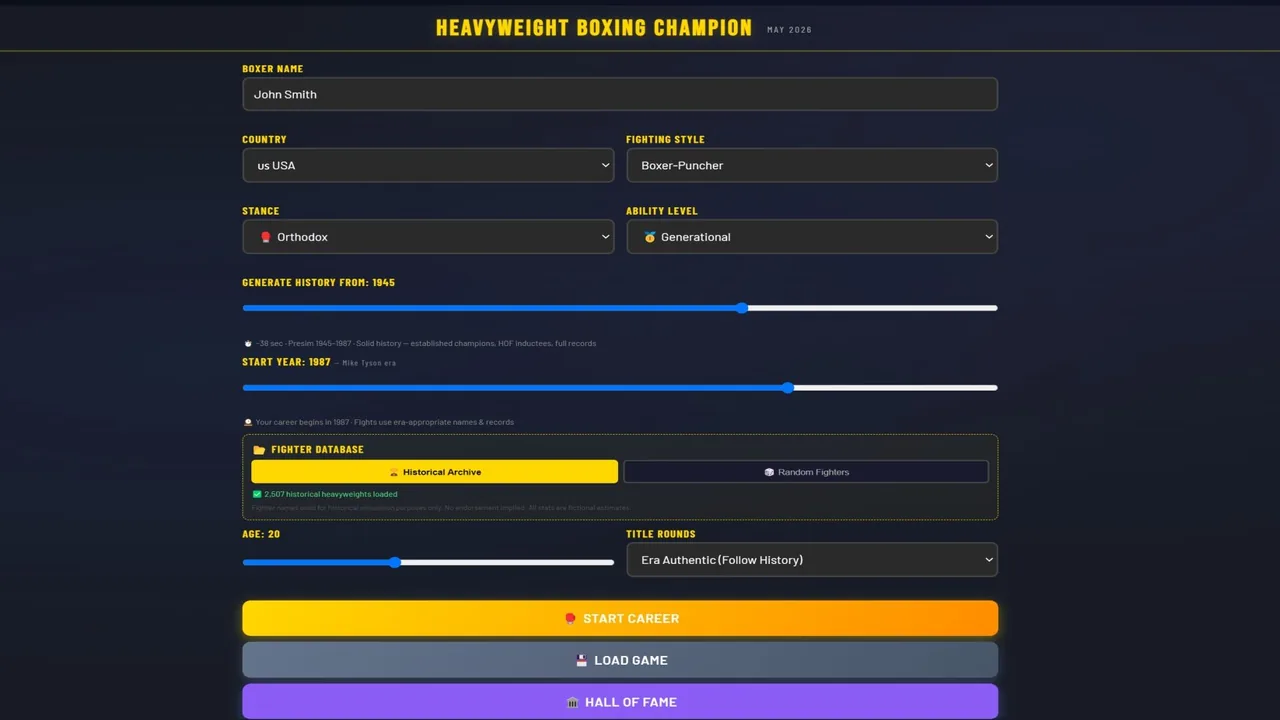
Image: Jfsimgames via Steam -
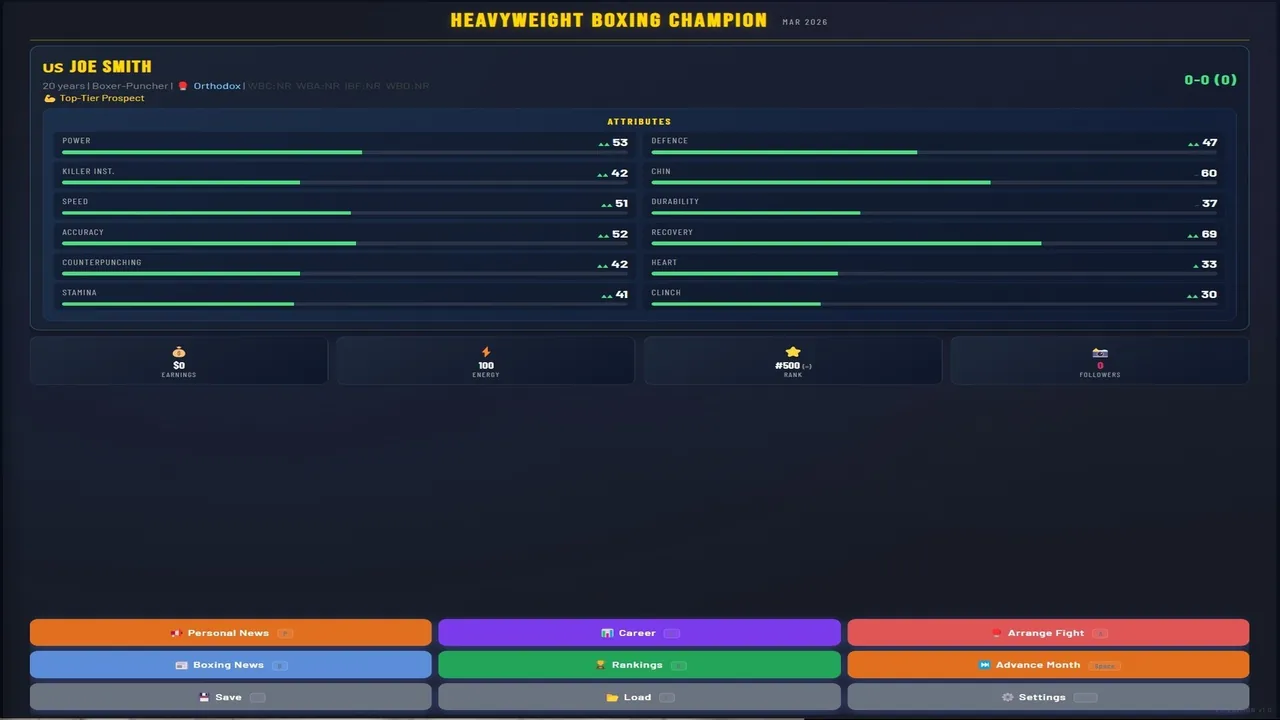
Image: Jfsimgames via Steam -
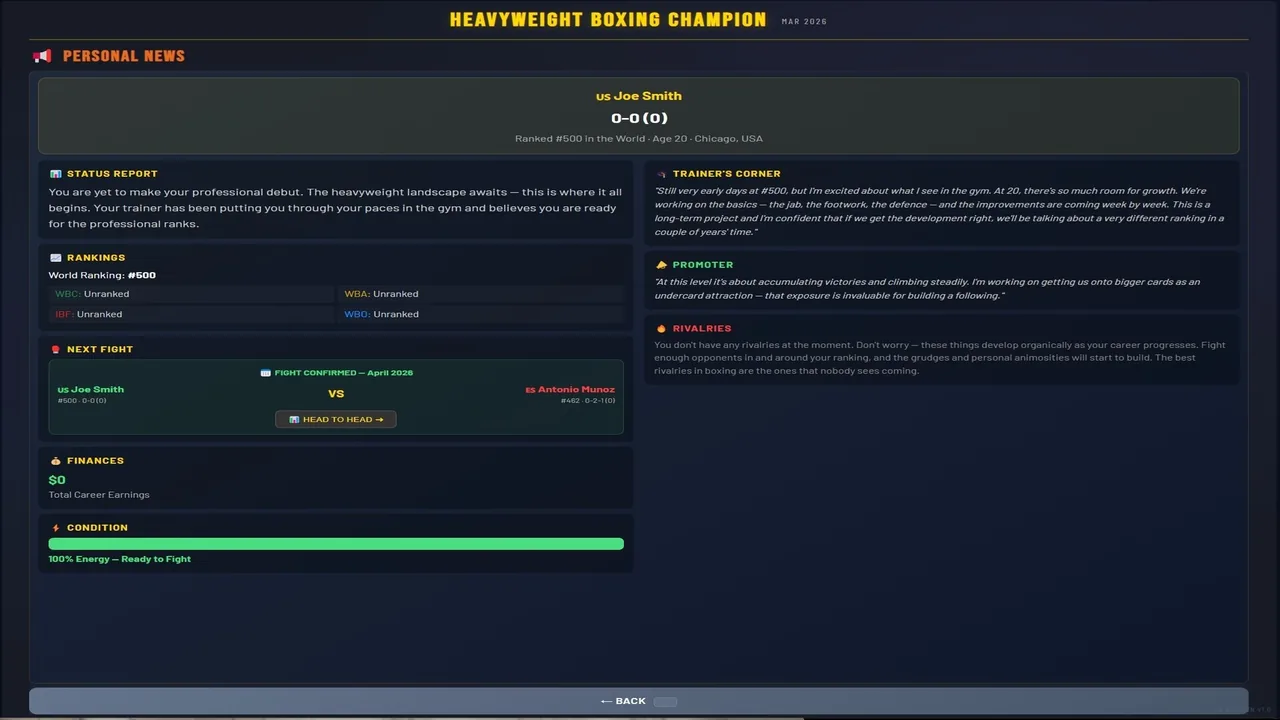
Image: Jfsimgames via Steam -
Wanderer Editorial -
Wanderer Editorial -
Wanderer Editorial