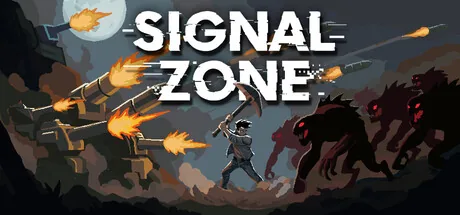
Game review
Signal Zone
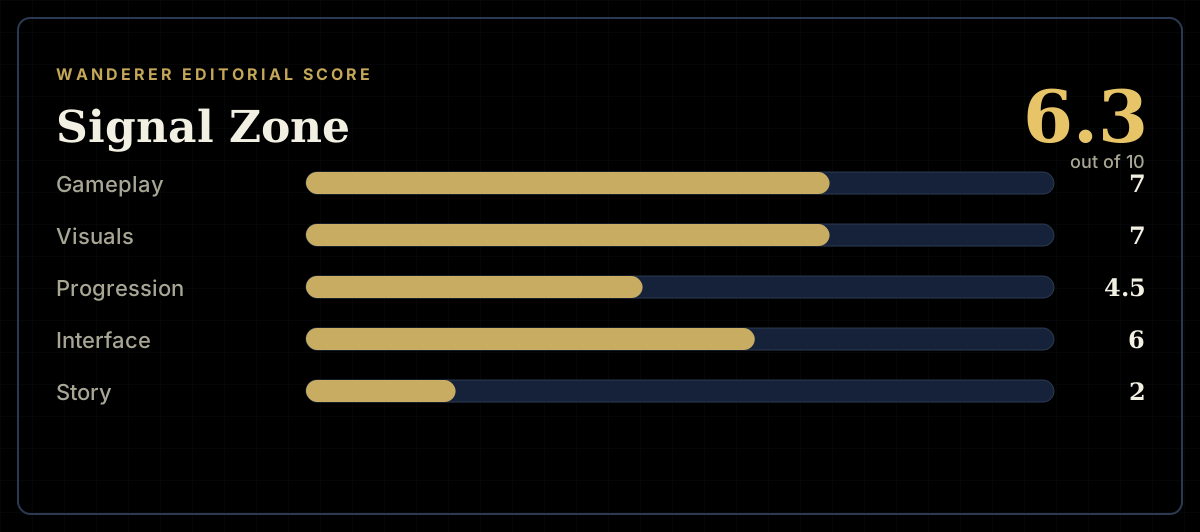
6.3 / 10
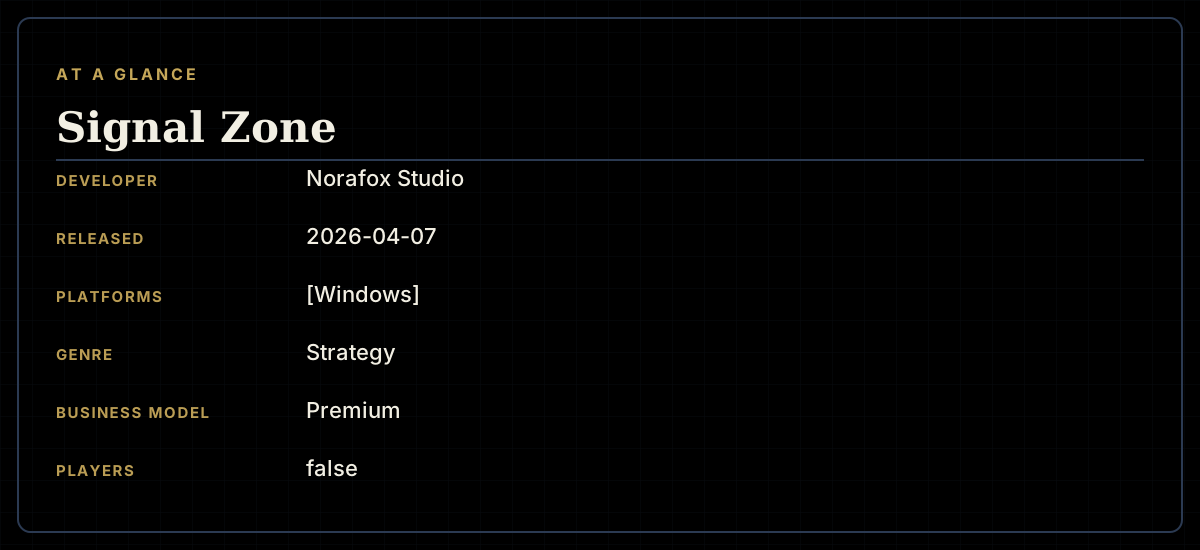
- Developer
- Norafox Studio
- Publisher
- Norafox Studio
- Released
- 7 April 2026
- Platforms
- [Windows]
- Genre
- Strategy
- Monetisation
- Premium
- Players
- false
The short version
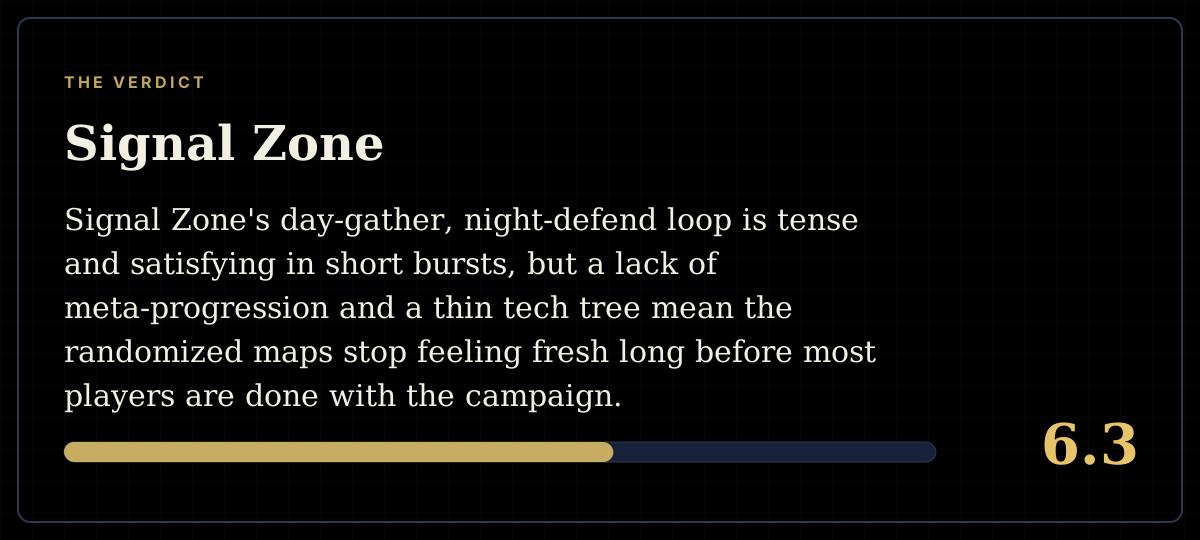
Signal Zone's day-gather, night-defend loop is tense and satisfying in short bursts, but a lack of meta-progression and a thin tech tree mean the randomized maps stop feeling fresh long before most players are done with the campaign.
Biggest strengths
- A genuinely tense day-gather, night-defend loop with a well-tuned sense of urgency
- Distinctive isometric pixel art and a soundtrack multiple reviewers single out as a highlight
- Randomized maps add welcome variance between runs, and it runs well on Steam Deck
Biggest weaknesses
- No meta-progression between missions, each one restarts base-building from scratch, which several reviewers found deflating
- A thin roster of turret and building types leads to repetition after several hours
- Map-seed RNG can strand players without a required resource, turning some missions into pure bad luck
Who it's for: Tower-defense and base-building fans who want a tight, roguelike-adjacent survival loop and don't mind starting from zero every mission.
Our recommendation: Recommended with reservations
6.3 / 10
A small studio's tight little survival loop
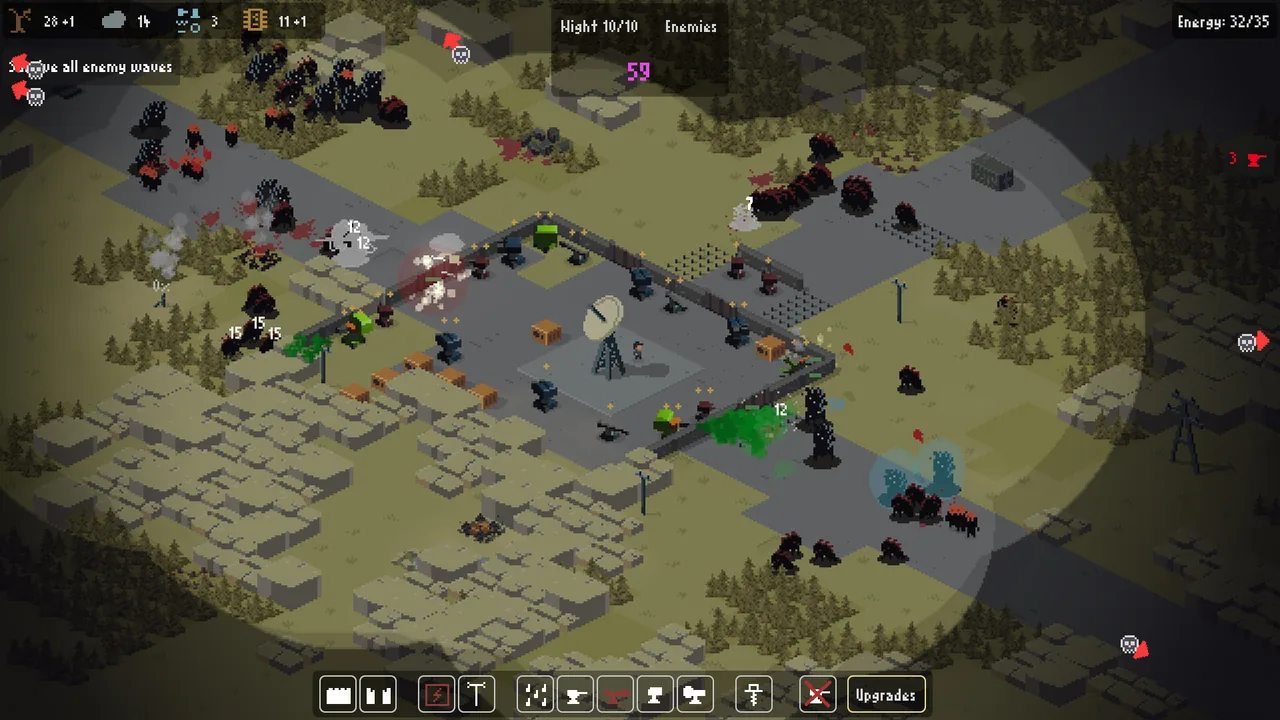
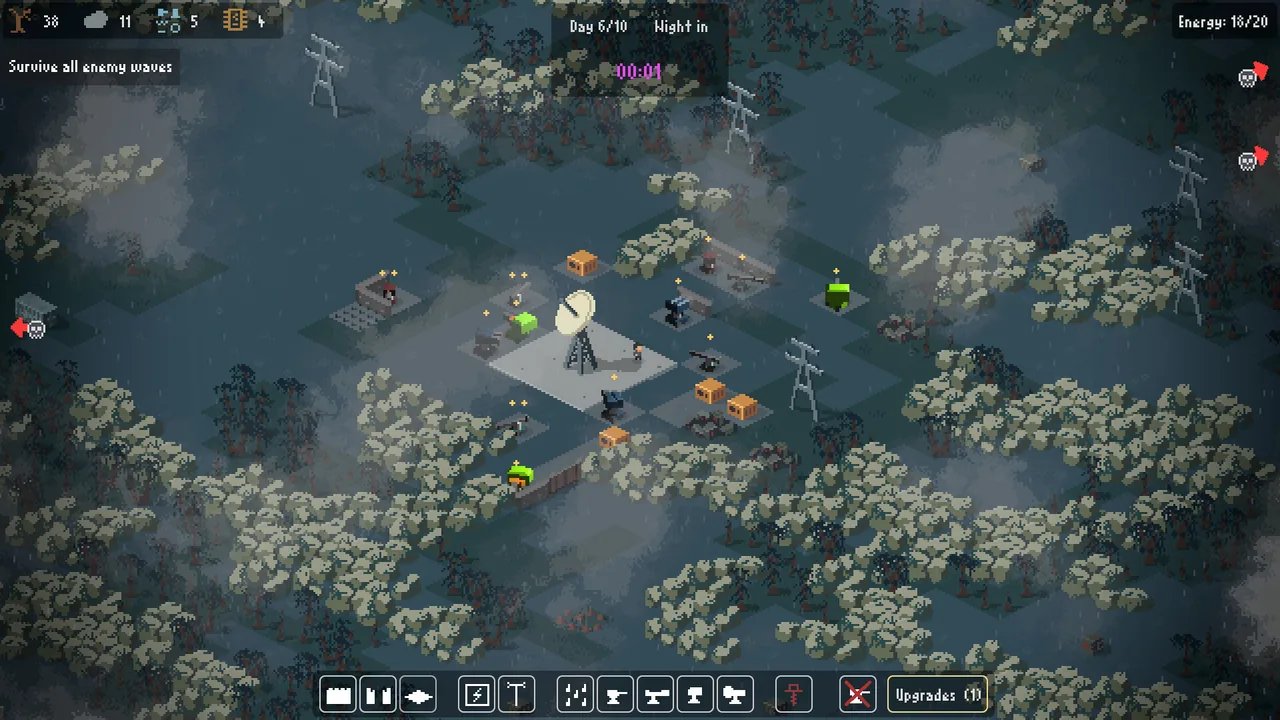
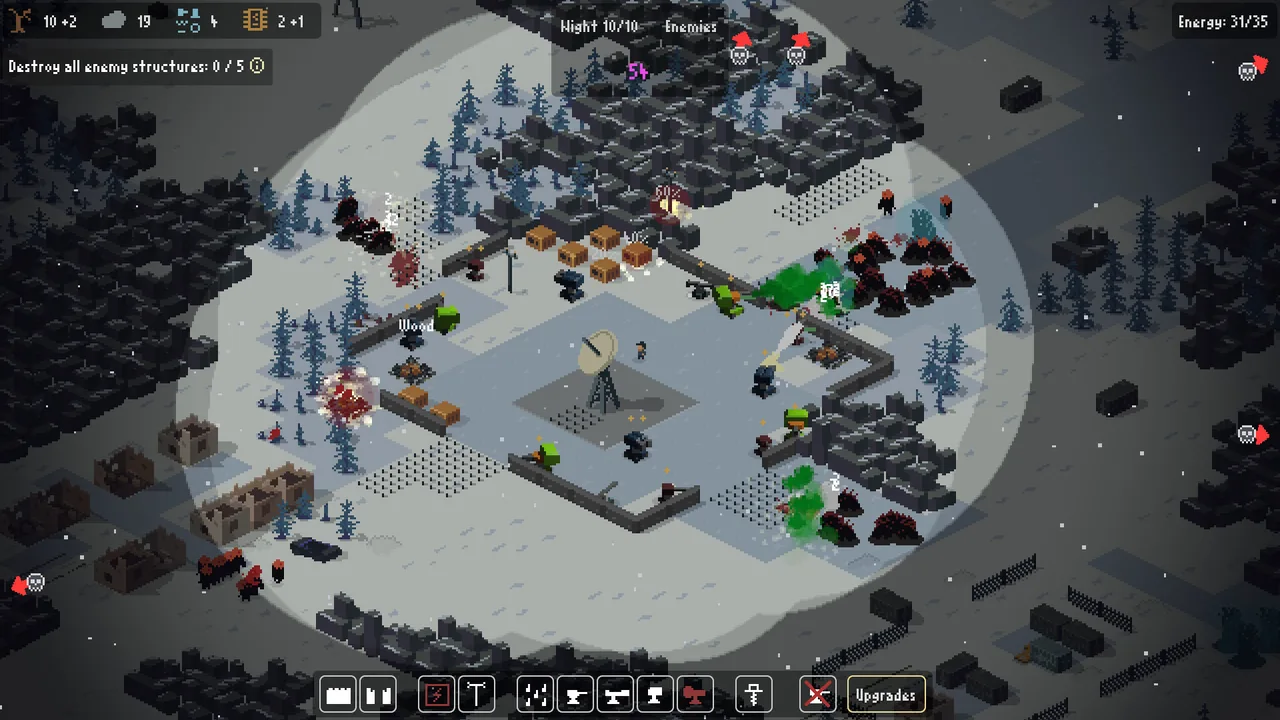
Signal Zone launched on April 7, 2026 from Norafox Studio, a two-person husband-and-wife developer team, following a demo period that ran since January. It's a top-down isometric hybrid of tower defense, base building, and survival: each day gives players a short window to explore, mine resources, and reinforce their base's defenses before night falls and waves of enemies converge on the central antenna. It launched to a Mostly Positive reception, 104 reviews and roughly 78% positive, a score that tracks closely with what's actually in the game: a genuinely compelling core loop wrapped around a thinner-than-ideal amount of long-term content.
Gather, build, survive, repeat
The day-night structure is the clear standout. Reviewers across nearly every language sampled describe the tension of racing the clock to gather wood, stone, electronics, and metal before dusk, then scrambling to patch walls and manage limited power between waves, as the game's strongest hook. Several specifically compare the feel favorably to survival-crafting hybrids like 7 Days to Die or They Are Billions, praising how the randomized map generation keeps individual runs from feeling identical even when the broader campaign structure repeats. The pixel art style and soundtrack draw consistent, unprompted praise, and the game reportedly runs well on Steam Deck, a detail several portable-focused reviewers call out specifically.
Starting from zero, every time
The most consistent complaint, and the one that drags the score down from what the moment-to-moment gameplay alone would earn, is the total absence of meta-progression. Every mission strips the player back down to nothing, no carried-over upgrades, no persistent unlocks, no growing arsenal, which multiple reviewers describe as actively demoralizing after putting in real time to build up a strong base only to lose it all at the next stage. A handful specifically wish for permanent upgrades to basic stats like movement speed or carrying capacity, small quality-of-life additions that wouldn't undercut the challenge but would make the early minutes of each run less of a chore. Combined with a genuinely thin turret and building roster, only a handful of defensive options exist for the entire game, this repetition sets in for a meaningful chunk of reviewers well before the campaign's end, with several describing runs of six to twenty hours before diminishing returns kick in.
When the dice don't cooperate
A second recurring frustration is how much a given run can hinge on map-seed luck. Some missions task players with locating a specific resource or objective somewhere on a randomly generated map, and if it spawns far from the base or in a hard-to-reach spot, players can burn their entire prep window without accomplishing anything, through no fault of their own. One detailed negative review frames this bluntly as more of a time-pressured puzzle than a strategy game, arguing the RNG can override skillful play entirely on a bad seed. It's not a universal complaint, several reviewers who enjoyed the game frame the variance positively, as a roguelike-style risk factor rather than a flaw, but it shows up often enough across independent reviews to be a real, not merely anecdotal, design tension.
Rough edges around the frame
A smaller cluster of technical issues surfaces repeatedly: no save functionality in the open-ended endless mode, meaning any interrupted session is simply lost, and scattered reports of a full-screen scaling bug that forces players on 2K or 4K monitors into windowed mode to avoid crashes. One isolated but striking report describes the game repeatedly resetting the player's monitor brightness settings even after quitting. None of these appear universal, but they're specific enough, and numerous enough across the sample, to be worth a note of caution for anyone on non-standard display setups.
Three modes, one underlying loop
Signal Zone ships with three ways to play its core loop: a structured campaign with escalating missions and objectives, a custom mode with adjustable settings, and an open-ended endless mode for players who just want to see how many nights they can survive. Reviewers generally treat the campaign as the strongest of the three, since its mission-specific objectives, find a crate, escort a convoy, hold a specific perimeter, at least vary the moment-to-moment goal even without carrying over any upgrades. Endless mode draws more mixed reactions: some reviewers describe it as the ideal way to unwind after a stressful day, since there's no larger stakes beyond the current run, while others found it punishing once resource scarcity compounds in the later waves without any save option to fall back on if something goes wrong.
Where it sits next to the genre
Set against dedicated tower-defense games and survival-crafting hybrids alike, Signal Zone occupies a narrower niche than either, closer in spirit to a timed puzzle with combat bolted on than to the deep tech trees of genre heavyweights. That's not automatically a weakness, several reviewers explicitly enjoy how quickly a single mission resolves compared to the hours-long commitment other base builders demand, but it does mean players coming in expecting something with the scope of a full survival game are likely to be disappointed by how quickly its handful of systems get exhausted. It's best understood as a tightly scoped arcade take on the genre rather than a direct competitor to its more expansive peers.
A promising foundation for a small studio
It's worth stressing how much reviewers credit this as an accomplished debut for what's described as a two-person team's first real project. The core tension of the day-night cycle is well-tuned, the presentation punches above its budget, and the studio's continued post-launch update cadence, several hotfixes and a couple of numbered updates within weeks of release, signals an active team still refining the experience rather than one that shipped and walked away. Reviewers who frame their criticism constructively mostly want more of what's already here: additional turret types, permanent upgrades, and a longer campaign, rather than a fundamentally different game.
The verdict
Signal Zone gets the tense, moment-to-moment push and pull of gathering resources under a ticking clock genuinely right, and it looks and sounds better than its scope might suggest. But without any meaningful progression carried between missions and with only a handful of tools to work with, the loop that hooks players in the first few hours starts to feel like a treadmill well before most campaigns are finished. It's worth playing for the day-night tension alone, especially at a discount, but go in expecting a tight, repeatable arcade loop rather than a strategy game with real long-term depth.
Pros and cons
Pros
- A genuinely tense day-gather, night-defend loop with a well-tuned sense of urgency
- Distinctive isometric pixel art and a soundtrack multiple reviewers single out as a highlight
- Randomized maps add welcome variance between runs, and it runs well on Steam Deck
- Strong value for a solo/two-person studio's debut, with several difficulty and mission-type options
Cons
- No meta-progression between missions, each one restarts base-building from scratch, which several reviewers found deflating
- A thin roster of turret and building types leads to repetition after several hours
- Map-seed RNG can strand players without a required resource, turning some missions into pure bad luck
- No save support in endless mode, plus scattered reports of a full-screen scaling bug on high-resolution monitors
Screenshots
-
Signal ZoneImage: Norafox Studio via Steam -
Signal ZoneImage: Norafox Studio via Steam -
Signal ZoneImage: Norafox Studio via Steam -
How the review scores each part of the gameWanderer Editorial -
Key facts at a glanceWanderer Editorial -
The short versionWanderer Editorial