Game review
Sensory Overload Review
7 / 10
- Developer
- Pancake Studios
- Publisher
- Pancake Studios
- Released
- 20 August 2026
- Platforms
- ["Windows"]
- Genre
- First-Person Precision Runner
A Tunnel Designed to Break Your Brain, on Purpose
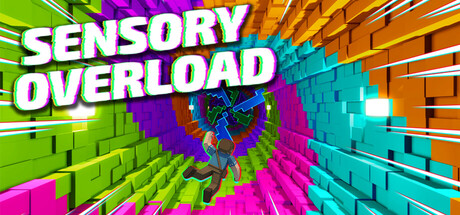
Sensory Overload, from solo-flavored studio Pancake Studios, launched on August 20, 2026, after a public demo period that reportedly pulled in 15,000 players and 200,000 runs before the full release ever arrived. The pitch is disarmingly simple: you're dropped into a first-person tunnel that twists, narrows, breathes, and strobes as you dodge obstacles at increasing speed, in the lineage of Minecraft dropper maps, Super Hexagon, and Audiosurf. There's no story, no characters, just a straight, punishing descent through psychedelic geometry. At 149 English-language reviews and 94% positive, "Very Positive," it's landed about as well as a ten-dollar arcade experiment can.
Calming Through Chaos
The most distinctive, most repeated thread in the review pool isn't about difficulty or design, it's about focus. A striking number of reviewers specifically identify as neurodivergent, describing ADHD or autism, and independently report that the game's overwhelming visual noise has a paradoxical, almost meditative calming effect, quieting a mind that otherwise won't stop talking. One reviewer put it simply: their brain "will never shut up," but something about the game's specific chaos let it go quiet. Several others frame it the same way, as a game built to overload the senses that somehow leaves them feeling more settled rather than less. That's a genuinely unusual, hard-to-manufacture response, and it shows up often enough across independent reviewers that it reads as a real property of the game rather than a coincidence.
The Core Loop Lands, When the Hitboxes Cooperate
Setting the sensory angle aside, the dropper loop itself is broadly well-received: reviewers praise its addictive, one-more-run pull, its strong soundtrack, and the satisfying, Beat-Saber-adjacent rhythm of weaving through obstacles at speed. But a specific technical complaint shows up across multiple independent reviews: the game's hitboxes are inconsistent, with at least three separate reviewers reporting, in some cases after frame-by-frame footage analysis, that they were hit when it visually looked like they'd cleared an obstacle, or vice versa. That's a real, corroborated problem for a game this dependent on split-second precision, since a dropper lives or dies by whether the player trusts what they're seeing. A further, less common complaint concerns the game's fixed field of view, which one detailed review argues distorts perspective in a way that makes precise dodging harder to judge consistently, though this specific critique appears from a single source rather than the wider pool.
A Few Rough Edges Around a Simple Core
Beyond hitboxes, a handful of reviewers flag secondary friction: a stark difference in difficulty between mouse and keyboard control schemes, with mouse play described as noticeably easier than the keyboard-first design apparently intends; some levels that force memorization of a single fixed path rather than allowing genuine on-the-fly reaction; and, for a small number of players, outright crashes tied to specific GPU configurations that were resolved only after hardware troubleshooting. None of these sink the experience for most of the review pool, but they're consistent enough to note as real launch-week rough edges rather than isolated complaints.
Verdict
Sensory Overload is a small, cheap, and genuinely clever arcade experiment that mostly delivers on an unusual promise: sensory chaos as a form of focus rather than a form of punishment. The dropper loop is addictive when the hitboxes behave, the soundtrack pulls its weight, and the price, kept deliberately under ten dollars, earns real goodwill in a review pool that clearly noticed and appreciated the choice. Its flaws are the ordinary growing pains of a small launch, imprecise hitboxes chief among them, rather than anything structurally wrong with the concept.
What makes this one worth a look beyond the usual arcade-runner crowd is exactly the neurodivergent-focused feedback that keeps surfacing unprompted across the review pool. This isn't a game marketed explicitly as a focus or sensory-regulation tool, and it shouldn't be mistaken for one, but the fact that so many independent players arrived at the same unusual description of its effect, calming through apparent chaos, suggests Pancake Studios stumbled onto something genuinely worth refining rather than a one-off gimmick. If the hitbox inconsistencies get tightened up in a patch or two, this could graduate from "clever ten-dollar curiosity" to a small staple of the genre; as it stands at launch, it's an easy recommendation for genre fans and an intriguing one for anyone curious whether visual noise can, counterintuitively, help a busy mind settle down.
It's also worth sizing up how much this genre asks of a ten-dollar impulse buy, and the answer here is refreshingly modest. There's no pretense of a ten-hour campaign or a sprawling meta-progression system to chase; the level editor and score-attack modes exist to extend a loop that's already fun in short bursts, not to pad out a thin core with busywork. A handful of reviewers who put dozens of hours in describe returning to it the way they'd return to a favorite rhythm game or endless runner, a few runs at a time rather than a single sitting, and that's exactly the shape of game this is built to be. Given the studio's visibly active patch cadence in the two weeks since launch, addressing crash reports and shipping quick hotfixes, there's reason to expect the hitbox and control-scheme complaints get real attention rather than languishing, which makes the current rough edges feel more like teething problems than a settled ceiling on the game's quality. For a solo-scale studio's first proper commercial release, that kind of responsiveness in the immediate post-launch window counts for a great deal, and it's the strongest single reason to bet on this one improving rather than stagnating.
Screenshots
-
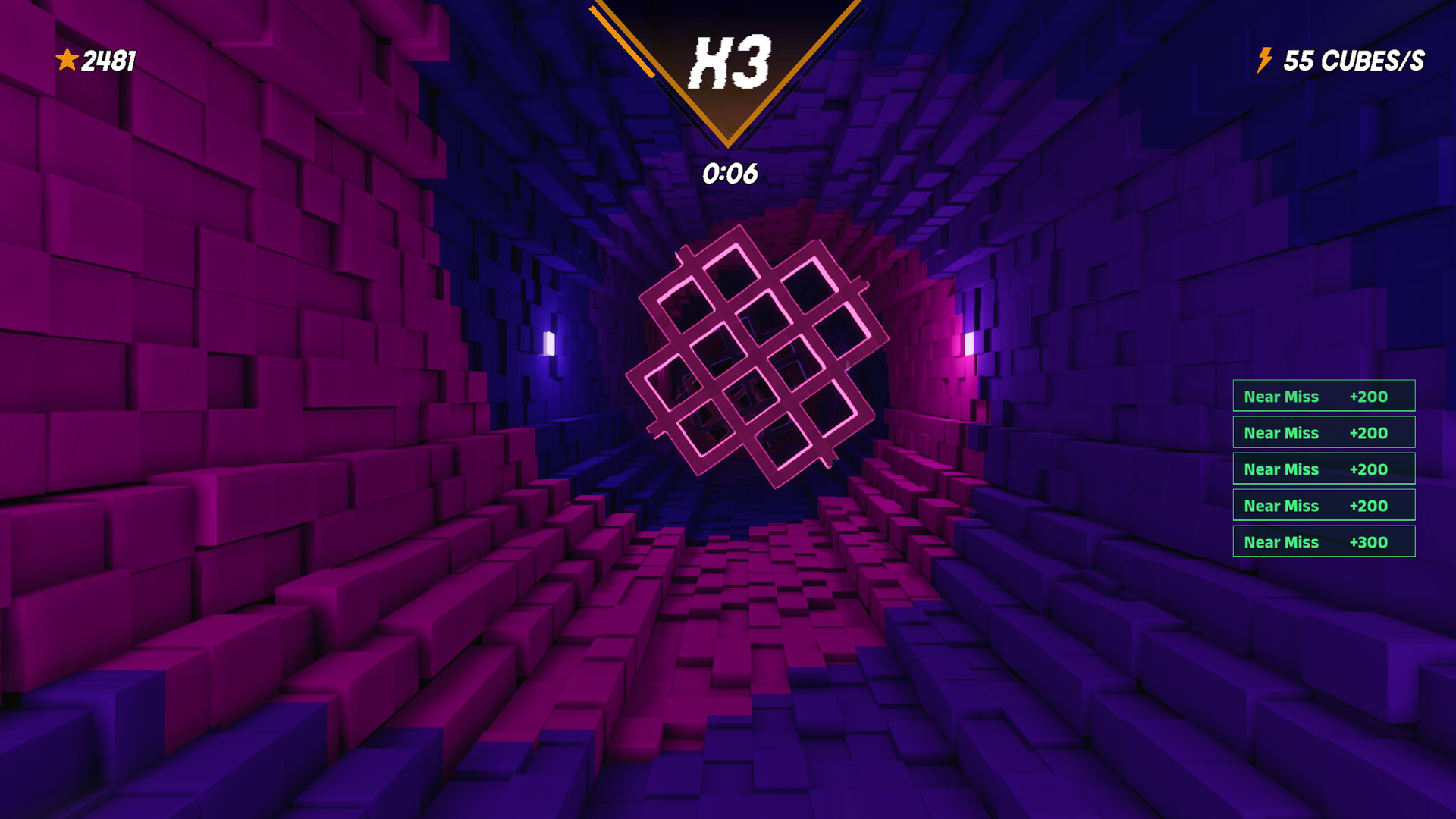
A near-miss streak stacking up on the right as the tunnel narrows around a grid-patterned obstacle, the cubes-per-second counter climbing in the corner.Image: Pancake Studios via Steam -
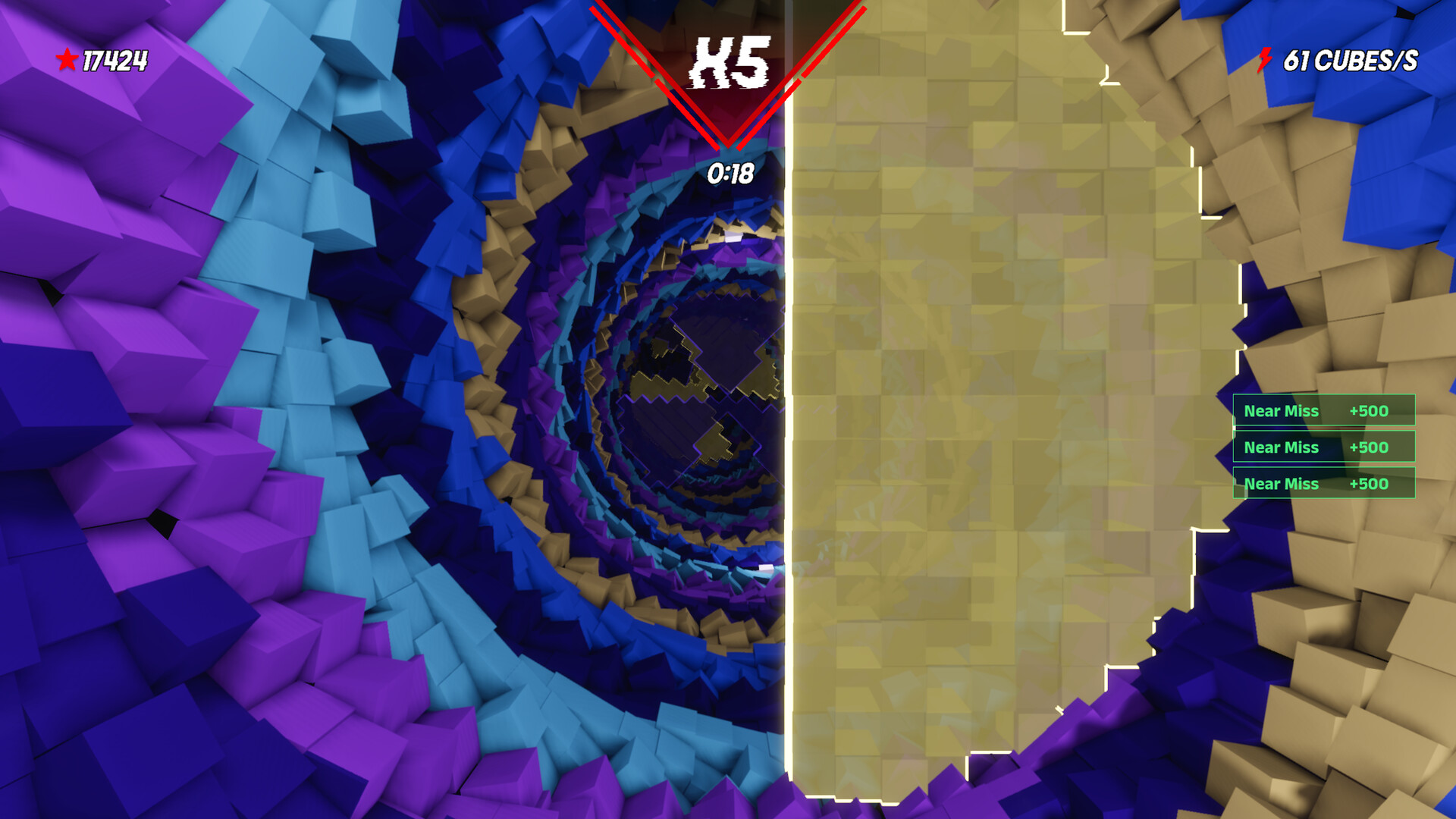
The tunnel's geometry and color palette shifting mid-run, half jagged and half smooth, while the combo counter and timer keep the pressure on.Image: Pancake Studios via Steam -
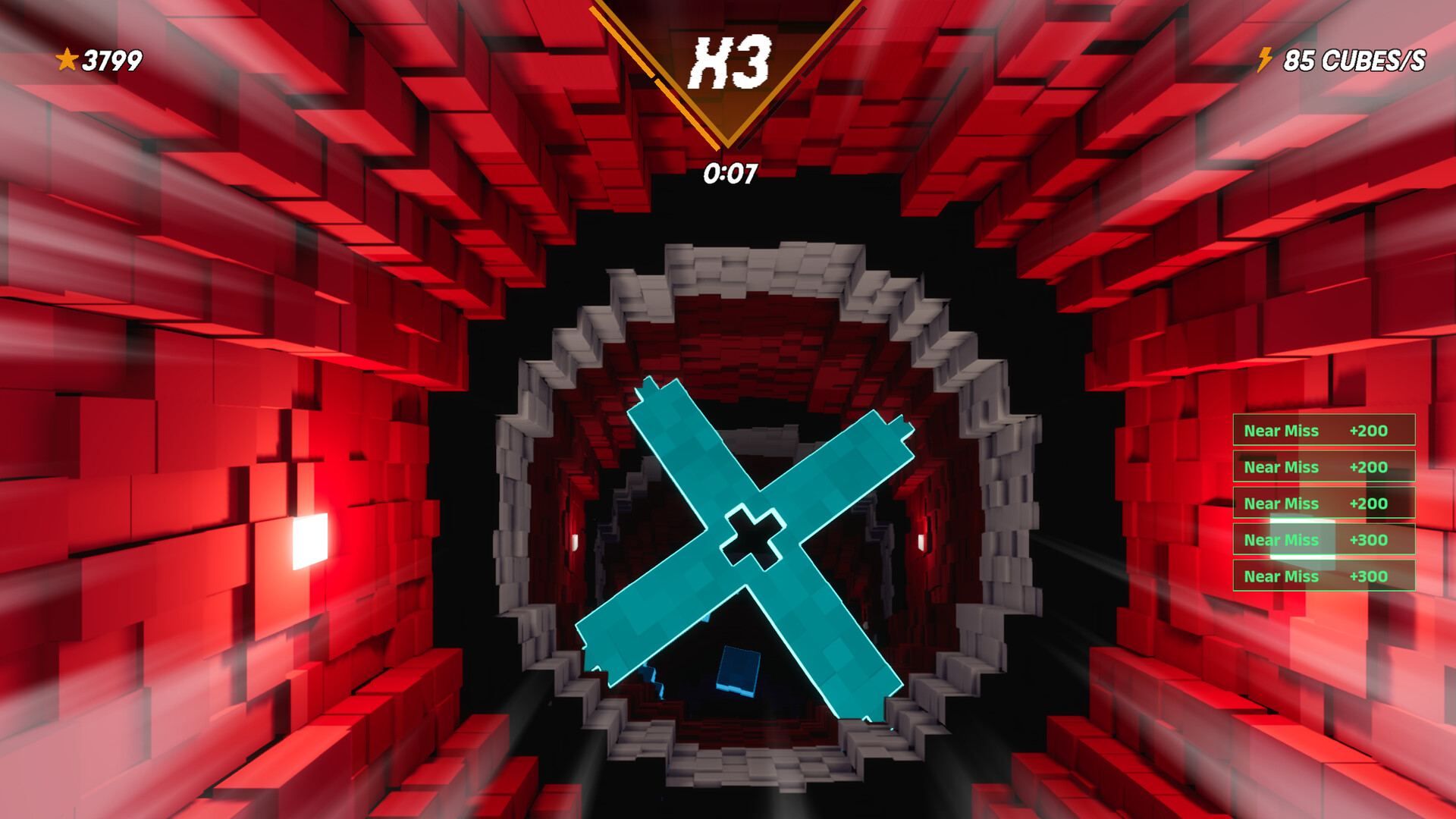
A red-toned stretch of tunnel with a teal X obstacle to dodge, one of the game's many recurring hazard shapes set against its ever-changing color schemes.Image: Pancake Studios via Steam