
Game review
Secret Agent Wizard Boy and the International Crime Syndicate
6.5 / 10
- Developer
- John Szymanski, Evan Szymanski
- Publisher
- David Szymanski
- Released
- 6 March 2025
- Platforms
- Windows
- Genre
- Action, Adventure, Indie
- Players
- Co-op
The short version
Biggest strengths
- A genuinely inspired, distinctive premise — a loving, physics-driven parody of early-2000s licensed PC wizard-school games — that reviewers describe generating some of the funniest emergent moments they've experienced in any game
- A deep, spell-combo-driven sandbox that rewards creative experimentation, with players consistently discovering unintended, hilarious exploits (enlarging objects into makeshift explosives, chaining spells for absurd results)
- Made by a small family team, including a developer with a well-regarded pedigree in the immersive-sim space, and reviewers consistently credit the obvious care and specificity of the Harry-Potter-game homage
Biggest weaknesses
- No persistent progression or saving of any kind currently exists — dying resets the player entirely back to the start, which several reviewers say undermines any sense of accumulated mastery or unlocked content
- An extremely fragile player character that dies from nearly any impact, which many reviewers find hilarious briefly but frustrating once they try to make actual progress
- Very short content even by Early Access standards, with detailed reviewers reporting as little as one to two hours before running out of new things to see
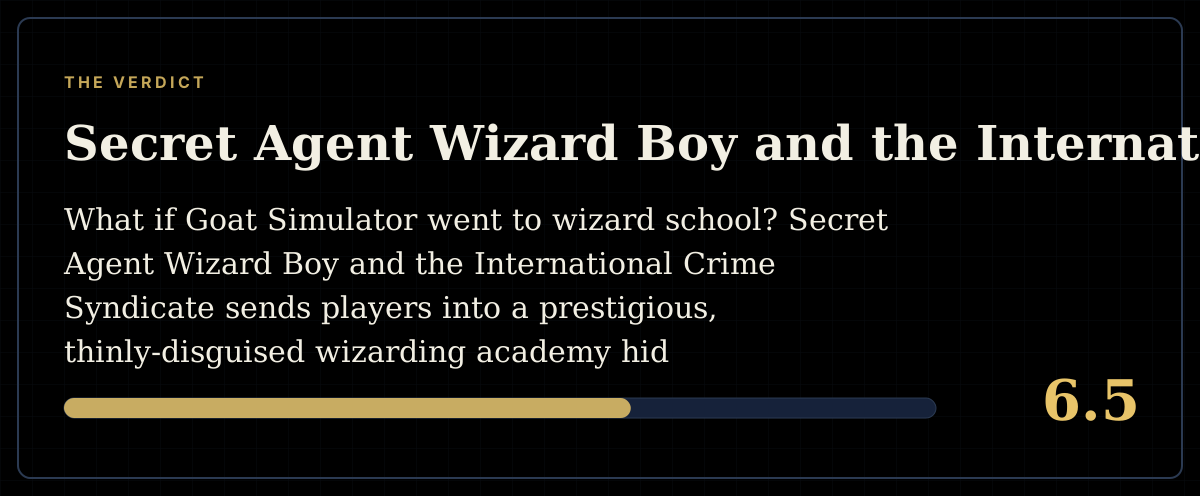
6.5 / 10
What if Goat Simulator went to wizard school?
Secret Agent Wizard Boy and the International Crime Syndicate sends players into a prestigious, thinly-disguised wizarding academy hiding a crime syndicate beneath it, armed with a growing arsenal of spells and, per the store page's own description, "military surplus explosives." It's built explicitly and lovingly in the image of the early-2000s licensed PC games based on a certain famous boy-wizard franchise, and based on the available English-language review sample of 788 reviews — 768 positive, 20 negative, landing at an Overwhelmingly Positive rating — that homage has connected with a very specific, very enthusiastic nostalgia. "Secret Agent Wizard Boy flashed me back (Ratatouille style) to when I was a kid playing the Harry Potter and the Chamber of Secrets PC game for hours trying to throw a gnome outside its intended puzzle so I could carry him around the rest of the game as a pet, I never was able to succeed. This is that feeling but as a real game," one reviewer writes, capturing precisely the specific, personal nostalgia the game is built to reward.
That nostalgia gets filtered through a genuinely deep, physics-driven sandbox that consistently produces the kind of emergent chaos this genre lives or dies on. "I don't know how, but somehow, some day, some guys thought the best Harry Potter game would be Goat Simulator. Turns out they were right," one reviewer writes, a comparison echoed across much of the review sample. One reviewer's detailed account of an emergent chain of events is worth quoting at length precisely because of how specifically absurd and unplanned it is: "Accidentally enlarged a Safe using a spell. In too deep, kept spamming the spell until the Safe clips through the walls. Stuck, have no idea what to do. While exploring, grabbed and throw a Health Potion to heal myself. The corpse next to my feet suddenly came back to life. Had a sudden brilliant idea. Search the map for a Teleportation Potion. Throw it at the Safe." That kind of genuinely surprising, self-generated problem-solving chaos recurs constantly across the sample as the game's central, most reliable pleasure.
A family project with real pedigree
Reviewers consistently note, with evident affection, that the game is a small family production. "I don't recommend this for everyone, but was created by 3 brothers," one reviewer writes matter-of-factly, and the broader positive reception reflects real appreciation for a project this personal and specific succeeding as thoroughly as it has. One especially detailed reviewer frames the appeal as sitting precisely at an intersection of very particular references: "This game is basically the most heart filled love letter to a very specific type of game based on two very English stories merged together. If you are in the intersection of any of these things you'll love it, if you are at the epicenter of them ALL, then you'll feel spiritual enlightenment."
No saving means every death costs everything
The single most substantive, most consistently raised criticism concerns the complete absence of persistent progression. "At this point, I can't recommend Wizard Boy — not because it's a bad game, but because it's missing some key features that I consider essential for long-term enjoyment. The biggest issue is the complete lack of permanent progression. Every time you quit the game, you start over from scratch. If you die seven times, that's it — back to the beginning. There's no saving system, and nothing you unlock persists," one detailed reviewer writes, a structural gap that directly undercuts the game's own sense of mastery and discovery over repeated sessions. That complaint connects directly to a second, related frustration: the player character's extreme fragility. "It's more frustrating than anything else. As many are quick to point out when folks complain about how easy death is, you can figure out the potions and get a million health. But before you figure out how to do that, or look up a guide, you die from jumping any amount of distance. You die from an object touching you, you die from bumping into a torch," one reviewer writes, describing a difficulty curve that depends heavily on knowledge the game doesn't yet clearly teach.
A separate reviewer frames the same fragility as initially funny but ultimately wearing thin: "Dying and wiggling around like a slug was hilarious for the first 5 minutes, but the novelty wore off very quickly. If the aim of this game is to die and search for a health potion to revive every 10 seconds, then they hit the nail on the head." That's a meaningful split in this review sample worth naming directly: many reviewers find the fragility itself part of the joke, contributing to the anarchic, slapstick tone, while a smaller but vocal minority finds it actively gets in the way of making real progress through the game's actual content.
Short, even generously judged as Early Access
Content length draws real, specific criticism even from reviewers otherwise sympathetic to an Early Access title. "Could be fun but 60 minutes of content isn't enough even for early access," one reviewer writes, and a separate reviewer reaches a similar conclusion with slightly more runtime: "Fun game, however, barely 2 hours of content. Not worth $10." One reviewer offers a more balanced framing, acknowledging the brevity while still crediting real underlying potential: "Even though it only took under a couple hours to complete the only available mission including screwing around and exploring, I still think this game has some potential... In its current state I don't know if it's worth buying since it feels more like a demo, but it was a lot of fun." A separate technical complaint concerns stability on some systems: "The game has a disgusting technical realization. The game crashes because of 'low video memory.'"
Notably, Secret Agent Wizard Boy currently has no Steam achievement system at all, leaving no structural markers of progress or content scope for players trying to gauge how much of the game they've actually seen — a real gap for an Early Access title still building out its systems, and one worth flagging directly for anyone weighing how much content the current build actually offers.
Where this leaves it
Secret Agent Wizard Boy and the International Crime Syndicate succeeds spectacularly at exactly what it sets out to do: recreate the specific, beloved jank and chaos of early-2000s licensed PC games as a deliberate, physics-driven sandbox built for creative destruction and emergent comedy. What currently holds it back from a stronger recommendation is entirely structural rather than creative — no persistent progression to reward repeated play, a fragile player character that some find funny and others find simply frustrating, and genuinely short content even by early-access standards. Strongly recommended for fans of physics sandboxes and immersive-sim chaos, especially anyone with fond memories of the specific genre this game is affectionately parodying, with the clear caveat that its current state rewards a single memorable session more reliably than sustained, long-term play.
Pros and cons
Pros
- A genuinely inspired, distinctive premise — a loving, physics-driven parody of early-2000s licensed PC wizard-school games — that reviewers describe generating some of the funniest emergent moments they've experienced in any game
- A deep, spell-combo-driven sandbox that rewards creative experimentation, with players consistently discovering unintended, hilarious exploits (enlarging objects into makeshift explosives, chaining spells for absurd results)
- Made by a small family team, including a developer with a well-regarded pedigree in the immersive-sim space, and reviewers consistently credit the obvious care and specificity of the Harry-Potter-game homage
- Genuinely funny, highly shareable co-op chaos when playing with friends
Cons
- No persistent progression or saving of any kind currently exists — dying resets the player entirely back to the start, which several reviewers say undermines any sense of accumulated mastery or unlocked content
- An extremely fragile player character that dies from nearly any impact, which many reviewers find hilarious briefly but frustrating once they try to make actual progress
- Very short content even by Early Access standards, with detailed reviewers reporting as little as one to two hours before running out of new things to see
- Reported crashes tied to video memory issues on some systems
- No Steam achievement system currently exists at all
Screenshots
-

Secret Agent Wizard Boy and the International Crime SyndicateImage: David Szymanski via Steam -

Secret Agent Wizard Boy and the International Crime SyndicateImage: David Szymanski via Steam -

Secret Agent Wizard Boy and the International Crime SyndicateImage: David Szymanski via Steam -
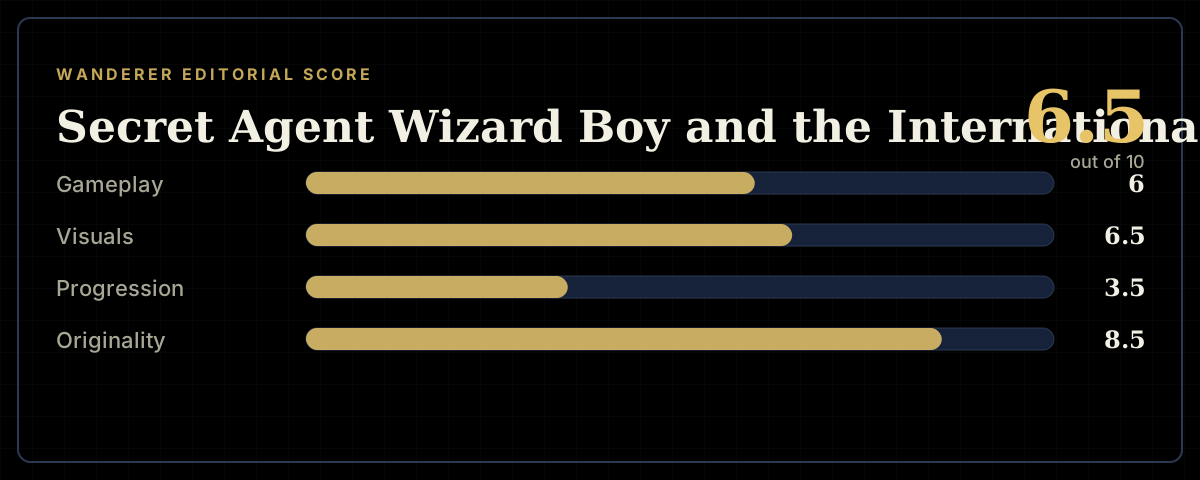
How the review scores each part of the gameWanderer Editorial -
The short versionWanderer Editorial