
Game review
Planet Nine Review
5.6 / 10
- Developer
- haizai
- Publisher
- RED GAUGE STUDIO
- Released
- 9 September 2026
- Platforms
- ["Windows"]
- Genre
- Puzzle
A Suika-Style Merge Game That Launches Planets Like Billiard Balls
Planet Nine takes the now-familiar "merge two matching shapes to make a bigger one" formula popularized by Suika Game and gives it a genuinely different physical language: instead of dropping shapes from above to stack them under gravity, players aim and launch small planets across the play field like billiard balls, sending them crashing into each other to merge, with the resulting planet occasionally cannoning off in an unpredicted direction and threatening whatever's in its path. Starting from a tiny Mercury and working up through the solar system's real relative scale toward the elusive, unconfirmed "ninth planet" that gives the game its name, each run lasts three to five minutes, is played entirely with a mouse, and ends the moment any planet crosses a red line at the bottom of the screen. It's built by a two-credit team, solo developer haizai and publisher RED GAUGE STUDIO, ships with 17 language options including English and Japanese, and launched on Steam on September 9, 2026, priced at $6.99 before a 10% launch discount brought it to $6.29.
A Tiny Launch Pool, Almost Entirely in Japanese and Chinese
Planet Nine launched to just 8 total reviews across languages at the time of writing, 7 positive and 1 negative, too small a sample for Steam's percentage tiers but a clear early lean toward approval. Every review in the pool is written in Japanese or Simplified Chinese, with nothing yet in English despite the game explicitly listing English support among its 17 localizations, so this early verdict comes entirely from an audience discovering the game through Japan's and China's respective storefronts rather than the West's.
A Physical Twist That Reviewers Say Genuinely Refreshes a Crowded Genre
The positive reviews are unusually specific for a pool this small, and they converge repeatedly on the same idea: the billiard-style launch mechanic isn't just a cosmetic change from typical merge games, it meaningfully alters how the genre feels to play. One detailed Chinese-language review, posted by a Steam curator group, calls it essentially "a planet-themed version of Suika Game, but built bottom-up," praising how the planets' relative sizes roughly follow the real eight planets' proportions and highlighting the daily, monthly, and all-time regional leaderboards alongside a coin system that unlocks cosmetic themes, music, and gallery art as a source of ongoing positive feedback. A Japanese reviewer who reached the ninth planet describes the loop in almost the same terms independently, noting planets move "like billiard balls" and that crossing the red line ends the run, and admits to writing the review specifically so they could go start another game immediately afterward. Multiple other Japanese reviews describe losing track of time entirely, with one writing that a run that starts with casually flicking planets around demands increasingly precise, nerve-wracking force control once the board fills up roughly halfway, and another praising how a merged planet's unpredictable post-collision trajectory keeps play from ever feeling fully automatic or rote, even after the core loop becomes familiar. Cute presentation earns consistent, if brief, praise across nearly every review, several single-line reviews simply calling it charming and easy to pick up during small pockets of free time.
A Physics Engine That One Detailed Reviewer Says Undercuts the Puzzle Itself
The pool's lone negative review is also its most technically detailed, and it's worth taking seriously precisely because its author is otherwise sympathetic to the game. Having reached the ninth planet twice specifically to write an informed review, the reviewer states plainly they find the game hard to recommend, not because it's poorly made or lacks charm, both of which they credit it with having, but because the physics-engine behavior governing planet collisions produces a level of unpredictability that, in their judgment, crosses from charming chaos into genuine player-facing stress once a run gets crowded, undermining its credibility specifically as a puzzle game rather than as a looser physics toy. The same review flags two smaller, more concrete limitations: the game supports only fullscreen display, offering players no windowed option, and while it's playable with a gamepad as well as a mouse, fine positional adjustment is noticeably harder with a controller, leaving mouse control as the clearly preferable way to play despite the flexibility on offer. None of the game's other reviewers raise the physics complaint directly, but it's a specific, reasoned critique from someone who otherwise liked enough about the game to finish it twice, which gives it real weight even inside an overwhelmingly positive pool.
Verdict
Planet Nine takes a genre that's grown crowded with near-identical Suika clones and finds a legitimately different feel for it, swapping vertical stacking for a billiard-style launch mechanic that reviewers describe as genuinely more tense, more unpredictable, and more replayable than the format they were expecting. Its small early audience, so far entirely Japanese- and Chinese-speaking despite built-in English support, backs that up with real enthusiasm for its cute presentation, its real-planet scaling gimmick, and its leaderboard-and-unlock structure. But it's worth weighing the game's most detailed critical voice, who argues the same physics system that makes runs feel alive can also tip into genuine frustration once the board fills up, alongside real if minor limitations like fullscreen-only display and imprecise controller aiming. At $6.29 for a game built around three-to-five-minute sessions, this is an easy recommendation for merge-puzzle fans who want a twist on the formula and don't mind a little chaos with their relaxation, with the caveat that the same unpredictability some players find thrilling, at least one careful reviewer found genuinely at odds with the puzzle-solving satisfaction the genre is supposed to deliver.
Screenshots
-
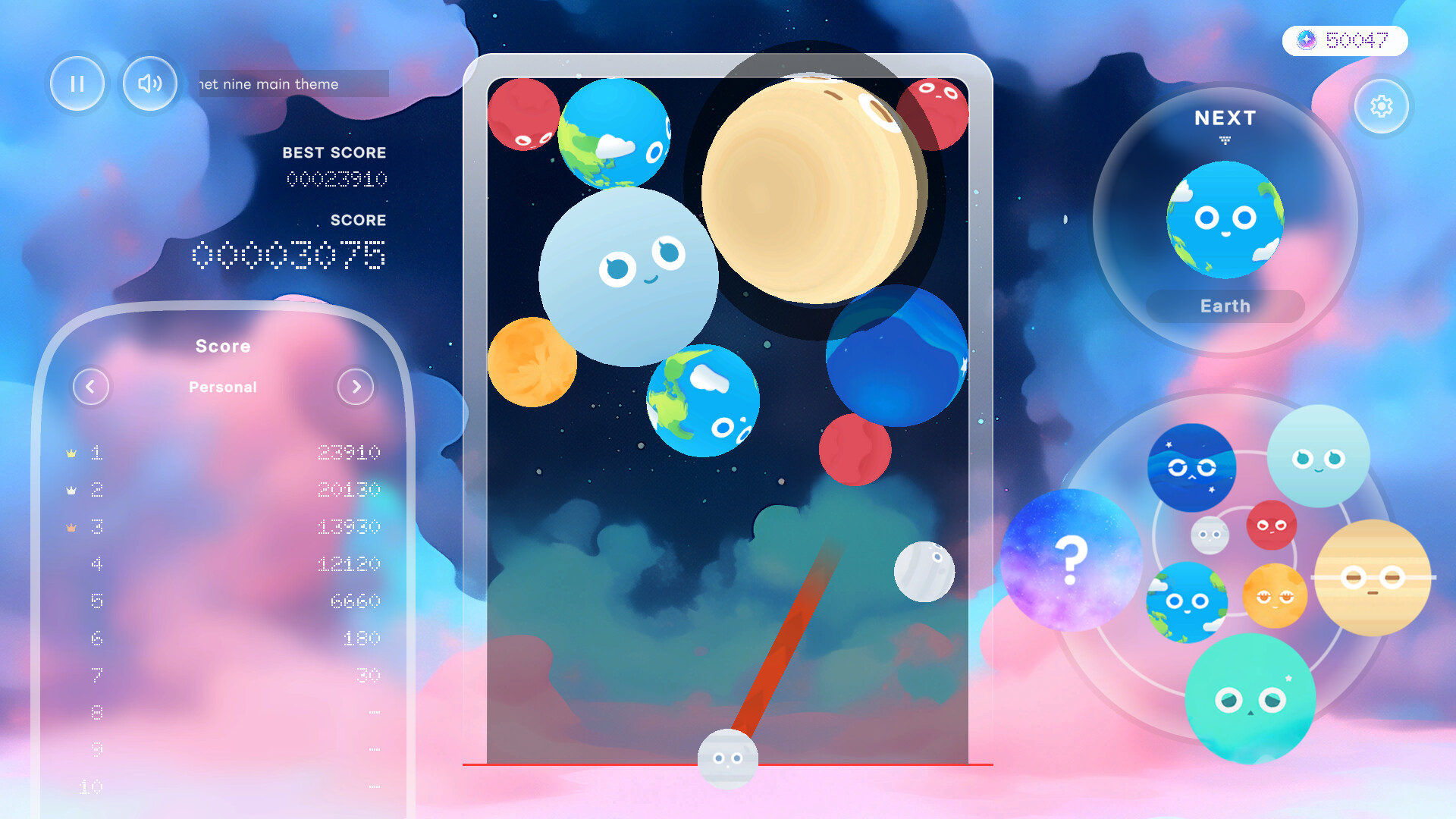
Planets pile up above the red line as a run escalates, with personal-best leaderboards tracked alongside the current scoreImage: RED GAUGE STUDIO via Steam -
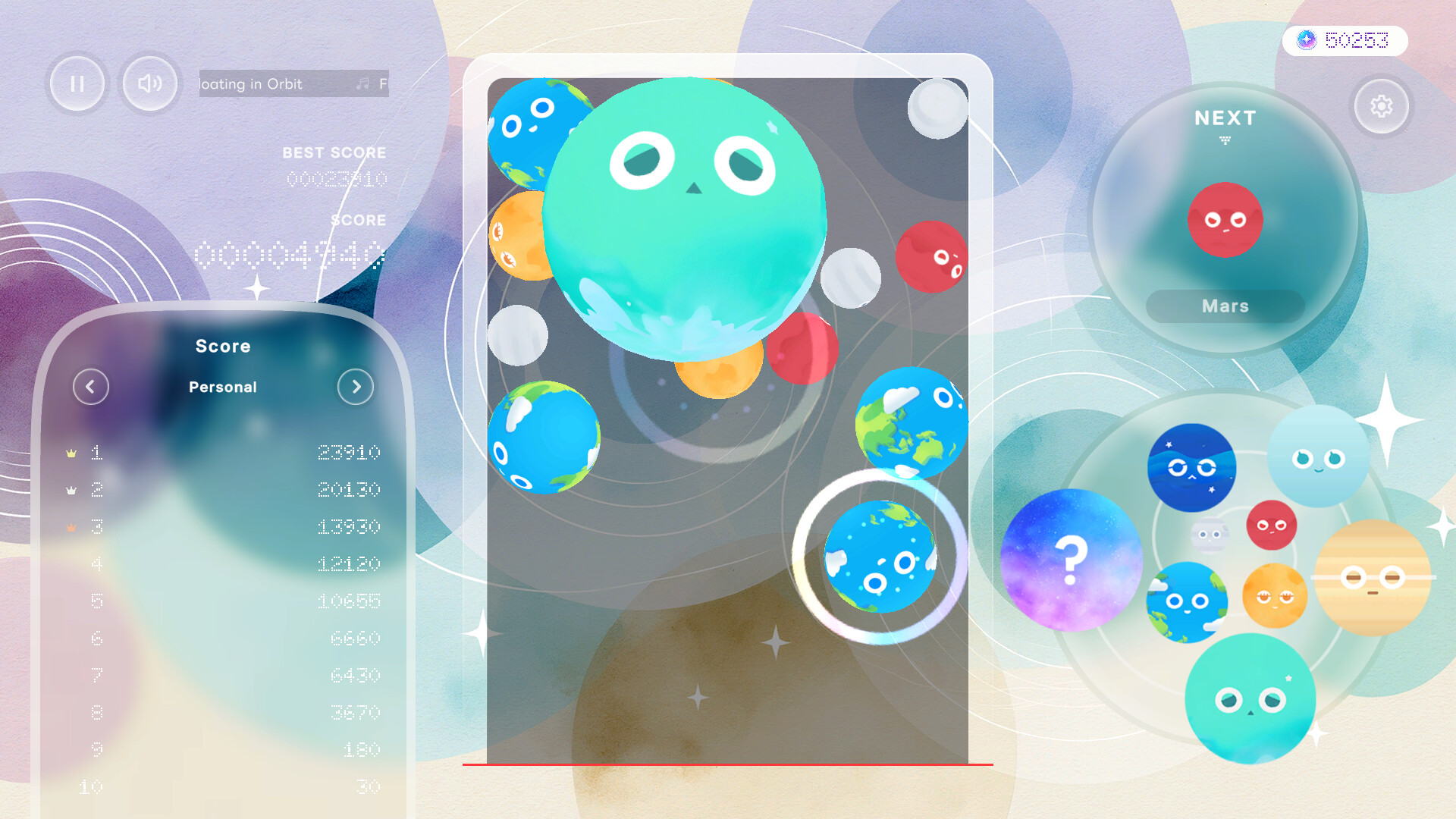
A larger merged planet dominates the board, with the next planet in the launch queue previewed in the cornerImage: RED GAUGE STUDIO via Steam -
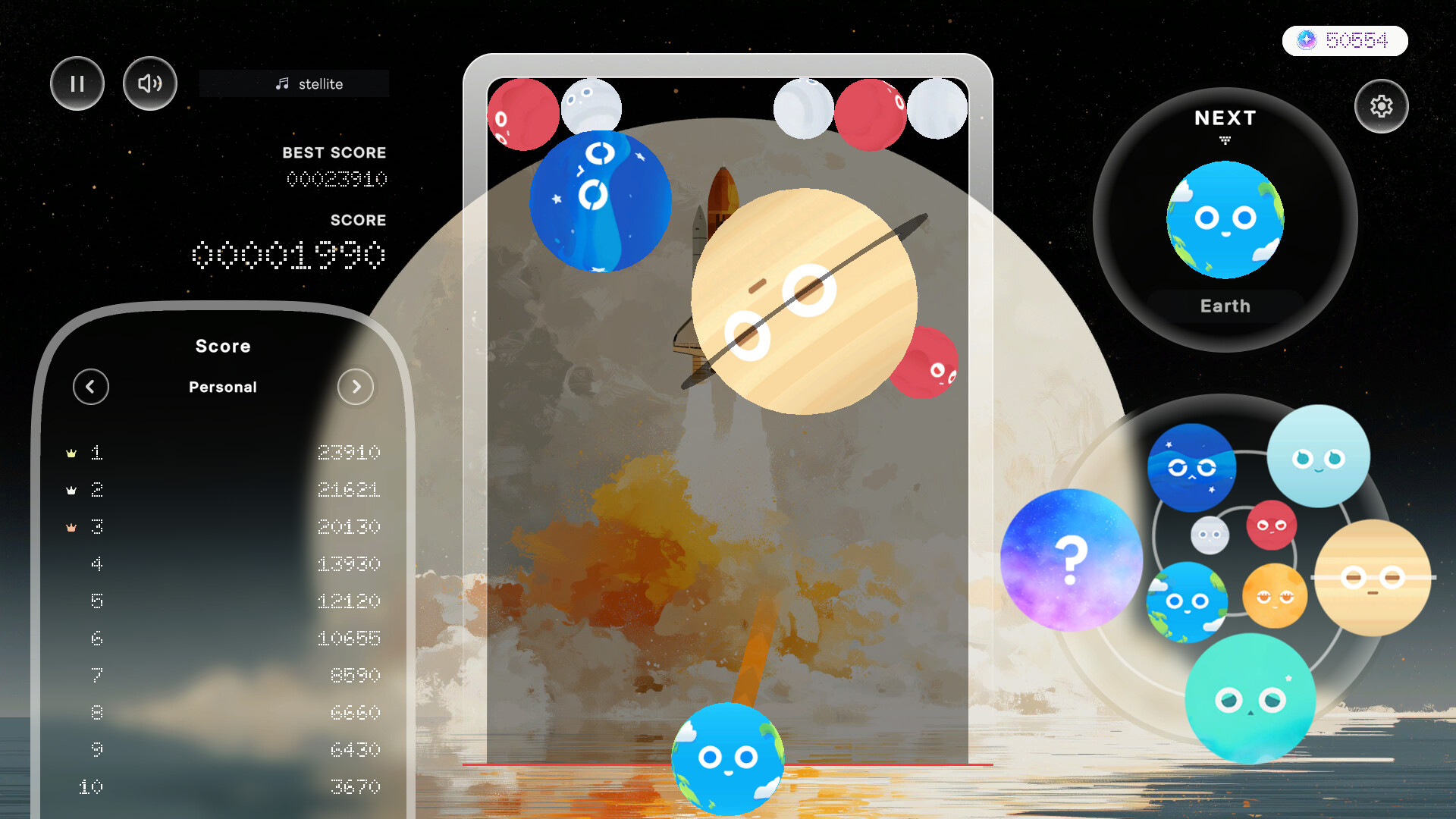
Cosmetic background themes, like this rocket-launch backdrop, are among the unlocks reviewers say give runs extra long-term pullImage: RED GAUGE STUDIO via Steam