
Game review
Megaloot
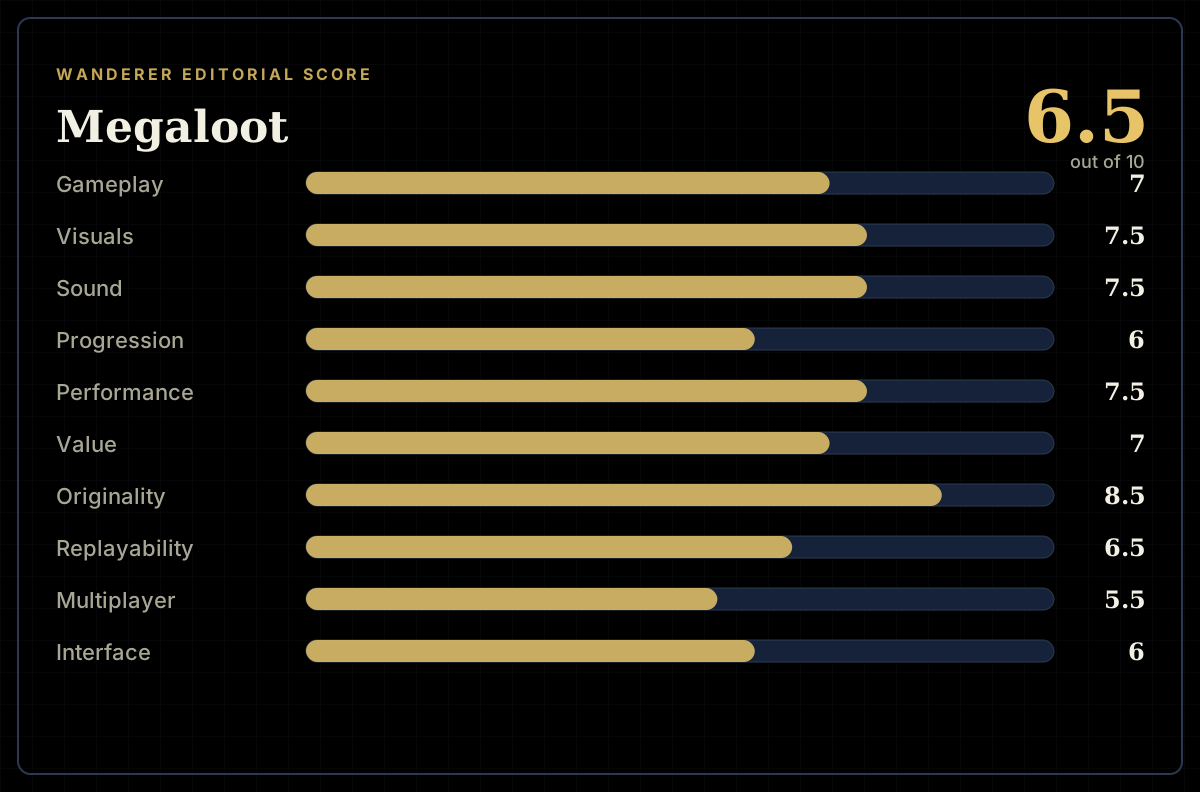
6.5 / 10
- Developer
- axilirate
- Publisher
- Ravenage Games and Sidekick Publishing
- Released
- 30 August 2024
- Platforms
- Windows
- Genre
- Roguelite / Inventory Management RPG
- Monetisation
- Premium one-off purchase; one optional DLC (a soundtrack) that adds nothing to gameplay; no ads, no in-game currency, no subscription
- Players
- Online co-op and PvP alongside single-player; co-op stability is a recurring complaint in player feedback
The short version
Megaloot's premise is genuinely sharp: instead of loot management being the tedious admin between the interesting parts of a roguelite, it is the interesting part. Dragging items around a grid, banishing the ones you don't want for a shot at something better, and stacking twenty- seven overlapping stats into a build that suddenly clicks is a real, distinct kind of fun that most loot games never bother chasing.
It's also a game that has spent well over a year rewriting its own rules out from under the players who liked it first. Skill trees got pulled and replaced. Set bonuses that used to define builds got quietly gutted. The developer never explains the twenty-seven stats to begin with, and a meaningful slice of the audience has watched updates remove the exact systems that made their early runs feel good. The idea is still excellent. The execution has been a moving target.
Biggest strengths
- Discarding an unwanted item briefly grants its power before it's gone, turning inventory cleanup into a real tactical choice rather than housekeeping
- Twenty-seven overlapping stats and 150-plus items produce genuine emergent builds that don't resemble a simple damage-stacking exercise
- Ten characters with distinct starting kits change which stats and item types are worth chasing from the first floor
Biggest weaknesses
- The game never explains its own stat system, and tooltips rarely clarify why a build is or isn't working
- Several major systems present at launch, including full skill trees and set-specific bonuses, have since been removed or significantly cut down
- There is no meta-progression between runs, so a bad early read on a build can make an entire attempt feel like a foregone conclusion
Who it's for: Players who like puzzling out a system through trial and error more than being taught it, and anyone who finds real satisfaction in optimising a grid of items rather than a character sheet. Players who want a roguelite that respects their time with steady meta-progression, or who get frustrated when a game changes its own rules after they've already learned them, should be more cautious.
Our recommendation: Worth the asking price for the core idea alone, and the free demo removes any risk in finding out whether the lack of a tutorial is charming or maddening for you personally. Go in expecting a game still being actively rebalanced rather than a finished, settled design.
6.5 / 10
Most loot games treat the inventory screen as a tax you pay between the parts that matter — the menu you tolerate so the fighting can continue. Megaloot's whole pitch is refusing that trade. You don't manage loot around the game. The loot management is the game, and for a genre that usually buries its best ideas under combat systems, that's a distinctive enough premise to build a whole review around testing whether it actually holds up.
It mostly does, floor to floor. Whether it still holds up as a finished product, after well over a year of the developer rewriting core systems in response to its own community, is a much messier question, and the honest answer sits somewhere in the middle of Megaloot's own review score.
The grid is the whole fight
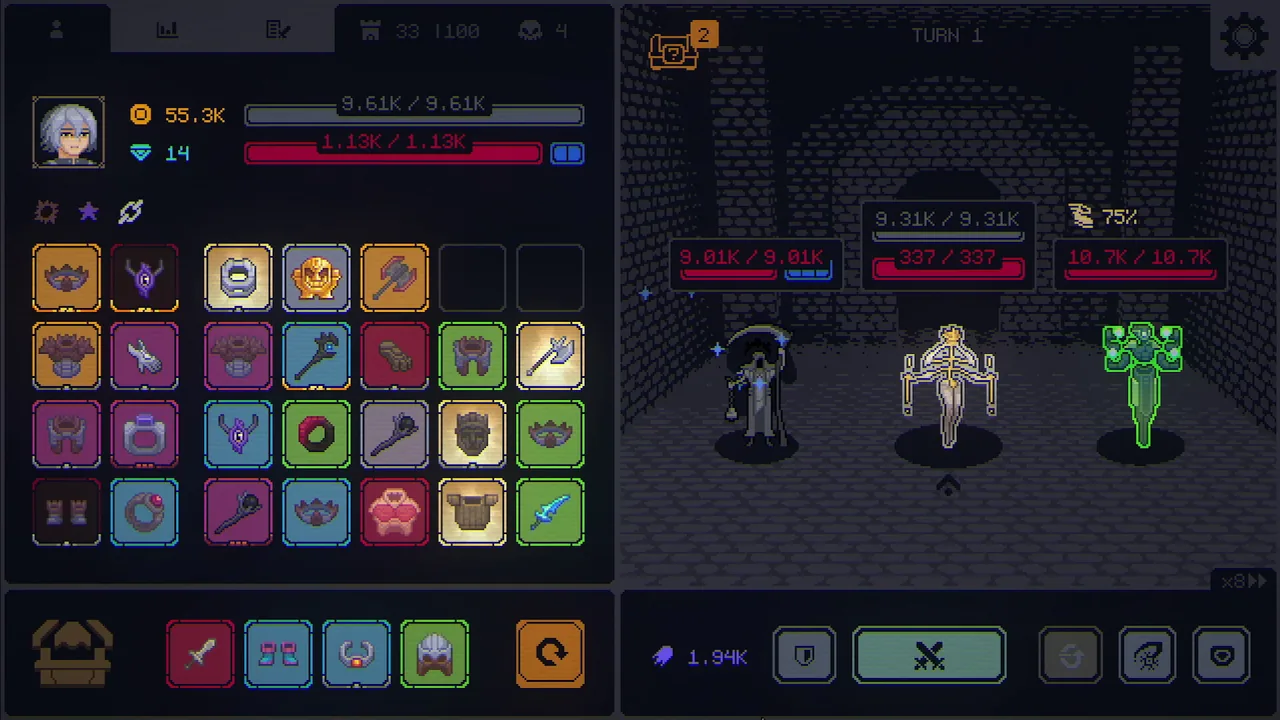
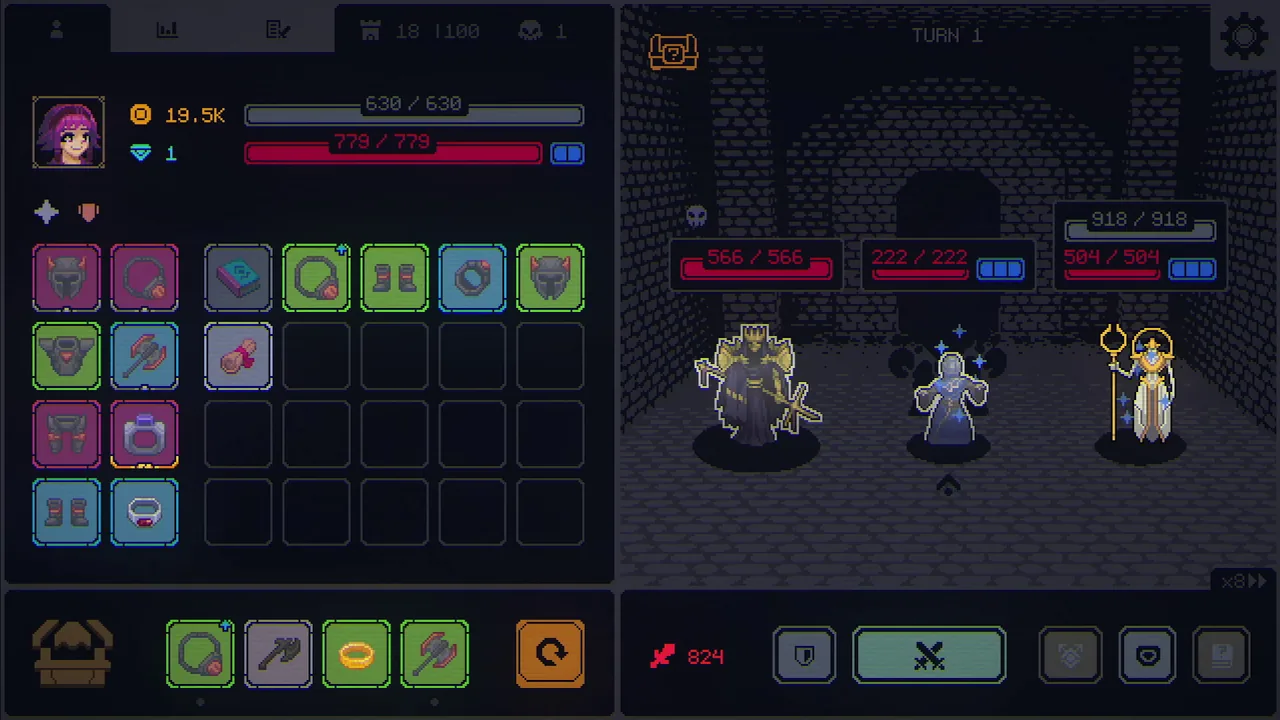
Every run drops you into a tower with a limited number of item slots and a shop full of gear you can't yet afford. The trick isn't just picking upgrades — it's the game's central mechanic of absorbing power from items you discard. Sell or banish something you no longer need and its stats briefly flow through your build before disappearing, which turns even the act of clearing inventory space into a live tactical decision rather than bookkeeping. Do you keep a mediocre ring for its slot, or banish it mid-fight for a temporary spike and gamble that the shop refreshes with something better? That single loop — hold, discard, absorb, gamble on the replacement — is Megaloot's best idea, and it's one very few loot-focused games have actually built a combat system around rather than just referencing in passing.
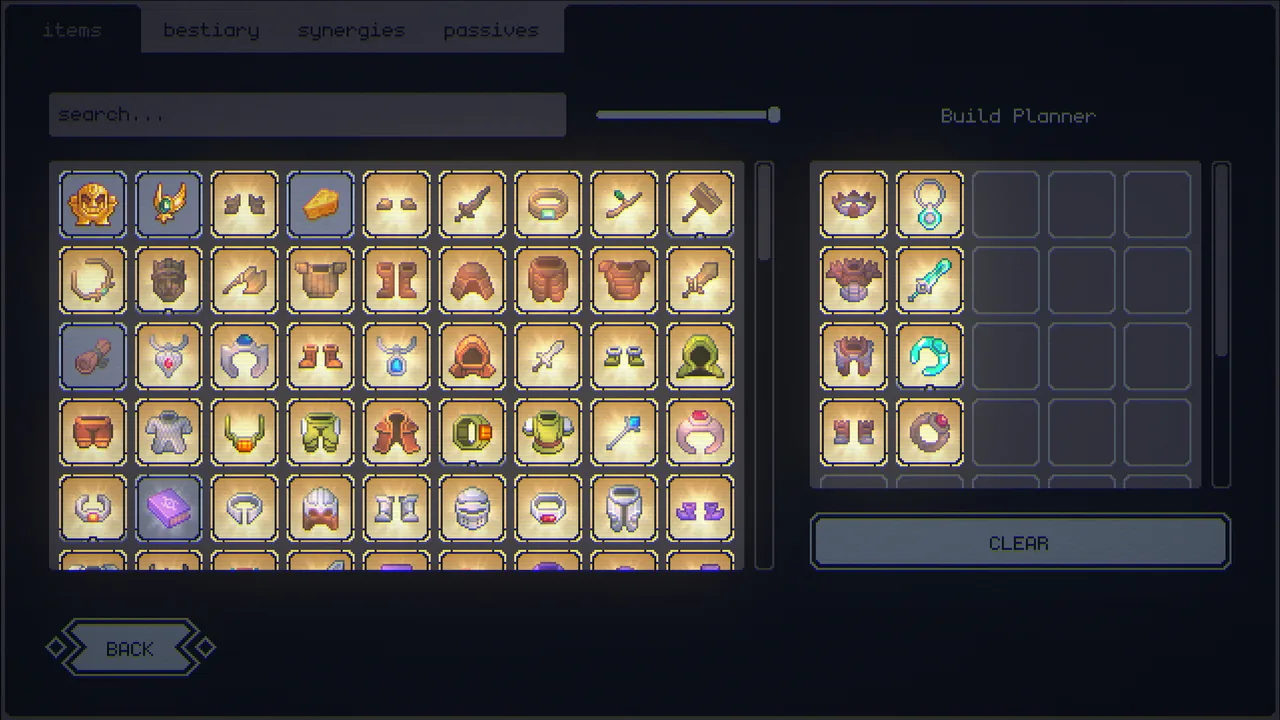
Twenty-seven stats sit underneath that loop: Strength, Wisdom, Faith, Toxicity, Recovery and others, each interacting with specific item types and character kits in ways the game never spells out. Ten characters change which of those stats are worth chasing from floor one, and a genuinely different build can emerge from the same shop inventory depending on who you're playing. On paper, that's a deep synergy system, and 150-plus items is enough raw material to support it.
Turn-based combat that's really a delivery system
Combat resolves in turns rather than real time, and that's the correct call for a game this committed to stat-reading — a fight you can pause and study rewards a build you actually understand better than a fight you're reacting to on reflex. The problem is that Megaloot deliberately doesn't help you build that understanding. Multiple long-time players report reaching dozens of hours in without being able to explain why a multi-hit triggered on one turn and not the next, or why a health total that read in the thousands suddenly reads in the millions with no visible cause. That's not one isolated complaint — it's the single most consistent objection in the negative feedback, and it points at a real design tension: opacity can be a deliberate, respected choice in a game that rewards the digging (there's a real tradition of that in this genre), but only if the numbers underneath are consistent enough to reward the digging once it happens. Enough players report the opposite — that the effort to reverse-engineer a stat interaction doesn't reliably pay off — that this reads as a genuine weakness rather than a difficult-but-fair puzzle.
No safety net between runs
There's no meta-progression carried between attempts. Die on floor forty and the next run starts from the same blank slate as the first one did. That's a legitimate design choice — it keeps every run's build decisions meaningful instead of diluted by permanent unlocks doing the work for you — but it raises the stakes on the game actually teaching you enough to make an informed choice early, which is exactly the piece Megaloot is proudest of skipping. A player who reads the shop wrong on floor two is often just watching a foregone conclusion play out for the next thirty minutes, with no tutorial, no retry-with-hindsight advantage, and no compensating unlock to soften the loss. Compare that to genre neighbours that layer in a persistent tech tree or currency between runs, and Megaloot's refusal to do the same reads less like purity and more like a missed opportunity to make failure feel like progress instead of just failure.
A moving target, patch after patch
This is where Megaloot's story gets complicated, and it's the pattern that shows up over and over in the negative reviews once you look past the individual complaints about difficulty. The game launched in August 2024 with a fuller build of its own systems than it currently ships — full skill trees existed per character, and item sets carried bonuses specific to that set that made mixing and matching gear a real strategic axis. Updates since then have replaced the skill trees with a single passive and a single active ability per character, and cut down which item sets still grant a bonus when combined with others. Long-time players describe builds that used to define a run no longer functioning the way they remember, and more than a few reviews explicitly frame the current version as a worse game than the one they bought.
That's worth separating from ordinary post-launch grumbling. This isn't a vocal minority reacting to one bad patch — it's a recurring theme across reviews written months apart, several from players with thousands of minutes logged who came back specifically to check on changes and left disappointed by what they found. At the same time, the developer hasn't gone quiet: mini-updates were still shipping as of this writing, more than a year and a half after release, including continued rebalancing, quality-of-life fixes like a market search function, and folder-based modding support for the community that's stuck around. Active support is a real point in Megaloot's favour. It just hasn't yet translated into the systems settling down, and a buyer today should know they're picking up a game still being actively rebuilt rather than a finished, stable design.
Co-op exists, but leans on you tolerating it
Online co-op and PvP sit alongside the single-player tower climb, and the games-with-friends experience gets specifically praised by some players as the mode where Megaloot is at its best. It's also the mode most consistently flagged for desync issues — fights where players end up seeing different enemies or states than their partner, undermining the shared-run appeal the mode is built around. A basic lobby-ready system that several players have asked for isn't reliably in place, which is a small thing but a telling one: a loot game whose core interest is precise numbers matching between players is a bad place to have synchronisation gaps.
A UI-heavy game that only half solves its own UI problem
Given that Megaloot is, structurally, a game made of menus — inventory grids, shop screens, stat panels, a dismantle option that resurfaces on a floor cadence — its interface has to do more work than most roguelites ask of theirs, and it's a mixed result. The grid itself is legible and item comparison is straightforward enough moment to moment. Where it falls down is exactly the point already raised about the stat system: tooltips exist, but players consistently report that they don't clarify the underlying math, which turns a UI-first game's most important job — explaining what your own numbers are doing — into the thing it does least well. A game this dependent on its own interface to teach mechanics doesn't get to treat "figure it out yourself" as a stylistic choice without it also being an interface failure.
Presentation carries what the systems don't always explain
Even players frustrated with balance and clarity tend to agree on two things: the game has a strong visual identity, and its audio design is a clear strength, with satisfying feedback on hits, drops and item pickups that makes the moment-to-moment loop pleasant even during a run that's clearly going sideways. That presentation layer is doing real work carrying players through the stretches where the underlying systems are asking more patience of them than they've earned.
Performance and value
Megaloot is a light, Windows-only download with modest system requirements, and there are no recurring reports of performance problems or crashes in the feedback — the one notable exception is an isolated report of the game failing to launch entirely after an update, which reads as a specific bug rather than a pattern echoed elsewhere. At NZ$14.75, backed by a free demo that lets you test the tutorial-free learning curve before paying, and a purely cosmetic soundtrack DLC that changes nothing about the game itself, the asking price is fair for what's here even accounting for the instability in its own design. Players who want their progression systems to stay put once they've learned them, the way Wanderer's own gathering and gear systems are built to hold steady patch over patch, should treat that as the deciding factor rather than the price tag.
Verdict
Megaloot's central idea — that discarding and rearranging loot can be the actual game rather than the admin around it — is good enough to be worth the entry price on its own, and the character and stat variety give that idea real room to breathe. What keeps this from scoring higher is that the game has spent much of its life since launch removing and rewriting the systems that made its early version work, without ever building the tutorial its opacity-as-design philosophy has always needed. A 6.5 reflects a genuinely original concept that hasn't yet found a stable, well-taught version of itself to settle into.
Pricing and platform details checked 30 July 2026.
Pros and cons
Pros
- Discarding an unwanted item briefly grants its power before it's gone, turning inventory cleanup into a real tactical choice rather than housekeeping
- Twenty-seven overlapping stats and 150-plus items produce genuine emergent builds that don't resemble a simple damage-stacking exercise
- Ten characters with distinct starting kits change which stats and item types are worth chasing from the first floor
- A free demo lets you test the deliberately unexplained learning curve before paying anything
- The developer is still shipping regular updates well over a year after launch rather than abandoning the game
Cons
- The game never explains its own stat system, and tooltips rarely clarify why a build is or isn't working
- Several major systems present at launch, including full skill trees and set-specific bonuses, have since been removed or significantly cut down
- There is no meta-progression between runs, so a bad early read on a build can make an entire attempt feel like a foregone conclusion
- Online co-op is reported to desync regularly enough that it undermines the feature it's built around
- Balance swings hard between patches, and long-time players describe builds that used to work no longer functioning the same way
Screenshots
-
MegalootImage: Ravenage Games via Steam -
MegalootImage: Ravenage Games via Steam -
MegalootImage: Ravenage Games via Steam -
How the review scores each part of the gameWanderer Editorial -
The short versionWanderer Editorial