Game review
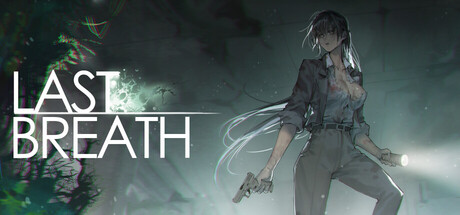
Last Breath Review
6.5 / 10
- Developer
- HP⁺ DOG
- Publisher
- HP⁺ DOG
- Released
- 28 August 2026
- Platforms
- ["Windows"]
- Genre
- Action
A Fungal Apocalypse, a Missing Sister, and a Two-Person Team's Ambitious Debut
Last Breath puts players in control of Guan Jin, an older sister searching a fungus-ravaged world for her missing sibling after the population has been overrun by what its own marketing calls "Spore Zombies." It's a 2.5D side-scrolling survival shooter, blending hand-drawn 2D character and environment art with a layered, walkable 3D-feeling stage design that lets Guan Jin move between foreground and background planes as she scavenges, shoots, and dodges her way through roughly five chapters. What makes the game notable isn't just its scope, but who made it: reviewers who found the developers' hidden in-game Easter-egg rooms report the whole thing was built by a team of only two people, reportedly pouring around 2,000 hours into what started as a smaller passion project. For a $6.99 asking price, that's an unusually large and polished undertaking from such a small studio.
Last Breath sits in a specific and growing niche that reviewers compare to games like Killing Antidote: story-driven "erotic East Asia horror," where a striking, capable heroine fights monsters while sporting a wardrobe of unlockable outfits that visibly tear and degrade as she takes damage in combat. Reviewers are consistent that this is fan service without crossing into explicit content — no nudity, no sex — and that the game's own store description is upfront about the clothing-damage system rather than hiding it. Whether that appeals to a given player is obviously a matter of taste, but it isn't dishonestly marketed.
Solid, Weighty Gunplay Anchored by a Surprisingly Affecting Story
The most consistent praise across reviews lands on two things: the combat and the storytelling. Guan Jin can carry a genuine arsenal of realistic firearms and calibers rather than the abstracted weapon sets typical of budget indie shooters, and reviewers describe the shooting, dodging, melee backstabs, and throwable-grenade options as tight and satisfying, with well-balanced boss fights that reward exploiting weak points and managing utility items like molotovs. Several reviewers say the narrative caught them off guard given the price point, describing genuine emotional investment in the world's mysteries, hidden lore notes, and a small cast that, while thin, left a real impression by the credits. More than one reviewer says the ending stuck with them well after finishing, and multiple describe replaying the roughly 10-to-20-hour campaign in New Game+ purely because they wanted more time with it.
The art direction draws consistent praise too: hand-painted 2.5D environments, a genuinely upsetting fungal-horror aesthetic, and creature designs that reviewers say feel consistent and purposeful rather than thrown together. One detail worth noting honestly: at least one reviewer flags that the game's achievement icons appear to be AI-generated, standing out against the otherwise entirely hand-drawn art — a small, specific observation about the game's own production rather than a judgment on the review itself.
A Resource Curve That Loosens Instead of Tightens, and a Rocky Endgame
Where Last Breath runs into real trouble is pacing and balance. Multiple reviewers independently flag the same problem: ammo and healing items are generous early and become lopsided later, with some weapon types (like rifles and pistols) staying scarce while others (shotgun shells, medkits) pile up in surplus. One detailed review calculated finishing the game with 100 shotgun shells, 400 pistol rounds, 300 rifle rounds, and 50 grenades left unused at the final boss — describing the game as abandoning its own early survival-horror tension (a contamination meter and stealth options introduced in chapter one) in favor of becoming a straightforward action shooter well before the credits. The practical effect is that normal difficulty trends toward too easy rather than too hard, which undercuts a horror game that otherwise wants its atmosphere taken seriously.
The endgame draws the sharpest specific criticism. Multiple reviewers single out the final boss fight as a poorly designed three-phase gauntlet — an enemy-spam gauntlet, a roughly 90-second tower-defense segment, then a flying-enemy and gas-cloud spam phase with an unclear damage threshold — that forces a full restart from phase one on failure. Reviewers who played before an August 31st patch describe genuine frustration bordering on giving up on the game entirely at that point; the patch reportedly added a mid-fight checkpoint and softened the difficulty, which reviewers who experienced the fix say helped meaningfully, though the underlying "bullet-spam" design of the encounter still draws complaints even afterward.
Dialogue Delivery, UI Rough Edges, and Missing Quality-of-Life Options
The most frequently repeated complaint across both positive and negative reviews isn't about combat at all — it's about how the story text is delivered. Dialogue scrolls automatically at a pace multiple reviewers describe as too slow to read comfortably, yet advances on its own regardless of whether the player has finished reading, and several reviewers report it can appear during active combat and boss fights with no way to pause it, effectively forcing a choice between reading the story and surviving the fight. There's no manual-advance or slow-down option, and a couple of reviewers say they missed entire plot beats as a result, or had to reload earlier saves just to re-watch cutscenes they couldn't finish reading the first time. Given how much reviewers otherwise praise the writing and worldbuilding, this feels like the single most fixable issue holding the game back.
Smaller interface complaints stack up too: there's no key rebinding, which several reviewers specifically ask for given the number of context-sensitive actions (weapon switches, kick, two separate healing item types, flashlight, grenades) crammed onto a handful of keys; the character portrait in the UI always shows Guan Jin's default outfit rather than whatever costume is actually equipped; and later chapters introduce foreground scenery (like parked cars in a town-map chapter) that can obscure enemies until they're already attacking, along with environmental damage-over-time hazards that reviewers say tick inconsistently. None of these individually sink the experience, but together they contribute to the sense of a talented two-person team that ran out of runway for polish before launch.
Verdict
Last Breath is a rough-edged but genuinely impressive debut from a two-person studio, delivering a hand-drawn fungal-horror shooter with real emotional stakes, satisfying gunplay, and a huge amount of content for a $6.99 asking price. Its combat and art direction consistently outperform its budget, and its story left a real impression on reviewers who came in expecting little more than a fan-service shooter. But an unbalanced resource curve that drains the game's early survival-horror tension, a genuinely punishing (if since-patched) final boss, and dialogue delivery that actively fights the player during combat all hold it back from being a clean recommendation without caveats. For horror-shooter fans willing to tolerate some real jank in exchange for a cheap, heartfelt, and surprisingly ambitious ride, Last Breath is well worth the price of admission.
Pros:
- Weighty, varied gunplay with a genuinely large arsenal of realistic weapons
- A surprisingly emotional story and consistent, atmospheric hand-drawn art direction
- An enormous amount of content, replayability, and difficulty options for a $6.99 price
- Well-balanced early boss fights that reward smart resource and utility-item use
- Built almost entirely by a two-person team, with hidden dev rooms and easter eggs to find
Cons:
- Dialogue auto-advances too quickly and often continues uninterrupted during combat
- Ammo and healing resources become badly imbalanced later, flattening the difficulty
- The final boss was a widely criticized spam gauntlet before an August 31st balance patch
- No key rebinding despite a large number of context-sensitive combat actions
- UI and visual issues, including a costume-mismatched portrait and obscuring foreground objects
Screenshots
-
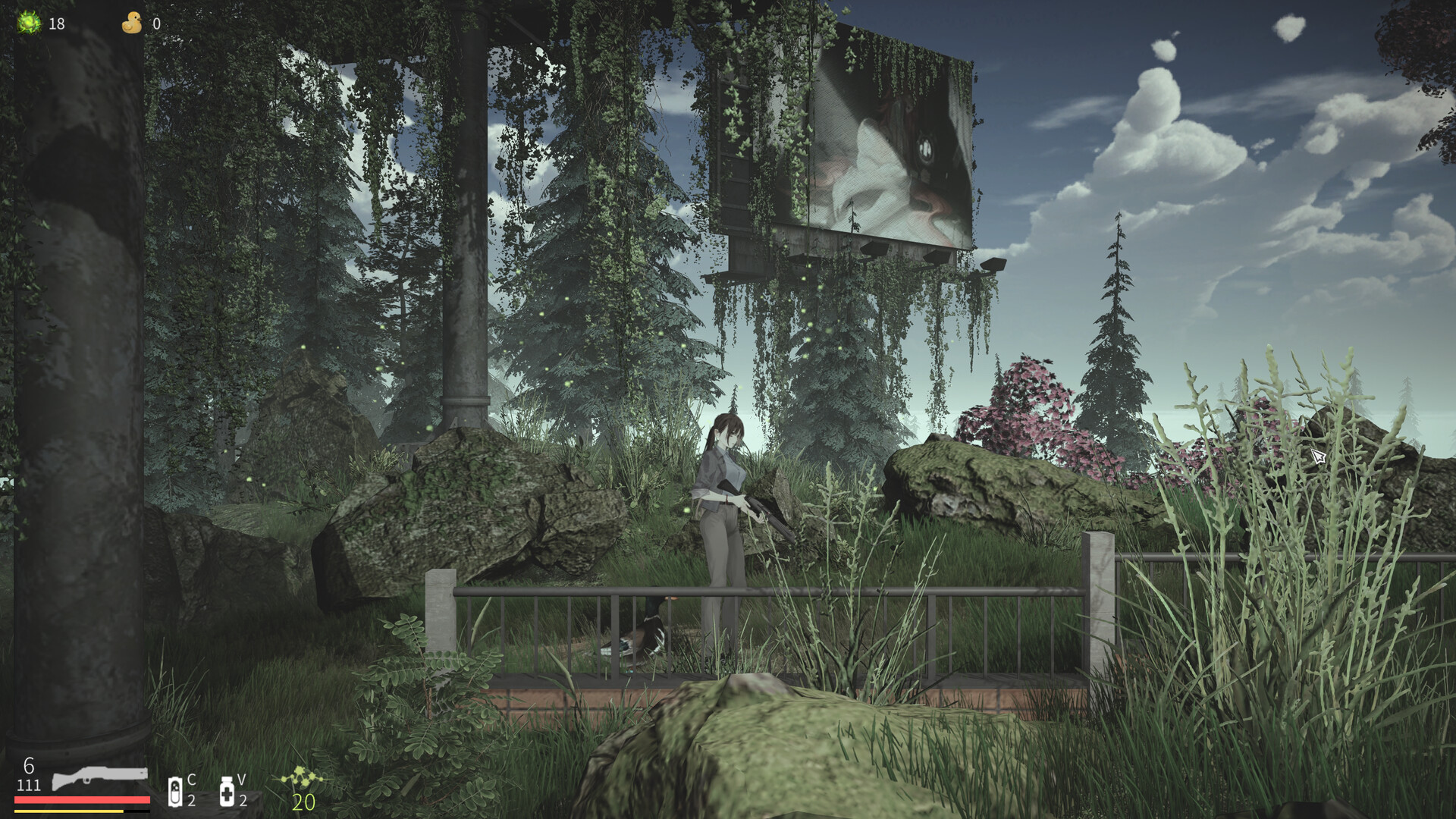
Exploring an overgrown, fungus-reclaimed stretch of the outside worldImage: HP⁺ DOG -
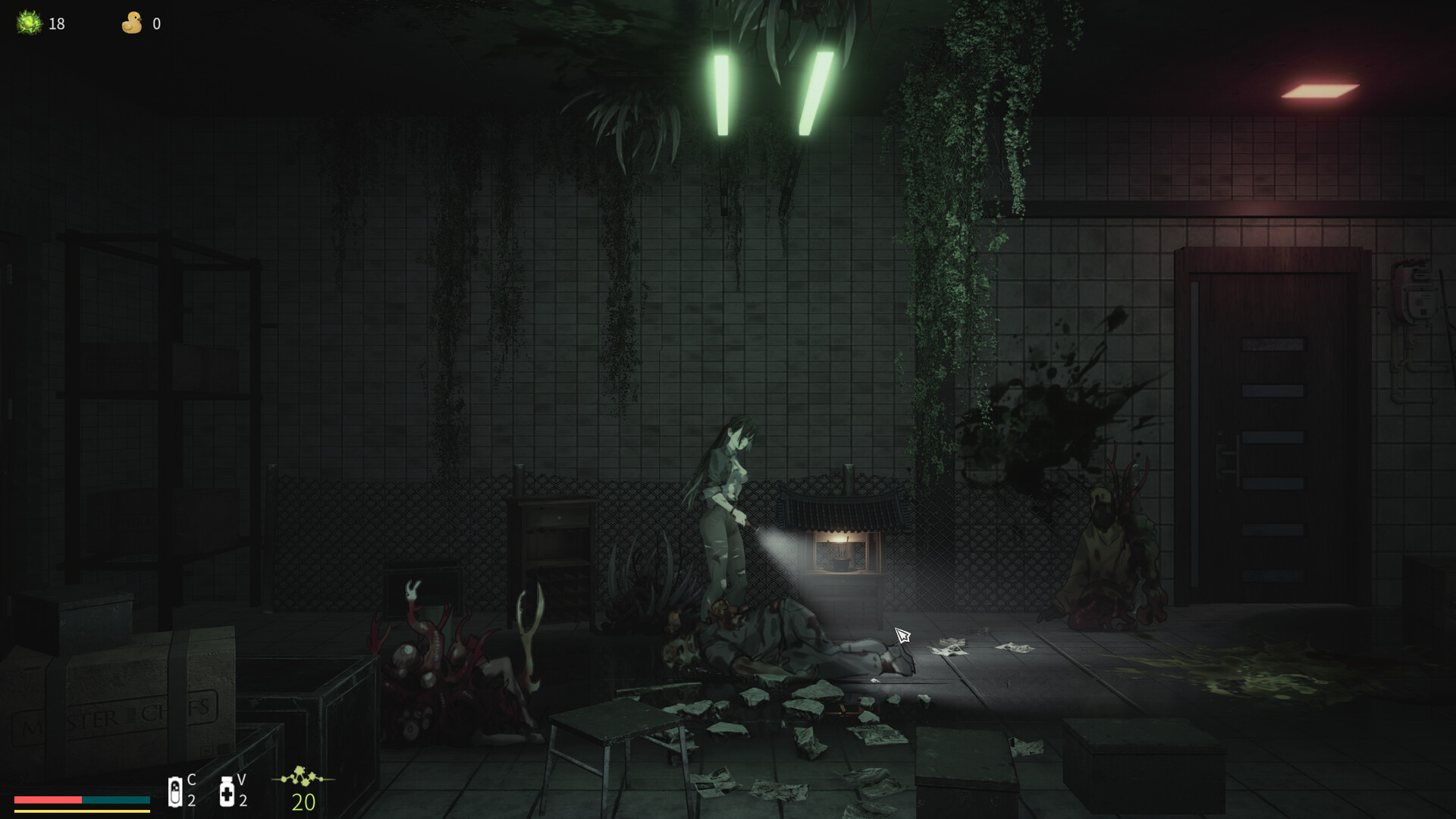
Searching a dark, tiled room lit only by flashlightImage: HP⁺ DOG -
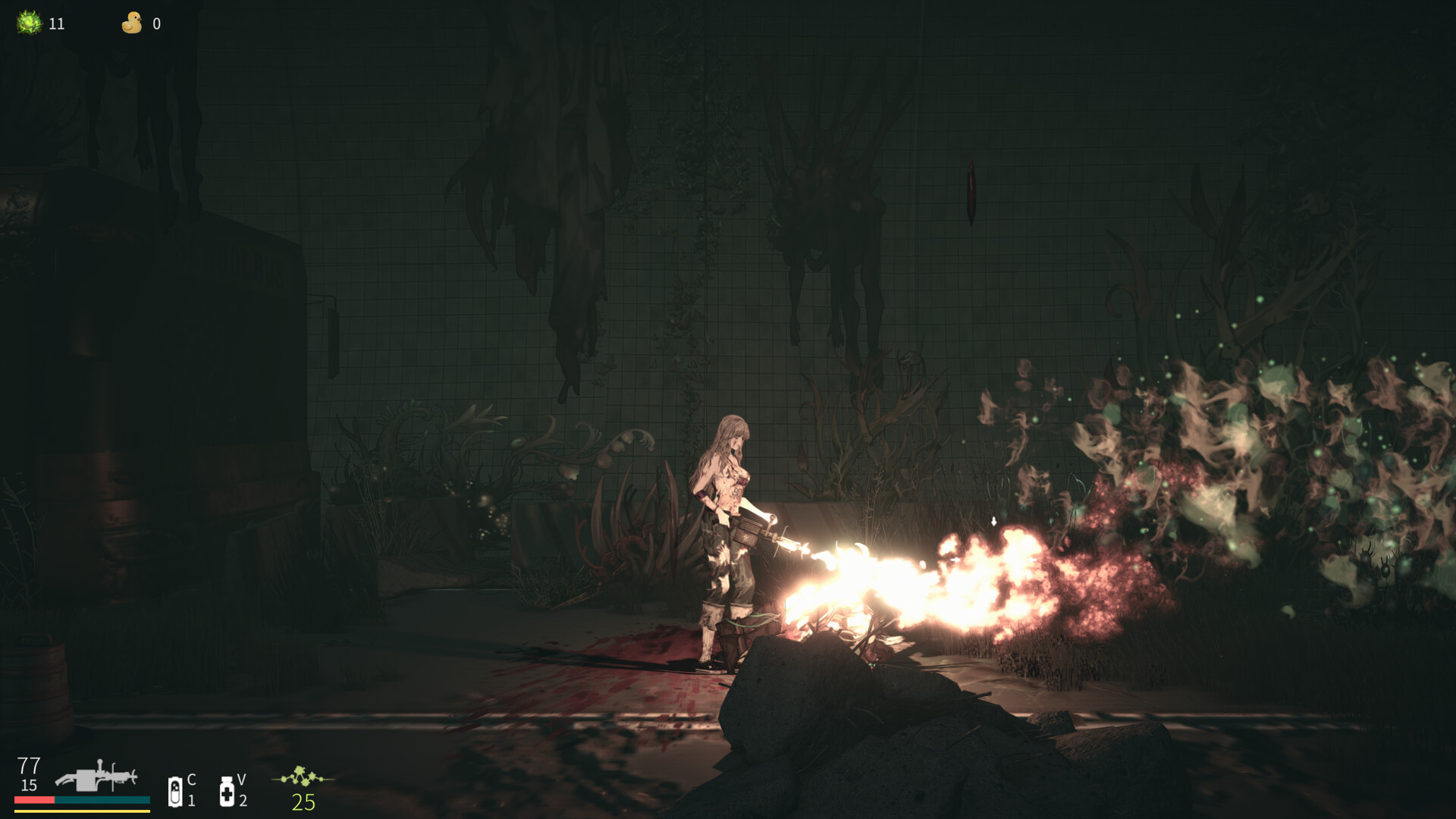
Battle damage takes its toll during a fight against fungal creaturesImage: HP⁺ DOG -
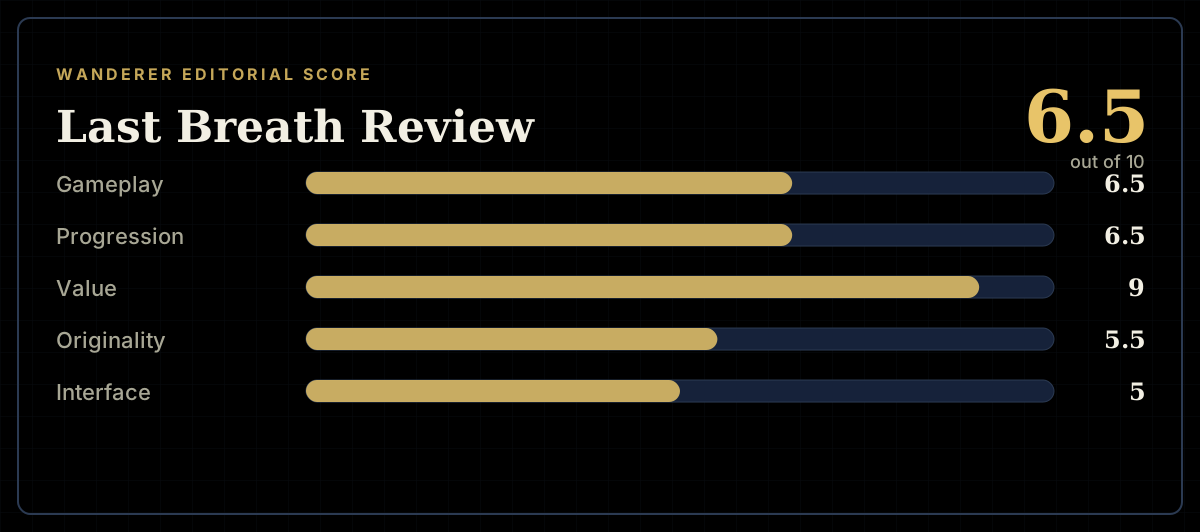
How the review scores each part of the gameWanderer Editorial -
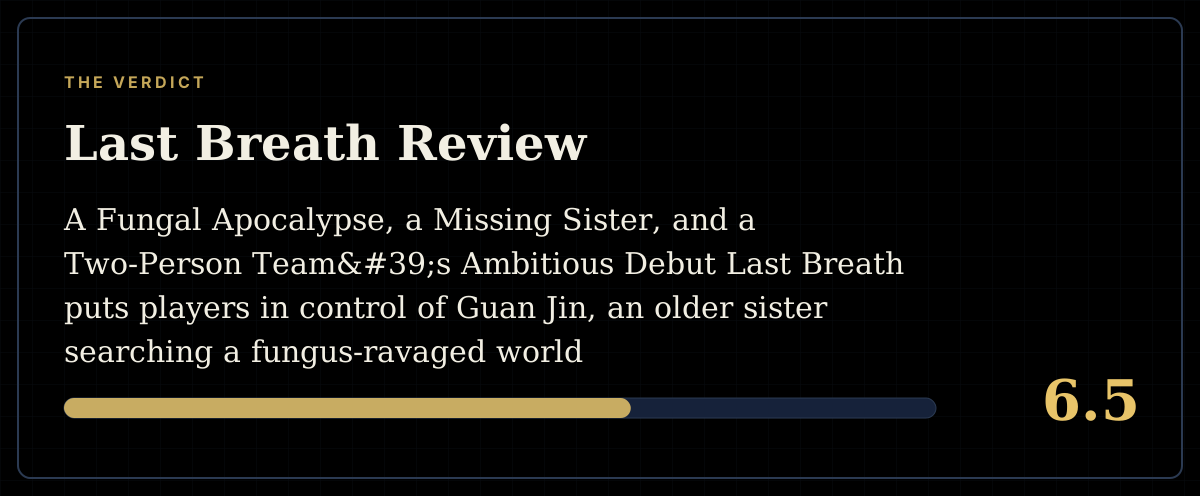
The short versionWanderer Editorial