
Game review
Idling Idol
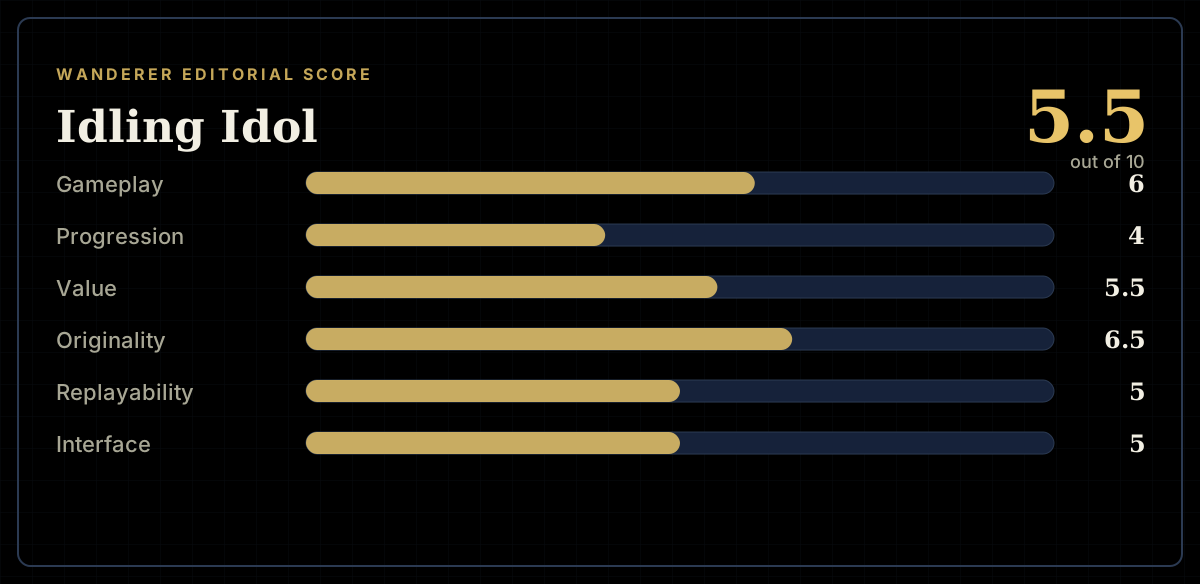
5.5 / 10
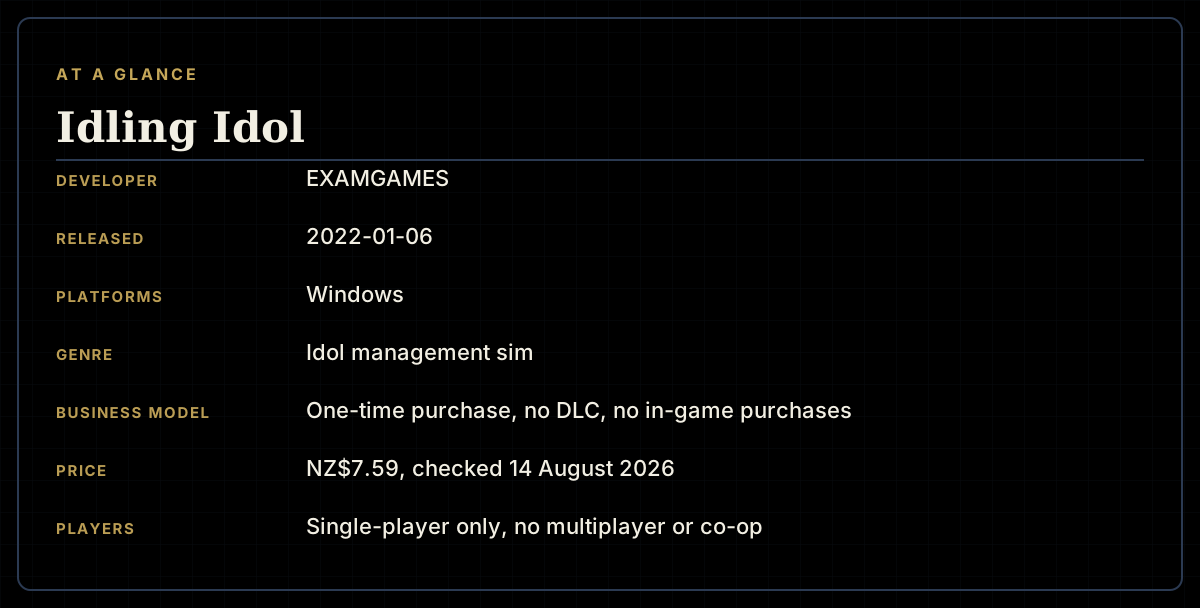
- Developer
- EXAMGAMES
- Publisher
- EXAMGAMES
- Released
- 6 January 2022
- Platforms
- Windows
- Genre
- Idol management sim
- Monetisation
- One-time purchase, no DLC, no in-game purchases
- Players
- Single-player only, no multiplayer or co-op
The short version
Idling Idol's own store page announces "The basis of the game rule is Idling!" — and its most upvoted review on the entire page, a recommended one with 42 votes, opens by correcting that claim directly: "No, not really." Across a small but genuinely bilingual review corpus, English and Japanese reviewers alike independently describe the same thing — a compact, actively-managed score-attack sim lasting about 15 to 20 minutes per playthrough, with no save carried between runs, closer to a resource-management puzzle than a "set and forget" idler. Reviewers who came in expecting the second thing are consistently disappointed; reviewers who understood what it actually was tend to rate it as a tight, replayable little management game.
Biggest strengths
- A genuinely distinctive premise — manage up to five idols' training, work and live performances toward a "Dome Live" — that several reviewers, once past the labeling confusion, call one of the more tolerable entries in the clicker-adjacent genre
- Pause and fast-forward controls let players either plan carefully like a strategy game or blitz through a run quickly, and reviewers use both approaches
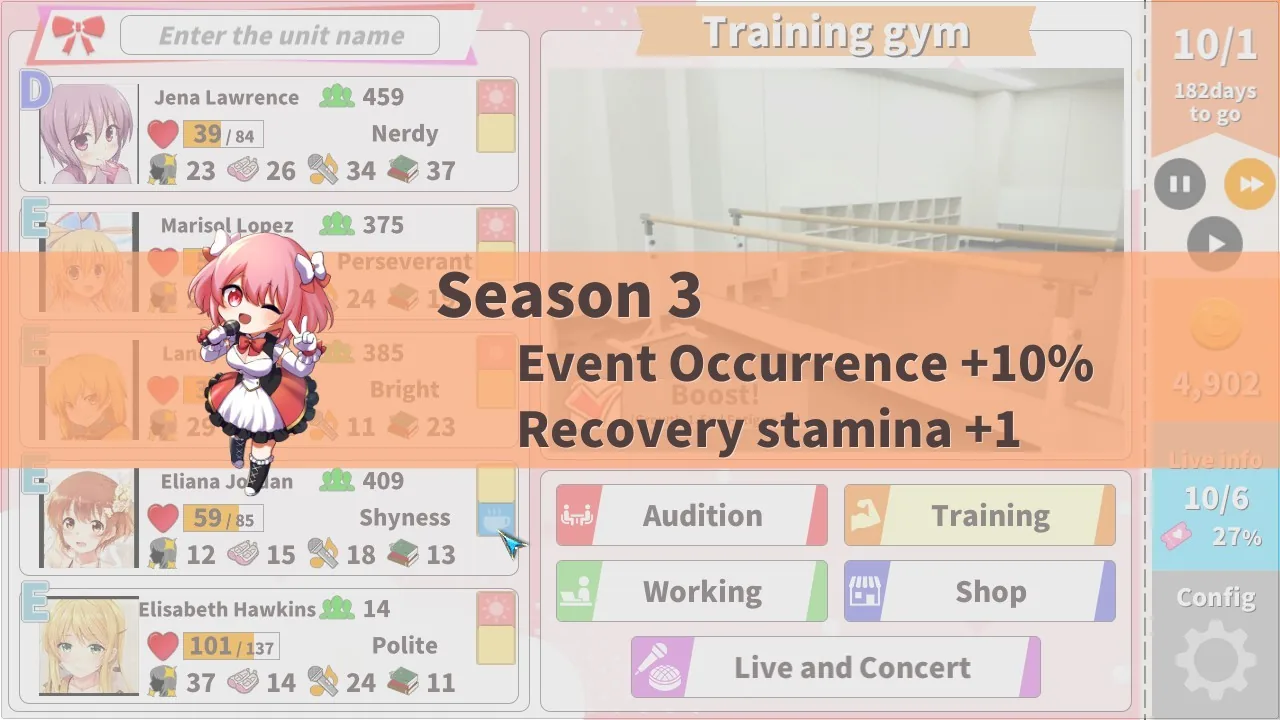
- Random events during training add a light layer of unpredictability without derailing the core resource-juggling loop
Biggest weaknesses
- The single most consistent complaint across the entire review corpus, echoed in the highest-voted review on the page, is that the game markets itself as an idle/"set and forget" experience and isn't one — it runs in-game days on a fixed timer with the pause button as your main tool, not true offline or afk progression
- There is no save data carried between playthroughs; each run starts from zero, which several reviewers call a hard stop on any sense of long-term progression
- Two of the highest-voted Japanese reviews, posted in the game's launch week, independently describe it as "not a clicker or idle game at all, just resembling them graphically," with runs lasting only about 10-15 minutes and no carryover confirmed on replay
Who it's for: Fans of tight, replayable time-management sims who like decision-dense short sessions — not idle-genre players expecting to leave the game running and come back to progress.
Our recommendation: Skip it if you want a genuine idle game; the title is the single biggest source of buyer's remorse in its own review corpus. Worth a look at NZ$7.59 if a 15-to-20-minute idol-producer resource puzzle with no persistent progression sounds appealing on its own terms.
5.5 / 10
Idling Idol's store page states its premise plainly: "Raise up idols by idling! The basis of the game rule is Idling!" Its own most-upvoted review — 42 votes, marked recommended — opens by disagreeing with that sentence directly: "No, not really. It's a time-management game with limited in-game days and your biggest friend is the pause button. This is not a 'set and forget' game, as a true Idle game would be." That correction, echoed independently across English and Japanese reviews spanning the game's entire three-and-a-half-year lifespan, is the single most important thing to know before buying it.
The marketing oversells the idling, and both sides of the review split agree
What makes this an unusually clean case is that the "it's not really idle" observation isn't confined to critics. It shows up in the game's harshest reviews and its warmest ones alike. Two of the highest-voted Japanese reviews, both posted in the game's launch week in January 2022, make nearly identical points independently: one (43 votes) states flatly that it's "neither a clicker nor an idle game — it just resembles them graphically," describing runs of roughly 10 minutes with no carryover element found across two playthroughs; the other (31 votes) confirms a fixed in-game year of roughly 10-15 minutes of activity determining a final score, with "no succession elements" and no room for the kind of long-term nurturing an idle-genre fan expects. An English-language review from June 2025 arrives at the same conclusion from a completely different angle, years later: "It is called 'idle' but has a time limit. After one ingame year it ends and you must restart. No carry over... Maybe the pause button on the screenshots should have warned me."
What separates this from an ordinary false-advertising complaint is that the game's own fans make the identical correction before praising it anyway. The 42-vote top review, after its opening correction, goes on to describe genuine appreciation for the management systems underneath. A March 2023 review with 11.5 hours logged calls it "one of the most tolerable clicker/idle games with an idol unit management theme," explicitly noting the pause function lets you "plan ahead like a chess match" rather than click reflexively. Once the genre expectation is corrected, in other words, the actual game underneath gets a fair hearing — and mostly passes it.
What it actually is: a tight resource-management sprint
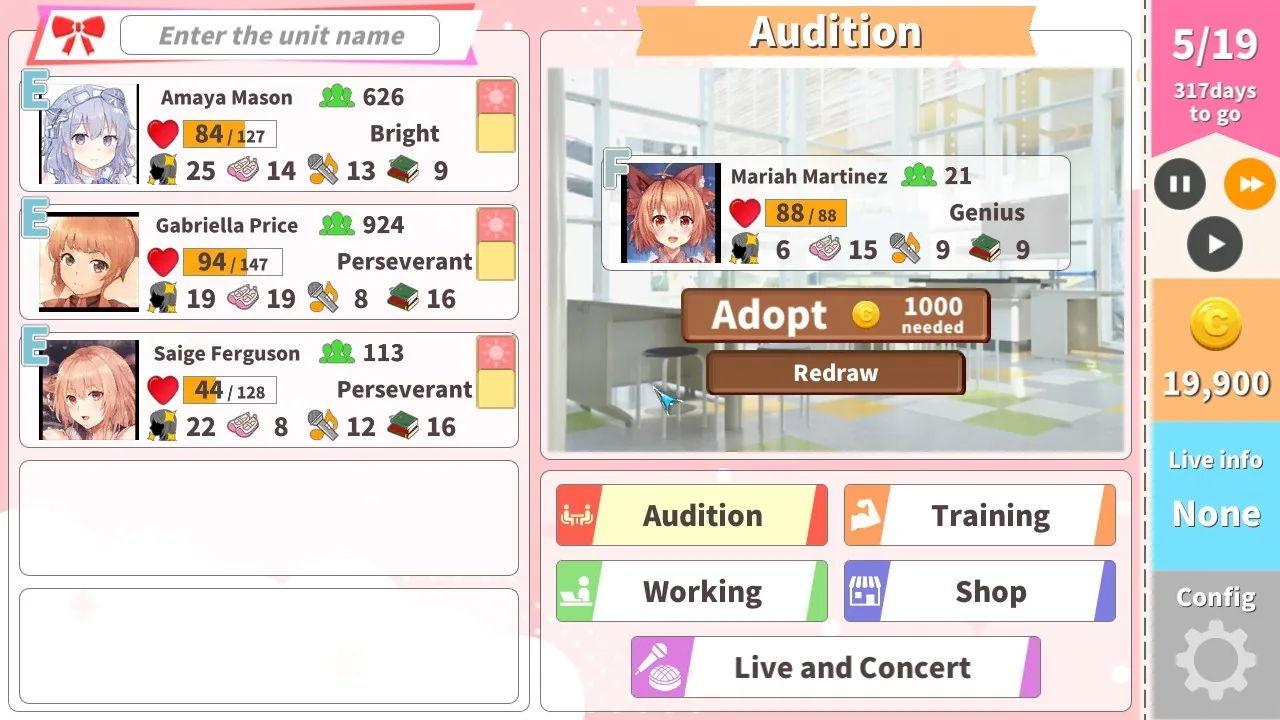
Strip away the "idle" framing and what's left is a compact idol-producer sim: pick up to five idols with randomised names, appearances, stats and personalities, then juggle training, work, live performances and fan acquisition across a fixed run of in-game days, aiming toward the stated dream goal of a "Dome Live" concert. Japanese reviewers describe the loop with real specificity — funding, training and fan-building cycling in short bursts, health and stamina items growing more expensive with each use, ticket pricing as a tunable lever, and enough decision density that a 15-20 minute session can stretch to closer to an hour if played slowly and deliberately. One reviewer compares the rhythm to watching Cookie Clicker numbers tick over, just compressed to updates every few seconds rather than minutes — busy rather than restful, and explicitly not marketed correctly by its own comparison to idle games.
Pause and fast-forward controls give players real choice in how to engage with that density: blitz through a run in the base 15-20 minutes, or pause constantly to plan each decision like a turn-based strategy game. Random training events add stat swings that reward paying attention rather than walking away, which is precisely the opposite of what the "idling" framing promises but is, on its own terms, a reasonably well-built small management loop.
A real gap between English and Japanese reception
Splitting the 30-review corpus by language surfaces a pattern worth reporting, even on a sample this small: English-language reviews sit at 9 of 14 positive (64.3%), while Japanese-language reviews sit at 11 of 13 positive (84.6%) — a 20-point gap on a game whose central mechanic (idol-producer management) sits squarely inside a genre Japanese audiences have far more genre-fluency with. That's consistent with what the actual review text shows: several of the more frustrated English reviews specifically cite confusion about what kind of game they'd bought, while Japanese reviews more often walk straight into describing the resource-management specifics without relitigating the labeling question first. With samples this size the gap shouldn't be read as a precise statistic, but the direction and the reasoning behind it both hold up.
What the achievement data shows
Idling Idol tracks only 10 Steam achievements, a small list befitting a short-session game. The earliest goal sits at 81.0%, a healthy completion rate for a first milestone, but the numbers thin quickly after that — fan acquisition and training-related achievements in the 25-39% range, and the game's own stated dream ending, the Dome Live concert the store page builds its whole pitch around, at just 14.4%. Topping the idol group rankings, presumably the game's true "best ending," sits at 10.1%. That's not an unusual shape for a short, replayable score-attack game where most buyers try it once or twice rather than optimising toward the top rank, and it's broadly consistent with a game whose own reviewers say there's little reason to keep replaying once a run's score is banked, since nothing carries forward.
Final verdict
Idling Idol is a reasonably well-constructed short idol-management sim wearing a label that actively works against it. The word "Idle" in the title and the store page's own "set and forget" framing set an expectation the game structurally cannot meet — fixed-length runs, active decision-making, and no persistence between playthroughs are the opposite of what idle-genre shoppers are looking for, and its own most-upvoted review says so before it says anything else. Buyers who go in already knowing that, per the genuinely bilingual review record, tend to find a tight, decision-dense 15-to-20-minute loop worth returning to a few times. Buyers drawn in by the title looking for a true idle game are, by the corpus's own account, the ones most likely to bounce off it fast.
Pros and cons
Pros
- A genuinely distinctive premise — manage up to five idols' training, work and live performances toward a "Dome Live" — that several reviewers, once past the labeling confusion, call one of the more tolerable entries in the clicker-adjacent genre
- Pause and fast-forward controls let players either plan carefully like a strategy game or blitz through a run quickly, and reviewers use both approaches
- Random events during training add a light layer of unpredictability without derailing the core resource-juggling loop
- Japanese-language reviewers in particular describe a dense, replayable 15-to-20-minute session that rewards planning ahead, comparing the pacing favourably to more traditional resource-management games
Cons
- The single most consistent complaint across the entire review corpus, echoed in the highest-voted review on the page, is that the game markets itself as an idle/"set and forget" experience and isn't one — it runs in-game days on a fixed timer with the pause button as your main tool, not true offline or afk progression
- There is no save data carried between playthroughs; each run starts from zero, which several reviewers call a hard stop on any sense of long-term progression
- Two of the highest-voted Japanese reviews, posted in the game's launch week, independently describe it as "not a clicker or idle game at all, just resembling them graphically," with runs lasting only about 10-15 minutes and no carryover confirmed on replay
- English-language reception (9 of 14 positive, 64.3%) runs noticeably cooler than Japanese-language reception (11 of 13 positive, 84.6%), though the sample on both sides is small enough that the gap should be read as a pattern worth noting rather than a precise measurement
- Ships with only 10 Steam achievements, and the rarest tracked milestone (topping the idol group rankings) sits at 10.1%, suggesting most buyers don't push toward the game's stated endgame
Screenshots
-

Idling IdolImage: EXAMGAMES via Steam -
Idling IdolImage: EXAMGAMES via Steam -
Idling IdolImage: EXAMGAMES via Steam -
How the review scores each part of the gameWanderer Editorial -
The game at a glanceWanderer Editorial -
The short versionWanderer Editorial