Game review
Idle Trillionaire
7.3 / 10
- Developer
- The Slanted Room
- Publisher
- The Slanted Room
- Released
- 28 January 2024
- Platforms
- Windows, macOS
- Genre
- Casual, Indie, Simulation
- Monetisation
- One-time purchase, US$5.00; no DLC, no in-app-purchase Steamworks category, and no currency shop, gacha panel or ad prompt visible in any of the seven official Steam screenshots or the game's own in-fiction slot-machine minigame, which pays out in the game's own currencies rather than real money
- Players
- Single-player only — Steamworks categories list Single-player, Steam Achievements, Steam Cloud and Family Sharing, with no multiplayer or co-op flag
The short version
Idle Trillionaire hands you a lawn-mowing job and a single goal — earn a trillion dollars — then lets a deck of over 600 hand-written cards decide how monstrous you become on the way. Steam's real review corpus is small but clear: 34 positive and 7 negative of 41 lifetime reviews, 82.9%, "Positive." That number holds up against the reviews themselves, which mostly argue about the same two things — a content ceiling that arrives a handful of prestiges in, and a reset mechanic that can end a run without warning, which the developer patched within two weeks of launch but left switched off by default, so the same complaint keeps resurfacing more than a year later.
What nobody argues about is the price. Five dollars, one purchase, no currency shop anywhere in the game's own screenshots, and a solo developer who was still shipping content updates into July 2026, two and a half years after release.
Biggest strengths
- Genuinely clean monetisation: a single US$5 one-time purchase, no DLC, no in-app-purchase Steamworks category, and nothing resembling a currency shop or ad prompt anywhere in the official screenshots — even the in-game slot machine pays out in the game's own money and happiness currencies, not real ones
- A distinctive premise for this library's idle shelf — a card-driven life-sim built entirely around escalating capitalist excess, from "Lawn Mowing Job" and "First Kiss" to "Rig an Election" and "Blackmail the Global Royalty" — verified as its own thing, not a reskin of another idle game
- Real, sustained post-launch support: 17 news posts from launch (28 January 2024) through July 2026, including a community deck editor for player-made mod content, localisation into 14 languages, and Steam Deck support added March 2026
Biggest weaknesses
- A reset mechanic — spend more happiness or money than you have and the run can end outright — blindsided reviewers at launch badly enough that the developer shipped a warnings patch within two weeks, but the warning toggle defaults to off ("Easy Mode", unchecked out of the box), so the identical complaint recurs in reviews dated a full year and more after the fix shipped
- The clearest, most consistent negative-review theme is a content ceiling: multiple reviewers across three different languages independently report that the writing and the challenge both flatten out within five to eight prestiges, after which there is "nothing left to discover"
- A December 2024 patch specifically targeted offline progress (raising the offline time-conversion rate 25-fold), yet a detailed 160-hour review posted in March 2026 — over a year later — still names weak offline progress as its top complaint, so the fix has not fully settled the question
Who it's for: Idle and incremental fans who want something to read as much as click — the dark, satirical writing is the actual product here, not a number going up. Not a fit for anyone who wants a long-tail idle game to leave running for months, or anyone who'd rather not be surprised by a run-ending card partway through the opening hours.
Our recommendation: A confident buy at US$5 for the stated pitch — a short, funny, cleanly monetised card-driven idle game about the corrupting logic of infinite wealth. Turn on the card-warning toggle in the options menu before you start (it ships off by default), expect the game to run out of new things to say somewhere around your fifth to eighth prestige, and treat a "your first playthrough" review score as the honest one — this is a six-to-twenty-hour game, not a hundred-hour one.
7.3 / 10
A trillion dollars, one card at a time
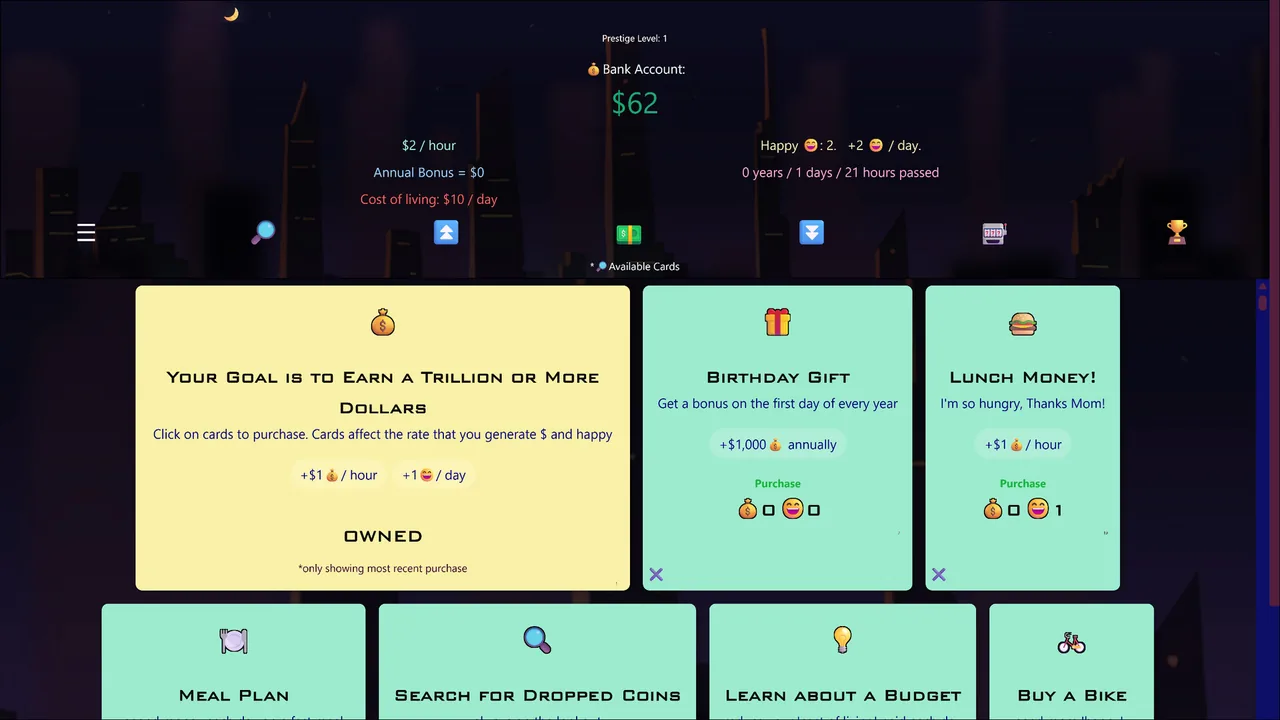
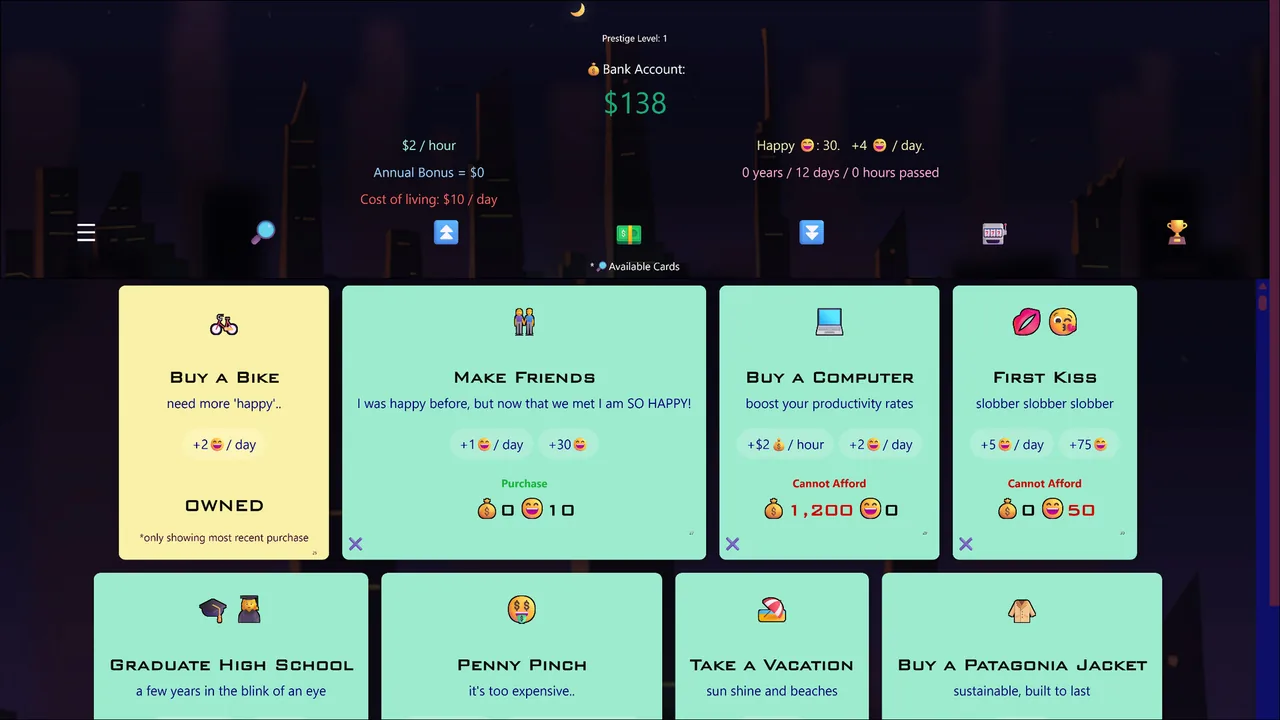
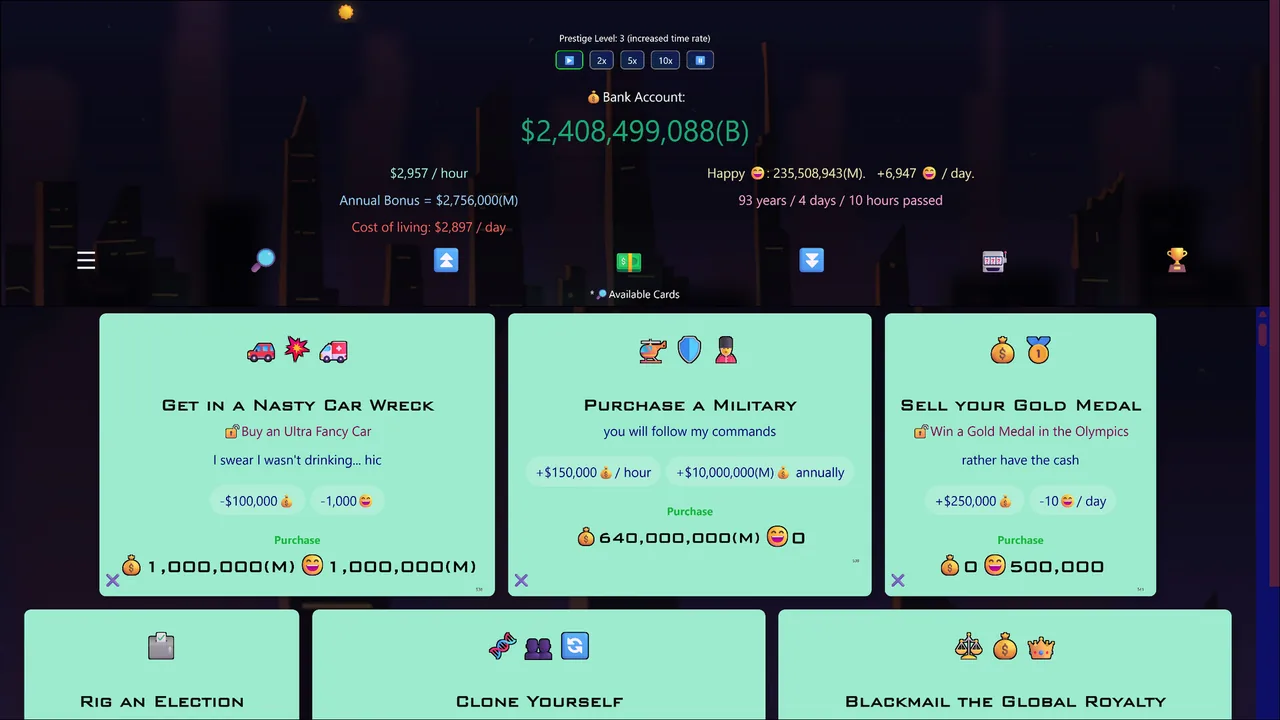
Idle Trillionaire starts you with a lawn-mowing job and a single stated objective: accumulate a trillion dollars or more. Every few seconds a new card appears — "Birthday Gift," "Lunch Money," "Make Friends" — each one a small, funny, occasionally cruel slice of a life event that costs or generates some mix of two resources: money and happiness. Buy the cards you can afford, watch your income tick up, and the game does the rest, running in the background while you do something else. It is, mechanically, an ordinary number-go-up incremental. What makes it worth a review is the writing wrapped around that mechanism: over 600 hand-written cards that escalate from mundane (Graduate High School, Buy a Bike) to darkly satirical (Rig an Election, Clone Yourself, Blackmail the Global Royalty) as your net worth climbs past the point where ordinary consequences stop applying to you. By the game's own late-game screens you are not buying a house, you are buying Australia, then Brazil, then Canada, at prices measured in trillions, on your way to a card literally called "Break the Universe."
That premise checks out as genuinely its own thing rather than a reskin of an existing idle game — a direct Steam search for the title returns only the base game and its own official demo, and the community tag list (Idler, Incremental, Life Sim, Capitalism, Dystopian, Satire, Text-Based, Dark Comedy) reads as an accurate description rather than a mis-tag, which is not something every small idle title on this library's shelf can claim. The official genre listing — Casual, Indie, Simulation — undersells how thoroughly idle-and-incremental-coded the actual game is; readers looking specifically for that genre should trust the tags over the storefront category.
The number backs up what the reviews actually argue about
Idle Trillionaire sits at 82.9% positive — 34 of 41 lifetime reviews, "Positive" on Steam's own scale. That is a small corpus, and this review read every one of the seven negative reviews along with the great majority of the positive ones rather than sampling. SteamSpy's own aggregator, used elsewhere in this library only as a rough discovery signal, estimated 31 reviews at 26 positive and 5 negative — close to the real figures but short by roughly a quarter of the true total, which is why this review pulled the actual corpus directly rather than repeating the estimate. English makes up 68% of the sample, comfortably enough to rule out the kind of single-language distortion that has skewed other small titles' headline scores in this library, and the year-by-year split — 88% positive in 2024, 80% in 2025, 71% in 2026 on a thin seven-review sample — shows ordinary variation rather than either a launch-week honeymoon or a later revolt.
What the negative reviews actually complain about is narrow and consistent. A Chinese review asks bluntly whether the game has any content "after breaking the infinite" and calls it "shorter than the vast majority of free incremental games" once the eight available prestige tiers run out. A Traditional Chinese positive review makes the identical point in six words: "got every achievement, prestige 8, you can close the game." A German review that runs to 160 hours and lands on a technically-positive but lukewarm verdict says the cards "become the same after reading them three or four times" and that repeated clicking starts to grate. None of this is really a complaint about quality — it is a complaint about a hard ceiling on content, which for a $5 game that several reviewers independently clock at six to twenty hours to finish is a fairer trade than it would be at a higher price point.
A patched flaw that still catches players a year later
The single most interesting finding in this corpus is not in the review text alone — it is in what the developer's own patch notes say happened. The two earliest reviews in the entire corpus, both posted 2 February 2024, five days after launch, describe the same problem from opposite sides of the recommendation: one calls the game "fun, but oh man, I am over it," explaining "I have accidentally suislided twice because I bought something for more happy than I had"; the other, more clinical, flags "instawipe cards" that force a reset with no warning and specifically criticises a prestige button "hidden inside the reset button" that risks resetting a save by accident. The developer responded fast — a "Dangerous Card Warnings Update" shipped 8 February 2024, adding explicit on-card labels like "Bankruptcy Risk" and "Suicide Risk" to dangerous choices, followed a day later by a toggle to show or hide those warnings.
The patch notes for that toggle are the part worth reading closely: "If you're a thinker the default 'Card Warnings Off' will suit you. 'Easy Mode' toggle added to show/hide dangerous card warnings (default off)." The fix is real, but it ships switched off. That is the difference between a bug that got fixed and a bug that got made optional, and the review corpus shows the gap directly — a February 2025 review, a full year after the warnings patch, reports "you can accidentally kill yourself, losing multiple hours of progress. The game never warns you this is a possibility," and an 18 February 2025 review separately says "I also got reset from picking a card and lost hours of progress, so I am bitter." A boundary-checked search across the English-language corpus finds this complaint in 6 of 28 reviews — 21% — spread across positive and negative reviews alike, a year and a half apart. This review's main store screenshot of the game's Spanish-language menu confirms the mechanic is real and by design: you lose the run if your money falls below -$100,000 or your happiness falls below -10,000, stated plainly as one of the two rules of the game. It is not hidden, exactly. It is simply not warned-about by default.
Offline progress: fixed once, still contested
A second recurring theme in the longer reviews is offline progress — whether the game keeps earning while you are away from it, the standing question this library asks of every idle title. The developer clearly heard this complaint too: a 14 December 2024 patch titled "Idle Trillionaire Revamped: Offline Progress & Visual Glow-Up!" raised the offline time-conversion rate from four in-game hours per real hour to a hundred, a twenty-five-fold increase, explicitly framed as a response to player requests. That should have settled it. It has not entirely: the same 160-hour German review quoted above, posted in March 2026 — well over a year after that patch — names weak offline progress as its single biggest complaint, writing that the game feels like it needs to be left running constantly, which for an idle game it calls simply "dumb." This review cannot adjudicate whether that reviewer's experience reflects a setting, a platform difference or a genuine gap between the patch notes and the live build; it can only report that the developer shipped a fix aimed squarely at this complaint, and that the complaint still appears well after the fix shipped.
Clean money, sharp writing, one specific objection
On monetisation there is very little to relitigate, which puts Idle Trillionaire in the rare, easy category for this library. Five dollars, once, on Steam. No DLC is listed, no in-app-purchase Steamworks category exists, and across all seven official screenshots — the core card-buying loop, the late-game country-purchase screen, even an in-fiction Slot Machine minigame — nothing resembles a currency shop or an ad prompt. The slot machine is worth calling out specifically because it is the one screen in this genre that most often hides a real-money gamble: here it pays out in the game's own Cash and Happy currencies only, functioning as a flavour minigame rather than a monetisation vector. The developer also ships a free community deck editor, letting players write and share their own mod cards at no cost — an unusual thing for a $5 solo project to give away rather than sell.
The satirical writing that makes the core loop distinctive is, inevitably, not going to land the same way for everyone. One Simplified Chinese review specifically objects to a "Buy China" card whose flavour text frames the purchase as "become a dictator," calling the framing inappropriate and marking the review negative largely on that basis. It is a single low-vote review in a 41-review corpus, but the underlying design choice is real and verifiable — every playable-country card in the late game carries a similarly pointed, darkly comic caption ("Buy Canada... and don't apologize"; "Buy India... while drunk") — so this review reports the objection rather than the specific wording as fact, and leaves the judgment about where dark satire tips into bad taste to the reader.
What the achievement curve says about who finishes it
Steam's global achievement data gives an unusually clean read on completion for a game this small, because the achievement names are legible rather than opaque internal codes. Five onboarding-tier achievements — get a birthday gift, a first kiss, go to the movies, work hard, attract a lover — sit at 87.9-97.5%, the ordinary shape of a tutorial curve. A wide middle band of ten achievements, including beatGame at 52.5%, prestigeUp at 54.1% and globalDomination at 55.0%, clusters tightly at 48.2-63.2%: roughly half of everyone who buys the game sees a complete first run through to its ending, which corroborates the review corpus's repeated description of this as a short, finishable, one-sitting-plus-a- weekend game rather than one people abandon early. Only the two hardest late-game achievements, becomeGod and breakUniverse, fall away sharply to 24.7% and 24.4% — a plateau rather than a cliff, and consistent with the negative reviews' specific complaint that the deepest prestige tiers run out of new material rather than becoming impossible.
Final verdict
Idle Trillionaire earns its 82.9% "Positive" score honestly. The core loop is a well-executed, distinctively written take on a familiar idle-clicker shape, the price is fair and the monetisation is about as clean as this library ever finds, and the developer kept shipping real content and fixes for two and a half years after a $5 launch — Steam Deck support and a new content pack both arrived in 2026 alone. Set against that: a content ceiling that a meaningful slice of the corpus hits by the fifth to eighth prestige, and a run-ending mechanic that the developer genuinely tried to fix but left optional, so the exact complaint that greeted the game at launch was still being written by players a year later. Buy it for what it is — a sharp, short, funny satire about the psychology of infinite wealth — turn the card warnings on in the options menu before your first run, and expect the credits to roll well before the hundred-hour mark most idle games chase.
Pros and cons
Pros
- Genuinely clean monetisation: a single US$5 one-time purchase, no DLC, no in-app-purchase Steamworks category, and nothing resembling a currency shop or ad prompt anywhere in the official screenshots — even the in-game slot machine pays out in the game's own money and happiness currencies, not real ones
- A distinctive premise for this library's idle shelf — a card-driven life-sim built entirely around escalating capitalist excess, from "Lawn Mowing Job" and "First Kiss" to "Rig an Election" and "Blackmail the Global Royalty" — verified as its own thing, not a reskin of another idle game
- Real, sustained post-launch support: 17 news posts from launch (28 January 2024) through July 2026, including a community deck editor for player-made mod content, localisation into 14 languages, and Steam Deck support added March 2026
- Consistently praised value for a $5 game — multiple reviewers independently put a full playthrough at six to twenty hours and call that a fair trade, and one explicitly says the game is worth US$20 at minimum
- The global achievement curve backs up the review split rather than contradicting it: beatGame sits at 52.5%, meaning more than half of buyers who bought it actually finish a first run, before a real drop-off into the deepest late-game achievements
Cons
- A reset mechanic — spend more happiness or money than you have and the run can end outright — blindsided reviewers at launch badly enough that the developer shipped a warnings patch within two weeks, but the warning toggle defaults to off ("Easy Mode", unchecked out of the box), so the identical complaint recurs in reviews dated a full year and more after the fix shipped
- The clearest, most consistent negative-review theme is a content ceiling: multiple reviewers across three different languages independently report that the writing and the challenge both flatten out within five to eight prestiges, after which there is "nothing left to discover"
- A December 2024 patch specifically targeted offline progress (raising the offline time-conversion rate 25-fold), yet a detailed 160-hour review posted in March 2026 — over a year later — still names weak offline progress as its top complaint, so the fix has not fully settled the question
- The escalating dark satire that is the game's main selling point is also, for at least one reviewer, a dealbreaker: a Simplified Chinese review specifically objects to a "Buy China" card whose flavour text frames the purchase as "become a dictator," calling it inappropriate
- No controller support and a fixed emoji-and-text presentation that a couple of reviewers call plain — this is a game that leans entirely on its writing, and players who came for spectacle say so
Screenshots
-
Idle TrillionaireImage: The Slanted Room via Steam -
Idle TrillionaireImage: The Slanted Room via Steam -
Idle TrillionaireImage: The Slanted Room via Steam -
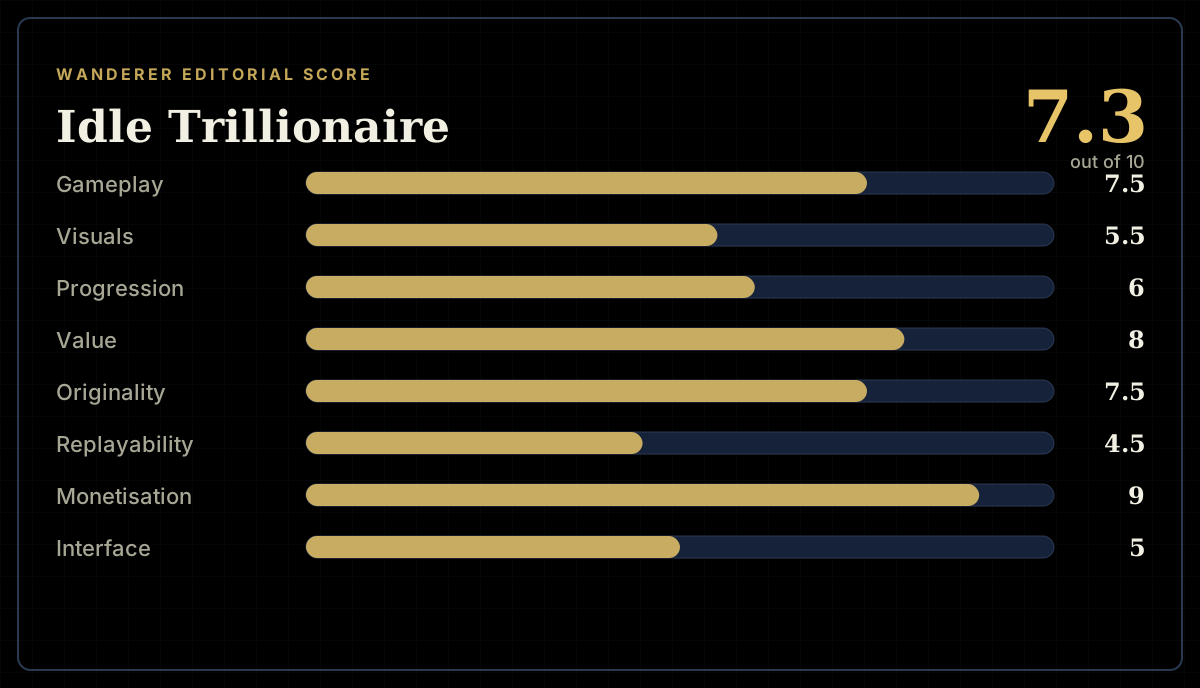
How the review scores each part of the gameWanderer Editorial -
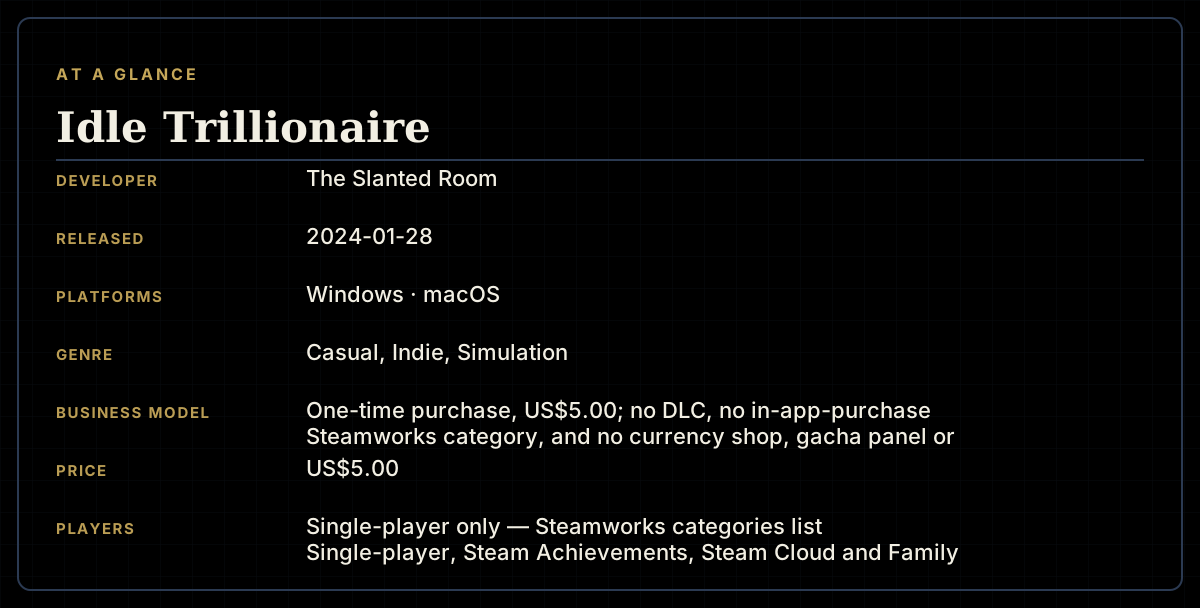
The game at a glanceWanderer Editorial -
The short versionWanderer Editorial