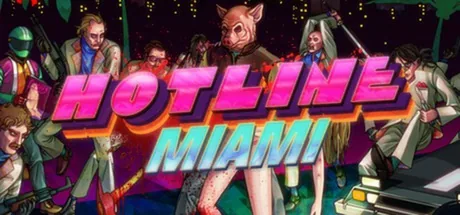
Game review
Hotline Miami
9 / 10
- Developer
- Dennaton Games
- Publisher
- Devolver Digital
- Released
- 23 October 2012
- Platforms
- Windows, macOS, Linux
- Genre
- Top-Down Action
- Monetisation
- One-time purchase, plus a separate soundtrack. No in-game purchases.
- Players
- Single-player
The short version
You put on an animal mask, walk into a building, and everyone inside dies in about forty seconds — including you, repeatedly, because one bullet is fatal for everybody. Hotline Miami turned that into one of the most imitated designs of the last fifteen years, wrapped in a soundtrack that people still listen to independently of the game.
It's 96.4% positive across 51,022 English reviews. Its criticism is remarkably consistent: **controls appear in 20 of the 100 most-helpful negatives and difficulty in 20**, with the targeting system and enemy detection the specific culprits. The most-upvoted negative of all, at 611 votes, is essentially a public-service warning rather than a complaint.
Biggest strengths
- A design so influential that an entire subgenre of top-down action followed it
- One of the great video game soundtracks, and inseparable from how the game feels
- Astonishing pace — encounters resolve in seconds and restart instantly
Biggest weaknesses
- The targeting system is the single most-cited flaw, and it was never fixed
- Enemy detection is inconsistent enough that deaths can feel unearned
- Punishing to the point of exclusion — the median achievement is held by 10.3% of players
Who it's for: People who want a hard, fast, extremely violent puzzle-action game and will restart a level thirty times without resenting it. Everyone else should read the difficulty section first.
Our recommendation: Buy it — at NZ$3.68 it's the cheapest landmark in this library. Just understand that it is genuinely difficult, that you will die constantly by design, and that the aiming is the one part that never stopped being awkward.
9 / 10
The most-upvoted negative review of Hotline Miami, at 611 votes, opens by recommending it:
For anyone with good reflexes and a taste for ultra-violence, good music, and retro graphics. Read no further - go buy the game. Don't even wait for a sale. If you have slow reflexes, or bad coordination however; or if you simply dislike difficult games - this game is really not for you.
The second, at 228 votes: "While I didn't like this game and I regret buying it, it's not the game's fault but my own."
That's the shape of the entire negative column. This is a game that knows exactly what it is, and the people it doesn't suit mostly say so without rancour.
A note on reading the dates
Something worth flagging, because it nearly misled me. Bucketing the hundred most-helpful negatives by year gives 28 in 2025 and 42 in 2026 — which looks like a game falling apart.
It isn't. The median vote count on those 2026 reviews is 1. The median on the pre-2020 ones is 54. Steam's sample is a handful of genuinely helpful old reviews plus a long tail of recent low-vote filler, and the year distribution of that mix measures nothing at all. The nine highest-voted negatives are from 2015, 2014, 2017, 2022, 2016, 2022, 2019, 2023 and 2018.
Recent sentiment is unmoved: 94 of the last 100 English reviews are positive, with a 7.3-hour median.
Why it mattered
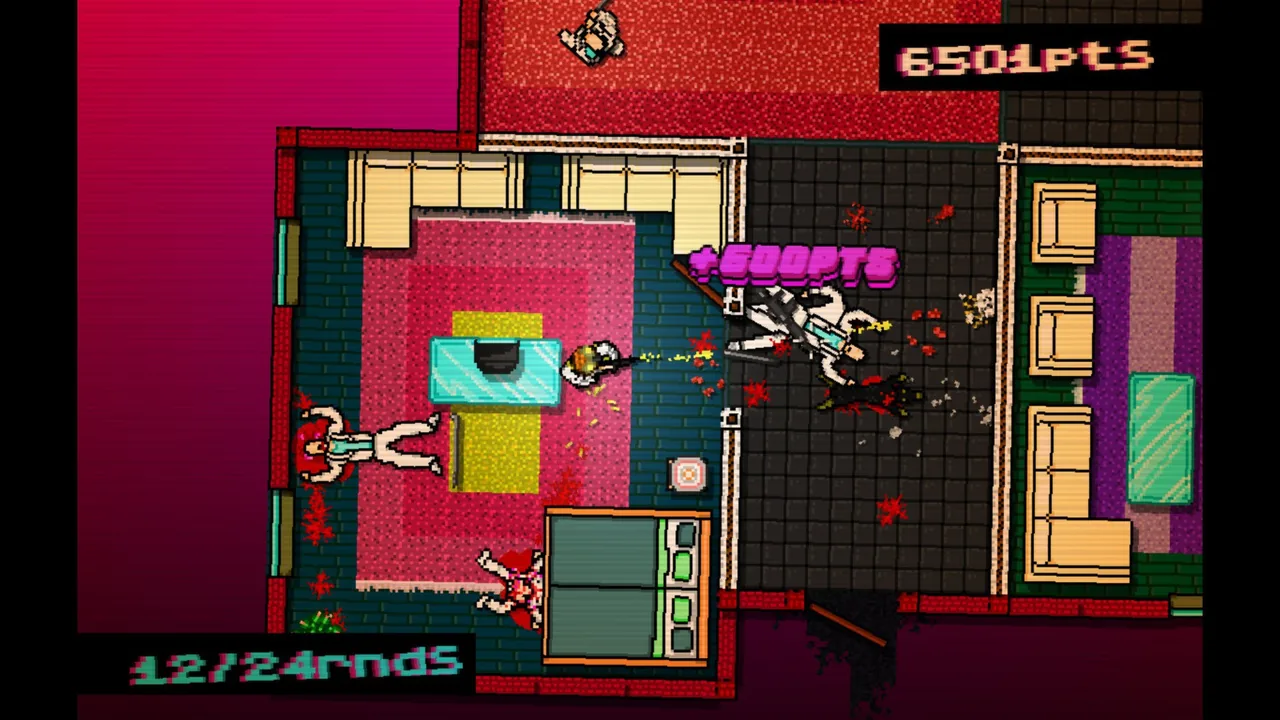
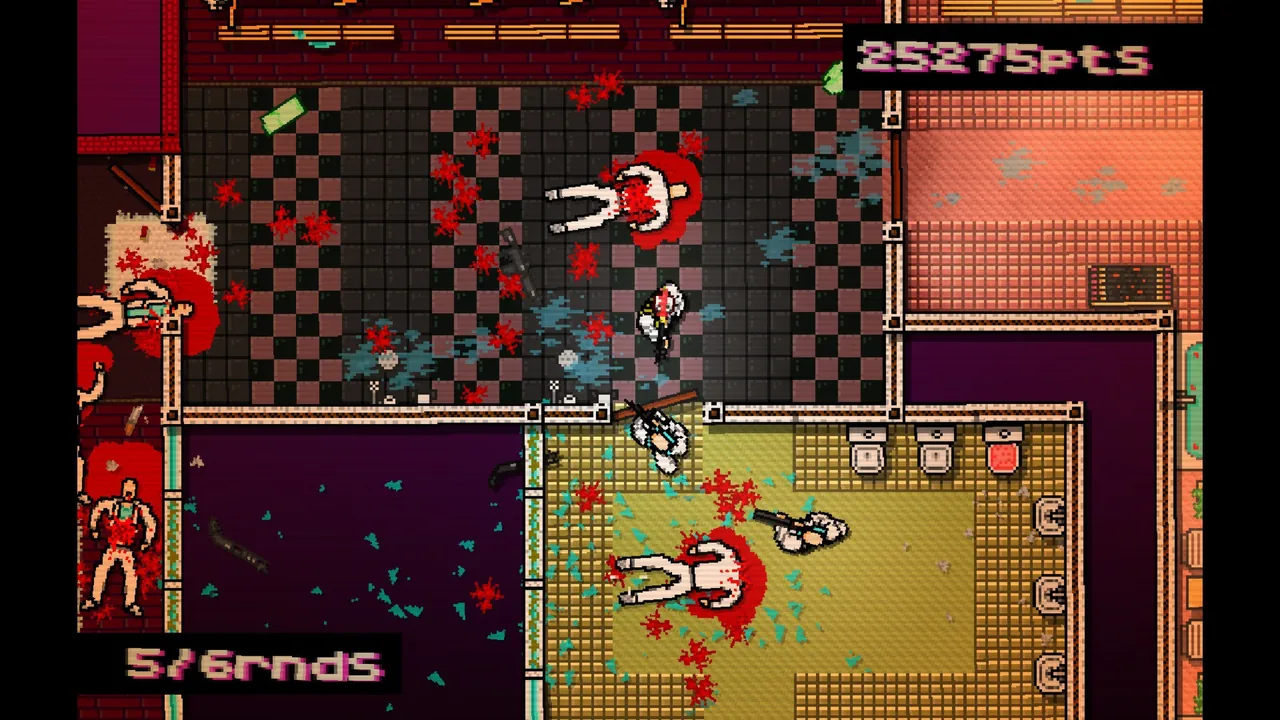
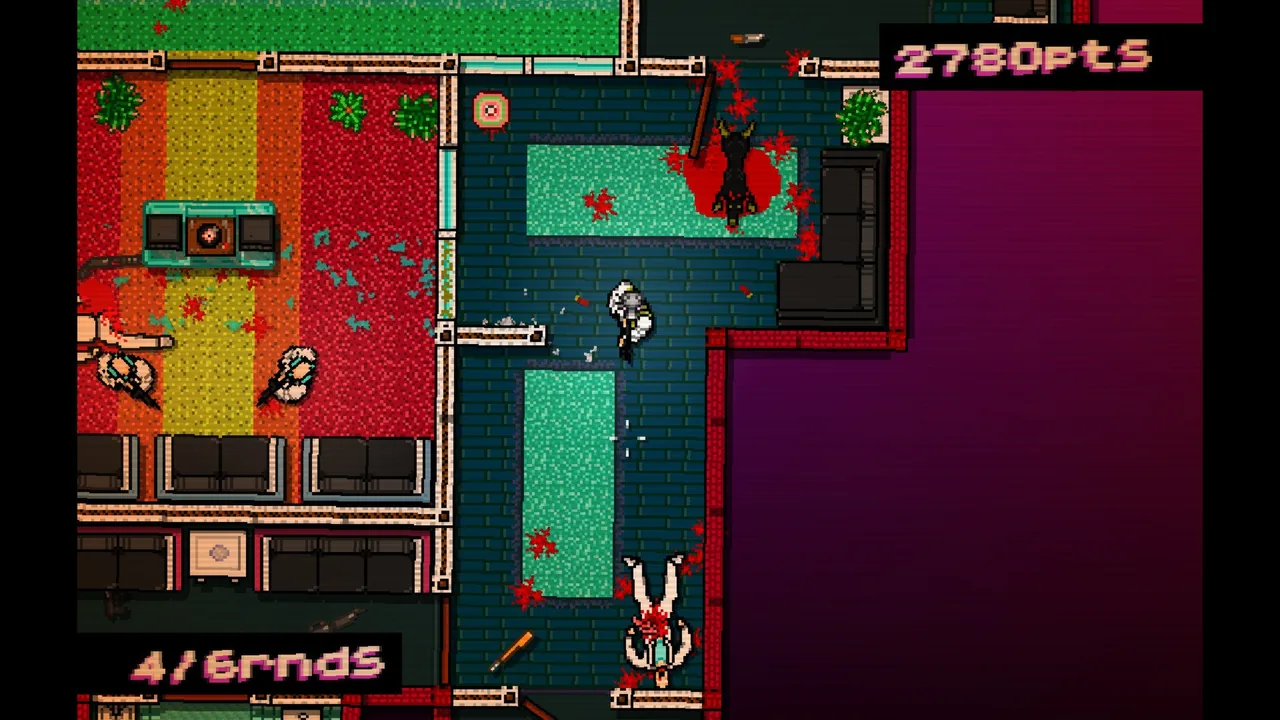
Hotline Miami's rule is that everything dies in one hit, including you. That single decision turns a top-down shooter into a puzzle: each room is a problem with a correct sequence, and you solve it by dying until you find it. Deaths cost you nothing — the restart is instant — so failure becomes rhythm rather than punishment.
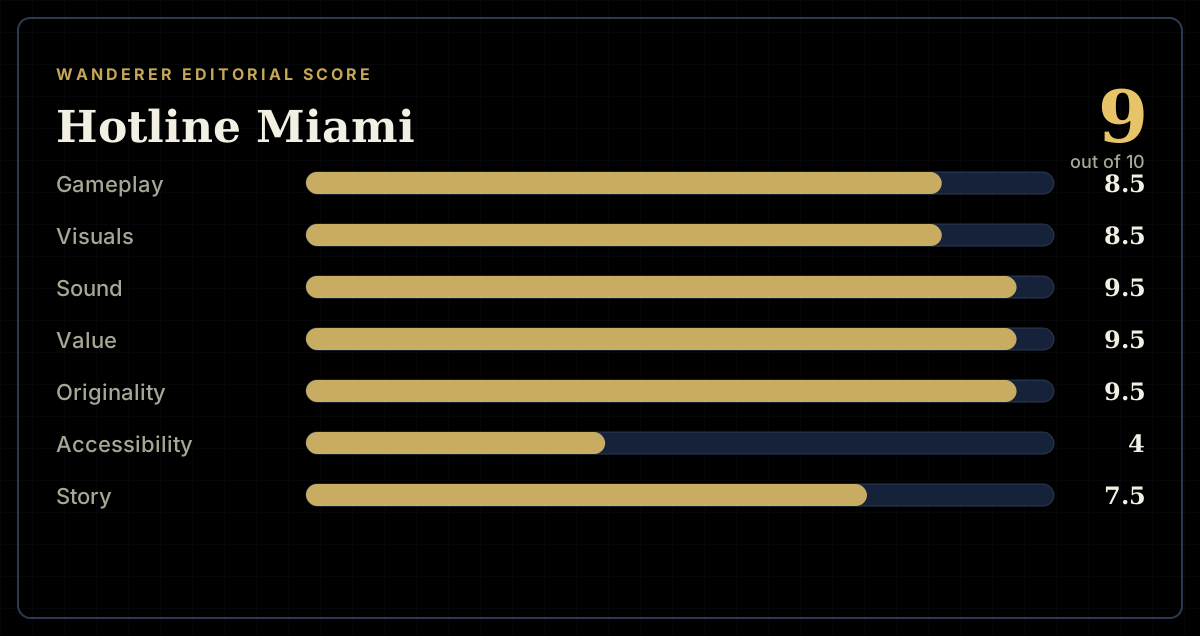
Around that sits presentation doing enormous work. The neon-and-VHS-grain look was widely copied afterwards, and the soundtrack is the part people still talk about fourteen years later. Music and soundtrack appear in 18 of the hundred negative reviews, essentially always as praise. It earns a 9.5 and sits just under this library's only perfect sound scores.
And it's short and dense in a way modern games rarely are — four to six hours, designed to be replayed for score and mask combinations rather than padded.
Its influence is everywhere. This library has already covered Machine Party and Bomb Rush Cyberfunk, both of which owe it something in tone or presentation.
The flaw that never got fixed
Controls appear in 20 of a hundred negatives, aiming in 6, and the AI in 13.
The specific complaint is consistent and, I think, correct. An 18-vote reviewer: "Hotline Miami is a good game with horrifically awful controls… This game has the worst targeting system I've ever experienced in a video game." Lock-on behaves unpredictably at range, and a 25-vote review describes enemies shooting "from a place where they can't see you", with a 19-vote one adding that enemy detection radius is inconsistent and can exceed your own view in widescreen.
In a game where one bullet kills you, an unreliable targeting system and inconsistent enemy vision mean some deaths are genuinely not your fault. That's the difference between hard and unfair, and it's the one criticism I'd endorse without qualification.
How hard is it, really
The achievement curve answers plainly: 35 achievements, the most common at 80%, but the median held by just 10.3% of players and the rarest at 4%. Compare Slime Rancher's 20.6% median, or Loddlenaut's 49.8%. Most people who buy Hotline Miami do not finish very much of it.
Accessibility scores a 4 for that, plus two things worth stating: the violence is extreme and unglamorised, and the game uses heavy screen-flashing and colour distortion that should carry a photosensitivity warning.
The verdict
Hotline Miami earns a 9. It's a genuinely important game — one clean idea executed with total confidence, a soundtrack that outlived it, and a look that a decade of imitators haven't worn out. At NZ$3.68 it's the best value in this library by some margin.
It falls short of higher marks for one reason: fourteen years later, the targeting is still the thing most likely to kill you unfairly, and its own admirers say so. That's a real flaw in a game where every death is supposed to be a lesson.
Buy it. Turn the music up. And accept that you're going to die about four hundred times.
Pros and cons
Pros
- A design so influential that an entire subgenre of top-down action followed it
- One of the great video game soundtracks, and inseparable from how the game feels
- Astonishing pace — encounters resolve in seconds and restart instantly
- Striking neon-and-grain art direction that still looks deliberate rather than dated
- Under four dollars on sale for a complete, historically important game
Cons
- The targeting system is the single most-cited flaw, and it was never fixed
- Enemy detection is inconsistent enough that deaths can feel unearned
- Punishing to the point of exclusion — the median achievement is held by 10.3% of players
- Extremely violent, with flashing visuals that warrant a photosensitivity warning
- Around four to six hours, though it's designed for repetition rather than length
Screenshots
-
Hotline MiamiImage: Devolver Digital via Steam -
Hotline MiamiImage: Devolver Digital via Steam -
Hotline MiamiImage: Devolver Digital via Steam -
How the review scores each part of the gameWanderer Editorial -
The short versionWanderer Editorial