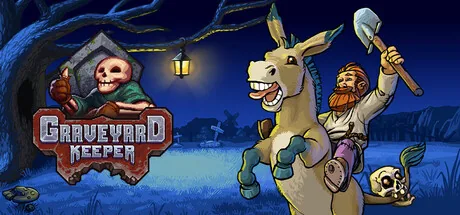
Game review
Graveyard Keeper
6.5 / 10
- Developer
- Lazy Bear Games
- Publisher
- tinyBuild
- Released
- 15 August 2018
- Platforms
- Windows, macOS, Linux
- Genre
- Crafting / Management Sim
- Monetisation
- One-time purchase at NZ$28.99 with five DLC. No microtransactions. Frequently and heavily discounted. Checked 4 August 2026.
- Players
- Single-player only
The short version
Underneath the jokes about what you're allowed to put in a coffin, Graveyard Keeper hides one of the largest and most genuinely satisfying tech trees in any game of its size — dozens of interlocking production chains feeding a cemetery, a church, an alchemy lab and a tavern. The writing is sharp and the atmosphere is excellent. What sits between you and all of it is friction: a slow character, a tiny inventory, a stamina bar that empties in a minute, NPCs available only on specific weekdays, and information the game simply never tells you. Whether that reads as satire or as contempt is the argument this game has been having with its players since 2018.
Biggest strengths
- An enormous, genuinely deep tech tree with production chains that interlock in satisfying ways
- Sharp, funny writing and a strong atmosphere that carries the medieval-satire premise
- Huge amount of content for the price, with players logging hundreds of hours
Biggest weaknesses
- The friction is relentless — slow movement, cramped inventory, a stamina bar that drains in about a minute, and map design that maximises walking
- Essential information isn't in the game; the wiki is effectively a required companion
- NPCs are gated to specific weekdays, so missing one costs you in-game days
Who it's for: Players who genuinely enjoy optimising long production chains and don't mind consulting a wiki, and who find dark comedy about medieval corpse economics funny. Not for anyone expecting a cosy Stardew Valley evening.
Our recommendation: Buy it on sale, which is nearly always, and install quality-of-life mods before your first session rather than after your twentieth hour — the community's walk-speed, inventory and information mods address the exact complaints in the review corpus, and the game is markedly better with them. Keep the wiki open; this is not optional. And save manually and often, because there is no autosave and players still lose hours to crashes.
6.5 / 10
A player with fifty hours logged wrote this in April: "I basically beat this game out of hatred."
That's not a drive-by. Fifty hours is a commitment, and the review goes on to explain precisely why — the game doesn't respect your time, the wiki is the only place most necessary information exists, and the ending teases content the DLC never delivers. It has over eleven hundred helpful votes.
Graveyard Keeper is a good game with a design philosophy that a large minority of its players experience as hostile, and after reading nine years of its reviews I don't think either side is wrong.
The tech tree is the point
Strip away the setting and this is a production-chain game, and a surprisingly ambitious one.
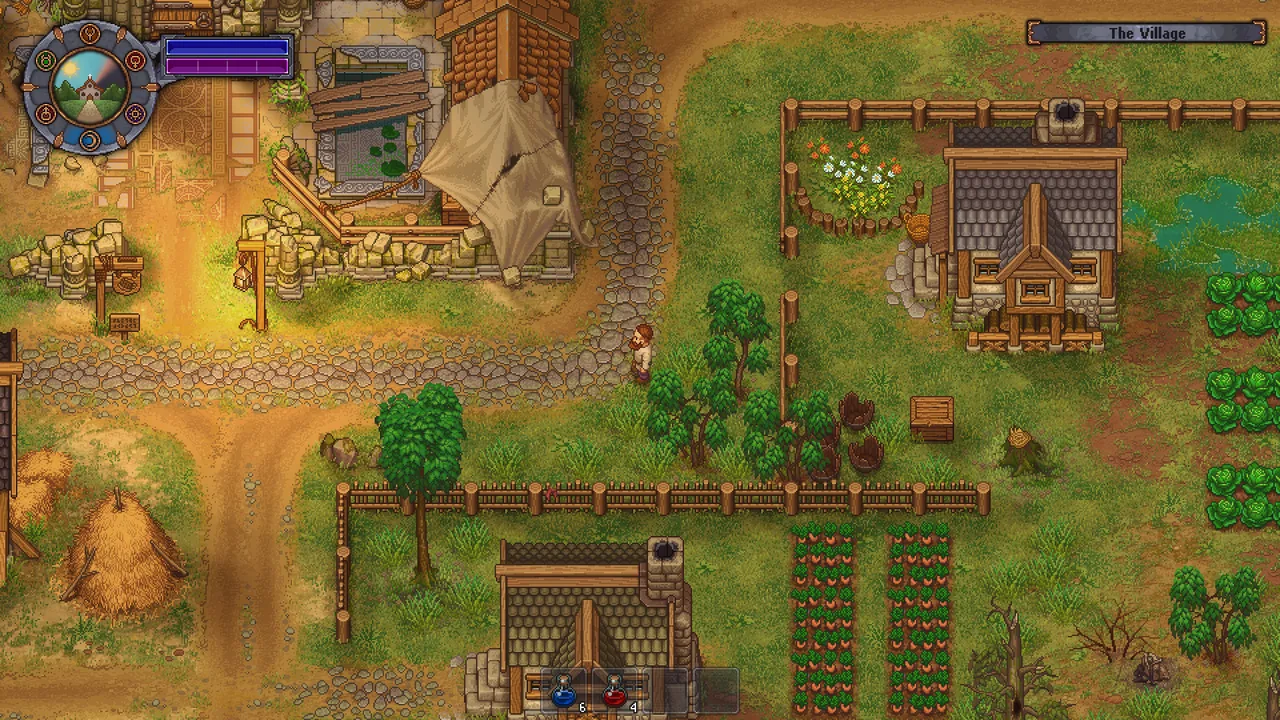
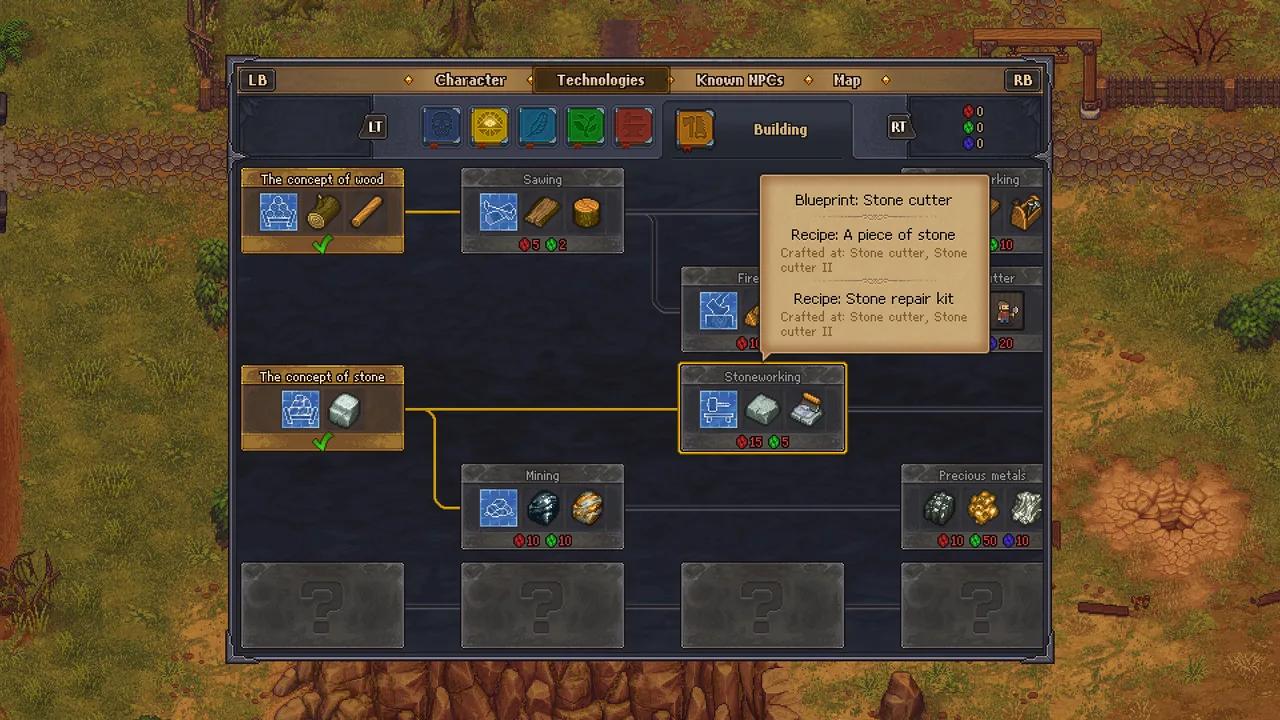
You inherit a cemetery. To improve it you need better gravestones, which need stone, which needs a quarry and a workbench and eventually a whole masonry line. The church needs candles and sermons and a congregation. The alchemy lab turns growable inputs into reagents that feed the embalming that raises corpse quality that raises graveyard rating that unlocks the next tier. There's a tavern, a winery, a garden, a morgue, a smithy.
Everything feeds something else, and the tech tree — spread across three resource types earned by different activities — is large enough that mapping a route through it is genuinely engaging. That is the thing this game does well, and 125 achievements sit on top of it. Players who click with it log hundreds of hours; one recent reviewer is at 369.
The writing helps. It's a comedy about the economics of medieval death — what you can quietly substitute in a burial, what the church will overlook, who is worth the good coffin — and it commits to the bit without becoming smug. The atmosphere is genuinely strong, the pixel art is lovely, and the NPCs are memorable.
The friction is not accidental
Now the other side, and the reviews are remarkably consistent about the specifics.
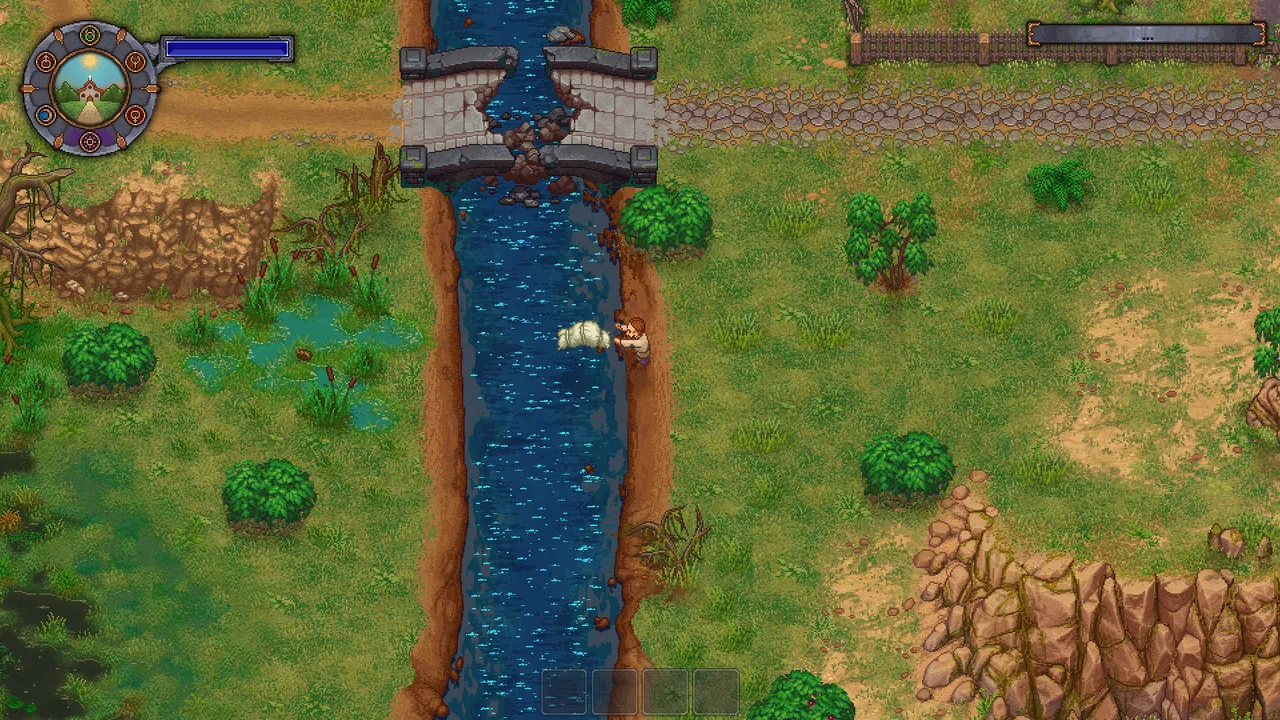
You walk slowly, and the map is built to make you walk. Reviewers describe obstructions placed seemingly to lengthen routes, and hours lost to the round trip between the quarry and home. One estimates five to ten hours of pure menial running across a playthrough.
Your stamina empties in about a minute of real activity, forcing sleep or food, which costs the in-game day you were spending.
Your inventory is tiny, so the walking is multiplied by trips.
NPCs are weekday-gated. Some people only exist on certain days, so missing one doesn't cost you a minute, it costs you in-game days — and even a happy reviewer with 369 hours admits to repeatedly losing track and missing them again.
The game withholds information. Not as mystery, as omission: recipes, requirements and consequences that aren't documented anywhere in the product. The wiki isn't a convenience here, it's a dependency, and multiple reviewers say so flatly.
Stack those and you get the complaint that recurs from 2018 to this year: it isn't that the game is grindy — the genre is grindy, Stardew Valley is grindy — it's that the friction seems designed to consume time rather than to make the time meaningful.
Why the Stardew comparison keeps coming up
Almost every review reaches for Stardew Valley, usually to warn you off. It's worth being precise about the difference, because the two games share a loop and diverge on one decision.
Stardew respects the day as a unit. You wake up, you have a finite amount of energy and daylight, and the game's design consistently tries to let you finish something inside it — a section of field cleared, a relationship advanced, a floor of the mine. The friction exists, but it's tuned so that a session ends with an accomplishment you can name.
Graveyard Keeper spends the day differently. A large share of it goes to transit and inventory management, so a session can end with nothing to show but a slightly fuller chest. That's why "grindy" doesn't quite capture the complaint. Stardew is grindy too. The difference is where the grind's payoff lands — immediately and legibly in one, several sessions later in the other.
The second difference is information. Stardew tells you what a crop sells for and when it grows. Graveyard Keeper very often doesn't, so optimisation — the pleasure its tech tree is built to deliver — happens in a browser tab rather than in the game.
None of that makes it the worse design. It makes it a factory game wearing a farming sim's clothes, and factory games ask you to think in hours and chains rather than days and harvests. The players who love this one talk about it exactly the way Factorio players talk: routes, throughput, the satisfaction of a line that finally feeds itself.
If that's what you want, the Stardew comparison has been steering you wrong the whole time. If you wanted a cosy evening in a village, it's been steering you right.
What the mods tell you
Here's the detail I find most revealing. The single most-upvoted negative review, from launch week 2018, carries an edit from 2024: the author returned with the DLC and a large suite of mods specifically designed to reduce tedium — walk speed, inventory size, the usual annoyances — and reports enjoying it. Then adds that there's only so much mods can do about the underlying design.
That's the community's verdict in miniature. The game underneath is good enough that people build tools to get at it, and the tools are all addressed at the same handful of decisions.
If you buy this, do what they did, but do it first. Install the quality-of-life mods before hour one rather than after hour twenty. It's the difference between a 6.5 and something closer to an 8.
Two more practical warnings. There is no autosave — a recent reviewer lost three hours to a crash and still gave it a thumbs up, which tells you something about the game's hold. And a locale bug reportedly left Turkish players unable to see the menu at all, described as unaddressed for two years while the game stayed on sale there; that was in 2021, so check before buying if it affects you.
6.5 out of 10. Rated 6.5 out of 10.
There's a genuinely good game here — inventive, funny, deeper than it looks, and enormous for thirty dollars. I understand completely why 85% of its players recommend it, and why one of them has 369 hours.
I also understand the 76% who recommend it among recent reviewers, and the fifty-hour player who finished it out of spite. Graveyard Keeper's design treats your time as the resource it's mining, and it never quite decides whether that's the joke or the point. Buy it cheap, mod it early, keep the wiki open, and it's a fine hundred hours. Go in unprepared and you'll be writing one of those reviews yourself.
Pros and cons
Pros
- An enormous, genuinely deep tech tree with production chains that interlock in satisfying ways
- Sharp, funny writing and a strong atmosphere that carries the medieval-satire premise
- Huge amount of content for the price, with players logging hundreds of hours
- The DLC adds real systems, including zombie labour that automates some of the worst drudgery
- Excellent pixel art and a cohesive, gloomy sense of place
- Frequently discounted to a point where the value question mostly answers itself
Cons
- The friction is relentless — slow movement, cramped inventory, a stamina bar that drains in about a minute, and map design that maximises walking
- Essential information isn't in the game; the wiki is effectively a required companion
- NPCs are gated to specific weekdays, so missing one costs you in-game days
- No autosave, and players still report losing hours of progress to crashes
- The base game ends by teasing threads the DLC then doesn't resolve
- A locale bug prevented Turkish players from seeing the menu at all, reported as unaddressed for two years while the game remained on sale in that market
Screenshots
-
Graveyard KeeperImage: tinyBuild via Steam -
Graveyard KeeperImage: tinyBuild via Steam -
Graveyard KeeperImage: tinyBuild via Steam -
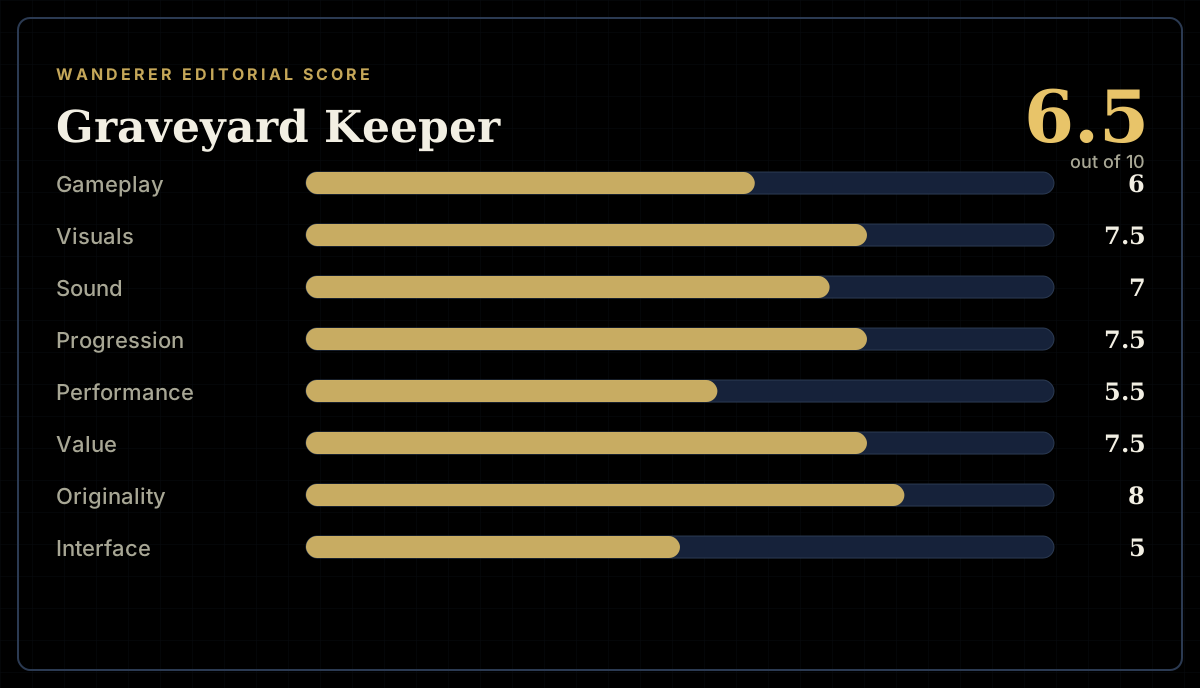
How the review scores each part of the gameWanderer Editorial -
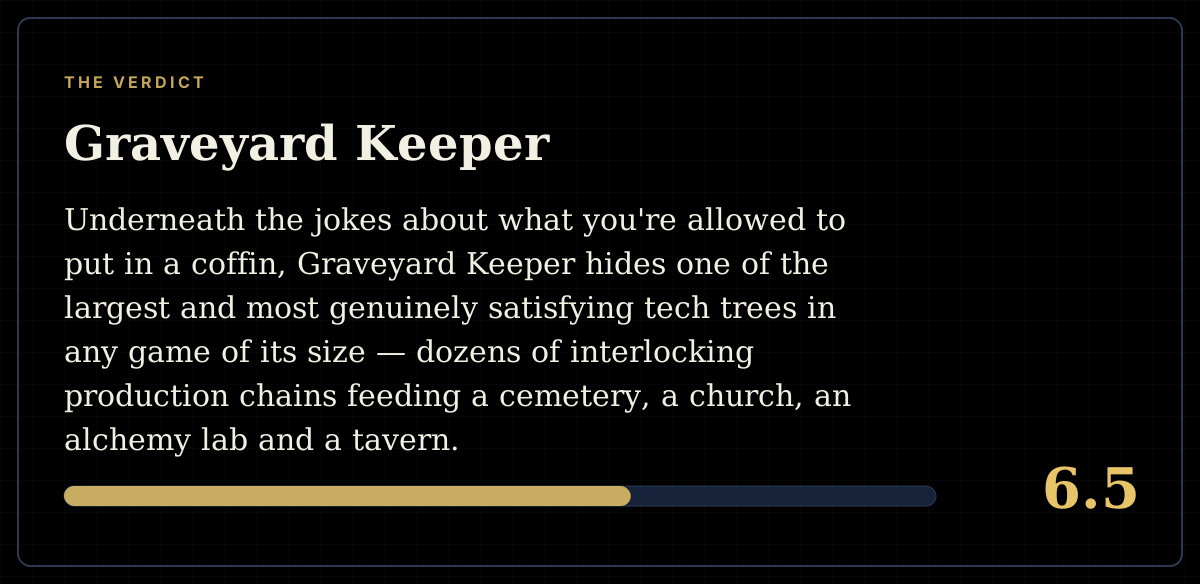
The short versionWanderer Editorial