Game review
Ghost of Tsushima DIRECTOR'S CUT
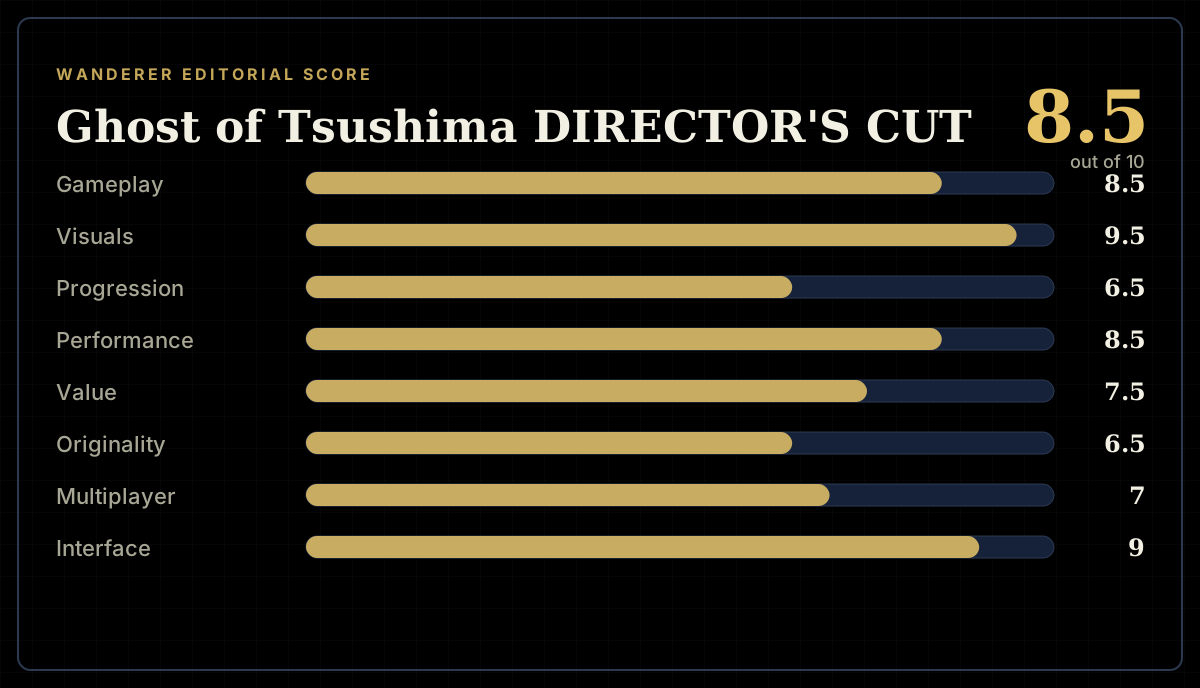
8.5 / 10
- Developer
- Sucker Punch Productions, Nixxes Software
- Publisher
- PlayStation Publishing LLC
- Released
- 16 May 2024
- Platforms
- Windows
- Genre
- Open World Action
- Monetisation
- One-time purchase at NZ$104.95, no in-game purchases. The co-op Legends mode was split out on 27 October 2025 as a free DLC unlock rather than being cut or sold.
- Players
- Single-player campaign, plus the separate co-op and PvP Legends mode, which requires a linked PlayStation Network account
The short version
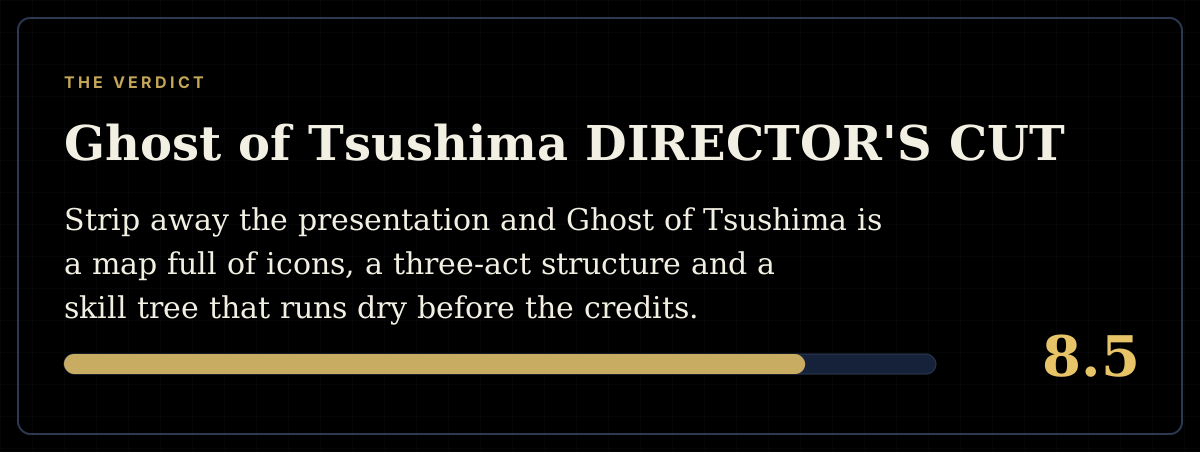
Strip away the presentation and Ghost of Tsushima is a map full of icons, a three-act structure and a skill tree that runs dry before the credits. Its critics are right about all of that, and they are also missing the point: almost nothing here is new, but the wind-guided navigation, the duelling camera and the near-absent HUD combine into the most confident open-world interface anyone has shipped. It turns the boring part of the genre — getting from A to B — into the part you'd choose.
The combat holds up under scrutiny too, provided you turn the difficulty up. Stance-swapping against different Mongol weapon types is a real system rather than a colour-coded chore, and on Lethal the whole thing tightens into something genuinely dangerous. What stops it scoring higher is the middle: hours 15 to 30 lean hard on the same investigate-a-camp-and-clear-it loop, and the skill tree stops offering meaningful choices well before the island stops offering markers.
Biggest strengths
- Wind-guided navigation and a near-empty HUD make exploration feel like looking at the world rather than reading a minimap
- Stance-swapping combat against distinct Mongol weapon types is a genuine tactical system, especially on the Lethal difficulty
- One of the best-behaved PlayStation PC conversions Nixxes has shipped, still receiving patches 26 months after launch and now Steam Deck Verified
Biggest weaknesses
- The mid-game leans heavily on a repeated clear-the-camp loop, and a consistent thread of reviewers describe the world as beautiful but samey after ten hours
- The skill tree exhausts its interesting unlocks well before the campaign ends, leaving late progression as flat numerical upgrades
- Structurally this is Assassin's Creed with better manners — several of its most enthusiastic reviewers say so directly, and mean it as praise
Who it's for: Anyone who wants a gorgeous, grounded samurai action game with excellent swordplay and the best navigation design in the open-world genre — and who is comfortable with a structure openly borrowed from Assassin's Creed. Players who bounce off icon-driven open worlds on principle will bounce off this one too, no matter how good it looks.
Our recommendation: Worth buying, though NZ$104.95 is steep for a two-year-old port and it has been 33% off before. The single-player campaign needs no PlayStation Network account — only the optional co-op Legends mode does, which is the reverse of what the launch-week controversy left people believing.
8.5 / 10
Most open-world games ask you to look at a minimap. Ghost of Tsushima asks you to look at the wind. Swipe the touchpad, or flick the mouse, and a gust runs off across the grass in the direction of whatever you told the game you were interested in. Follow it. That's the whole navigation system, and it is the single best design decision in a game that otherwise borrows almost everything it does from somewhere else.
That tension runs through the entire package. Under the hood this is a map covered in icons, a three-act campaign, a bloated skill tree and a crafting economy that exists mainly to give the icons a purpose. Its most enthusiastic Steam reviewers keep reaching for the same comparison without being prompted — "the best Assassin's Creed game I have ever played" is one of the highest-voted positive reviews in the game's history, and another simply calls it "the best Assassin's Creed game since Black Flag, and I say that lovingly." When a game's fans define it by another studio's series, that tells you something real about its skeleton. What it doesn't tell you is how good the muscle on top turns out to be.
The interface that isn't there
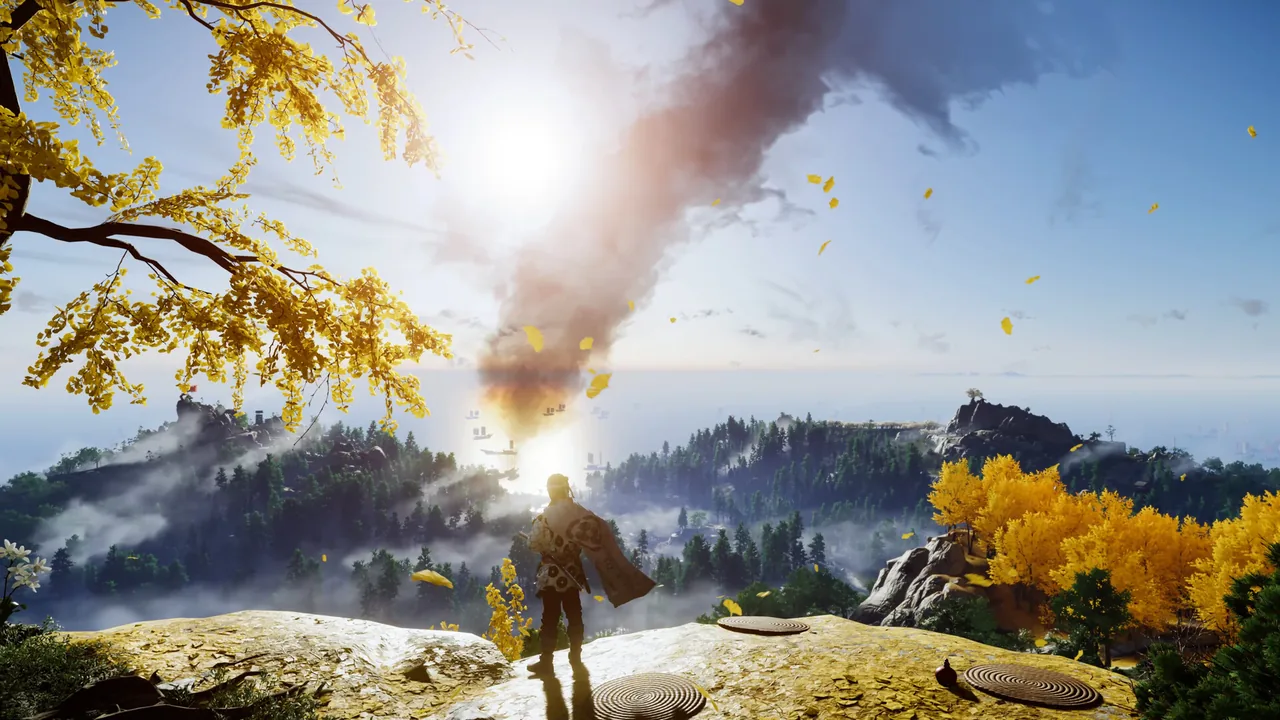
Sucker Punch's actual innovation is subtraction. There is no compass ribbon, no floating quest marker, no minimap in the corner eating your attention. Objectives are communicated by the wind, by birds that lead you to points of interest, by foxes that trot off toward hidden shrines, by smoke on the horizon. The result is that you spend the game looking at Tsushima instead of at a HUD overlaid on Tsushima, which sounds like a small thing and is not: it changes what your eyes do for forty hours.
It also does something clever to the pacing. In most open worlds, travel is dead time you fast-travel through. Here the ride between markers is where the game does its best work — a sudden downpour, a maple forest that turns the screen orange, a duel offered by a wandering ronin. Reviewers who love this game overwhelmingly describe the moving around rather than the objectives, and that is not an accident of taste. It's the design working.
The photography obsession is real too. The Kurosawa mode, black-and-white with added film grain and wind noise, is more than a filter gimmick because the game's framing and colour work were built to survive the loss of colour. And on PC, cinematics render in real time, which is what makes the Japanese lip-sync possible — pick the original-language performance and the mouths match. That is a genuinely rare courtesy in a Western-developed game set in Japan, and it removes the usual reason to default to English.
Combat is better than its reputation, if you make it harder
The standard complaint, which shows up regularly in the negative sample, is that combat is too easy. One reviewer with twelve hours logged and Act I finished writes that it's "frustratingly easy," and they're not wrong about the default difficulty. The game hands you a huge toolkit — four stances, each tuned against a specific Mongol weapon type, plus bows, kunai, smoke bombs, sticky bombs and a stealth suite — and on Normal you rarely need more than two of them.
Turn it up and the system reveals itself. On Lethal, enemies and Jin both die in a couple of hits, which converts every encounter from a damage race into a reading exercise: identify the weapon, switch stance, break the guard, punish. Stance-swapping mid-fight against a mixed group is the closest this game comes to the deliberate, high-consequence swordplay of Sekiro: Shadows Die Twice, and while it never reaches that level of precision, it's playing a more interesting game than its default settings suggest.
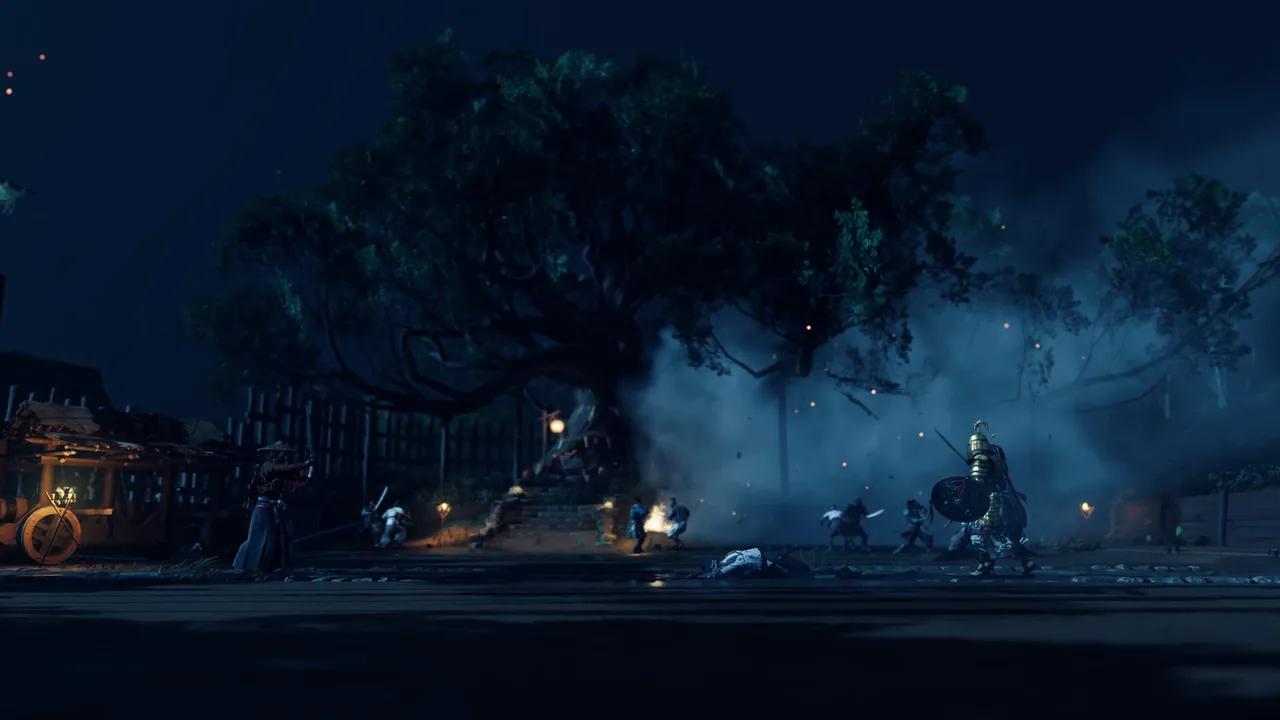
The duels are the highlight and the frustration. One-on-one fights against named opponents are staged beautifully — rain, wind-blown leaves, a slow circling camera — and mechanically they're a tight parry-and-punish loop. But the pattern library is small, and by the fourth or fifth duel you are recognising the moves rather than reading them. The standoff, where Jin challenges a group and kills the first enemy who twitches, is the game's best piece of theatre and drew years of complaints: "For the love of god patch the standoff bug. One of the coolest mechanics in the game and it doesn't even work half of the time," reads a review with nearly a thousand upvotes. Nixxes hotfixed a version of that problem in May 2024 — the mechanic misbehaved at high frame rates, a very PC-port sort of bug — but the mechanic remains the thing players most want to be more reliable than it feels.
Where it runs out of ideas
Between roughly hour 15 and hour 30, the seams show. The structure repeats: ride to a marker, investigate a scene, follow tracks, clear a camp, free some hostages, collect the resources, unlock the next node. The negative reviews that aren't about Sony are almost entirely about this, and the best of them are specific rather than dismissive. "EVERY single point of interest I've found ended up being — go to a place, watch a cutscene, kill some Mongols or bandits," writes one reviewer ten hours in. Another, at 20 hours, makes the sharper version of the argument: the world is enormous for the sake of being enormous, and it works against a story about a man defending a specific, small, knowable island.
The progression system compounds it. The skill tree front-loads its interesting unlocks — new stances, new tools, the abilities that change how a fight opens — and the back half is numerical: more resolve, slightly better ranged damage, another charm slot. By the time you're clearing the third act's content, levelling has stopped being a reason to do anything. The charm system, which should be where builds get expressive, mostly offers small percentage modifiers that never demand a real trade-off.
None of this is fatal, and the campaign's actual story — Jin's slow abandonment of samurai honour for methods that work — is well told and lands its ending. But it does mean the game is at its strongest in its first ten hours and its last five, with a soft middle that a tighter map would have fixed.
The PlayStation Network mess, correctly explained
The single most-upvoted negative review in this game's history, with over five thousand votes, is one sentence long: "I purchased this game on Steam to play it on Steam. I do not want to link or create a PSN account. Absurd behaviour from Sony." It was posted on launch day, and it defined the game's reputation on PC for a year.
Here is where that stands in August 2026, because it has changed and almost nobody has noticed. On 27 October 2025 the Legends multiplayer mode was split out of the base game into a separate free DLC unlock. The store page's third-party account notice now scopes the PlayStation Network requirement to "Online Multiplayer, PlayStation overlay" — the single-player campaign, which is the reason 99% of readers will buy this, does not need one. The same restructure is why the game finally picked up a Steam Deck Verified rating that month, since the verification process no longer has to reckon with an account-linking flow the Deck handles badly.
That is a genuinely good outcome, arrived at slowly and without much fanfare, and it deserves saying plainly: the co-op mode was made free and optional rather than cut or sold. Compare that to the account-requirement fight around Helldivers 2, where the same publisher handled a similar problem far worse. If PSN linking is your objection, the objection now only applies to a mode you can ignore entirely.
Legends, and whether to bother
Legends is the four-class co-op mode — Samurai, Hunter, Ronin, Assassin — running two-player story missions, four-player survival waves and a competitive Rivals mode, styled after Japanese folklore rather than the campaign's grounded history. It's a decent gear-chasing loop with a genuine difficulty ceiling, cross-play was enabled in July 2024, and as a free unlock attached to a single-player game it's a fair bit of extra value.
It is also a mode whose population depends entirely on other people still being here two years after launch, and it now requires a deliberate extra download plus an account link. Treat it as a bonus you might enjoy, not as a reason to buy.
Port quality and performance
Nixxes has one of the better track records in this business, and this is one of its better jobs. Unlocked frame rates, DLSS 3, FSR 3 and XeSS, NVIDIA Reflex, ultrawide up to 48:9 triple-monitor, fully remappable mouse and keyboard, and DualSense haptics over a wired connection. The requirements are modest — a GTX 960 at minimum, an RTX 2060 recommended — for a game that still looks like this.
Launch wasn't clean. The first two months brought seven patches for crashes on AMD Radeon hardware, audio dropouts, Legends matchmaking, and a memory-management problem that a 59-hour player summed up in June 2024 as "good game but terrible port. Memory leak is not fixed after 5 patches." Patch 6 in July 2024 specifically listed memory-management improvements, and the complaint largely stops appearing after that. Some players circulated a workaround involving deleting the PlayStation PC SDK folder for a claimed performance gain, which is worth knowing exists but is a player-reported fix, not a supported one — and it disables the overlay and multiplayer that the folder is there for.
What's more telling is what has happened since. Machine-learning FSR frame generation support arrived in December 2025. A patch improving DualSense Edge controller support shipped in July 2026. That's 26 months of maintenance on a port most publishers would have abandoned after six.
What buying it in 2026 actually means
Something has shifted around this game that changes the recommendation, and it isn't in the game. In March 2026 Bloomberg reported that Sony is stepping back from bringing its PlayStation 5 single-player titles to PC, with subsequent reporting indicating that Ghost of Yotei — the sequel, already released on PlayStation 5 — and Saros are no longer planned for PC release. Sony's stated concern is PC sales performance and the effect on console hardware.
You can see the consequence directly in this game's review feed. Roughly a sixth of the all-time negative sample was posted in 2026, and a striking number of those reviews open by praising the game. "Great game and probably my favourite story game ever, but after Sony announced they will not be releasing Ghost of Yotei or any other single player games to PC I..." — that reviewer has 122 hours logged. Another, at 95 hours, gave a positive review that reads "Ghost of Tsushima, my favourite open world. Jin Sakai, my goat. 10/10. Sad I'll never be able to play Ghost of Yotei though." These aren't brigade posts from people who haven't played it; the median playtime across the entire hundred-review negative sample is 31 hours, and the loudest 2026 voices are well past that.
Read as a review score, that's noise. Read as information, it's the actual context for a purchase: this is a self-contained story that ends properly, and on current reporting its sequel isn't coming to this platform. If you want the rest of the series you'll need a PlayStation. Nothing about that makes the game in front of you worse — it just means you should buy it as a complete thing rather than as an entry point.
The numbers, briefly
94.0% of 38,525 English reviews are positive, 93.9% across all 63,501 languages, and the recent trend is stronger than the lifetime figure: 95 of the last 100 English reviews are positive, posted across four days in early August 2026, with a median playtime of 38 hours. Two years on, people are still buying it and still finishing it.
The achievement curve tells the completion story. Around 93% of players clear the opening, roughly half the 77-entry list sits above 46%, and the tail drops to 2–4% for full-completion and challenge-condition unlocks — a healthy shape for a 40-hour game, and not the cliff you see in games people abandon. It's worth noting the rarest entries include co-op content that's now a separate download, which drags the bottom of the curve lower than single-player engagement alone would.
The verdict
Ghost of Tsushima Director's Cut is an 8.5, and the half-point below a 9 is entirely structural. The presentation is close to peerless — this is one of the most beautiful games ever released on PC, and its navigation design should have been copied by everyone by now. The combat rewards the players who engage with it, particularly on Lethal. The port is well-built and still maintained. The story ends with real weight.
What holds it back is that it is, underneath, a genre exercise. The map is too big, the middle act repeats itself, and progression stops being interesting long before content stops arriving. Its critics who call it repetitive are describing something true, and no amount of maple-leaf lighting fixes a checklist. It's a great version of a formula rather than a game that changes the formula, and it should be scored as one.
Buy it if you want a gorgeous samurai action game and don't mind an icon-driven world. Wait for a discount if you can — NZ$104.95 is a 2020 game at 2026's full price, and 33% off has happened before. Skip it if open-world checklists actively annoy you, because this one is prettier than most and otherwise the same.
If it's the systems rather than the swordplay you're chasing — a world that keeps developing your character while you're doing something else — Wanderer runs on a different clock entirely, and costs nothing to start.
Pros and cons
Pros
- Wind-guided navigation and a near-empty HUD make exploration feel like looking at the world rather than reading a minimap
- Stance-swapping combat against distinct Mongol weapon types is a genuine tactical system, especially on the Lethal difficulty
- One of the best-behaved PlayStation PC conversions Nixxes has shipped, still receiving patches 26 months after launch and now Steam Deck Verified
- The co-op Legends mode was made a free unlock in October 2025 rather than being cut or monetised
- Japanese lip-sync rendered in real time makes the original-language performance a first-class option rather than a subtitle compromise
Cons
- The mid-game leans heavily on a repeated clear-the-camp loop, and a consistent thread of reviewers describe the world as beautiful but samey after ten hours
- The skill tree exhausts its interesting unlocks well before the campaign ends, leaving late progression as flat numerical upgrades
- Structurally this is Assassin's Creed with better manners — several of its most enthusiastic reviewers say so directly, and mean it as praise
- Boss duels repeat a small set of patterns, and the standoff mechanic drew years of complaints before and after its 2024 hotfix
- Full price is NZ$104.95 for a game that first shipped in 2020, with no discount live at the time of writing
Screenshots
-
Ghost of Tsushima DIRECTOR'S CUTImage: PlayStation Publishing LLC via Steam -
Ghost of Tsushima DIRECTOR'S CUTImage: PlayStation Publishing LLC via Steam -
Ghost of Tsushima DIRECTOR'S CUTImage: PlayStation Publishing LLC via Steam -
How the review scores each part of the gameWanderer Editorial -
The short versionWanderer Editorial