Game review
Garden Galaxy
7 / 10
- Developer
- Anneka Tran
- Publisher
- Anneka Tran
- Released
- 14 December 2022
- Platforms
- Windows
- Genre
- Idle Sandbox
- Monetisation
- One-time purchase at NZ$14.75. No in-app purchases of any kind -- confirmed by the store page and repeated across positive and negative reviews from launch week through 2026.
- Players
- Single-player only
The short version
Garden Galaxy asks you to build a personal garden almost entirely out of items you don't get to choose -- visitors drop coins, coins go in a pot, the pot spits out a random plant, ornament or piece of furniture from a huge shared pool, and you decide where it goes. It's an unusual and genuinely likeable mashup of idle clicker, gacha collection game and cosy sandbox decorator, sold once for NZ$14.75 with no purchases of any kind afterward -- a detail four years of reviews single out with real relief given how the genre usually behaves.
It sits at Overwhelmingly Positive, 97.4% of 2,455 reviews across all languages (96.6% of 1,429 English-language reviews). The negative sample is small but consistent across every year since launch: the same randomised drops that make every garden unique also mean wanted items can take hours to appear, storage fills up faster than space or sorting tools keep pace, and completionists in particular describe the late game turning from relaxing into stressful.
Biggest strengths
- A genuinely distinctive hybrid of idle clicking, gacha-style collection and cosy garden decorating that doesn't closely resemble anything else on Steam
- No in-app purchases of any kind despite running on a randomised-drop economy, a detail positive and negative reviewers alike single out across four years of feedback
- Cheap one-time price with a permanent free demo, and years of free content updates -- Frost, Harvest and Summer updates through 2023, an item-inspection patch in 2024, a themed "Woolly" drop as recently as November 2025
Biggest weaknesses
- The randomised item drops that define the game's identity are also its most consistent complaint, forcing players toward a late-unlocked "banishment" tool just to stop already-owned items from clogging the pool
- Storage and clutter management becomes overwhelming well before the game hands you the space or sorting tools to control it -- a complaint that shows up in reviews from December 2022 through mid-2026 without much apparent change
- The camera is locked to four fixed rotations with no free camera control, and Steam Deck players report rotation and control issues the desktop build doesn't have
Who it's for: Players who like cosy decorating and collection games -- Animal Crossing, Viridi, Cozy Grove types -- and don't mind ceding some control to randomness in exchange for a genuinely distinctive loop. Less suited to anyone who wants precise, deliberate garden design from the start, or anyone prone to inventory-management anxiety in games.
Our recommendation: Worth its low asking price, especially since the free demo lets you try the exact core loop before buying and the full game adds no purchases beyond that one payment. Go in expecting a slow, chance-driven collection game rather than a creative sandbox with full control, and be ready for the completion grind to get more frustrating than relaxing well before you've seen everything.
7 / 10
Most games in the idle-hybrid space that reach for a "cosy" label lean on the word to paper over thin systems. Garden Galaxy earns it more honestly than most, and then spends its whole review history arguing with itself about whether it deserves to keep it. The pitch is simple: visitors wander through your garden, drop coins, you feed those coins into a pot, and the pot hands back a random item from a pool that runs into the hundreds -- furniture, plants, creatures, decorations, grouped into themed sets you're implicitly encouraged to complete. Where you put each item is entirely up to you. What item you get next is not up to you at all, and that single design choice is doing almost all the work in both directions -- it's the reason the game feels unlike anything else on Steam, and it's the reason a meaningful slice of its audience eventually bounces off it.
A pot, not a shop
Garden Galaxy's most quietly impressive achievement is what it doesn't do. It's built around a randomised-drop economy -- the exact structural shape that, in mobile gaming, almost always comes bolted to a premium currency and a "or pay to guarantee it" button. It has neither. The one-time purchase is NZ$14.75, there's a permanent free demo that plays the actual opening hours rather than a stripped-down teaser, and there is no cash shop of any kind behind the coin pot. Reviewers notice. "Honestly the best few bucks I ever spent," reads one. A detailed four-year retrospective review from January 2026, at 48.6 hours played, opens by praising exactly this: a chance-based collection game that never once asks for a second payment. For a genre this vulnerable to monetisation creep, that restraint is worth taking seriously as a design decision rather than an accident, and it's the single strongest thing about the game.
The pot is also the problem
Set the money question aside and the randomness itself is where the reviews complain, consistently, across every year since December 2022. The core frustration isn't the concept -- most players clearly enjoy not knowing what's coming next early on -- it's what happens once you've been playing long enough to have opinions about what you actually want. Coins buy a chance at an item, not the item, and duplicates are common. One reviewer at over 1,200 hours puts a number on it: the game "would be about 15 hours shorter" if every item in a set were guaranteed to appear at least once before repeating, rather than leaving that to a late-game tool called the "banishment" table that lets you manually exclude already-owned items from the pool. Until you've unlocked and used that tool, wanting one specific piece means grinding through duplicates you have no use for. A Chinese- language review from July 2026 makes the same complaint independently -- fun and addictive early, increasingly tedious once full-set completion becomes the goal, with the demo's drop rates remembered as noticeably kinder than the full release's.
This is also where the game's marketing and its actual pacing pull apart. The store page calls it a "relaxing idle / creative sandbox," and for the first hour or two that's accurate -- but multiple reviewers push back specifically on the idle half of that claim. "Has too much clicking and requires too much attention to be considered an idler," reads one from August 2026, listing the need to individually click each visitor to collect coins as the friction point. It isn't a false-advertising problem exactly -- visitors do keep arriving and generating coins passively while the window sits in the background, so genuine idle progress happens -- but the game rewards active attention so much more than passive waiting that calling it an idler undersells how hands-on it wants you to be once you're past the opening stretch.
Storage, clutter, and the missing creative mode
The second recurring complaint has nothing to do with randomness and everything to do with space. Items arrive faster than most players unlock room to display or store them, and the negative-review sample returns to this specific frustration in almost every year since launch -- "ends up mostly getting a lot of objects and not a lot of surface tiles," as one outside review from an independent blog puts it; "the amount of stuff you have to store just becomes overwhelming and tedious," reads a 2024 Steam review; a January 2026 review makes nearly the same complaint in almost the same words. That's an unusually long-lived pattern for a single design issue to survive across what the developer's own news feed shows as real, sustained post-launch support -- a Frost update and an Anniversary update in December 2023, a Harvest update that October, an item-inspection patch in March 2024, and a themed "Woolly" content drop as recently as November 2025. The updates are real and the game clearly hasn't been abandoned, despite one January 2026 review calling it exactly that; the storage-and-clutter complaint has simply outlasted several rounds of content patches without a structural fix.
Tied to both issues is the single most-requested feature across the whole review history: a creative or sandbox mode that would let players place items they already own freely, without the drop pool gating what's available. Several long-playtime reviewers describe discovering an unintended workaround -- certain late-game items effectively let you "force" creative-mode-like placement -- and treating it as the game finally clicking into place. That it takes an unofficial workaround to get there is itself the clearest evidence the feature request is a real gap rather than a vocal minority's preference.
Presentation and the numbers behind the curve
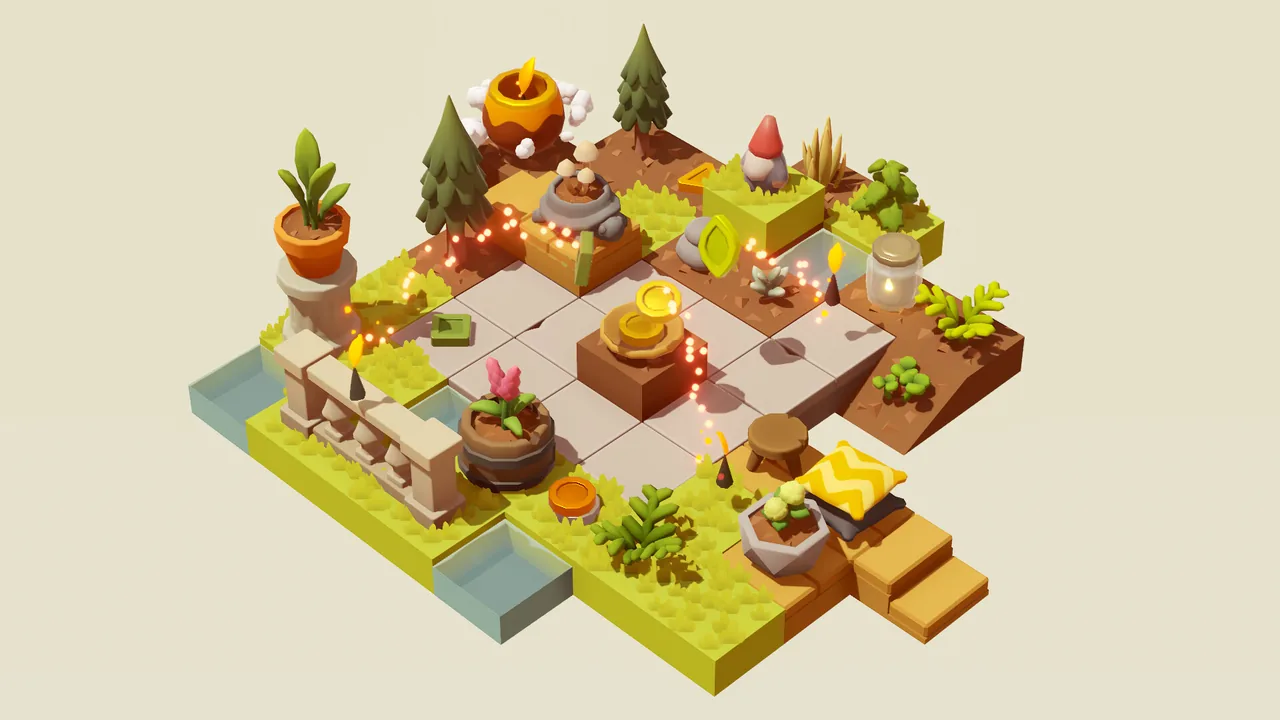
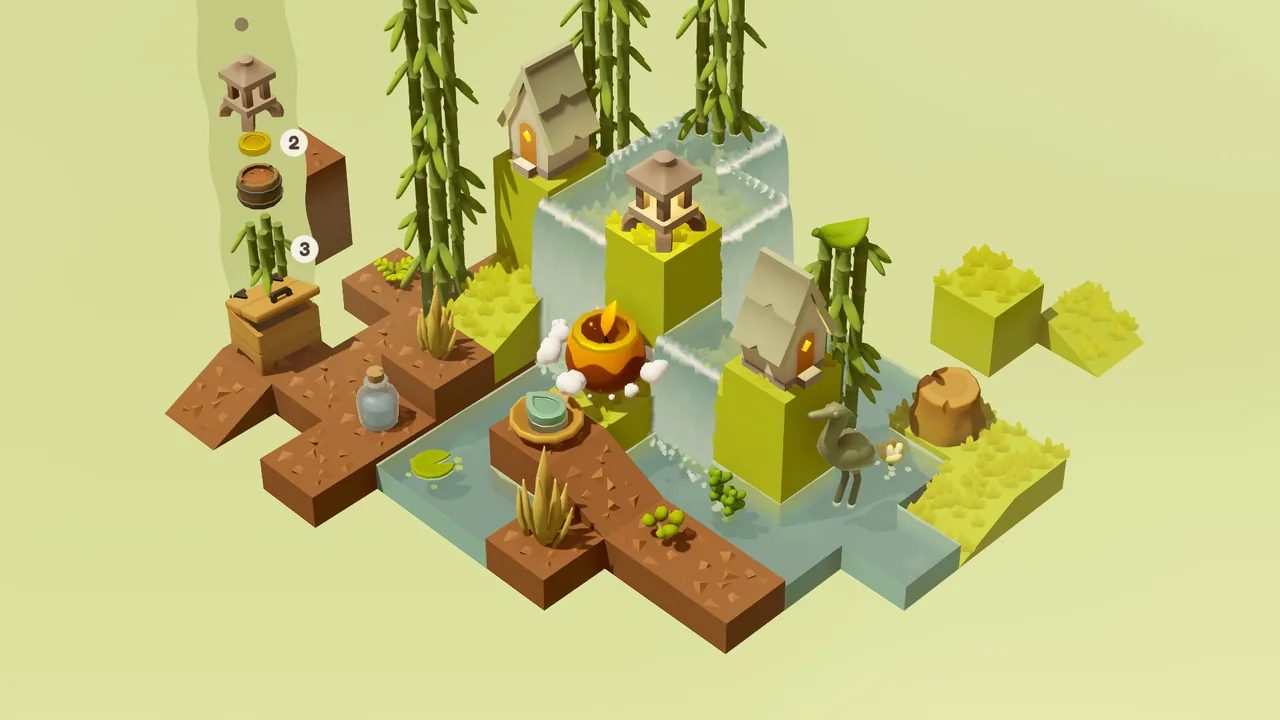
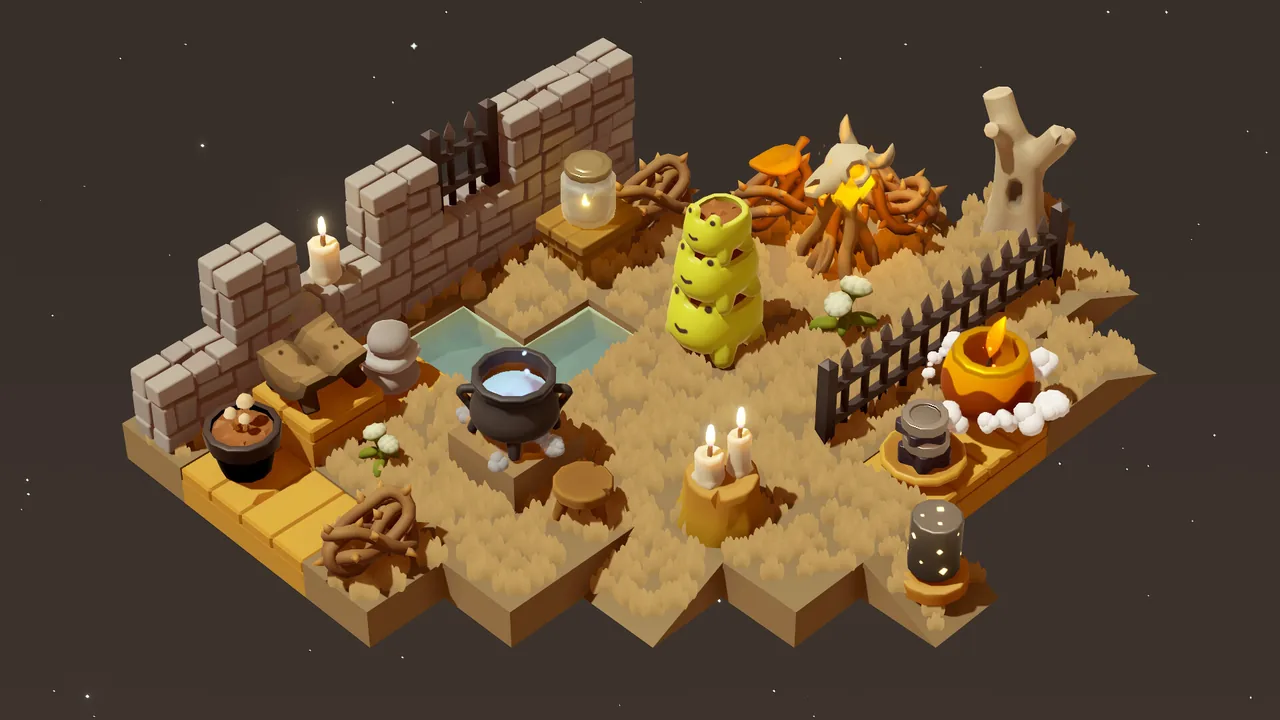
None of this undercuts the presentation, which is where the positive reviews are least divided. The pixel-garden aesthetic, ambient music and small interactive touches -- a fountain that waters a nearby flower, a lit fire that goes out if you water it, fence posts that auto-connect when placed next to matching pieces -- draw consistent praise, including from reviewers who otherwise land negative. "Nice graphics and can be addictive at first" is a common shape even among the complaints. It's a legitimately good-looking, well-composed game to sit and decorate in, at least for as long as the RNG cooperates.
The game's own achievement data backs up the shape of the complaint pattern rather than contradicting it. Early, low-effort achievements -- clicking visitors, spending your first coins -- sit at 86-99% completion, which is normal and unremarkable. But the set-completion achievements, one per themed collection, tell a different story: they range from roughly 42% down to 12%, meaning the large majority of players who bought the game never finished even a single themed set. That's consistent with a game that opens strong and loses a meaningful share of its audience somewhere in the middle stretch, exactly where the reviews describe the RNG grind starting to bite.
Final verdict
Garden Galaxy is a genuinely distinctive, cheap, and honestly-monetised idle-collection game that does something few of its closest comparisons attempt -- it just doesn't fully solve the tension between "randomised for variety" and "randomised for frustration" that its own core loop creates. The RNG is the reason no two gardens look alike, and it's also the reason a completionist mindset turns the back half of the game into a grind against duplicate items and a shortage of storage space. Years of free content updates show a developer who kept caring about the game long after launch, and the total absence of microtransactions on top of a drop-based economy is a genuinely rare thing to be able to say about a game in this space.
7.0 out of 10. Recommended for anyone drawn to cosy collection and decorating games who can make peace with letting chance drive the early hours, especially at this price with a real demo to try first. Go in expecting the pacing to shift from relaxing to occasionally stressful once you start chasing specific items rather than just enjoying whatever shows up, and don't expect the "idle" half of the pitch to mean you can walk away for long stretches and come back to real progress -- this one wants your hands on the mouse more often than the label suggests.
Pros and cons
Pros
- A genuinely distinctive hybrid of idle clicking, gacha-style collection and cosy garden decorating that doesn't closely resemble anything else on Steam
- No in-app purchases of any kind despite running on a randomised-drop economy, a detail positive and negative reviewers alike single out across four years of feedback
- Cheap one-time price with a permanent free demo, and years of free content updates -- Frost, Harvest and Summer updates through 2023, an item-inspection patch in 2024, a themed "Woolly" drop as recently as November 2025
- True idle-friendly design: visitors keep arriving and generating coins while the game sits in the background, so progress continues without constant attention
Cons
- The randomised item drops that define the game's identity are also its most consistent complaint, forcing players toward a late-unlocked "banishment" tool just to stop already-owned items from clogging the pool
- Storage and clutter management becomes overwhelming well before the game hands you the space or sorting tools to control it -- a complaint that shows up in reviews from December 2022 through mid-2026 without much apparent change
- The camera is locked to four fixed rotations with no free camera control, and Steam Deck players report rotation and control issues the desktop build doesn't have
- There's no dedicated creative mode, so players who want to design a garden on purpose rather than accept what the pot gives them are working against the core system rather than with it
Screenshots
-
Garden GalaxyImage: Anneka Tran via Steam -
Garden GalaxyImage: Anneka Tran via Steam -
Garden GalaxyImage: Anneka Tran via Steam -
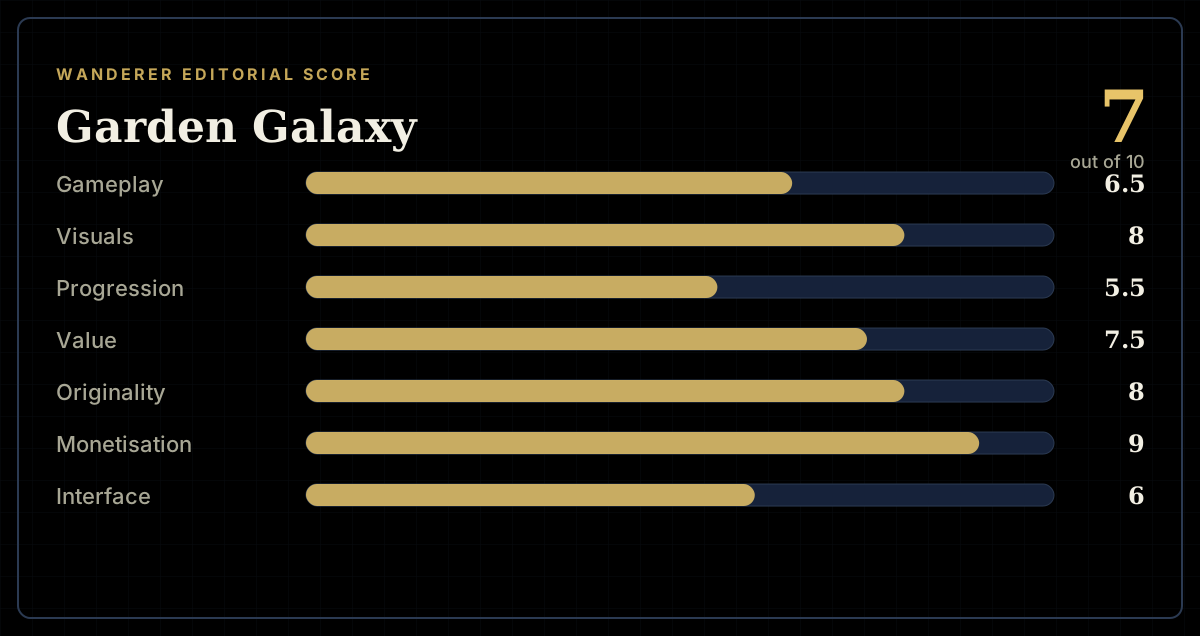
How the review scores each part of the gameWanderer Editorial -
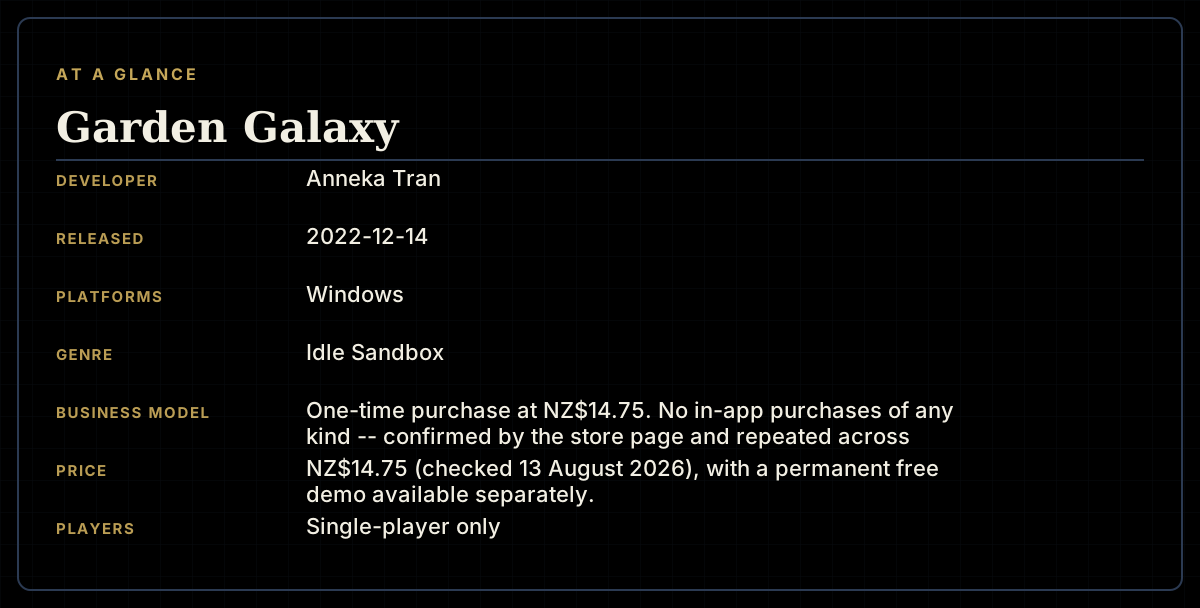
The essentialsWanderer Editorial -
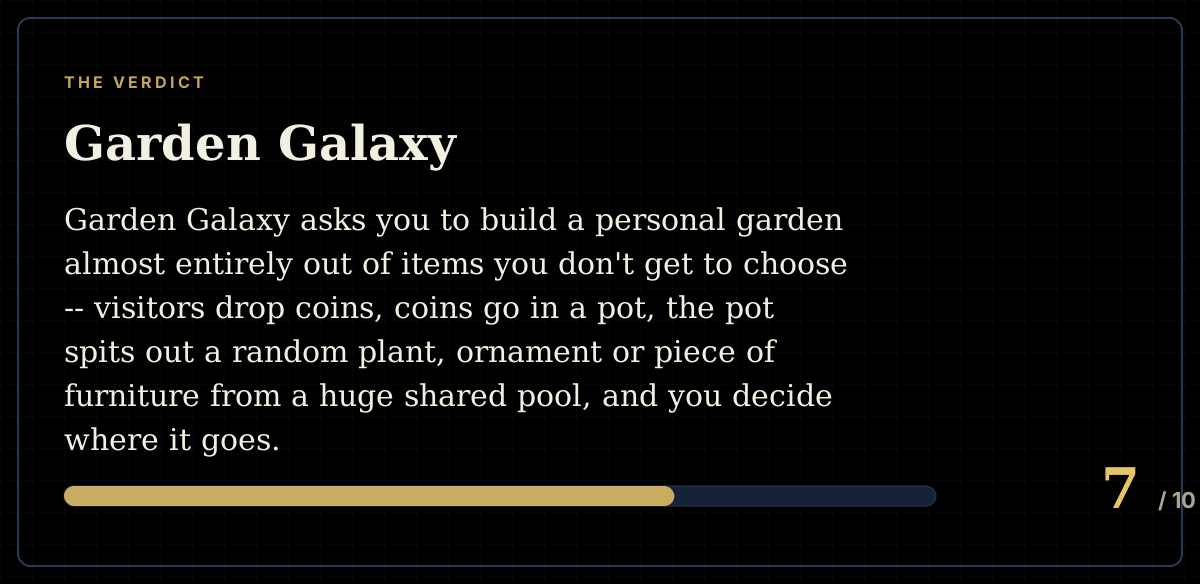
The final verdictWanderer Editorial