Game review
Diner Bros 2 Review: A Charming Cooking Sequel That Punishes Solo Play
6.5 / 10
- Developer
- JAYFLGAMES
- Publisher
- JAYFLGAMES
- Released
- 24 July 2025
- Platforms
- ["PC"]
- Genre
- Simulation
- Monetisation
- Paid
- Players
- true
The short version
Diner Bros 2 is a couch-co-op cooking and time-management sequel in the Overcooked/PlateUp mould, where players juggle orders, cook dishes and design their own kitchen across a series of themed campaigns. Reviewers who play it the way it's built to be played, with friends or family in the same room, describe it enthusiastically as a polished, more customisable follow-up to the 2018 original. That same design choice becomes the game's biggest liability for anyone playing alone, with multiple reviewers independently reporting the difficulty is balanced around a full team and becomes close to unplayable solo, alongside a genuinely recurring complaint about hard-to-distinguish food icons, especially in the donut campaign.
Biggest strengths
- Reviewers who play with a full group, especially returning fans of the original Diner Bros, consistently describe it as a fun, polished, more customisable evolution of the first game
- The campaign structure, kitchen-design freedom and its roster of quirky, demanding customer types are repeatedly singled out as the game's most distinctive and enjoyable additions over its predecessor
- Multiple reviewers highlight strong Steam Deck and Remote Play Together support, and call it an easy, welcoming pick-up for non-gamers playing alongside more experienced players
Biggest weaknesses
- A specific and repeated complaint: the game has no online co-op, only local/split-screen and Remote Play Together, and its difficulty is balanced around a full player count, leaving solo players describing entire campaigns as close to impossible
- Reviewers repeatedly report that similar-looking food and drink icons, worst in the donut campaign's toppings and drink-size variations, are hard to tell apart, with one explicitly asking for the large, clear accessibility labelling PlateUp! offers
- A handful of reviewers describe post-launch content updates as slow to arrive after launch, and note the core loop grows repetitive over longer campaigns without much difficulty scaling
Who it's for: Couch co-op groups, families and cooking-sim fans who enjoyed Overcooked or PlateUp!, but not solo players looking for a single-player time-management game.
Our recommendation: Recommended for co-op groups; solo players should look elsewhere or expect real frustration.
6.5 / 10
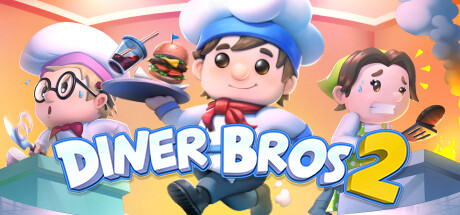
Diner Bros 2 hands players a diner, a growing menu and a clock, then asks them to cook, plate and serve a parade of increasingly demanding customers before dining rooms descend into chaos. It's a direct sequel to 2018's Diner Bros, built in the same Overcooked-inspired time-management tradition but leaning explicitly on mechanics borrowed from PlateUp!, including kitchen layout design players customise as they progress through themed campaigns. Developed and published by JAYFLGAMES, the game launched to full release in July 2025 and sits at 87% positive across 147 Steam reviews. The 20-review English-language sample gathered for this piece, spanning both the toprated and most-recent review queues, describes a game its fans genuinely love playing together, set against two specific, recurring frustrations that show up again and again independently of each other.
A Polished, Charming Sequel, When Played With Others
The dominant note across the sample is straightforward affection, particularly from players returning from the original Diner Bros. Reviewers describe the sequel as retaining everything that made the first game work while adding real depth: a proper campaign structure across multiple themed restaurants (burgers, chicken, donuts and more), movement and equipment upgrades, expandable kitchens players get to lay out themselves, and a cast of "unique customers" with their own quirks, from impatient joggers to teenagers who overstay their welcome. One reviewer who has played extensively across Overcooked, Overcooked 2, Overcooked: All You Can Eat and PlateUp! specifically credits Diner Bros 2 with carving out its own lane in a crowded genre, praising the campaign format and its movement-upgrade system as a smarter, less fiddly alternative to PlateUp!'s emphasis on dish cleaning and slowing players down. Another describes playing the game "often" with both kids and friends, swapping between accounts, and calling the difficulty options fair and adjustable enough to suit a casual group or a more competitive one. Steam Deck and Remote Play Together support both draw specific, repeated praise, with more than one reviewer flagging the game as an easy, welcoming pick for non-gamers sitting down with more practiced players.
No Online Co-op, and Solo Players Are Left Behind
Set against that warmth is a specific, repeated, and consistent structural complaint: Diner Bros 2 has no online co-op, only local split-screen and Remote Play Together, and its difficulty curve is tuned around a full group rather than scaling down for fewer players. One reviewer with over 50 hours in the original game reports abandoning the sequel after less than three hours, describing certain campaigns, the chicken campaign in particular, as "horribly balanced" for smaller parties and effectively unplayable solo, explicitly asking for the kind of player-count-based difficulty adjustment PlateUp! offers. A separate reviewer flatly states the sequel is "impossible solo" and recommends anyone playing alone simply stick with the first Diner Bros instead. A third reviewer's one-line review is blunter still: "No online coop is a HUGE mistake please add online coop." This isn't a single dissenting voice; it's the same specific critique arriving independently from multiple reviewers, which suggests anyone drawn to Diner Bros 2 expecting to play it as a single-player time-management game should expect real, well-documented friction rather than a minor rough edge.
The Icons Are a Genuine Recurring Problem
The second consistent complaint concerns legibility. Multiple reviewers, including some who otherwise recommend the game enthusiastically, describe struggling to tell similar food and drink icons apart at a glance, a problem most acute in the donut campaign, where topping variations and coffee and tea combinations use small, similar-looking symbols. One detailed review walks through the issue at length: a tiny icon-inside-an-icon denoting donut toppings that's nearly impossible to read, drink-size icons only a few pixels apart, and a camera that zooms further out as the restaurant expands, shrinking already-small icons further still. That reviewer explicitly asks for the kind of large, clear, alphanumeric accessibility labelling PlateUp! provides for players with limited eyesight or smaller screens, calling it "a pretty important piece of information to convey in a game like this." Another reviewer's list of complaints leads with the same underlying issue: fries and cheesy fries that look nearly identical, a glazed-donut icon that doesn't match the in-game sprite, and colour choices, like pale pink raw chicken against white countertops, that blend into the environment under time pressure. It's a fixable UI problem rather than a design flaw, but its independent recurrence across multiple, otherwise positive reviews marks it as a real one.
Smaller Frustrations and a Loud Volume Slider
A handful of smaller complaints round out the critical side of the sample without rising to the level of the two issues above. More than one reviewer reports finicky object-targeting, where the character occasionally fails to pick up or interact with an item for several seconds during high-pressure moments, and one reviewer flags the game's default audio as strikingly loud, needing the in-game volume and system mixer both turned down substantially. A longer, more measured review notes that content updates felt slow to arrive in the weeks after launch, though the same reviewer acknowledges new campaigns (a Wok stage and a Donut stage) have since shipped, and describes the core loop growing repetitive over a long campaign without much difficulty scaling to match player skill as levels are unlocked. One reviewer reports a buggy early session where completed dishes wouldn't register as deliverable, missing the refund window before the issue resolved itself, though this reads as an outlier rather than a pattern in the wider sample.
Value and Final Verdict
At its price, the sample lands solidly on the side of recommending Diner Bros 2, provided it's bought for what it actually is: a local co-op party game rather than a solo time-management title. Reviewers repeatedly describe it as good value for a group, offering a meaningful evolution over the original Diner Bros through its campaign structure, kitchen customisation and standout roster of demanding customers, all wrapped in cozy, approachable presentation that works well on Steam Deck. The lack of online co-op and the genuinely punishing solo-play balance are serious caveats for anyone without a regular co-op partner, and the icon-legibility complaints are common enough to expect some eye strain during the donut campaign in particular. But for the couch co-op audience it's clearly built for, this is a charming, well-received sequel that mostly delivers on its promise.
Pros and cons
Pros
- Reviewers who play with a full group, especially returning fans of the original Diner Bros, consistently describe it as a fun, polished, more customisable evolution of the first game
- The campaign structure, kitchen-design freedom and its roster of quirky, demanding customer types are repeatedly singled out as the game's most distinctive and enjoyable additions over its predecessor
- Multiple reviewers highlight strong Steam Deck and Remote Play Together support, and call it an easy, welcoming pick-up for non-gamers playing alongside more experienced players
Cons
- A specific and repeated complaint: the game has no online co-op, only local/split-screen and Remote Play Together, and its difficulty is balanced around a full player count, leaving solo players describing entire campaigns as close to impossible
- Reviewers repeatedly report that similar-looking food and drink icons, worst in the donut campaign's toppings and drink-size variations, are hard to tell apart, with one explicitly asking for the large, clear accessibility labelling PlateUp! offers
- A handful of reviewers describe post-launch content updates as slow to arrive after launch, and note the core loop grows repetitive over longer campaigns without much difficulty scaling
Screenshots
-
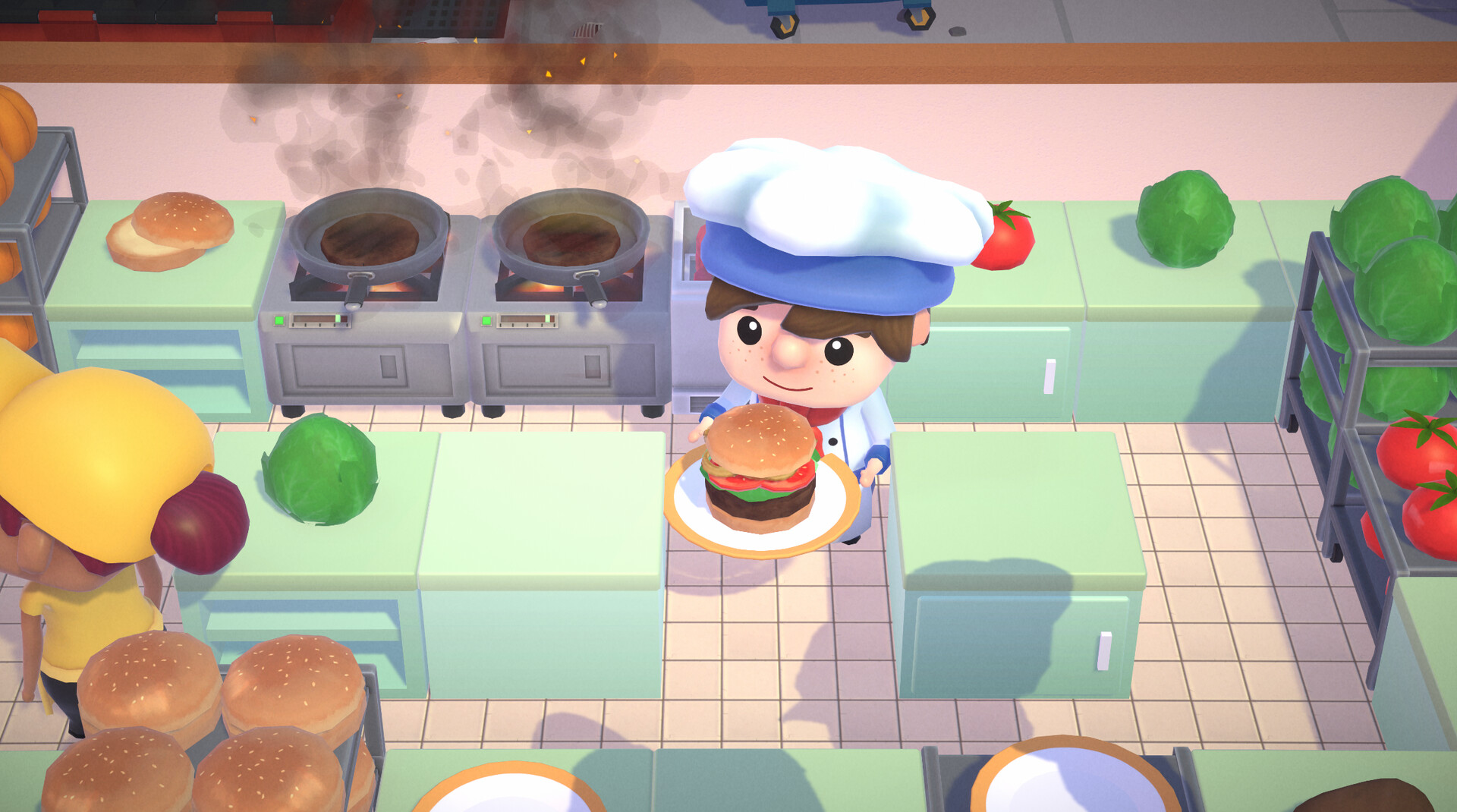
Plating a burger before the smoke sets off a problemJAYFLGAMES -
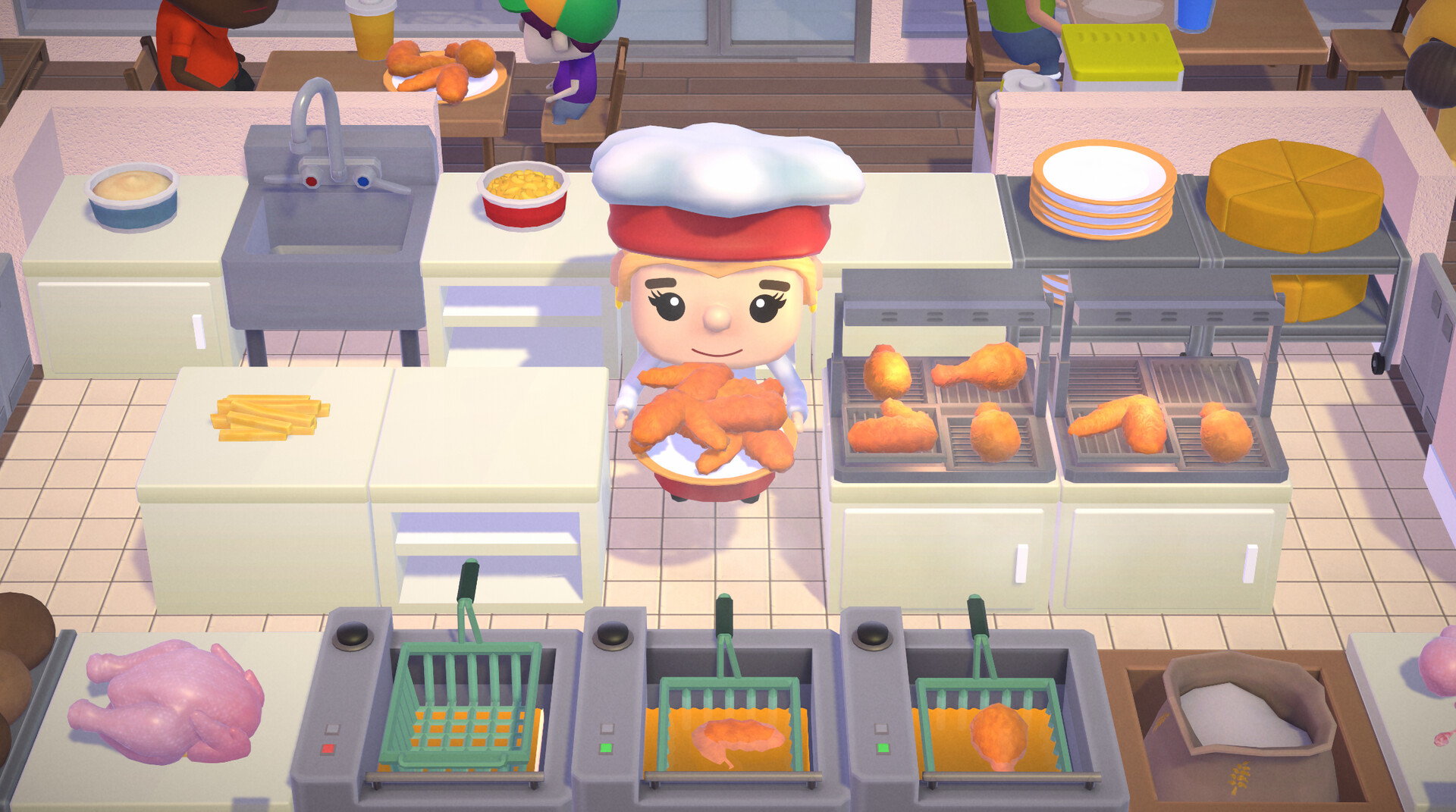
Frying up an order in the chicken campaign's kitchenJAYFLGAMES -
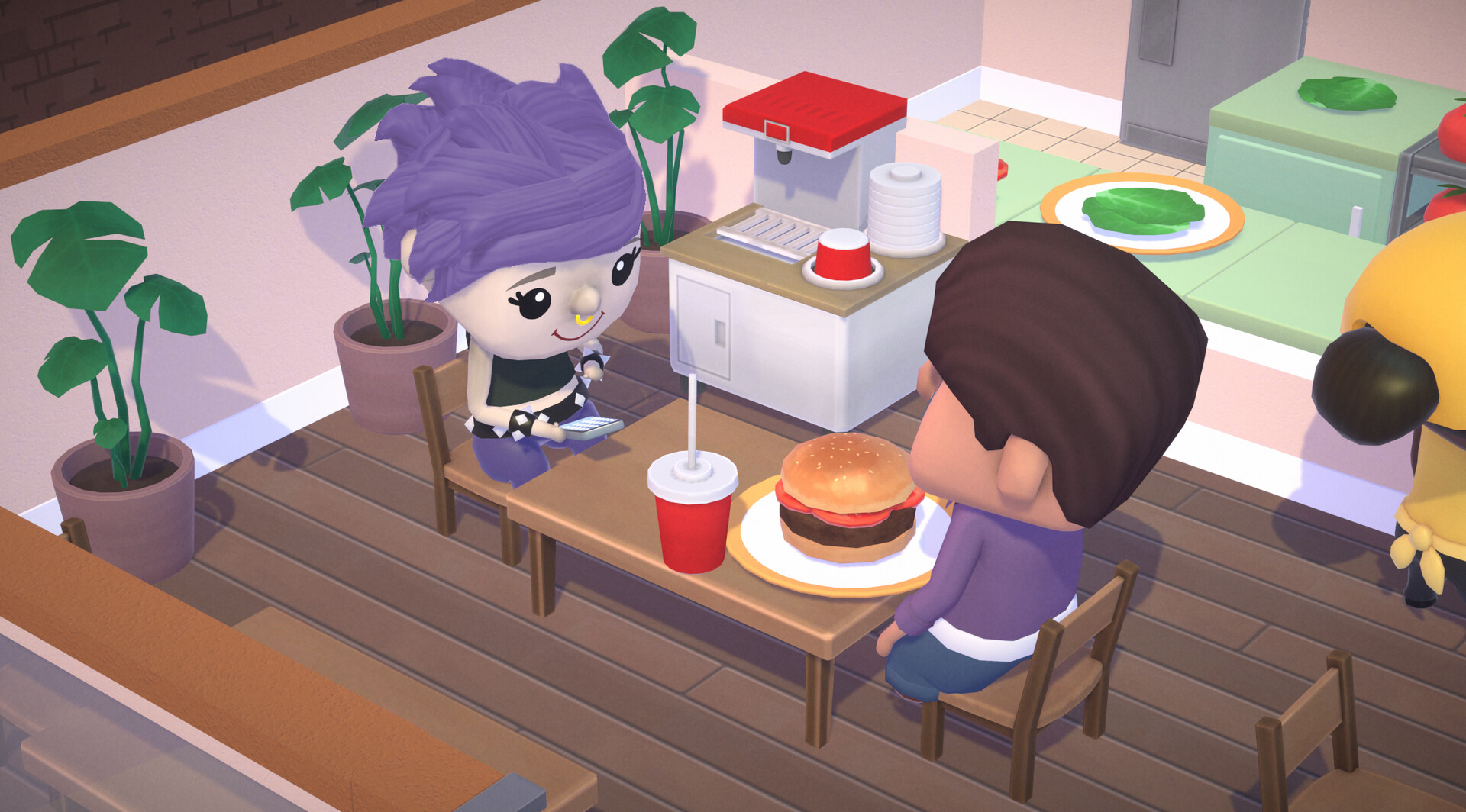
A seated customer waiting to be served in the dining roomJAYFLGAMES -
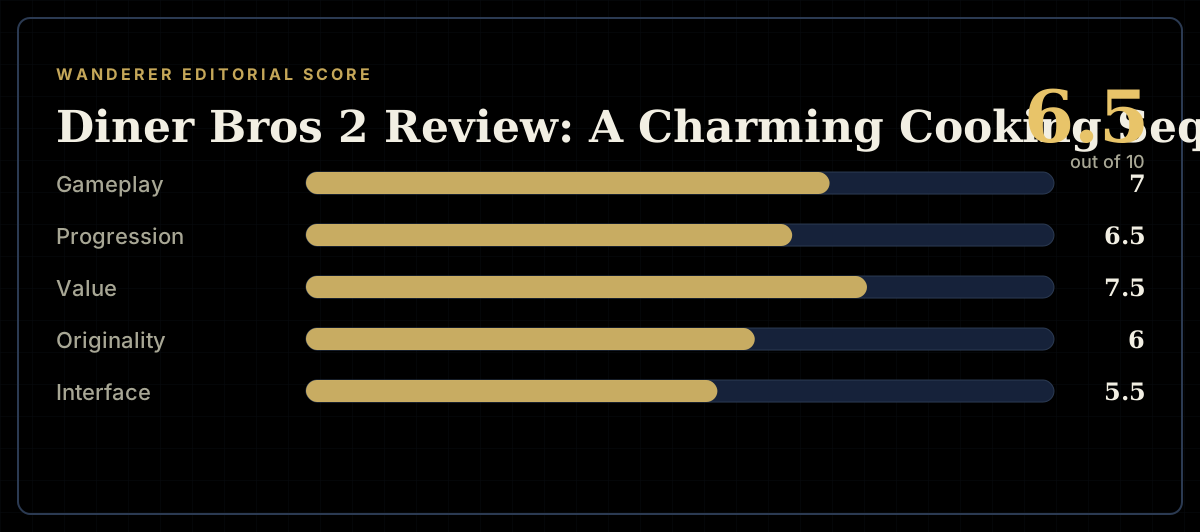
How the review scores each part of the gameWanderer Editorial -
The short versionWanderer Editorial