Game review
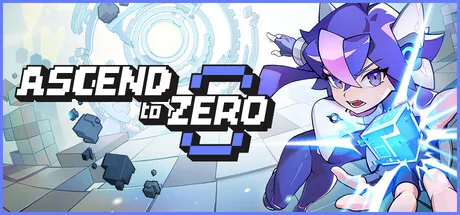
Ascend to ZERO
8 / 10
- Developer
- Flyway Games
- Publisher
- Flyway Games and KRAFTON, Inc.
- Released
- 13 July 2026
- Platforms
- Windows, Xbox Series X|S
- Genre
- Action Roguelite
- Monetisation
- Premium one-off purchase on PC and Xbox; included at no extra cost with Xbox Game Pass Ultimate and PC Game Pass from launch day; two optional paid DLC packs (a soundtrack and a Supporter Pack)
- Players
- Single-player
The short version
Ascend to ZERO takes the most punishing element of any roguelite — the timer that ends your run — and rebuilds it as the entire game: your health bar, your currency, your dodge button and your ultimate ability are all just different ways of spending the same thirty seconds. That single idea, executed with real conviction across avatars, tech chips and a genuinely useful freeze mechanic, is more than enough to make this one of the more distinctive action roguelites in years.
It's also a game that oversells its own systems before it explains them, buries a clean core loop under four overlapping currencies in the opening hours, and lets its power curve get so generous that the clock that once threatened you stops feeling dangerous by the midgame. None of that undoes the central idea, but it keeps this out of genre-best territory.
Biggest strengths
- Freezing time doubles as pause-and-plan, a dodge, positioning tool and build-defining ability all at once, so nearly every decision in a run routes through the same mechanic
- Each avatar's Hyper Skill changes what the freeze window actually does rather than just reskinning it, making new unlocks feel like new toolkits instead of new outfits
- Defeating elite "Unbeatable" enemies and bosses hands back chunks of the clock, turning risk-taking into the game's core skill expression instead of a punishment for aggression
Biggest weaknesses
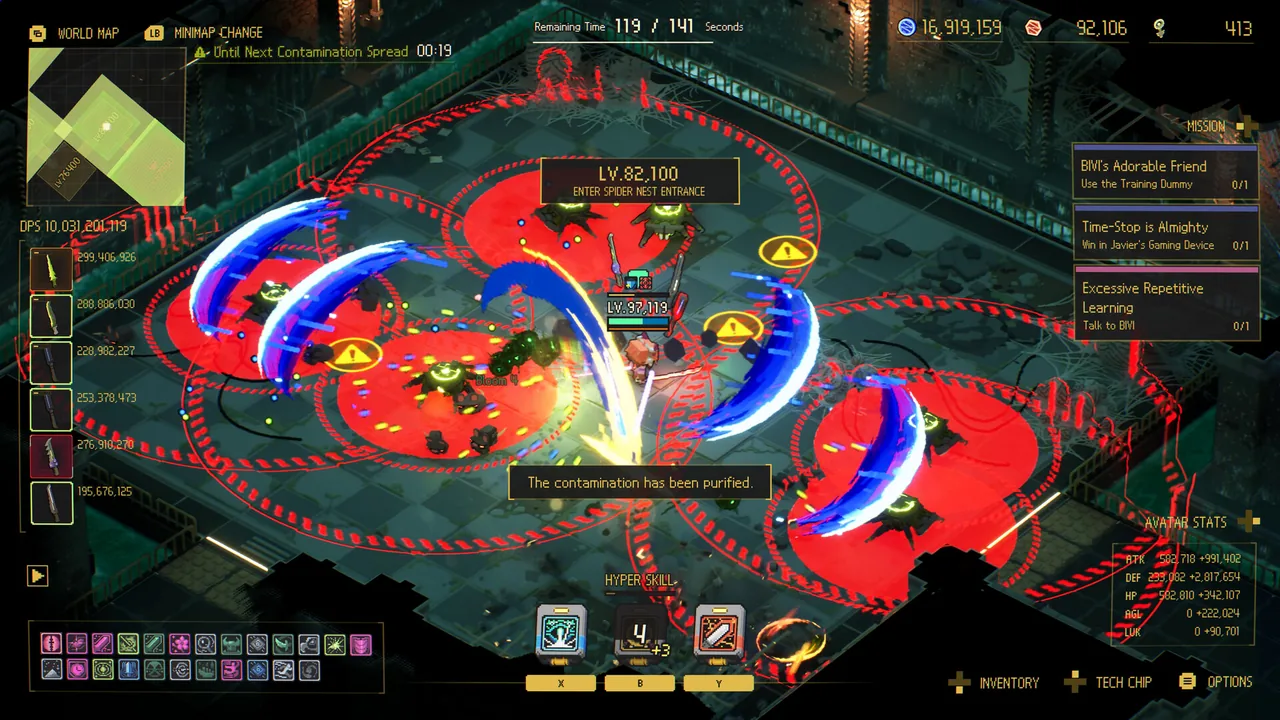
- The combat screen stacks countdown timers, chip icons and stat readouts on top of enemies and slowed-time effects, and it gets hardest to read exactly when a precise read matters most
- Four separate progression currencies — equipment, tech chips, devices and stat upgrades — arrive with almost no in-game explanation, front-loading real confusion onto a player's first few runs
- Room layouts are drawn from a limited pool of preset arrangements that start repeating well before the unlock list runs out
Who it's for: Roguelite players who want a genuinely new twist on the survivors-like formula, anyone who enjoys min-maxing overlapping currencies across runs, and Game Pass subscribers looking for a day-one pick that doesn't play it safe mechanically.
Our recommendation: Try it through Xbox Game Pass or PC Game Pass first if either is already in your library — it costs nothing to see whether the time-freeze loop clicks for you. Buying outright on Steam is an easy recommendation at its asking price if the pitch appeals; skip the Supporter Pack unless you specifically want to throw the developer extra money.
8 / 10
Every roguelite has a clock ticking somewhere in the background, even if it's just the enemy spawn timer counting up toward the moment your build finally falls apart. Ascend to ZERO takes that background pressure and drags it into the foreground: you start every run with thirty seconds, and that number is simultaneously your health bar, your currency, your best defensive tool and the thing every single system in the game is quietly built to manipulate. It's a simple pitch that could easily have curdled into a gimmick. Instead it's the most interesting thing to happen to the survivors-like genre in a while — even if the game surrounding that idea doesn't always match its ambition.
The clock is not a timer, it's the whole game
The premise: playing as the Chrono Child, flung backward through a rift to escape an invading machine army, you fight through waves of enemies while a thirty-second counter ticks down in real time. Reach zero and the run ends. So far, standard roguelite stakes. What makes Ascend to ZERO distinctive is how many different jobs that counter is asked to do at once. It's your health bar — take a hit, lose time. It's your currency — remaining seconds can be spent to revive mid-combat or fuel certain abilities. And it's your primary defensive tool, because you can freeze time entirely at will, almost on demand, to reposition, line up an attack, or simply catch your breath while the game holds still around you.
That freeze is the mechanic doing the real work. While time is stopped, most enemies can't act either, which turns every fight into a rhythm of predicting an attack, freezing to dodge or reposition, then unfreezing to counter and press the advantage. It's a loop that rewards reading a fight rather than just out-damaging it, and it's the reason the clock never quite feels like the punishing countdown it looks like on paper — killing enemies, especially the elite "Unbeatable" variants and bosses, hands time back, so an aggressive, well-read run can end up with more seconds on the clock than it started with. The tension the game is built around isn't "how do I avoid running out of time" so much as "how much time am I willing to gamble on this next engagement," and that's a genuinely sharper question than most roguelites ask.
Avatars, Hyper Skills and tech chips
You don't stay the Chrono Child forever. Rescuing survivors back at the game's underground bunker hub unlocks additional playable avatars — melee bruisers, ranged specialists, and hybrid builds further out — each with a signature Hyper Skill that changes what freezing time actually does for that character rather than just how they look while doing it. That's the detail that keeps the avatar roster from feeling like a cosmetic unlock list: picking a new avatar is picking a different relationship with the game's central mechanic, not just a new weapon skin standing in the same combat loop.
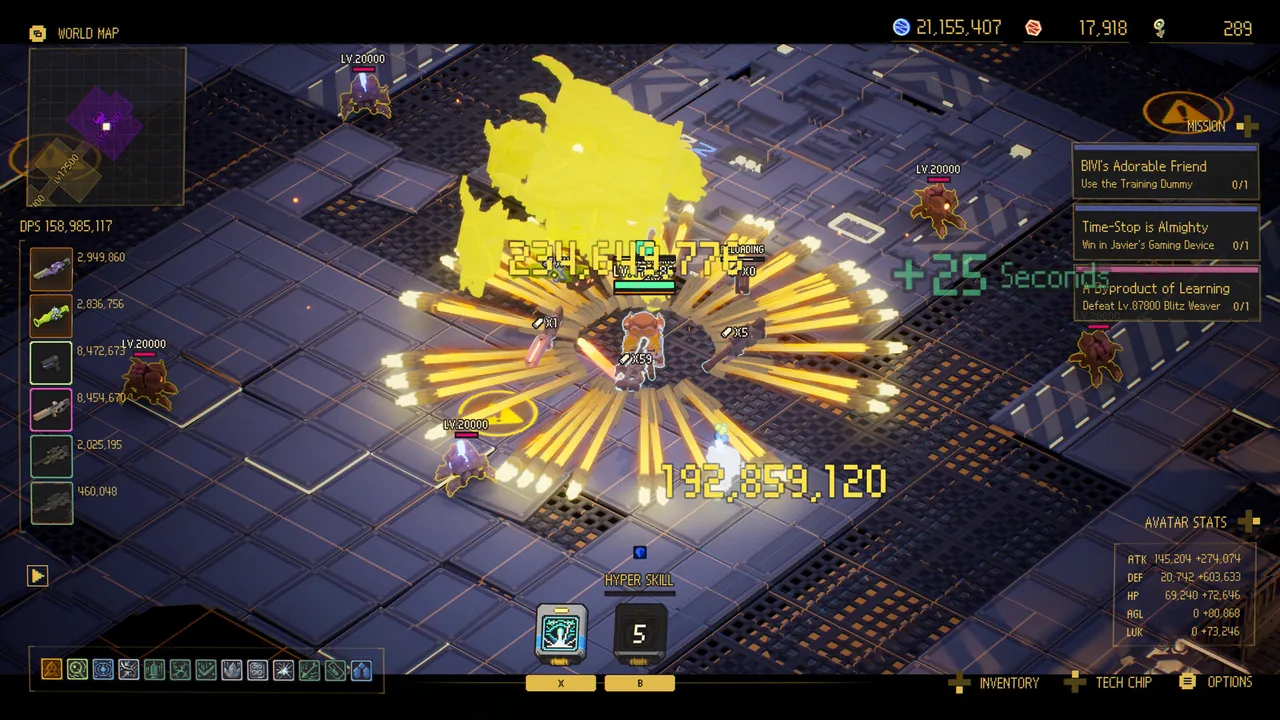
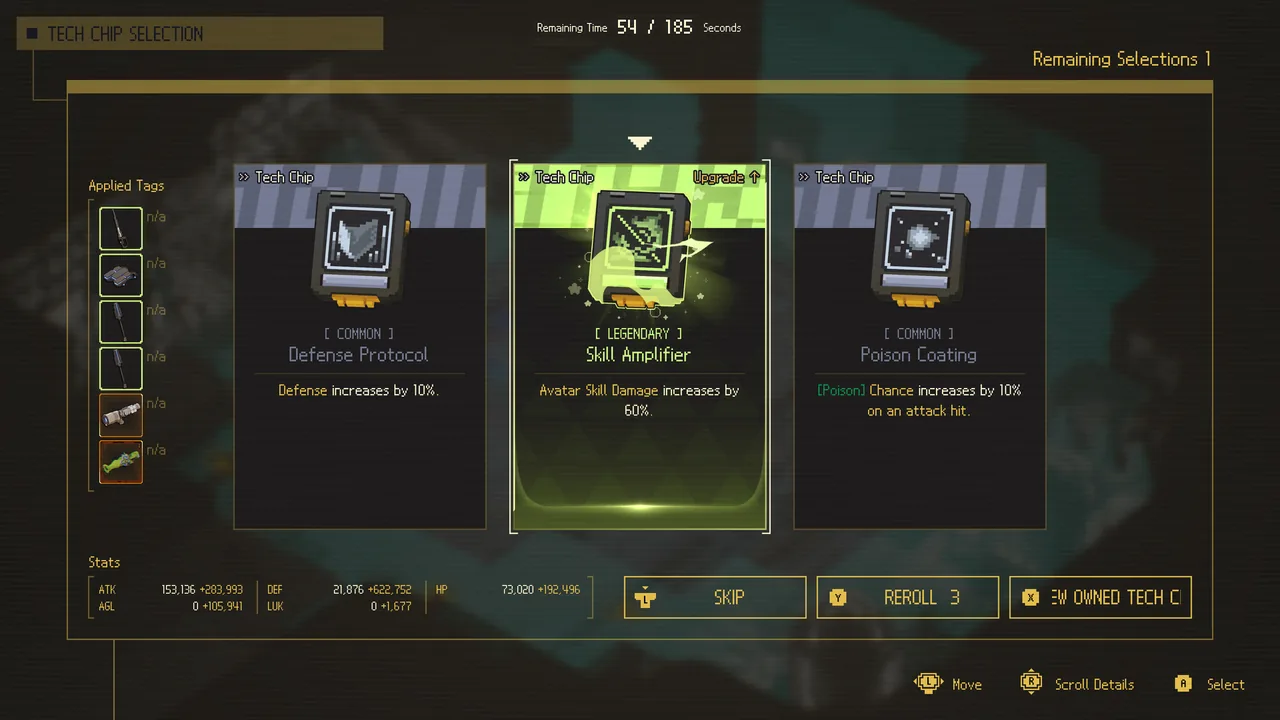
Layered on top of avatar choice are tech chips, equipment and devices, which is where Ascend to ZERO's build variety really opens up. Chips modify stats, weapon behaviour and how time itself regenerates or drains, and the combinations scale into properly absurd territory by the back half of a good run — the kind of exponential, number-go-up escalation that fans of Japanese inflation-style RPGs will recognise immediately, and that the genre's best entries live or die on. When a run is cooking, the pace of escalation stays compelling far longer than most survivors-likes manage, and that's the game's clearest strength alongside the time mechanic itself.
The cost of all that depth is a genuinely rough onboarding stretch. Equipment, tech chips, devices and stat upgrades are four separate, overlapping progression currencies, and the game introduces most of them with minimal explanation, leaning on trial and error where a proper tutorial should sit. Early runs spend real time just figuring out what's worth spending on, before the systems start making sense together — and that's a genuine barrier for players who aren't already fluent in roguelite conventions, not a deliberate mystery the design is asking you to solve.
Combat, pacing and the difficulty curve's soft middle
Combat itself splits across melee and ranged avatars, and the moment-to-moment feel is consistently praised across the games press covering it at launch — the action lands, the freeze window gives fights a readable rhythm, and boss encounters in particular lean hard into the predict-freeze-counter loop the whole game is built around. Where the design shows real strain is in how the difficulty curve behaves once a build is actually working. The same generous power scaling that makes tech chip combinations so satisfying also drains tension out of the clock mechanic that sold the whole game in the first place — once a build snowballs, enemies stop threatening the timer in any meaningful way, and a system built entirely around risking seconds you can't get back stops feeling risky. Early runs, before time-stop opens up strategically, can also feel comparatively flat, which means the game's best moments sit in a specific middle stretch rather than bookending the whole experience evenly.
Room layouts add a separate wrinkle. They're drawn from a limited pool of preset arrangements, and repeat visits start to feel familiar well before the avatar and chip unlock lists run out, which works against a genre where the room-to-room variety is usually doing as much work as the build variety.
Presentation
Ascend to ZERO renders its world in high-quality 3D voxels — a Minecraft-adjacent look applied to cyberpunk environments that collapse into their component blocks convincingly when destroyed. It suits the game's frozen-time set pieces particularly well, since the contrast between a paused, crystalline scene and the chaos of unfrozen combat is one of the presentation's more genuinely striking touches. Where it gets awkward is the gap between the avatars' hand-painted, full-body character art — used in menus, dialogue and character select — and the blocky voxel models actually running around during combat. It's a visual seam the game never fully closes, and it reads as two different art directions bolted together rather than one consistent style.
The soundtrack backs the escalating pace of a run well enough that Flyway Games sells it as standalone DLC, and it holds up as a genuine draw on its own rather than an afterthought.
Interface and accessibility
This is the review's most consistent complaint across outlets, and it holds up under scrutiny. The combat screen stacks countdown timers, tech chip icons, stat readouts and enemy telegraphs on top of an already busy arena, and dense encounters compound the problem further. It's exactly the wrong moment for a cluttered HUD, since reading the clock and an incoming attack correctly is the entire skill test the combat is built around. Full controller support and confirmed handheld compatibility make the game a legitimate pick for Steam Deck-class hardware and Xbox's handheld and cloud options, but the interface density works against it in exactly those smaller-screen contexts.
Monetisation and value
The business model here is refreshingly uncomplicated: buy it once on Steam or Xbox, or access it at no extra cost through Xbox Game Pass Ultimate or PC Game Pass from launch day, with no in-run purchases, energy systems or premium currency anywhere in sight. A standalone soundtrack and a Supporter Pack sit alongside the base game as optional extras rather than anything the core experience gates behind them. For a game this mechanically ambitious, the asking price is reasonable, and the Game Pass availability makes trying it essentially risk-free for anyone already subscribed.
Verdict
Eight out of ten. Ascend to ZERO's central idea — that a countdown timer can be a health bar, a currency, a dodge button and a build-defining resource all at once — is genuinely one of the more inventive things a roguelite has done with its core loop in some time, and the freeze mechanic built around it gives combat a rhythm that holds up across dozens of runs. What keeps it from the genre's very top is specific: onboarding introduces four overlapping currencies with too little explanation, the difficulty curve softens right when the clock mechanic should be at its most tense, preset room layouts repeat sooner than the unlock list justifies, and the combat interface gets crowded exactly when a clean read matters most. None of that undoes what works. Players who want a roguelite that's actually trying something structurally new, rather than another survivors-like reskin, should play this — through Game Pass first if it's already available, and without hesitation on Steam if the pitch on its own sounds worth the price.
Pros and cons
Pros
- Freezing time doubles as pause-and-plan, a dodge, positioning tool and build-defining ability all at once, so nearly every decision in a run routes through the same mechanic
- Each avatar's Hyper Skill changes what the freeze window actually does rather than just reskinning it, making new unlocks feel like new toolkits instead of new outfits
- Defeating elite "Unbeatable" enemies and bosses hands back chunks of the clock, turning risk-taking into the game's core skill expression instead of a punishment for aggression
- Tech chip combinations scale into genuinely absurd, screen-filling builds within a single run, and the escalation stays satisfying well past the point most roguelites plateau
- Day-one inclusion in Xbox Game Pass and PC Game Pass gives a low-risk way to try a mechanic this unusual before committing money to it
Cons
- The combat screen stacks countdown timers, chip icons and stat readouts on top of enemies and slowed-time effects, and it gets hardest to read exactly when a precise read matters most
- Four separate progression currencies — equipment, tech chips, devices and stat upgrades — arrive with almost no in-game explanation, front-loading real confusion onto a player's first few runs
- Room layouts are drawn from a limited pool of preset arrangements that start repeating well before the unlock list runs out
- A build that's snowballing softens the clock's threat so much that the mechanic that sold the whole game stops feeling dangerous in the back half of a strong run
- Hand-painted avatar portraits sit awkwardly against the blocky voxel models doing the actual fighting, a visual seam the presentation never fully closes
Screenshots
-
Ascend to ZEROImage: Flyway Games, Inc. via Steam -
Ascend to ZEROImage: Flyway Games, Inc. via Steam -
Ascend to ZEROImage: Flyway Games, Inc. via Steam -
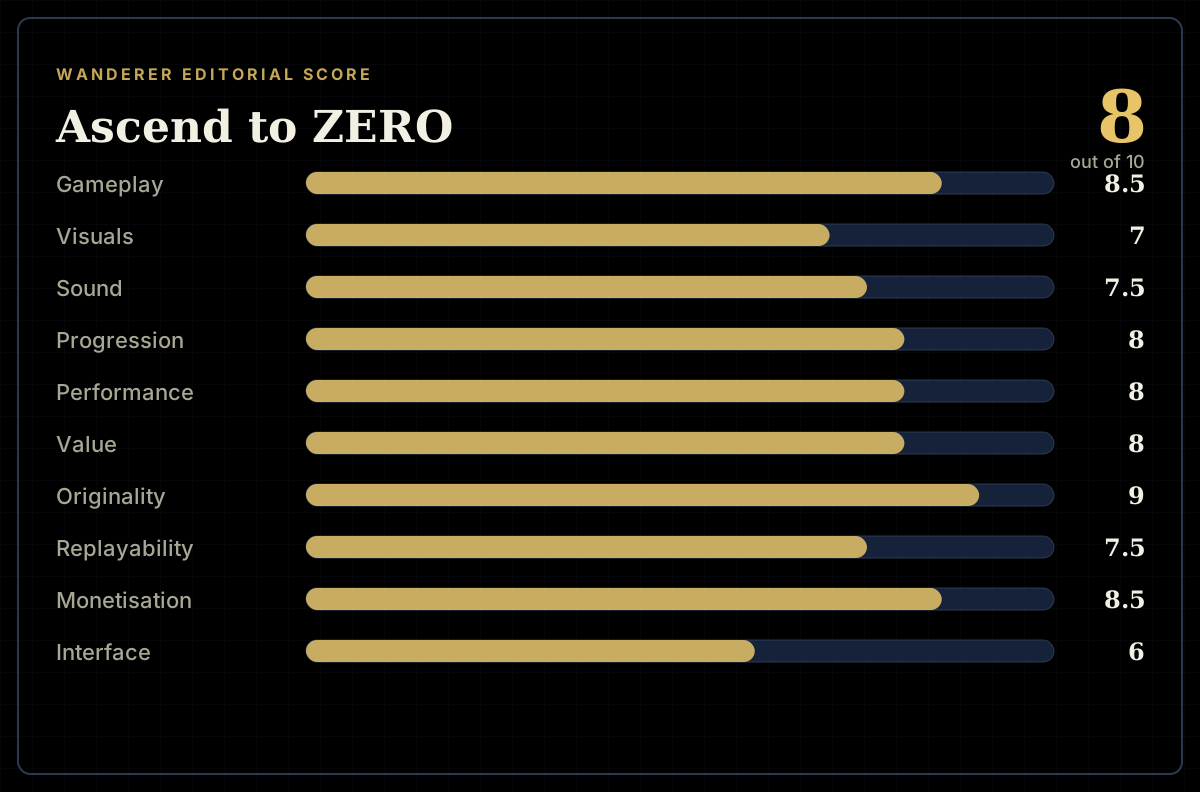
How the review scores each part of the gameWanderer Editorial -
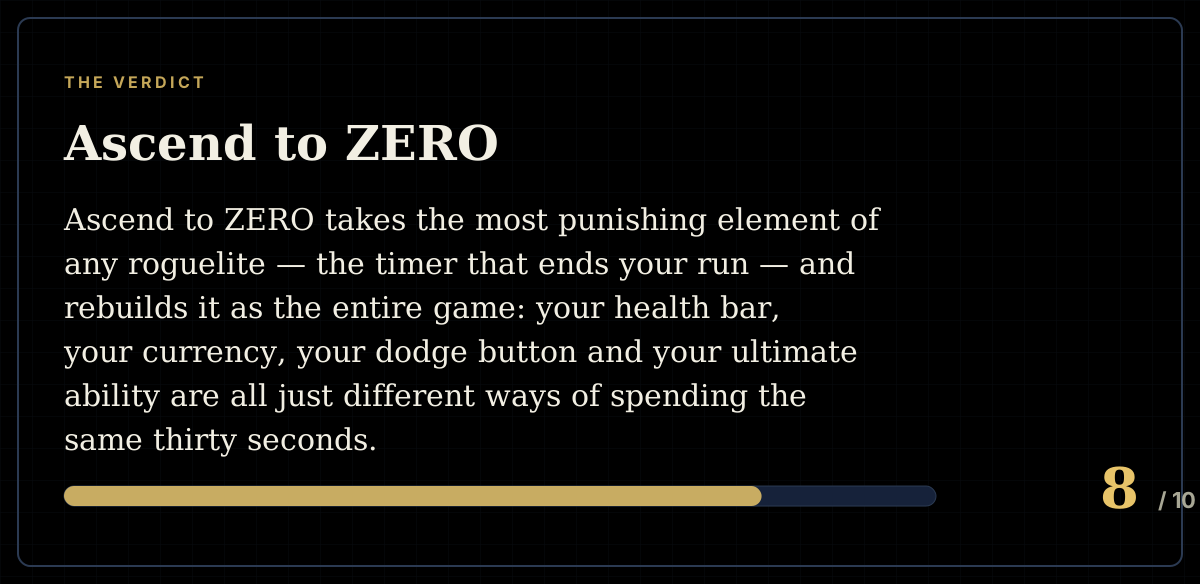
The short versionWanderer Editorial