Game review
A Little to the Left
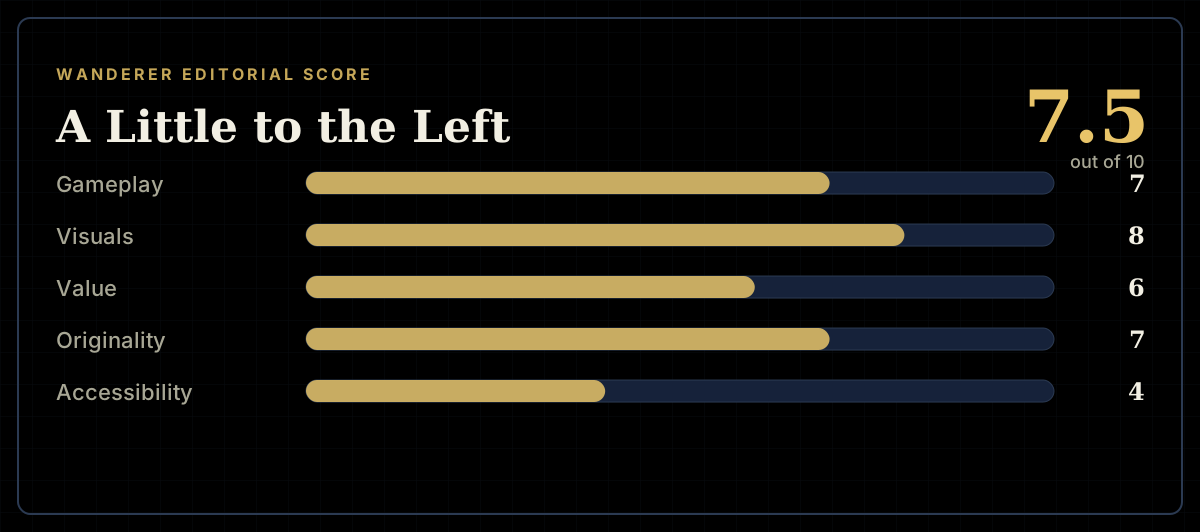
7.5 / 10
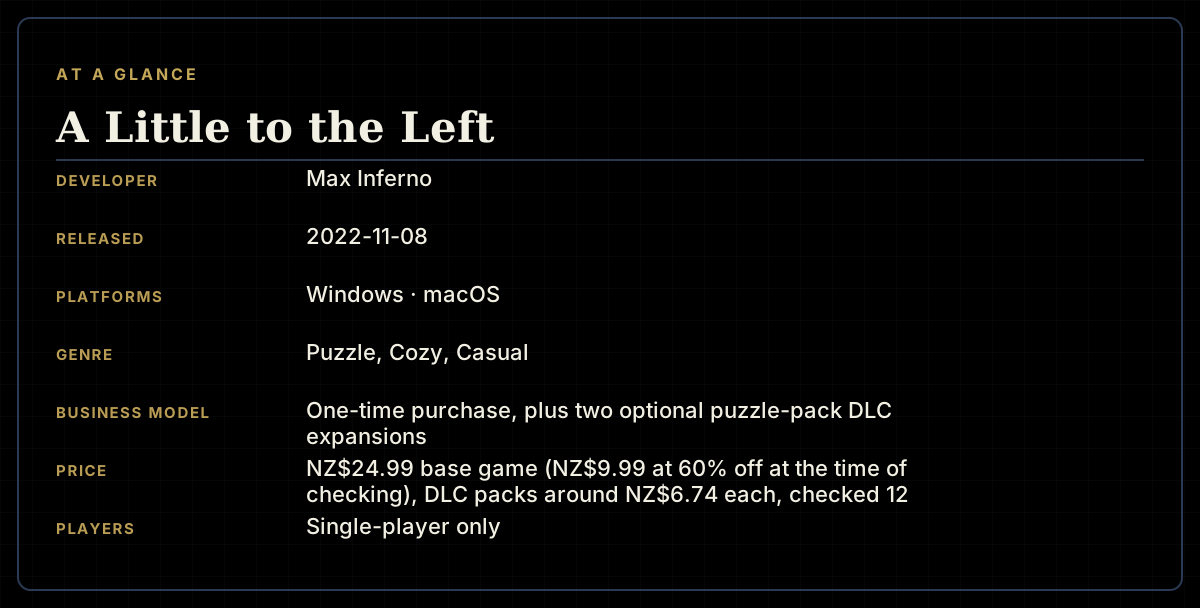
- Developer
- Max Inferno
- Publisher
- Secret Mode
- Released
- 8 November 2022
- Platforms
- Windows, macOS
- Genre
- Puzzle, Cozy, Casual
- Monetisation
- One-time purchase, plus two optional puzzle-pack DLC expansions
- Players
- Single-player only
The short version
A Little to the Left tasks the player with sorting, stacking and organising household items — cutlery drawers, bookshelves, a mischievous cat's scattered mess — into satisfying arrangements across more than 100 short puzzles. Developed by Max Inferno and published by Secret Mode, it released 8 November 2022 and sits at Very Positive, 92.2% across 11,215 English-language reviews. The core puzzle-solving and presentation draw wide, specific, often deeply personal praise. A consistent secondary thread runs through a meaningful share of the sample, though: many puzzles have exactly one correct solution despite marketing that emphasises open-ended, freeform tidying, and colour-blind players report specific puzzle types becoming genuinely unplayable.
Biggest strengths
- The core sorting and organising puzzles draw consistent, often ecstatic praise as genuinely satisfying, with reviewers describing individual "click" moments when an arrangement locks into place as a distinct, replicable pleasure
- Sound design earns specific, repeated praise, with several reviewers describing an ASMR-like quality to the game's tactile audio cues
- Real emotional resonance for a specific audience: multiple reviewers describe the game working exceptionally well for young children, autistic players and others who find satisfaction in sorting and pattern-matching specifically
Biggest weaknesses
- A recurring, specific complaint concerns expectations set by the game's marketing: many puzzles have exactly one intended solution despite framing that emphasises open-ended, freeform organisation, leading some reviewers to describe a "read the developer's mind" frustration rather than the relaxing experience they expected
- Colour-blind players report specific puzzle types built around colour-sorting becoming difficult or impossible to complete without external help, a concrete accessibility gap this review's sample documents in detail
- Multiple reviewers report the base game running short relative to its price, with some solved puzzles feeling repetitive across the roughly 100-plus included
Who it's for: Fans of satisfying, tactile puzzle design who enjoy figuring out a designer's intended solution; a less perfect fit for anyone specifically wanting a freeform, no-wrong-answers tidying experience the marketing sometimes implies.
Our recommendation: A genuinely delightful short puzzle game best enjoyed for what it actually is — clever, sometimes exacting sorting puzzles — rather than the purely freeform cozy experience its presentation can suggest at a glance.
7.5 / 10
Introduction
A Little to the Left hands the player a scattered household mess — a cluttered spice rack, a tangled drawer of cables, books stacked at odd angles — and asks them to sort it into a satisfying arrangement, all while a mischievous cat occasionally undoes the tidying. Developed by Max Inferno and published by Secret Mode, it released 8 November 2022 and sits at Very Positive, 92.2% across the 11,215 English-language reviews this review draws from. The puzzle design and presentation earn that score honestly, and this game's positive reviews include some of the most personally affecting testimonials this session has documented. What's worth reading closely, alongside that acclaim, is a specific, consistent secondary thread: a gap between how the game is marketed and what a meaningful share of its puzzles actually demand.
Puzzles reviewers describe with real specificity
Start with what draws the clearest praise across the sample: the core sorting mechanic genuinely works, and reviewers describe it with unusual precision rather than generic satisfaction. One detailed, 180-vote review, itself the game's own strongest recommendation in this sample, took care to correct a common misconception up front: "What it isn't: another 'Unpacking'... a decorating/ tidying-and-arranging-things-as-you-like-it game," framing it instead as a genuine logic puzzler with real solutions to find. Sound design earns its own specific, repeated praise, with multiple reviewers describing an ASMR-like quality to the tactile clicks and shuffles the game uses to signal progress. Perhaps most notably, several reviewers describe the game reaching audiences other puzzle games don't: one detailed review specifically credited the game as "autistic approved" for its satisfying pattern-matching, and another described watching a four-year-old become independently absorbed in it after a brief demonstration. That's a genuinely rare, specific kind of praise, and it recurs often enough in this corpus to be treated as a real strength rather than an isolated anecdote.
The gap between the pitch and the puzzles
Here's the recurring, specific complaint worth centring this review on. A large, detailed share of the negative sample describes a mismatch between the game's cozy, relaxed marketing and the actual rigidity of many puzzle solutions. One of the most-upvoted negative reviews in the entire sample, at 342 votes, put the distinction precisely: "the emphasis should be on PUZZLE," arguing that marketing built around "organizing, with multiple solutions" set up an expectation of freeform, zen-like tidying that the actual game, with its frequently single correct arrangement, doesn't deliver. Another reviewer described the specific frustration this creates directly: puzzles that demand "you read the developer's mind" rather than rewarding any reasonably tidy arrangement, which undercuts the stress-free framing for players who came in expecting exactly that. This isn't a complaint about puzzle difficulty in the abstract — reviewers making this point are often explicitly puzzle-game fans who simply feel the marketing oversold how open-ended the experience actually is.
A concrete accessibility gap
A separate, more serious and more specific complaint deserves direct attention: colour-blind players report that puzzle types built around sorting items by colour become difficult or effectively impossible to complete without outside help. One detailed 103-vote review laid out the problem plainly: "The game itself is very fun and relaxing. The puzzles are short, but clever. The art style is cute and cosy. The game has literally everything going for it. Well, until you get to the levels where you need to sort things by colour," at which point the puzzle became unsolvable for that player without assistance. This is a concrete, actionable accessibility gap rather than a subjective design critique, and it's worth flagging clearly for any colour-blind reader considering the game.
A developer that appears to listen
It's worth noting a genuinely positive counter-thread running through several reviews: multiple reviewers describe the developer responding directly and thoughtfully to critical feedback, in ways that changed their overall impression. One reviewer, after initially posting a negative review over a specific 100%-completion requirement they found unreasonable, added a note that a developer had responded, and while the original criticism stood, the tone of engagement was clearly appreciated. Another reviewer described a similar experience more warmly, explicitly thanking "Max and co." for a kind response that made them "a lot more positive about the game and the devs." That's a genuinely useful signal about how this studio handles criticism, distinct from whether any specific complaint was actually resolved.
Length, repetition and a lingering bug report
A smaller cluster of complaints concerns value and polish. Several reviewers report the base game running shorter than its price suggests, with some solutions across the roughly 100-plus puzzles feeling repetitive by the back half. A more recent, more specific technical complaint concerns bugs concentrated in a particular later chapter, which a 2025 review described as reported on the community forums but still unresolved at the time of writing — worth checking current patch notes if that specific section matters to your purchase decision.
Where players actually finish
Steam's achievement data shows an unusually strong completion rate for the base game — the "tidy 100 items" milestone sits at 93.5%, and even the 250-item milestone holds at 82.5%, reflecting a genuinely high engagement rate for a puzzle game of this length. Notably, the two DLC expansions' unique achievements sit far lower, in the 2-3% range, suggesting either a smaller purchasing audience for the add-on content or puzzles pitched at a level only the most dedicated players push through — a useful data point for anyone deciding whether the expansions are worth adding to the base purchase.
Final Verdict
A Little to the Left is a genuinely well-crafted, satisfying puzzle game that earns the affection its strongest reviews describe, with sound design and puzzle logic reviewers return to specifically and repeatedly rather than praising in generic terms. What keeps this from an even higher score is a real, recurring gap between the freeform, cozy framing much of its marketing leans on and the frequently single-solution nature of its actual puzzles, alongside a concrete, unaddressed accessibility barrier for colour-blind players. If you go in expecting clever, sometimes exacting logic puzzles rather than a purely stress-free tidying sandbox, and colour-based sorting isn't a barrier for you, there's a genuinely lovely few hours here.
Pros and cons
Pros
- The core sorting and organising puzzles draw consistent, often ecstatic praise as genuinely satisfying, with reviewers describing individual "click" moments when an arrangement locks into place as a distinct, replicable pleasure
- Sound design earns specific, repeated praise, with several reviewers describing an ASMR-like quality to the game's tactile audio cues
- Real emotional resonance for a specific audience: multiple reviewers describe the game working exceptionally well for young children, autistic players and others who find satisfaction in sorting and pattern-matching specifically
- A developer visibly responsive to player feedback, with several reviewers describing direct, thoughtful responses to critical reviews that changed their overall impression for the better
Cons
- A recurring, specific complaint concerns expectations set by the game's marketing: many puzzles have exactly one intended solution despite framing that emphasises open-ended, freeform organisation, leading some reviewers to describe a "read the developer's mind" frustration rather than the relaxing experience they expected
- Colour-blind players report specific puzzle types built around colour-sorting becoming difficult or impossible to complete without external help, a concrete accessibility gap this review's sample documents in detail
- Multiple reviewers report the base game running short relative to its price, with some solved puzzles feeling repetitive across the roughly 100-plus included
- A cluster of reviewers report bugs concentrated in a specific later chapter, described as reported on the community forums but not yet resolved as of some 2025 reviews
Screenshots
-

A Little to the LeftImage: Secret Mode via Steam -
A Little to the LeftImage: Secret Mode via Steam -

A Little to the LeftImage: Secret Mode via Steam -
How the review scores each part of the gameWanderer Editorial -
The essentials at a glanceWanderer Editorial -
The short versionWanderer Editorial