
Game review
Void Miner – Incremental Asteroids Roguelite
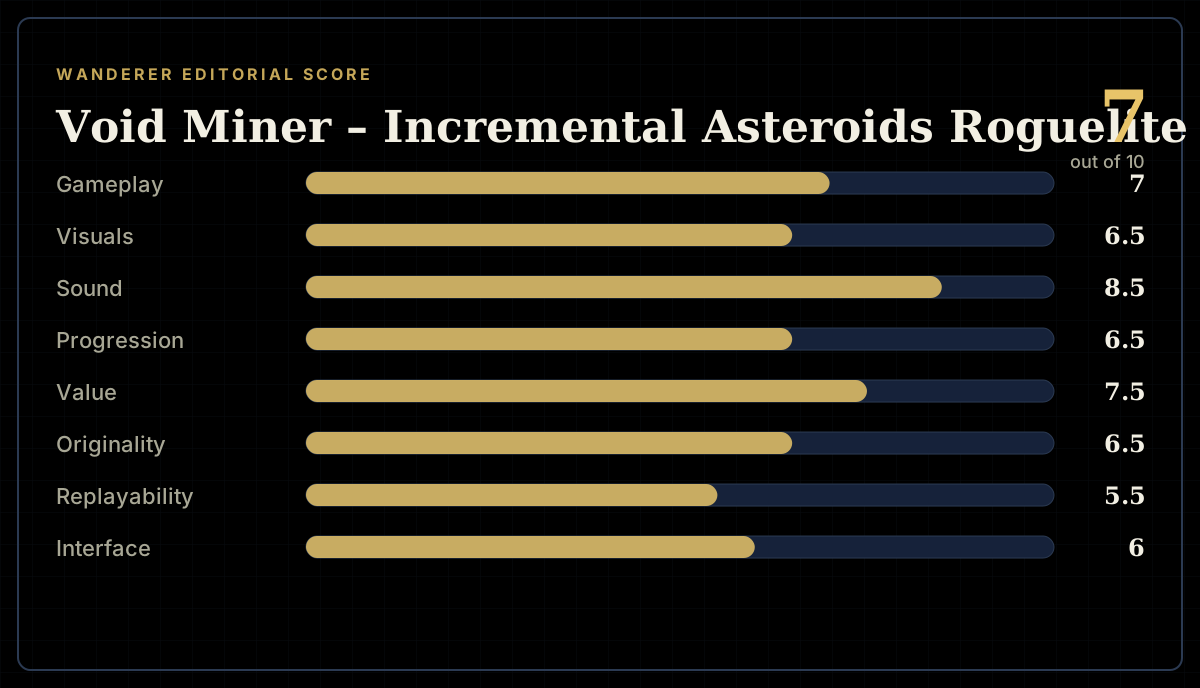
7 / 10
- Developer
- RyanJakob
- Publisher
- RyanJakob
- Released
- 16 November 2025
- Platforms
- Windows, Linux
- Genre
- Incremental Roguelite / Bullet Hell
- Monetisation
- One-time purchase, no in-app purchases, no ads, no premium currency
- Players
- None (single-player only)
The short version
Void Miner takes the oldest shooter idea there is — thrust, rotate, shoot the rocks before they hit you — and bolts on the two things that make it feel current: a second gun that fires on its own while you fly, and a between-run upgrade tree that turns each death into progress instead of a restart. For the first couple of hours that combination is genuinely compelling, and the soundtrack behind it is better than a five-dollar arcade throwback has any obligation to be.
It's a shorter, rougher package than the pitch suggests. The upgrade economy only starts to feel like an incremental once the run is nearly finished, the menus were clearly built for a controller and fight you with a mouse, and most players are done and 100 percent complete within an afternoon, with nothing but an endless mode waiting on the other side.
Biggest strengths
- The automated turret running alongside your own piloting gives every run a genuine dual-control incremental feel instead of just being Asteroids with a shop
- The soundtrack is consistently singled out as the strongest piece of the presentation, doing work the pixel art alone doesn't
- A free Prologue demo lets you test the flight feel and upgrade tree before spending anything
Biggest weaknesses
- Upgrade-screen mouse control has been widely reported as erratic, undermining the one moment where precision matters most
- The economy escalates slowly for most of the run and only starts feeling like a proper incremental once there's little game left to spend it on
- Steam Deck is Verified but the right stick reportedly stops responding for some players, a bad look for a controller-first release
Who it's for: Arcade and roguelite fans who want a tight, cheap session rather than another open-ended incremental grind, and anyone who grew up on Asteroids and wants to see what an automated turret and a skill tree do to it.
Our recommendation: At six dollars, the price is fair for what's here, and the free Prologue demo on Steam removes any risk before you commit. Play it with a controller if you have one — the mouse experience in the upgrade menus is the game's roughest edge — and go in expecting a single strong sitting rather than a long-term incremental to return to.
7 / 10
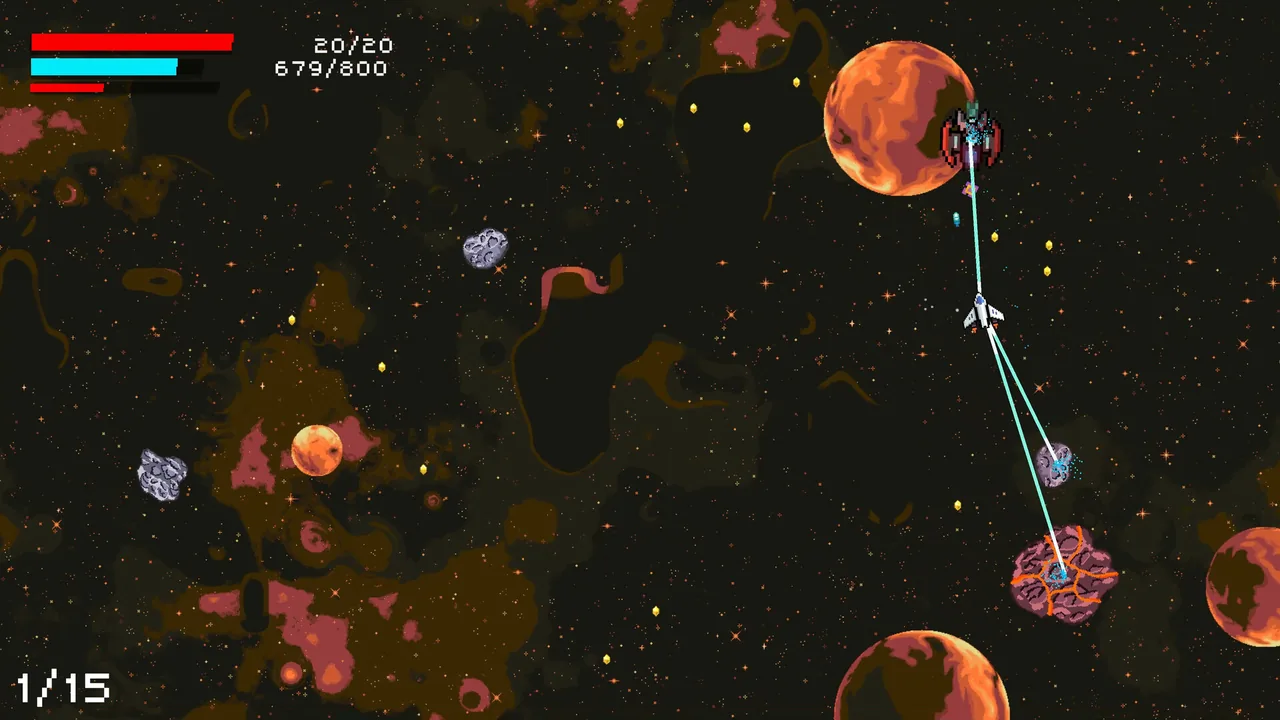
Asteroids has been remade as a twin-stick shooter more times than anyone could count, but Void Miner's angle on it is specific: alongside the ship you're actively flying and firing, an automated turret chips away at the same asteroid field on its own, upgraded from the same tree your manual weapons draw from. It's a small idea that does real work. Every run is doing two jobs at once — the part you're actively piloting, and the part quietly ticking over whether you're paying attention to it or not — which is exactly the trick incremental games are built on, applied to a genre that's usually pure reflex. For a first commercial release from a solo developer, that's a genuinely clever synthesis.
Blast, collect, upgrade, repeat
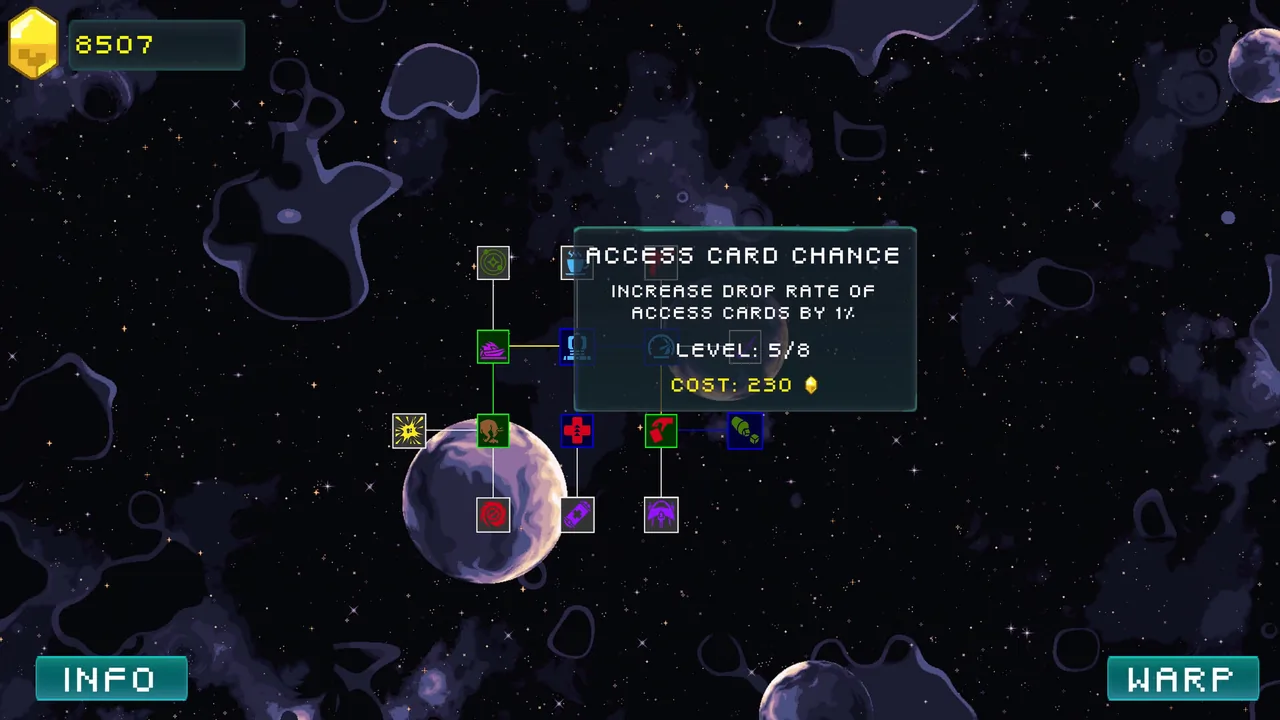
The loop is easy to describe and hard to argue with in the first hour: pilot a small ship into a field of asteroids, shoot and dodge your way through the chaos while the automated turret adds its own damage passively, bank whatever resources you pull out of the wreckage, and die eventually — death here isn't a failure state so much as the trigger for the next stage. Currency earned during a run gets spent on a persistent upgrade tree between attempts, in the now-familiar roguelite rhythm of run, die, buy, run again, stronger. Void Miner leans hard into escalation rather than variety — there's no branching narrative, no biome shift, just an asteroid belt that gets denser and meaner as your ship gets correspondingly more capable of handling it. That's a legitimate design choice for a game this size, and when the numbers are climbing and the screen is full of explosions, the hook lands.
Whether it earns the "roguelite" half of its own label is a fair question. There's no map to navigate, no build-defining choice between runs beyond straightforward upgrade purchases, and no meaningful randomness in what a given attempt offers you — it's closer to an arcade high-score loop with a shop bolted on than to the genre's usual structural ambition. That's not necessarily a problem, but players going in expecting Hades-style run variety are likely to find something considerably flatter underneath the label.
An upgrade tree that peaks too late
The bigger issue is pacing. Several players who've finished the game describe the same shape: income and power growth stay conspicuously slow for most of the run, then accelerate right around the point where the tree is nearly maxed and the campaign is close to over. That's close to the inverse of what makes incremental progression satisfying — the genre's whole appeal usually rests on numbers climbing at a rate that keeps feeling rewarding across the session, not on holding most of the payoff in reserve until there's barely any game left to enjoy it in. One player who cleared every achievement before their skill tree even finished noted exactly this: the escalation curve and the runtime don't line up, so the moment the game is supposed to feel like a proper incremental arrives just as the credits are approaching.
It's a tuning problem rather than a structural one, and it's the kind of thing a patch could meaningfully improve without touching anything else about the design. As shipped, though, it means the back half of the promise in the game's own subtitle is the part that lands weakest.
Built for a controller, unkind to a mouse
Void Miner supports keyboard and mouse, a controller, and full DualShock and DualSense input, and the difference between them is not subtle. Multiple players single out the upgrade-tree menu specifically as where mouse control breaks down — cursor movement described as sliding unpredictably, unrelated to anything happening during normal flight. That's a rough place for a control problem to live, since the upgrade screen is where you're making the decisions that define how the rest of the run plays out. Players who've tried both report a noticeably better experience with a controller in hand, to the point where recommending one over mouse and keyboard has become a recurring piece of advice in the game's own review section.
That makes the Steam Deck situation more disappointing than it would otherwise be. The game carries Valve's Verified badge, but several Deck players report the right analog stick failing to register during play — a specific, reproducible complaint rather than a vague performance gripe, and one that undercuts the platform Void Miner should arguably play best on. Settings not persisting between sessions and the absence of a mid-round save are smaller irritations in the same family: rough edges around a core loop that otherwise works.
Presentation: budget visuals, a soundtrack that overdelivers
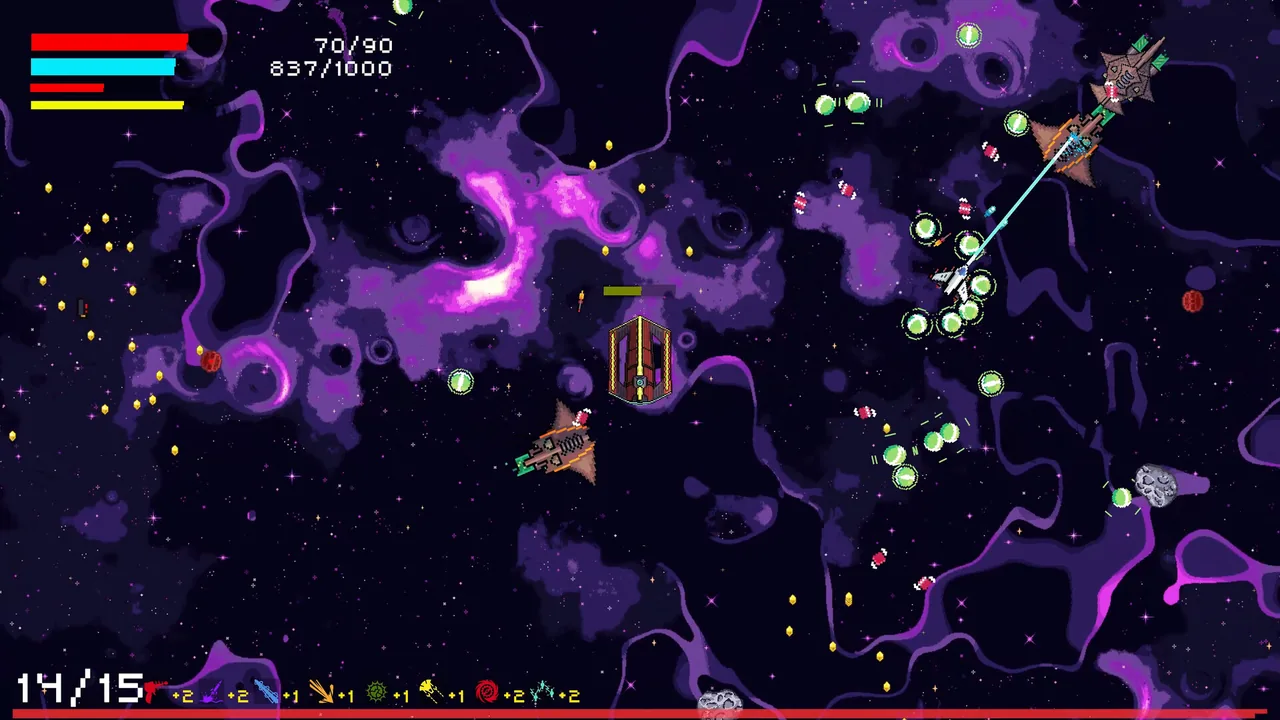
The pixel art doesn't hide its budget-indie origins, and more than one player has noted the sprite work reads as pulled from a mix of different resolutions and sources rather than a single cohesive style. Nostalgia carries a lot of the visual pitch instead — several reviews describe the whole package as feeling like a browser flash game from the mid-2010s, meant warmly rather than as an insult, evoking a very specific, very familiar kind of low-stakes arcade charm. Where that charm frays is in the late game, when bullet density and particle effects pile up to the point that players report genuinely losing track of their own cursor and ship in the clutter — a real problem in a game whose core skill is precise dodging.
The soundtrack is the one area with no real detractors. It comes up unprompted and consistently across player feedback, often as the single thing reviewers wanted to call out by name, and it's doing more to sell the retro-arcade fantasy than the visuals manage on their own.
How long it lasts, and what's left after
This is a short game, and it's worth being direct about that before anyone buys it expecting an ongoing incremental. Reports of full completion — main campaign cleared, upgrade tree maxed, all eleven Steam achievements collected — cluster tightly around the two-to-five-hour mark, occasionally less. What's left afterward is an endless mode, which several players describe honestly as a way to keep playing rather than a reason to. There's no second campaign, no meta-progression layer that carries into a fresh save, no branching content that opens up post-completion. For a genre that usually measures its hooks in weeks, Void Miner's entire arc fits in a single sitting.
Value and access
At roughly six US dollars with no in-app purchases, no ads and no premium currency anywhere in the package, Void Miner's asking price is honest and hard to argue with on its own terms — it's a complete, finite experience sold once, and several players note it feels entirely fair even for a two-to-three-hour clear. A free Prologue demo sits on Steam alongside the full release, which removes any real risk from trying it before paying: anyone unsure whether the flight feel or the upgrade tree will click can find out first-hand at no cost.
Verdict
Void Miner's central idea — an actively piloted ship paired with a turret that keeps working the same field on its own — is a smart, specific answer to the question of what an incremental version of Asteroids should feel like, and for a solo developer's first commercial release it's an impressively coherent one. What keeps it out of the higher scoring bracket is everything around that idea rather than the idea itself: an upgrade curve that saves too much of its payoff for the very end of a short run, a mouse-driven upgrade screen that multiple players describe as close to broken, a Steam Deck Verified badge undercut by a documented stick issue, and a total runtime that closes out in an afternoon with nothing beyond an endless mode to justify staying longer. None of that erases what works — the dual-control loop is genuinely fun while it lasts, and the soundtrack is better than the price tag has any right to expect. It's a good, cheap arcade session that knows exactly how long it wants to be, just don't buy it looking for a long-term incremental to sink weeks into.
Players who prefer persistent progression that keeps ticking over across sessions instead of resolving inside a single afternoon might also enjoy Wanderer — an incremental world built to be returned to, not finished in one sitting.
Pros and cons
Pros
- The automated turret running alongside your own piloting gives every run a genuine dual-control incremental feel instead of just being Asteroids with a shop
- The soundtrack is consistently singled out as the strongest piece of the presentation, doing work the pixel art alone doesn't
- A free Prologue demo lets you test the flight feel and upgrade tree before spending anything
- Full controller support, including DualSense, makes the game feel far tighter than the mouse-driven default
- Achievable in a single sitting for players who want a complete arc rather than an endless commitment
Cons
- Upgrade-screen mouse control has been widely reported as erratic, undermining the one moment where precision matters most
- The economy escalates slowly for most of the run and only starts feeling like a proper incremental once there's little game left to spend it on
- Steam Deck is Verified but the right stick reportedly stops responding for some players, a bad look for a controller-first release
- Most players clear the campaign and its achievements in two to five hours, after which only an endless mode remains
- Late-run bullet density gets visually noisy enough that players report losing track of their own cursor and ship
Screenshots
-
Void Miner – Incremental Asteroids RogueliteImage: RyanJakob via Steam -
Void Miner – Incremental Asteroids RogueliteImage: RyanJakob via Steam -
Void Miner – Incremental Asteroids RogueliteImage: RyanJakob via Steam -
How the review scores each part of the gameWanderer Editorial -
The short versionWanderer Editorial