Game review
The Life and Suffering of Sir Brante
7.5 / 10
- Developer
- Sever, Schisma Games
- Publisher
- 101XP
- Released
- 4 March 2021
- Platforms
- Windows
- Genre
- Narrative RPG
- Monetisation
- One-off premium purchase, with an optional Digital Content Bundle DLC; no in-app purchases and no premium currency
- Players
- None. Single-player only, with no leaderboard, co-op or shared-progress feature
The short version
The Life and Suffering of Sir Brante follows one man's entire life, from birth to death, in a ruthless fantasy empire where fate is dictated by the caste — or "Lot" — a person is born into. It's structured as a choice-driven narrative RPG, and its central, defining idea is genuinely bold: choices aren't simply narrative branches, they're gated by stats your earlier choices built, meaning the option that best fits the story you're trying to tell is often unavailable unless you've quietly built the right numbers beforehand. Reviewers are sharply, almost evenly divided on whether that's a brilliant subversion of choice-based storytelling convention or a broken promise at the genre's core. "What the game did is take one of the most ingrained storytelling choice-based conventions and burned it to the ground," one enthusiastic review states; a nearly identical number of equally thoughtful reviews describe the same mechanic as forcing players into "metagaming instead of roleplaying." What's not in dispute across either camp is the strength of the writing, art and music carrying the experience — Very Positive across more than 8,000 reviews, with the sharpest disagreement reserved specifically for how the game's mechanics interact with its own narrative promises.
Biggest strengths
- A genuinely bold, structurally unusual idea — choices gated by stats rather than freely available — that draws sincere praise as a deliberate subversion of "your choices matter" genre convention rather than a shallow implementation of it
- Writing, world-building and art direction draw close to universal praise, with a richly realised fantasy setting reviewers describe as avoiding overused genre tropes
- The soundtrack is repeatedly singled out by name as exceptional, elevating scenes well beyond what the presentation alone would achieve
Biggest weaknesses
- The central stat-gating mechanic is the review sample's most consistent and most divisive point of criticism, with a large share of otherwise sympathetic players describing the late game as forcing "metagaming" — picking options to build required stats rather than roleplaying the character they actually want to be
- Several detailed reviews describe feeling forced into choices that actively contradict their character's established motives and previous decisions, undermining the sense of authored, personal agency the game's premise promises
- The ending sequence draws specific, repeated criticism as feeling disconnected from a player's accumulated choices, with more than one reviewer describing a late-game restriction that "didn't logically follow from anything" they'd done before
Who it's for: Narrative RPG and choice-driven fiction fans who are specifically interested in a game that questions rather than simply delivers on the "your choices matter" promise, and who are comfortable with real, sometimes frustrating mechanical friction as part of that thematic point.
Our recommendation: A genuinely distinctive, well-crafted narrative RPG worth its price for the writing and world alone — just go in understanding it's a game about the illusion of free will as much as it is a game that grants you any, which some players find brilliant and others find simply frustrating.
7.5 / 10
Choice-driven narrative games make an implicit promise: the option a player picks because it fits their character is the option that should shape the story going forward. The Life and Suffering of Sir Brante, from developer Sever and Schisma Games, sets out to interrogate that promise rather than simply deliver on it. You play the title character from birth to death in the Great Arknian Empire, a rigid caste society where a person's "Lot" — noble, clergy, or lowborn — is meant to determine everything about their life. The game's central, structural idea is that your choices aren't purely narrative; they're gated by stats your earlier choices quietly built, meaning the option that best expresses who you want your character to be is often simply unavailable unless the numbers support it. More than five years after its March 2021 release, and with the developer's own spin-off sequel arriving in July 2026, Sir Brante remains Very Positive across more than 8,000 Steam reviews — and few games generate as much thoughtful, genuinely split disagreement about whether their core mechanic is a masterstroke or a mistake.
A writing and presentation achievement almost nobody disputes
Before getting into that disagreement, it's worth being clear about what draws near-universal praise regardless of where a given reviewer lands on the mechanics debate: the writing, world and sound design. "The lore is amazing — truly a unique fantasy setting inspired by pre-Age of Revolution France, but without falling into the all-too-common trap of copying Lord of the Rings," one review states, a sentiment echoed repeatedly across the sample. The soundtrack draws its own specific, sustained admiration — "amazing aesthetic, amazing writing, amazing soundtrack," reads a fairly representative pros list, and multiple reviewers describe individual musical cues elevating specific scenes well beyond what the visual presentation alone achieves. One review offers a genuinely useful piece of practical advice for experiencing the game at its best: "Take the day off. Pour a few cups of coffee. Have zero interruptions for the day. Let the world consume you" — testament to how fully the game's atmosphere draws players in when they let it.
The mechanic that splits its own fans
What makes Sir Brante worth reviewing carefully rather than simply celebrating is how consistently and articulately its own admirers disagree about the game's defining structural choice. On one side, reviewers frame the stat-gating system as a genuinely bold artistic statement about free will under an oppressive social order — the mechanical friction isn't a bug, it's the point. "This game made me rage. And I mean that as a compliment," one review states. "What the game did is take one of the most ingrained storytelling choice-based conventions and burned it to the ground. Then made a little dance on the ashes." Read that way, the frustration of watching a preferred choice sit greyed out because an earlier decision didn't build the right stat isn't a design failure — it's the game making its thematic point about a rigid caste system mechanically rather than just narratively, refusing to let players feel more free than the actual character would be.
The opposing camp, equally sincere and equally detailed, sees the same system as breaking the genre's basic contract. "I really want to like this game because of its incredible art style and storytelling, but I cannot recommend it because the 'freedom of choice'/'create your own story' is nothing but an illusion in this game," one review states plainly. Another, more specifically: "for essentially a choice based game, it goes out of its way to limit your ability to choose. Often find myself with 5 or more options, being forced down one, rubbish option, not just once or twice, but three or four times." A particularly detailed critical review names the specific practical consequence: "the only way to get anywhere towards the late game is to completely metagame it and build points to get specific outcomes, which kind of ruins the point of it being a choice-driven narrative" — describing a shift from authentic roleplay to spreadsheet-style stat optimisation as the game progresses, precisely the opposite experience the genre typically promises. Notably, even some positive reviews concede this tension directly rather than dismissing it: "I have to state that it is not a 'choose your own adventure' type of game," reads one otherwise warm recommendation, carefully managing expectations for anyone considering the purchase on the promise of pure freeform choice.
A late-game and ending that draws its own separate complaint
Distinct from the broader mechanical debate, the game's climax and ending sequence draw specific, repeated criticism even from reviewers who otherwise loved the journey. "I was really having the time of my life with this game until I hit the final chapter where... suddenly my choices were restricted in ways that didn't logically follow from anything I'd previously done," one detailed, otherwise-positive review states — a complaint echoed closely by multiple other reviewers describing the ending specifically, rather than the mechanic generally, as the point where the game's internal logic seems to break down. "The Life and Suffering of Sir Brante is a wonderfully crafted game that unfortunately falls short at the finish line," reads one representative negative review. That's a more specific and more consistently repeated complaint than the broader choice-versus-metagame debate, and worth flagging separately: even players sympathetic to the game's core thesis about constrained agency describe the actual ending execution as a step too far past what the buildup earns.
Where the fanbase's enthusiasm remains unqualified
None of this critical nuance should obscure how genuinely beloved the game is among a large portion of its audience, including from players initially skeptical because of exactly the negative reviews discussed above. "I slept on this because of the top negative review. However, after playing it I suspect that reviewer is just salty. The ending is absolutely phenomenal," one review states, a reminder that reception genuinely varies by individual playthrough and expectation set going in rather than splitting cleanly along any single axis. Multiple reviewers explicitly call for more games in the same vein — "this game honestly needs some sort of successor," one writes, a wish the developer has since answered directly with The Life and Suffering of Prince Jerian, a spin-off released in July 2026 that extends the same core ideas to a new protagonist and setting.
Where this leaves a buyer
At NZ$24.79 for a roughly six-hour playthrough with genuine replay value across its branching paths, Sir Brante delivers a writing, world-building and musical achievement that draws close to universal admiration, wrapped around a central mechanical choice that will land very differently depending on what a given player wants from a "choices matter" narrative RPG. Players drawn to the idea of a game that mechanically enforces the weight of a rigid social order — even at the cost of some frustration — are likely to find exactly the bold, thematically coherent experience its strongest advocates describe. Players who specifically want their roleplay choices to be freely available rather than stat-gated behind earlier decisions should go in with that expectation set clearly, and weigh the ending's specific, repeated criticism as a real factor rather than assuming the game's overall quality guarantees a satisfying close.
Pros and cons
Pros
- A genuinely bold, structurally unusual idea — choices gated by stats rather than freely available — that draws sincere praise as a deliberate subversion of "your choices matter" genre convention rather than a shallow implementation of it
- Writing, world-building and art direction draw close to universal praise, with a richly realised fantasy setting reviewers describe as avoiding overused genre tropes
- The soundtrack is repeatedly singled out by name as exceptional, elevating scenes well beyond what the presentation alone would achieve
- A structure spanning an entire lifetime, from birth to true death, gives real weight and consequence to early-game decisions that pay off — or come back to haunt the player — decades later in the story
Cons
- The central stat-gating mechanic is the review sample's most consistent and most divisive point of criticism, with a large share of otherwise sympathetic players describing the late game as forcing "metagaming" — picking options to build required stats rather than roleplaying the character they actually want to be
- Several detailed reviews describe feeling forced into choices that actively contradict their character's established motives and previous decisions, undermining the sense of authored, personal agency the game's premise promises
- The ending sequence draws specific, repeated criticism as feeling disconnected from a player's accumulated choices, with more than one reviewer describing a late-game restriction that "didn't logically follow from anything" they'd done before
- Noticeable translation and copy-editing issues (the game was originally written in Russian) draw occasional, if minor, complaints about grammar and missing words in the English text
Screenshots
-
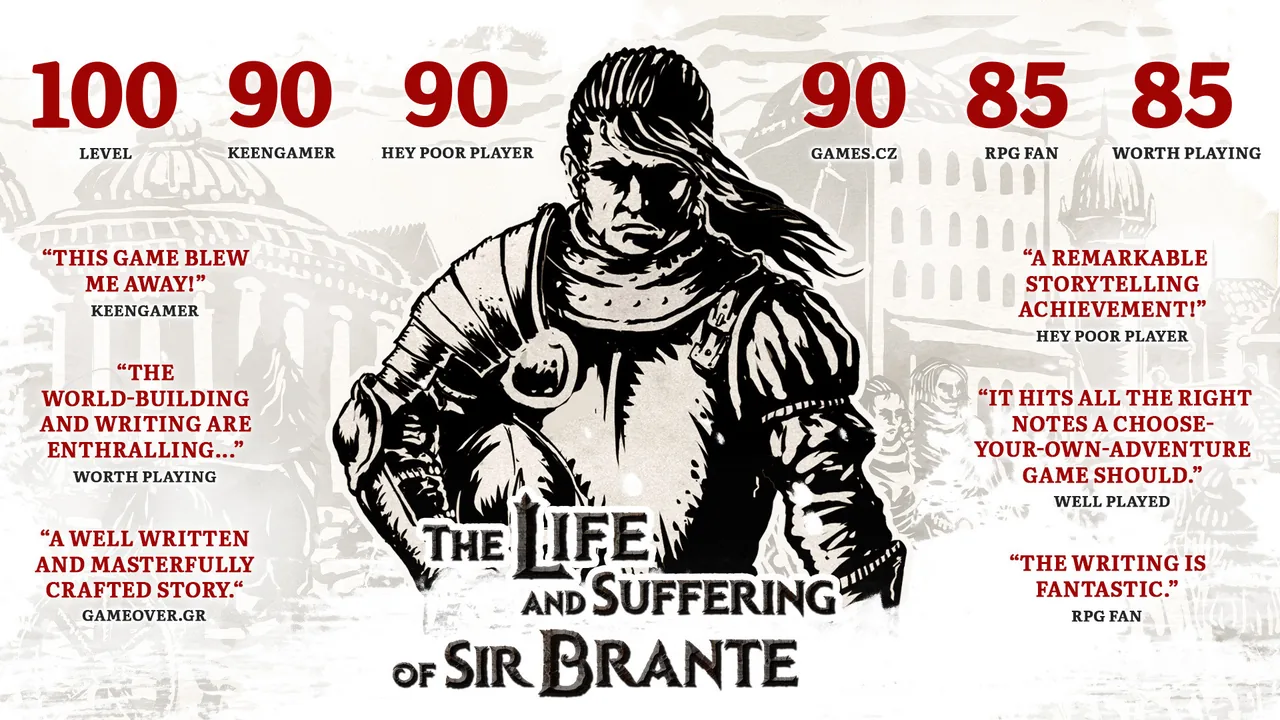
The Life and Suffering of Sir BranteImage: 101XP via Steam -
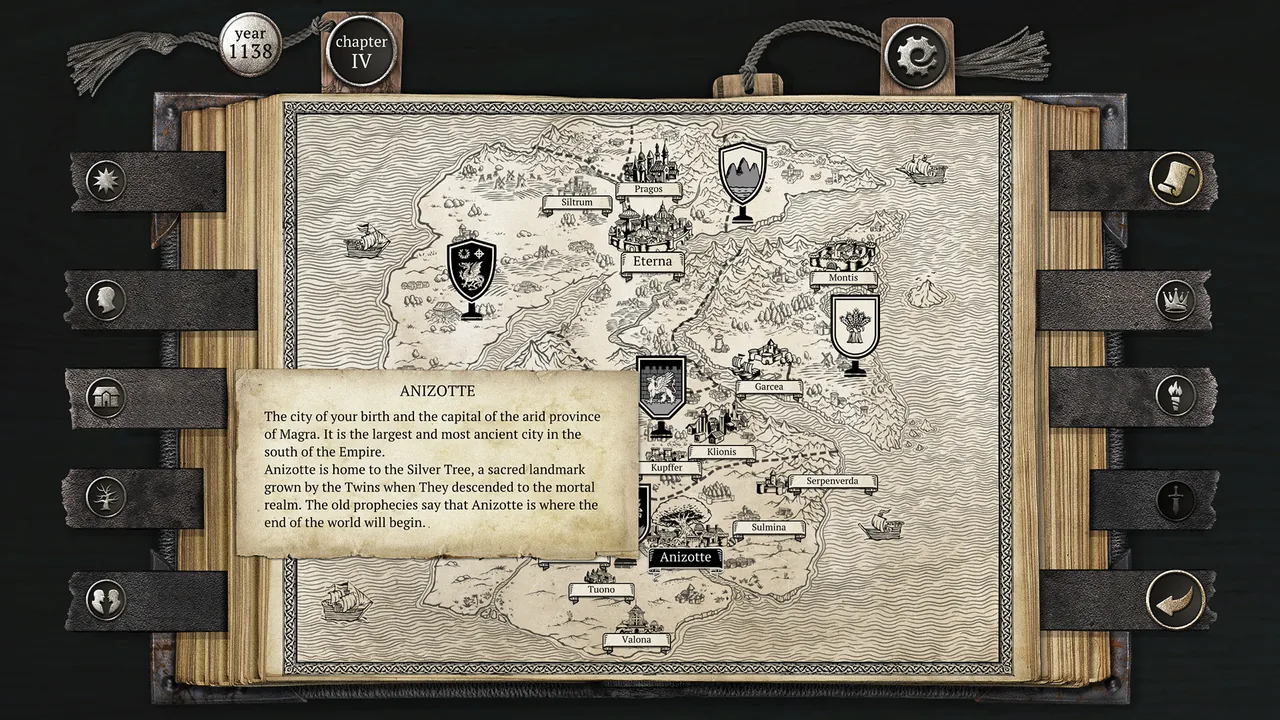
The Life and Suffering of Sir BranteImage: 101XP via Steam -
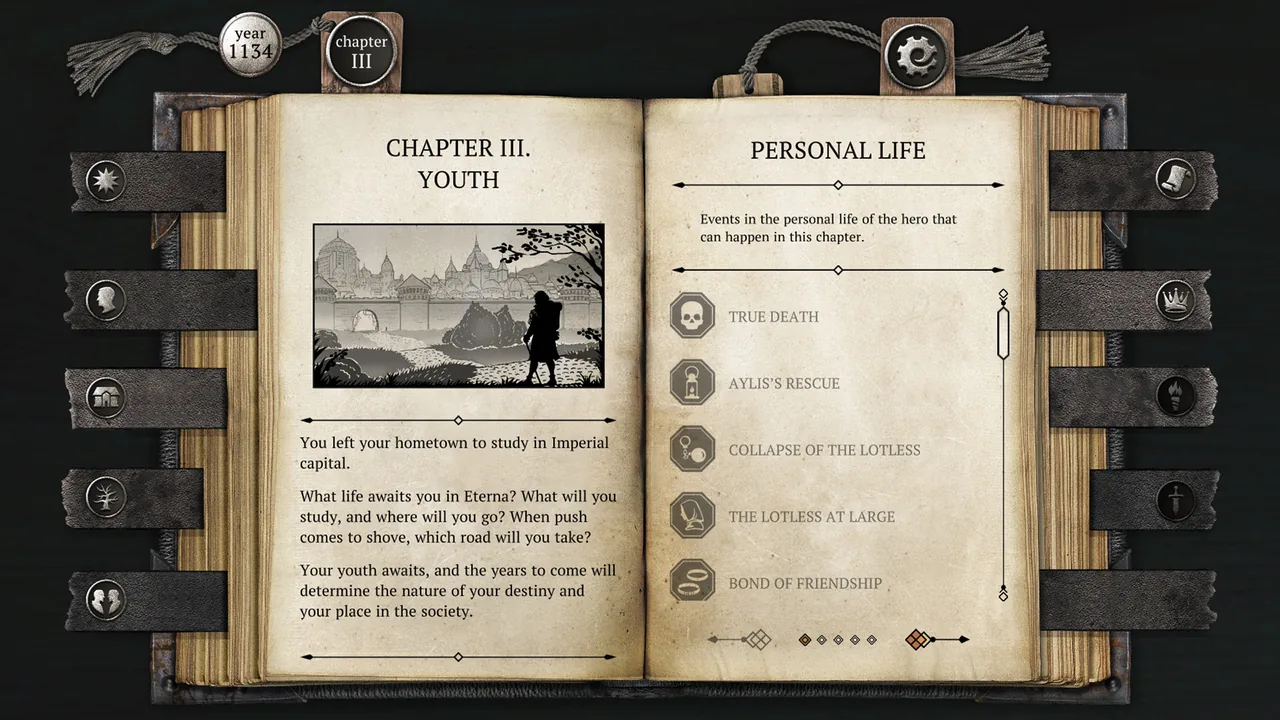
The Life and Suffering of Sir BranteImage: 101XP via Steam -
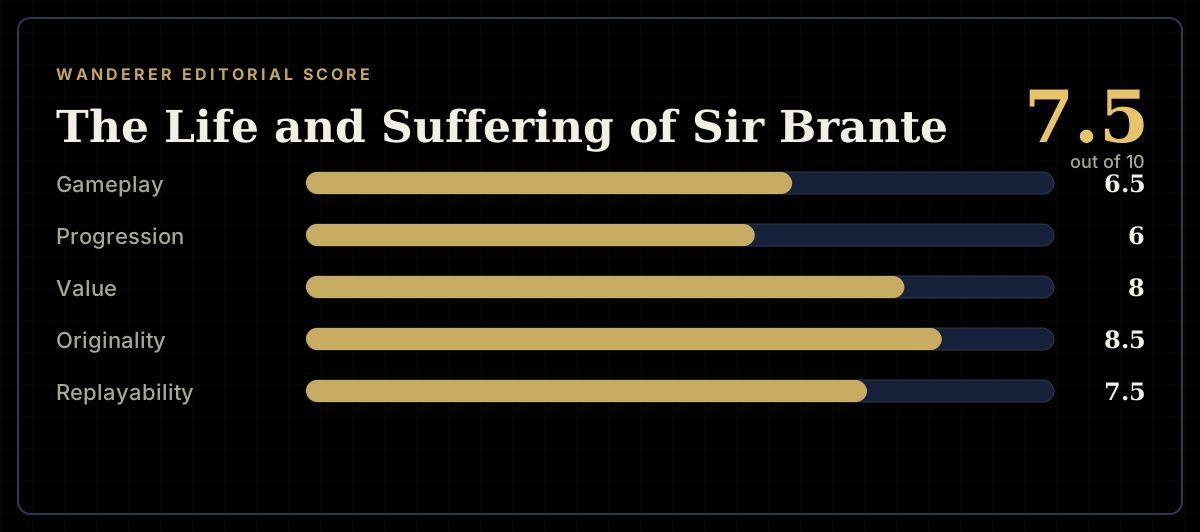
How the review scores each part of the gameWanderer Editorial -
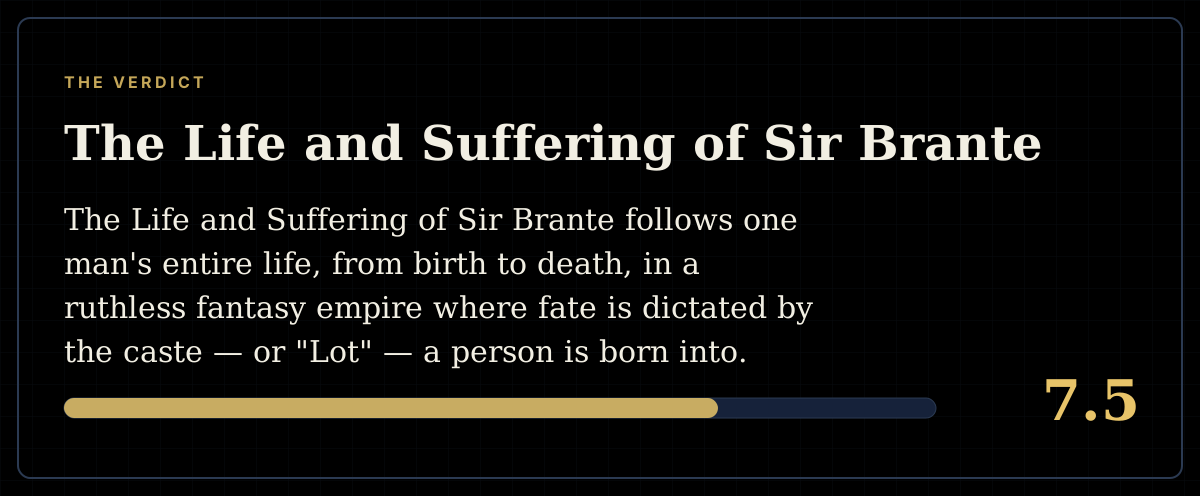
The short versionWanderer Editorial