
Game review
TetherGeist
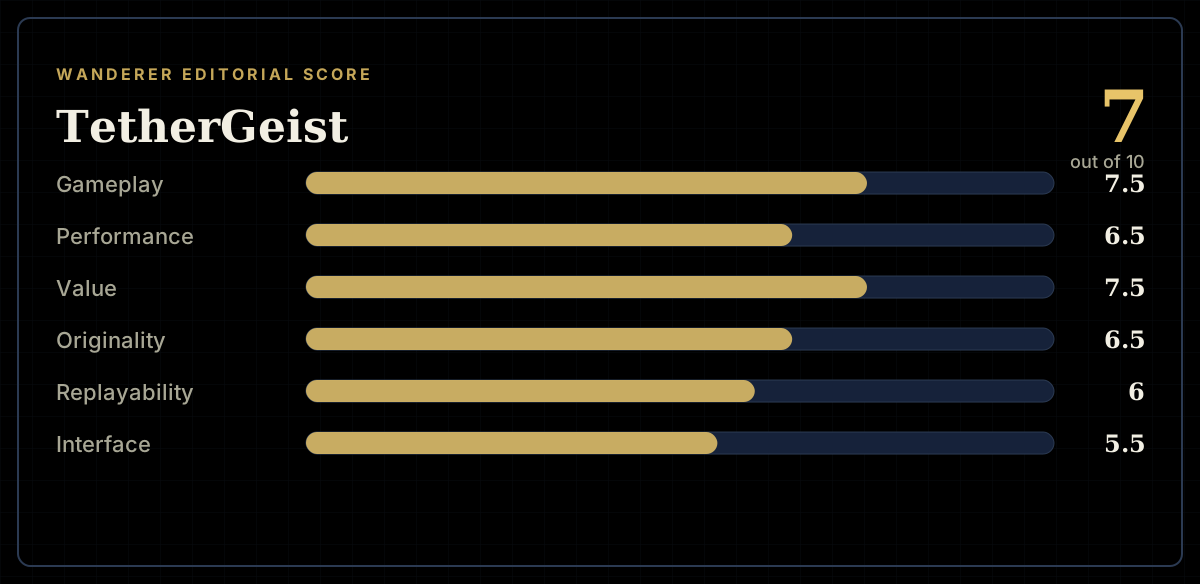
7 / 10
- Developer
- O. and Co. Games, Out of Space Games
- Publisher
- O. and Co. Games, Out of Space Games
- Released
- 7 May 2026
- Platforms
- Windows
- Genre
- Platformer
- Monetisation
- Paid, one-time purchase.
- Players
- Single-player only.
The short version
TetherGeist is a challenging precision platformer from O. and Co. Games and Out of Space Games, following Mae and her axolotl spirit Bao on a coming-of-age pilgrimage built around a tether-based Astral Projection mechanic. Its Very Positive rating across a rich English review sample reflects genuine, widely repeated praise as a heartfelt spiritual successor to Celeste, with this review finding fair complaints about missing accessibility options, a progress-loss bug tied to accidental menu navigation, and repetitive room design in its later chapters.
Biggest strengths
- Praised extensively as a spiritual successor to Celeste, with multiple reviewers specifically crediting its responsive controls and satisfying flow-state platforming.
- Praised repeatedly for its charming, understated story and the bond between Mae and her axolotl companion Bao.
- Praised for a wide range of unique chapter-specific mechanics, with several reviewers specifically noting distinctive movement abilities introduced throughout.
Biggest weaknesses
- A fair, most-upvoted critical complaint reports the game lacks accessibility options to ease difficulty for struggling players, compounded by bugs including wall-clipping and invisible hazards.
- A fair, specific complaint from the same review reports accidentally quitting to the overworld erases all progress on the current level with no confirmation prompt.
- A fair, detailed complaint from one reviewer reports there is often only one way to complete a given room, with later chapter mechanics feeling like minor variations on earlier ones rather than genuinely new ideas.
Who it's for: Fans of tight, precision-focused platformers like Celeste who enjoy escalating mechanical challenge and a warm, understated story; players who need accessibility options to manage difficulty, or want strong replay variety within individual levels, should temper expectations.
Our recommendation: A tightly controlled, heartfelt precision platformer let down by missing accessibility options, a costly quit-menu bug, and repetitive later rooms.
7 / 10
Praised extensively as a spiritual successor to Celeste
TetherGeist earns its Very Positive rating first through overwhelming comparisons to a genre touchstone. "I came for the Celeste-like experience, and CHERISH my new little axolotl buddy. Still early in Tethergeist, but it already has that 'one-more-try' flow state vibe I just love in platformers like this," reads one of the sample's most-upvoted reviews. A separate reviewer is even more direct: "A 2D platformer on the same quality and difficulty level as Celeste. If you liked Celeste you are gonna like this game." This review treats that praise as fair: an overwhelming number of reviewers independently reaching for the same specific comparison, and specifically praising control responsiveness and satisfying "flow state" platforming, is a strong, credible signal of tight, well-tuned core mechanics rather than surface-level similarity.
Praised for its charming story and companion
Beyond the platforming itself, this review found reviewers repeatedly praising the game's emotional register. "A wonderfully creative and fun platformer with a surprisingly warm and charming story," reads one review. A separate reviewer highlights the balance struck between story and challenge: "The controls are super responsive and the story is great but not intrusive, allowing for the gameplay to shine." This review treats that praise as fair: reviewers independently praising a story that supports difficult platforming without disrupting its pacing is a genuine design accomplishment, distinct from simply having a likeable premise.
Praised for a wide range of unique chapter mechanics
This review also found reviewers repeatedly praising the game's mechanical variety across its seven chapters. "Just pure, good feeling platforming with unique mechanics and great puzzles," reads one review. Even one of the sample's more mixed reviews concedes the same point: "One of the main gimmicks of the game is the variety of platforming powerups that you can store on your person... The (human) controls feel very responsive and jumping/turning around is nice and snappy." This review treats that praise as fair: reviewers across the spectrum of the sample, including those who ultimately did not enjoy the whole experience, still credit the game with introducing a genuinely varied toolkit of chapter-specific abilities.
A fair, most-upvoted complaint about missing accessibility and bugs
Set against that praise, this review found the sample's most-upvoted critical complaint. "This may seem a bit of an unfair criticism, but the game is in need of accessibility options. There were many times where I was struggling to get through sections, wishing there was an option to make it easier for myself. As I got later into the game, I found myself clipping into walls and dying, dying to invisible hazards," reads that review. This review treats that complaint as fair and significant: a precision platformer that deliberately courts a wide, non-expert audience through its warm story and framing benefits from options that let less skilled players see that story through, and specific bug reports about wall-clipping and invisible hazards are concrete technical issues independent of difficulty preference.
A fair, specific complaint about a costly progress-loss bug
The same review also details a fair, specific complaint about a menu-navigation bug. "If you accidentally hit quit to overworld, you have to restart the entire level. This was the point where I stopped playing the game. It needs to ask me if I want to quit the level instead of kicking you out and making you start over," reads that review, describing losing an entire stage of progress to a single misinput. This review treats that complaint as fair and severe: the absence of a confirmation prompt before discarding unsaved level progress is a straightforward, easily-avoidable design oversight, and one specific enough that it directly caused at least one reviewer to stop playing.
Fair complaints about repetitive room design and an unreliable mechanic
This review also found a fair, detailed complaint about the game's later-game structure. "There's really only one way to complete every room, there's not much variation you can do as a player to make the game yours... A lot of these mechanics are just kinda dull, or barely a variation of the previously introduced ones," reads one detailed critical review. A separate, otherwise enthusiastic reviewer flags a more specific mechanical complaint: "THE BOUNCY MUSHROOMS ON THE WALL FREAKING SUCK. they dont feel fun to bounce off of and most of the time it just doesn't let you bounce to where you need to go." This review treats both as fair: a single-solution room design philosophy limits player expression relative to genre peers, and a specific, named mechanic singled out as unreliable even by a fan is a legitimate, concrete critique rather than a general difficulty complaint.
Achievement data corroborates a gradual, fair difficulty curve
This review's own check of Steam's global achievement data shows a believable chapter-by-chapter decline: 79.9% of players complete Chapter 1, falling gradually to 50.8% by Chapter 2, and down to 27.3% by Chapter 7, with the finish_game achievement sitting almost exactly alongside it at 27.2%. Separately, death-count achievements at 100, 500, and 1,000 deaths sit at 74.2%, 51.0%, and 36.7% respectively, confirming frequent, expected failure is central to the experience rather than a symptom of unfair design. Together, this pattern is consistent with a well-paced, rising challenge that a majority of players who start the game engage with seriously, rather than one that spikes unfairly or loses players en masse at a single point.
Final verdict
TetherGeist is a tightly controlled, heartfelt precision platformer that earns its Very Positive rating through consistently credible comparisons to Celeste, a genuinely charming story, and a wide range of chapter-specific mechanics. Its clearest weaknesses are a fair, most-upvoted complaint about missing accessibility options alongside real technical bugs, a fair and severe complaint about a costly quit-menu progress-loss bug, and fair complaints about repetitive, single-solution room design and at least one unreliable mechanic in its later chapters. For fans of demanding, Celeste-style platforming willing to accept some rough edges, this is a confident recommendation.
Pros and cons
Pros
- Praised extensively as a spiritual successor to Celeste, with multiple reviewers specifically crediting its responsive controls and satisfying flow-state platforming.
- Praised repeatedly for its charming, understated story and the bond between Mae and her axolotl companion Bao.
- Praised for a wide range of unique chapter-specific mechanics, with several reviewers specifically noting distinctive movement abilities introduced throughout.
- This review's own check of achievement data shows a gradual, believable difficulty curve across the game's seven chapters, consistent with reviewer accounts of rising but fair challenge.
Cons
- A fair, most-upvoted critical complaint reports the game lacks accessibility options to ease difficulty for struggling players, compounded by bugs including wall-clipping and invisible hazards.
- A fair, specific complaint from the same review reports accidentally quitting to the overworld erases all progress on the current level with no confirmation prompt.
- A fair, detailed complaint from one reviewer reports there is often only one way to complete a given room, with later chapter mechanics feeling like minor variations on earlier ones rather than genuinely new ideas.
- A fair, specific complaint reports one wall-bounce mechanic in particular feels unreliable and inconsistent, even from an otherwise glowing review.
Screenshots
-
TetherGeistImage: O. and Co. Games via Steam -
TetherGeistImage: O. and Co. Games via Steam -
TetherGeistImage: O. and Co. Games via Steam -
How the review scores each part of the gameWanderer Editorial -
The short versionWanderer Editorial