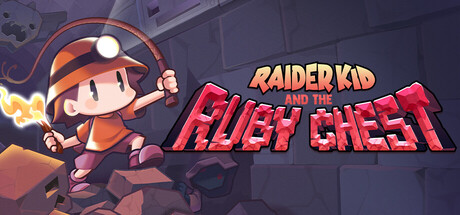
Game review
Raider Kid and the Ruby Chest Review: A Tiny, Near-Perfect Game Boy Metroidvania
7.9 / 10
- Developer
- Cacareco Games
- Publisher
- Cacareco Games
- Released
- 31 March 2026
- Platforms
- ["PC"]
- Genre
- Metroidvania / Platformer
- Monetisation
- Paid
- Players
- false
The short version
Raider Kid and the Ruby Chest is a deliberately tiny Game Boy Color-styled metroidvania that a remarkably consistent Steam sample says nails exactly what it sets out to do, clever compact level design and real retro charm, over combat and bosses that are functional rather than the main event.
Biggest strengths
- The sample is close to unanimous in praising the level design and puzzle-like exploration, with reviewers repeatedly citing rooms where you can see an item you can't yet reach and have to study the map to figure out how
- Multiple reviewers specifically call out generous accessibility options, including a damage slider that can be set to zero, as letting older or less reflex-focused players complete and fully enjoy the game
- The GBC-styled pixel art, music, and protagonist Alex draw consistent praise for charm and polish, with one reviewer calling it flawless and comparing its quality to well-regarded genre peers
Biggest weaknesses
- Combat and boss fights draw the most consistent criticism in the sample, described by multiple reviewers as functional but unremarkable, ranging from repetitive early on to genuinely fun only in the late game
- One detailed reviewer notes a key traversal ability required to reach some hidden treasures is never clearly explained by the game, relying on in-game hints rather than direct instruction
- A reviewer who otherwise praised the level design and bosses says the early dialogue set their expectations low, suggesting the writing is the weakest part of an otherwise polished package
Who it's for: Metroidvania fans who want a tightly-designed, 2-to-8-hour adventure rather than a sprawling one, and anyone nostalgic for Game Boy Color-era platformers.
Our recommendation: An easy recommendation at its price for genre fans, especially anyone who enjoys 'microvania'-length games and wants a complete, polished experience rather than a padded one.
7.9 / 10
Raider Kid and the Ruby Chest sends a whip-armed kid named Alex through a set of tightly-packed ancient ruins in search of hidden treasures, wrapped in a presentation styled deliberately after Game Boy Color-era platformers. Developed and published by Cacareco Games, it's built around a short runtime by design, most reviewers finish it in two to eight hours, and it has earned one of the more consistent Steam review profiles this lane has encountered: 98% positive across 221 reviews, with a 20-review English-language sample that reads almost as a chorus of agreement on exactly what the game does well.
A Deliberately Small Metroidvania, Done Properly
The sample repeatedly frames the game's short length as a strength rather than a limitation. One reviewer calls it "a perfect example that you don't need dozens of hours of gameplay to create a full experience," while another, who keeps a personal ranked list of what they call "microvanias" (metroidvania-likes under three and a half hours), places Raider Kid at the top of that list, noting that "decent full-length" metroidvanias would still beat it on scope but not necessarily on quality within its chosen scale. A third reviewer describes rooms built as single map tiles with no scrolling, comparing the structure to classic computer platformers like Maze of Galious, and calls the format "in the spirit" of that older design tradition.
Level Design and Exploration Are the Real Draw
Where the sample converges most strongly is on the game's level and puzzle design. Multiple reviewers independently describe the same satisfying loop: spotting an item across a gap or behind an obstacle, then studying the map and layout to work out how to reach it later once new abilities open up the route. One reviewer calls these moments "really clever, but not so hard as to stump you for a long time," while another specifically praises the game's approach to end-game item tracking for avoiding simple on-map markers in favour of genuine exploration. The map itself draws mixed but minor criticism, with one reviewer noting it doesn't mark collectibles for later return trips, a small quality-of-life gap in an otherwise well-regarded navigation system.
Combat and Bosses: Functional, Not the Highlight
Almost every detailed review agrees combat is the weakest pillar of the design, though reviewers are careful to frame it as adequate rather than bad. One reviewer notes the game has "excellent puzzles and level design, while combat and bosses are on the weaker side," and another tracks a clear arc across the run: boss fights are "kinda boring and repetitive in early game" before becoming "pretty fun and somewhat challenging in late game." The whip-based combat draws comparisons to NES-era Castlevania and Spelunky, and reviewers generally accept its simplicity as appropriate to the game's Game Boy-inspired scope rather than a shortfall relative to it.
A Deliberate Design Choice: No Double Jump
One especially detailed review highlights a specific traversal decision worth calling out: the game completely avoids giving the player a double jump, something the reviewer notes is present in "almost every other metroidvania." Instead, players unlock two separate wall-climb abilities to handle vertical movement, one of which the same reviewer describes as noticeably slow and less satisfying to use than the other. It's a rare example of a genre entry making a conscious traversal trade-off rather than defaulting to genre convention, and reviewers who mention it treat it as an interesting design choice rather than an oversight.
Accessibility Options Reviewers Actually Use
A recurring, specific point of praise is the game's accessibility settings, particularly a damage slider that can reportedly be adjusted all the way down to zero damage taken. One reviewer explicitly credits this setting with letting them fully complete the game despite feeling "too old for metroidvanias," and another describes using adjusted damage-dealt and damage-taken settings to complete 100% of the content "with no issue." This isn't treated as a niche footnote by the sample, it comes up specifically and approvingly across multiple independent reviews as a genuine reason the game works for a wider range of players than its old-school presentation might suggest.
A Few Rough Edges: Hidden Moves and Thin Writing
Not every part of the design lands cleanly. One detailed review notes that a specific move required to reach certain hidden treasures and upgrades is never outright explained by the game, relying instead on indirect in-game hints, though the same reviewer confirms nothing is missable and the game supports replaying the final stretch to chase a true ending without a full restart. Separately, a reviewer who otherwise praised the bosses and level design says the early dialogue "set my expectations low," a criticism echoed by the general absence of story or writing praise elsewhere in the sample, suggesting narrative polish trailed behind the game's mechanical and visual craft. One reviewer also flagged needing to tweak Steam Deck performance settings for the smoothest experience, pointing to ProtonDB for specific configuration advice rather than expecting it to run optimally out of the box.
Final Verdict
Raider Kid and the Ruby Chest earns an unusually consistent wave of praise for doing a small thing very well: a tightly-designed, GBC-styled metroidvania where clever compact level design, real retro charm, and genuinely useful accessibility options carry a run that most players finish in a single sitting or two. Combat and bosses are the clear weak point, functional rather than thrilling for much of the run, and the writing draws quiet criticism where it's mentioned at all. But for a genre often defined by sprawling scope, the sample's verdict is refreshingly specific: this is a small, polished, complete experience that knows exactly what it's trying to be.
Pros and cons
Pros
- The sample is close to unanimous in praising the level design and puzzle-like exploration, with reviewers repeatedly citing rooms where you can see an item you can't yet reach and have to study the map to figure out how
- Multiple reviewers specifically call out generous accessibility options, including a damage slider that can be set to zero, as letting older or less reflex-focused players complete and fully enjoy the game
- The GBC-styled pixel art, music, and protagonist Alex draw consistent praise for charm and polish, with one reviewer calling it flawless and comparing its quality to well-regarded genre peers
Cons
- Combat and boss fights draw the most consistent criticism in the sample, described by multiple reviewers as functional but unremarkable, ranging from repetitive early on to genuinely fun only in the late game
- One detailed reviewer notes a key traversal ability required to reach some hidden treasures is never clearly explained by the game, relying on in-game hints rather than direct instruction
- A reviewer who otherwise praised the level design and bosses says the early dialogue set their expectations low, suggesting the writing is the weakest part of an otherwise polished package
Screenshots
-

The game leans fully into its Game Boy Color-inspired presentation, framed here inside a handheld console mockupCacareco Games -
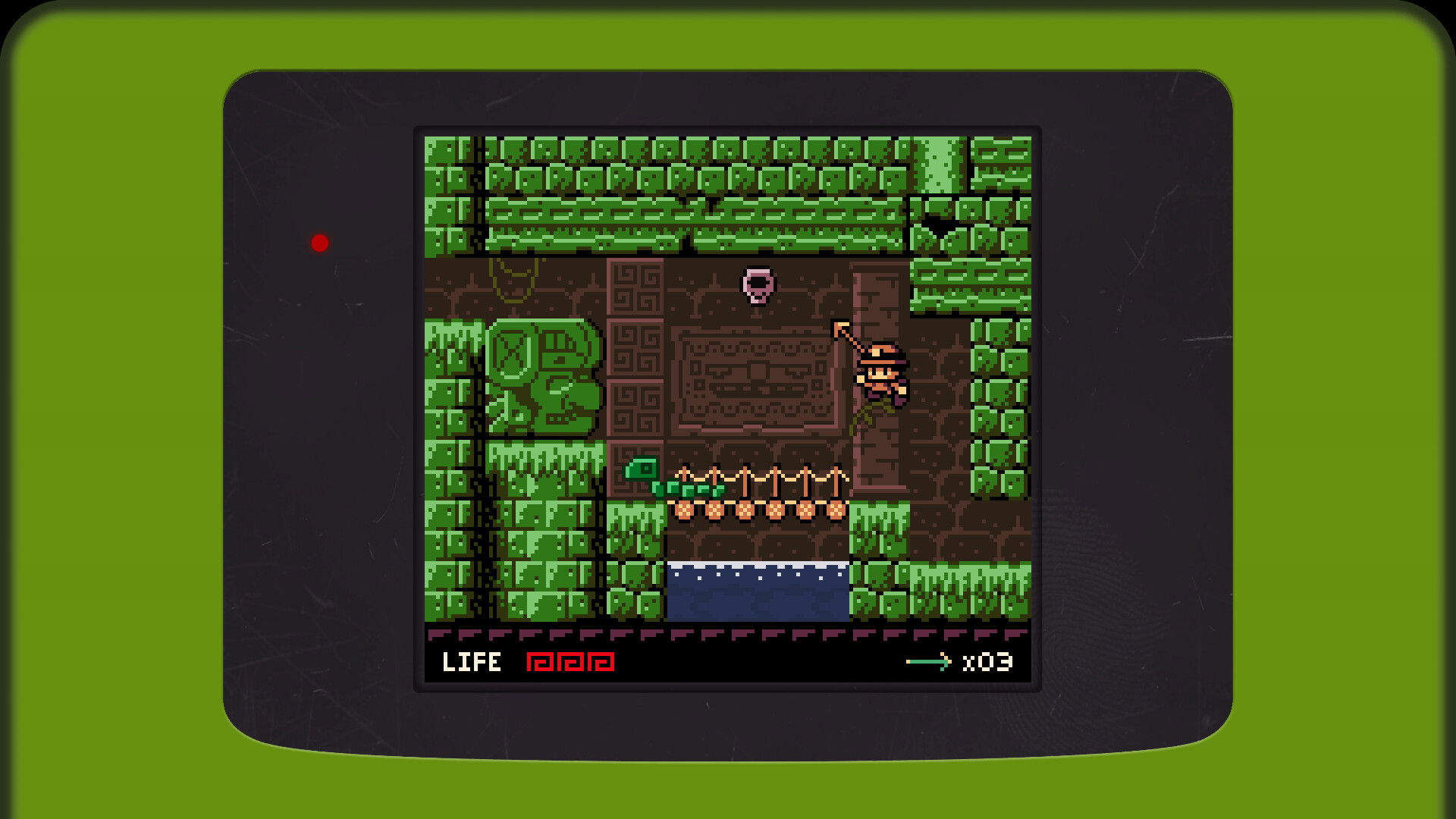
A temple exploration room, with the life meter and item count visible along the bottom edgeCacareco Games -
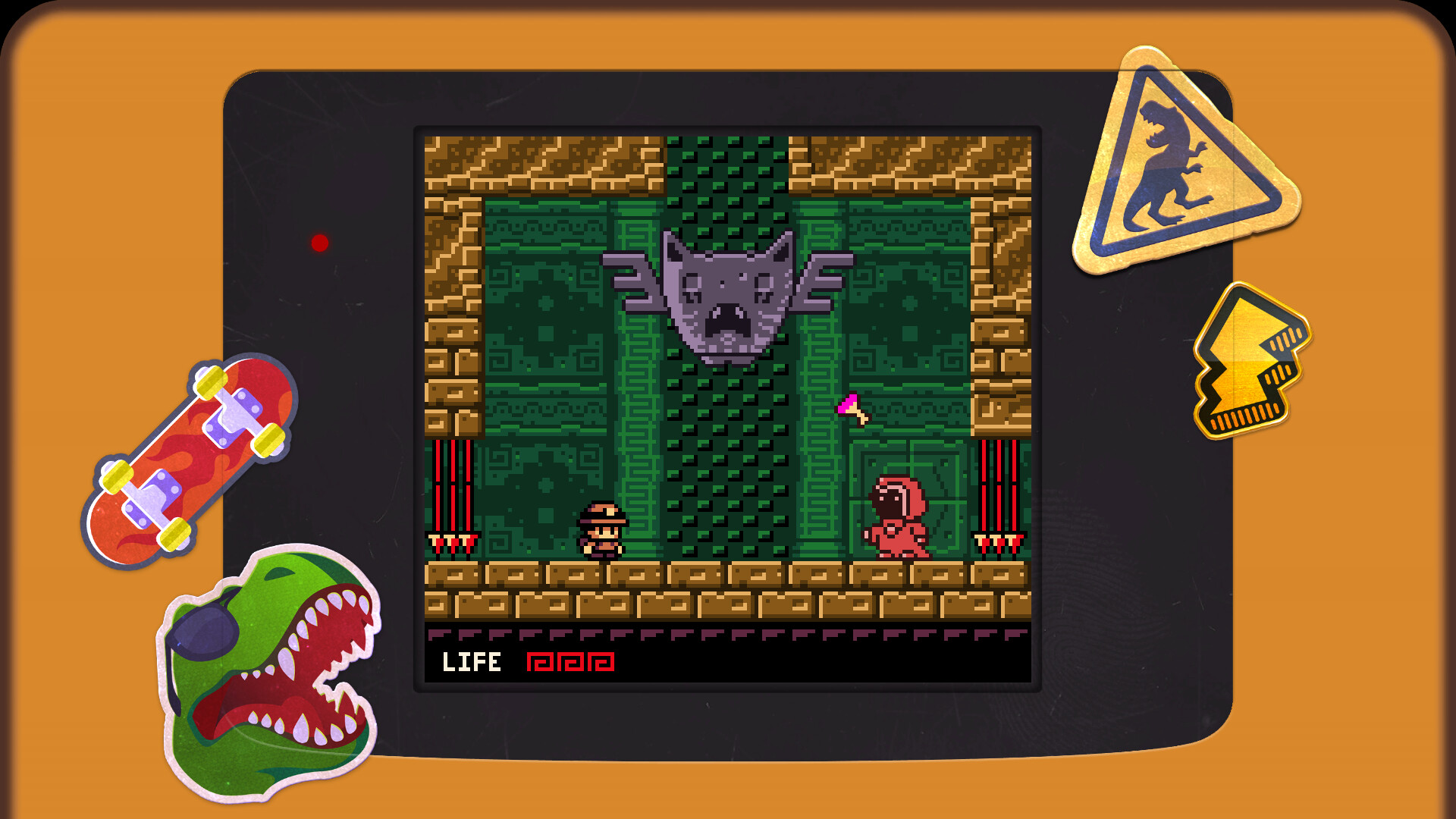
A boss encounter, one of the areas the Steam sample flags as ranging from repetitive early on to genuinely challenging laterCacareco Games -
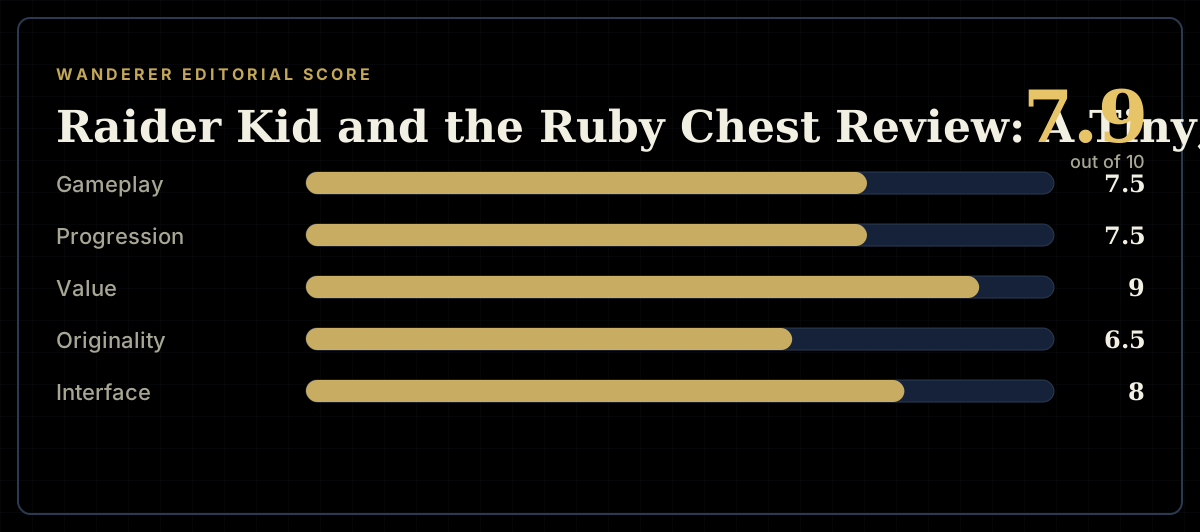
How the review scores each part of the gameWanderer Editorial -
The short versionWanderer Editorial