Game review
Mobiles Tycoon
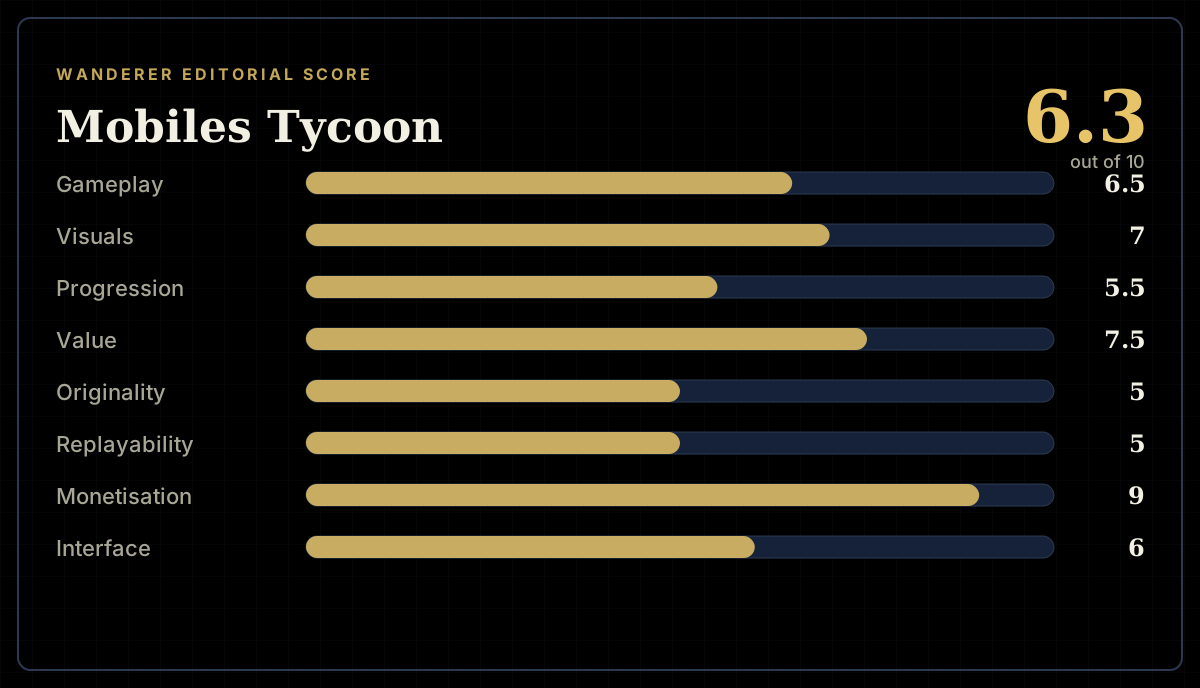
6.3 / 10
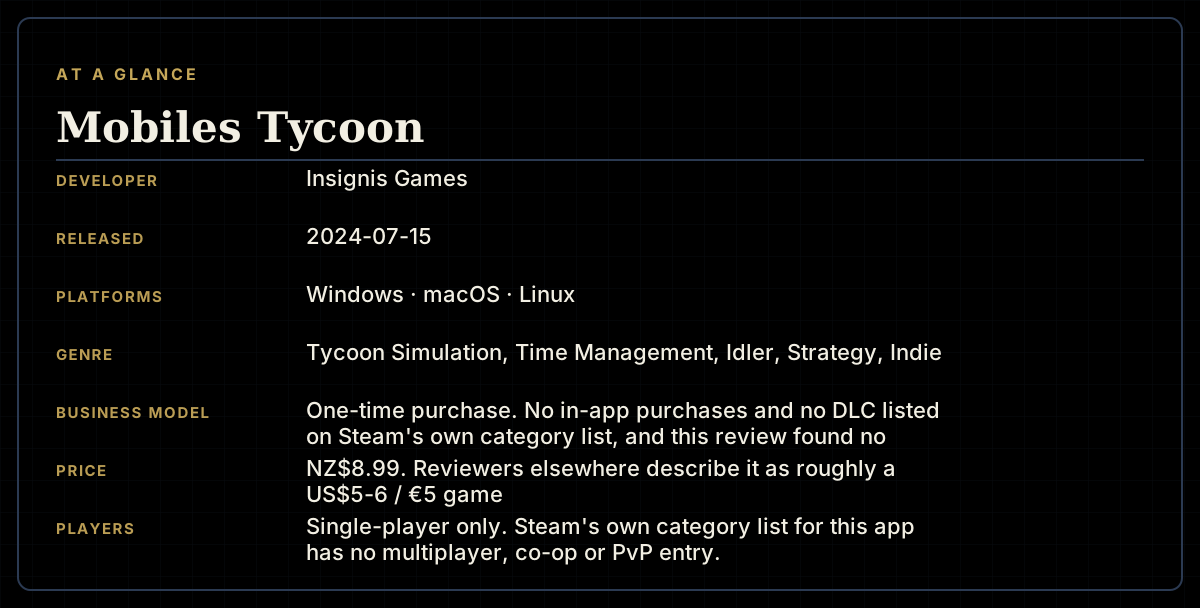
- Developer
- Insignis Games
- Publisher
- Insignis Games
- Released
- 15 July 2024
- Platforms
- Windows, macOS, Linux
- Genre
- Tycoon Simulation, Time Management, Idler, Strategy, Indie
- Monetisation
- One-time purchase. No in-app purchases and no DLC listed on Steam's own category list, and this review found no advertising anywhere in the store material. Two in-game currencies (cash and research points) exist, both earned only by playing, never sold for real money.
- Players
- Single-player only. Steam's own category list for this app has no multiplayer, co-op or PvP entry.
The short version
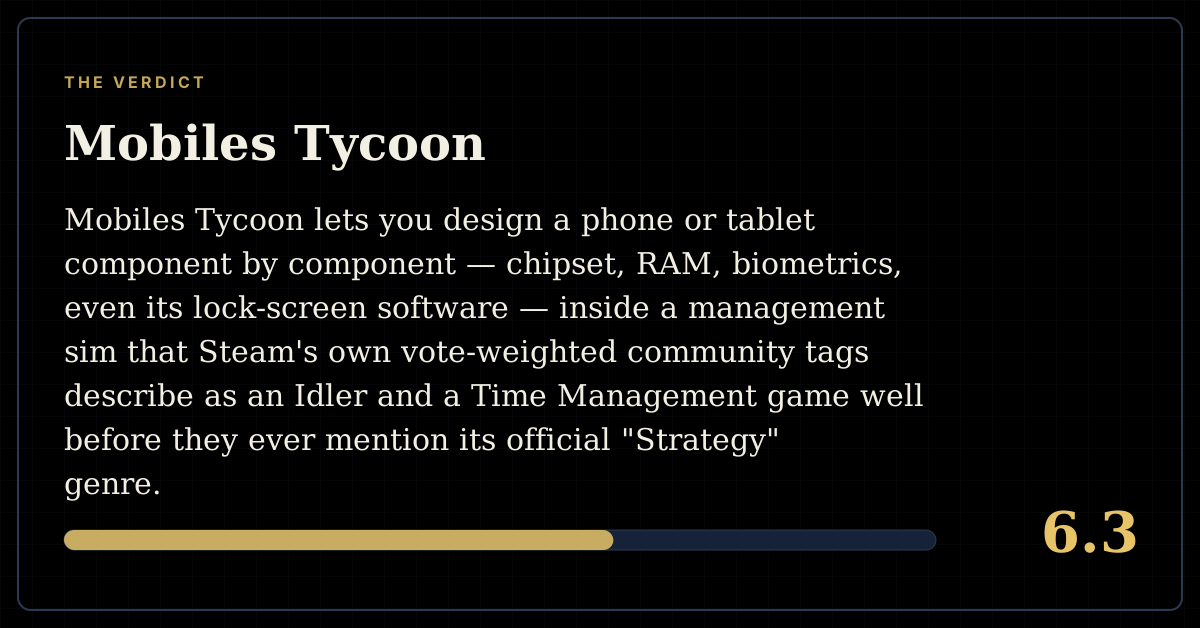
Mobiles Tycoon lets you design a phone or tablet component by component — chipset, RAM, biometrics, even its lock-screen software — inside a management sim that Steam's own vote-weighted community tags describe as an Idler and a Time Management game well before they ever mention its official "Strategy" genre. It's cheap and entirely free of the monetisation tricks this library usually has to warn readers about.
Its two real problems both come from its own players: a hard ceiling on content that several independent reviewers hit within a handful of hours, and a storefront score that reads very differently depending on which language you filter it to.
Biggest strengths
- A genuinely deep hardware-and-software design toolset — chipset, RAM type and size, storage, biometrics, screen, speakers, plus a full custom OS with its own lock-screen and widget settings — that goes well past the "drag one slider" version of this idea
- Completely clean, verifiable monetisation: a single flat NZ$8.99 price, no in-app-purchase category on Steam's own listing, no DLC, and no advertising found anywhere in the store material or the review corpus
- A well-observed rival-company system: AI competitors with parody tech-giant names (Appel, Miscrocoft, Samsumg, Mvidia) that research, price and market their own competing products while you watch their market share climb or fall on a shared leaderboard
Biggest weaknesses
- The single most-repeated complaint in the English corpus, made independently by several reviewers and echoed inside more than one positive review too, is that the game runs out of things to do within a handful of hours — "boring after 3-4 hours," "gets boring after a while," and a five-star review from October 2024 admits that once every upgrade tree is cleared, "this game becomes a boring one"
- Steam's own global achievement data shows a strikingly low floor: only 37.4% of owners have logged even two hours in-game — the single easiest time-based achievement the game offers — which is a soft ceiling for a management sim that is supposed to reward sticking around
- Development has gone quiet for close to two years. The last patch (Update 1.0.4) shipped in August 2024; since then the only news post has been a February 2025 announcement for the developer's next "Tycoon" game, and one 2026 negative review describes Mobiles Tycoon itself as "abandoned... without finishing"
Who it's for: Fans of Game Dev Tycoon and its many imitators who want a phone-and-tablet-flavoured spin on the format for less than the price of a coffee, and who are fine with a genuinely finite amount of content rather than a long-tail live-service tycoon that keeps adding to it.
Our recommendation: Worth the asking price for a dozen or so hours of unusually detailed hardware and software design, and there is nothing predatory lurking in the shop. Do not expect ongoing support — the developer's attention has visibly moved to a newer game on the same template — and go in expecting the loop to run dry well before you've researched everything on offer.
6.3 / 10
A phone company built one toggle at a time
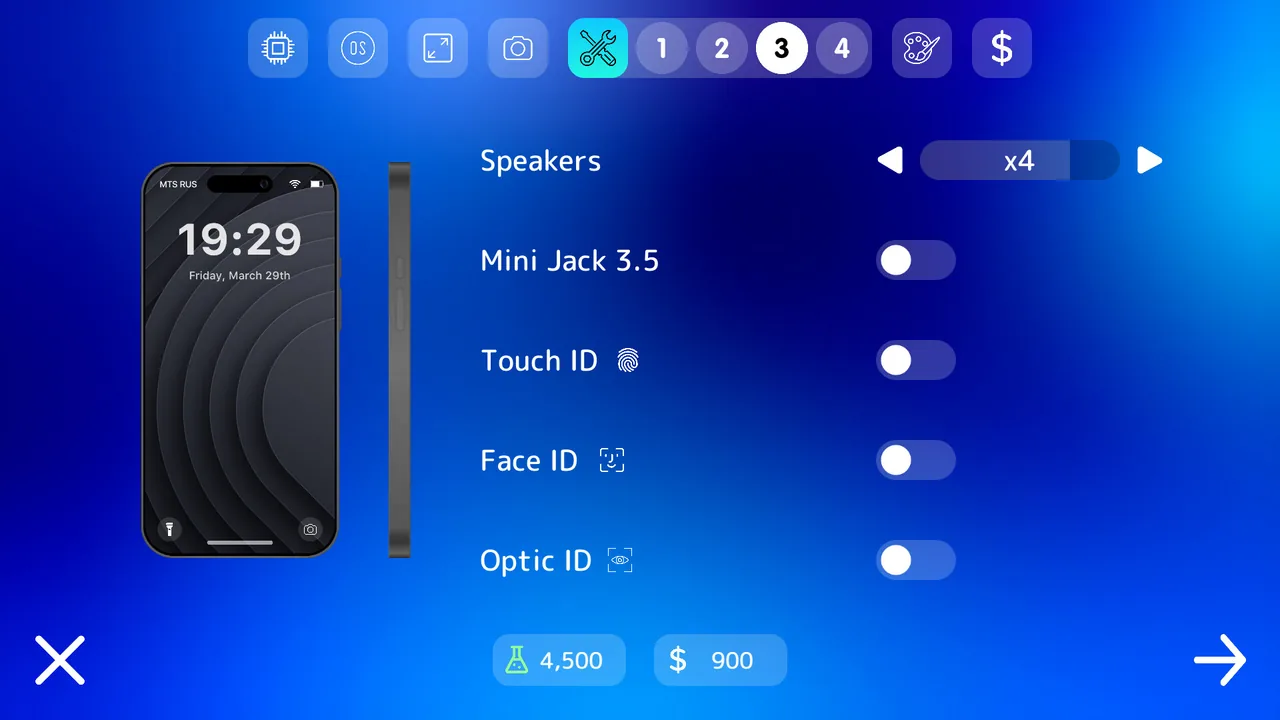
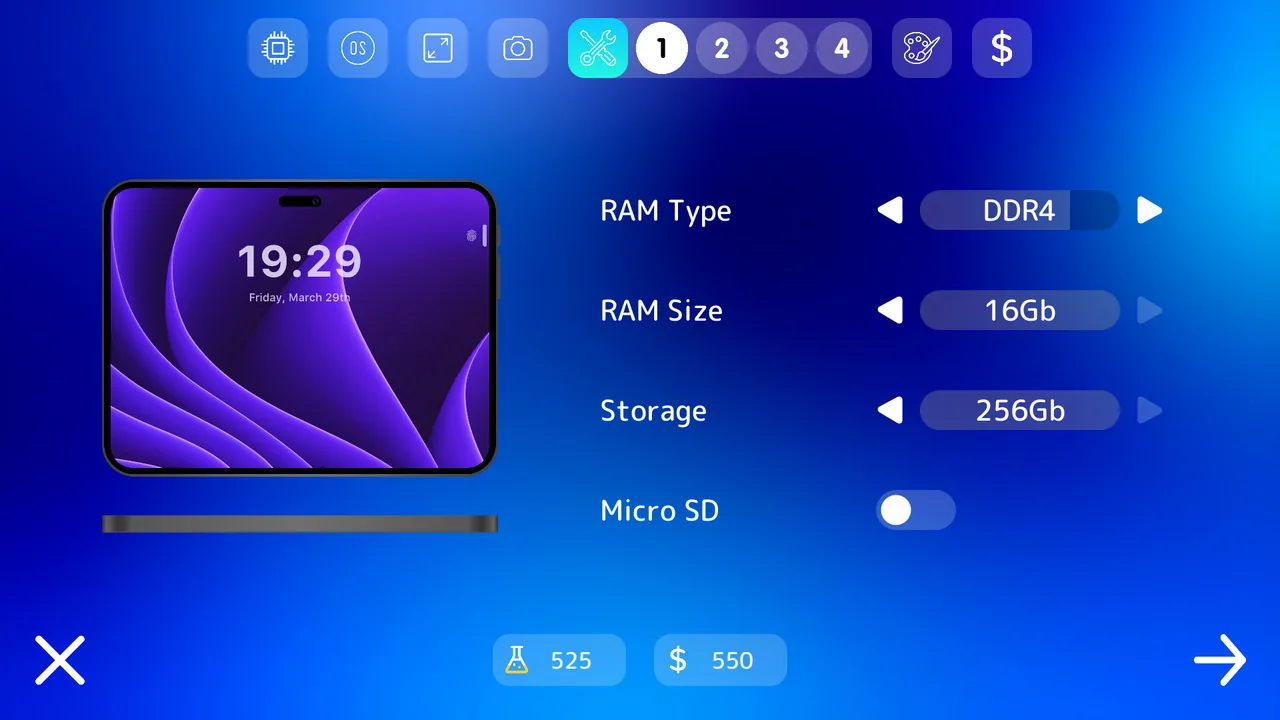
Mobiles Tycoon strips out the boardroom drama that a lot of tycoon games lean on and puts the spec sheet front and centre instead. Building a new phone or tablet means working through individual component categories one at a time — chipset and processor, RAM type and capacity, storage with an optional Micro SD toggle, screen, speakers, a Mini Jack port you can choose to include or cut, and biometric options broken out separately into Touch ID, Face ID and Optic ID. The official Steam screenshots show this design flow in enough detail to make the pitch on its own: sliders and forward/back arrow controls for every spec, a live phone mockup on the left that updates as you build, and a running cost readout in both cash and research points at the bottom of the screen.
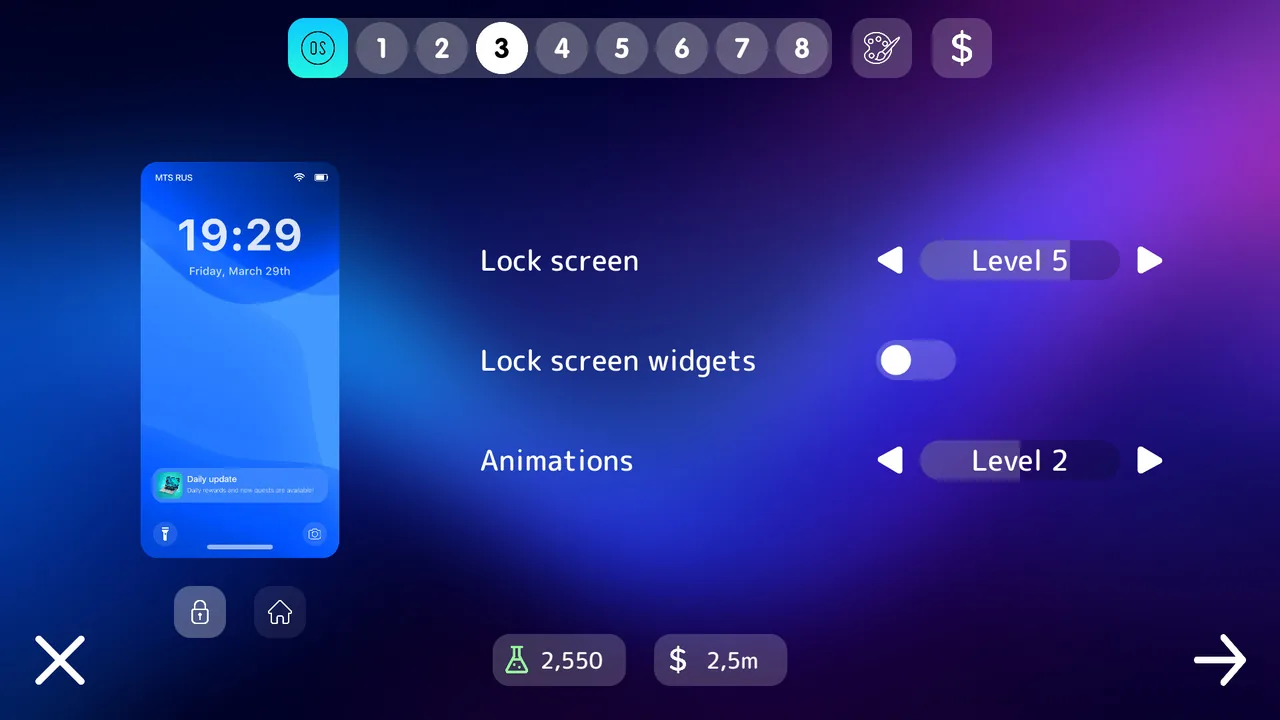
The same layered-toggle approach extends to the operating system your devices run. A separate OS design mode lets you set lock-screen "level," toggle lock-screen widgets and dial in an animation-quality tier — genuinely software design nested inside hardware design, which is a more ambitious structure than most games in this space attempt. Ten office-upgrade tiers with their own 3D-modelled interior, shown from an isometric angle with employees working at visibly different desks and furniture depending on the tier, back up the description's claim of "beautiful 3D models" with actual promotional art rather than a marketing phrase.
The community's own tag votes disagree with the store page
Steam's official genre list for Mobiles Tycoon reads Indie, Simulation, Strategy. Its vote-weighted community tags — the list players actually built by clicking, buried in the page's InitAppTagModal data rather than the pills shown near the top — tell a different story. Time Management leads with 162 votes, Idler is second with 156, and Sandbox is third with 151. Two of the three official genres fare much worse by comparison: "Indie" is dead last of eighteen tags at 22 votes, and "Simulation" sits 12th at 92. "Strategy," the one genre where the storefront and the community actually agree, still only manages 8th place. Players reaching for this game clearly experience it as a management-idler with a strategy layer, not as a strategy game that happens to be indie — which lines it up much more closely with the idle and incremental genre this library covers first than its own store page would suggest.
The AI rivals are the game's best idea
The most quietly well-designed system in Mobiles Tycoon is its competitor AI. Rather than static market-share numbers, rival companies research and release their own products, price them competitively, and climb or fall on a shared leaderboard sorted by company price, annual income, monthly income or fan count — all genuinely tracked and updated as the simulation runs. The developer clearly had some fun with the roster: the leaderboard is populated with parody tech giants like Appel, Miscrocoft, Samsumg, Mvidia, Infel and Asos, close enough to their real-world inspirations to land the joke without pretending to be anyone in particular. It's a small touch, but it's the part of the game that reads as genuinely designed rather than assembled from a tycoon-genre checklist, and it matches the store description's claim of "intelligent algorithms for evaluating products and behavior of companies" with something you can actually watch happen on screen.
What the "Very Positive" badge is actually measuring
Mobiles Tycoon sits at 82.2% positive across all 180 of its lifetime Steam reviews — comfortably "Very Positive." That number changes a great deal depending on which language you read it in. German is the single largest language in the corpus at 106 reviews, just under three in five of the entire total, and scores 89.6% positive on its own. English, the second-largest language at 30 reviews, sits at 60% — "Mixed" — nearly thirty points lower. This isn't a review-bombing story or anything illegitimate; it simply means the lifetime badge is being carried by an audience that likes the game noticeably more than its English-speaking one does, and a shopper reading the storefront score in English should know that before assuming it describes their own likely experience.
The English corpus is small enough that this review read every review it has: all 12 negatives and all 18 positives. Two of the twelve negatives independently reach for the same comparison — one calls the game "another soulless clone of game dev tycoon," and another separately describes it as "Game dev tycoon style game but with less polish, its a really good idea though and I think this would be great fun with a bit of work/modding." When a small sample converges on the same named rival unprompted twice, it's a real signal about where the game is being measured against, even if it isn't the majority complaint by volume.
The complaint that keeps repeating: it runs out of road
Set the language split aside and there's still a single dominant thread running through the English corpus, on both sides of the score: the game is a lot of fun for a handful of hours and then stops giving you much to do. Negative reviews put it plainly — "boring after 3-4 hours," "If you play it more than 2 times it gets boring not replayable," "It gets boring after a while." What makes the complaint worth taking seriously is that it isn't confined to the negatives. A three-vote positive review from October 2024, written by someone who calls it "the best tycoon i have ever played in my whole life," still adds that "after completing all trees of upgrades this game becomes a boring one" and asks for more offices, components and devices to keep the loop going.
Steam's own achievement data backs this up with a number rather than a vibe. Of the game's 50 achievements, the single easiest time-based one — simply logging two hours in-game — sits at 37.4% of all owners. That's a strikingly low floor for a management sim; it means a majority of everyone who has ever bought Mobiles Tycoon has not logged two hours playing it. The curve keeps tightening from there: five hours drops to 22.1%, ten hours to 9.9%, and the deepest completion achievements — researching every technology (5.2%), buying out every rival company (0.9%), or finishing the game's Challenging mode (0.4%) — are reached by only a sliver of the audience. Some of that tapering is normal for any tycoon game with an exponential late game, but a two-hour floor this low corroborates the reviewers' complaint that a meaningful share of buyers bounce off long before they'd naturally hit an endgame wall.
Bugs, localisation slips, and a studio that's moved on
Beyond the content-length complaint, a handful of English reviews describe specific, reproducible problems rather than general dissatisfaction. One reports that "Other Companys asking to buy my Processors bugs the game out (Stops the time and doesend restart)" — a described freeze tied to a specific in-game action rather than a vague crash report. Another, despite logging nearly 3,900 hours, writes in May 2026 that the game is "Unplayably buggy after the first few hours, And the developers abandoned it without finishing." A third flags language inconsistency inside the English build itself: "Some of the English text strings are in Russian. Fix that."
That last complaint has some context worth adding: Steam's news feed shows the developer shipped two named patches in the six weeks after launch — Version 1.0.2 (31 July 2024) and Update 1.0.4 (23 August 2024) — the second of which specifically lists "Updated german localization" among its changes, alongside rating-balance and bug fixes. Nothing has followed since. The only later post on the app's news feed, from February 2025, is an announcement for the developer's next game, Games Tycoon, which explicitly bills itself as carrying over "the main advantages of PC Tycoon 2 and Mobiles Tycoon." Insignis Games has now shipped three tycoon sims built on what looks like the same underlying template — PC Tycoon 2 in March 2024, this game four months later, and Games Tycoon in April 2026 — retooled each time for a different product category. That's not necessarily a knock on any one of them individually, but it does mean Mobiles Tycoon's own future updates look unlikely: the studio's attention has visibly moved on.
Clean, boring-in-a-good-way monetisation
Whatever else is contested, the business model isn't. Mobiles Tycoon is a single NZ$8.99 purchase, with no downloadable content and no in-app-purchase category anywhere on its own Steam listing. Two in-game currencies exist — cash and research points — and both are earned purely by running the company; neither appears anywhere in the store material as something you can buy with real money, and this review found no advertising in the store listing or in the review corpus that describes it. For a genre where mobile-adjacent titles routinely nickel-and-dime players through gem shops and energy timers, a game literally about the mobile-phone industry shipping with none of that is worth calling out plainly as a strength rather than a footnote.
Final verdict
Mobiles Tycoon earns a fair, unglamorous "Fair" score rather than a bad one. Its component-level design tools for phones, tablets and their operating systems go further than the genre's usual one-slider version of the idea, its rival-company AI is a genuinely clever touch, and its business model has nothing to apologise for. Set against that: a real, well-documented ceiling on content that shows up independently in negative reviews, in a positive review, and in Steam's own achievement floor, plus a studio whose attention has clearly moved to its next tycoon game rather than fixing this one's remaining rough edges. The "Very Positive" badge on the store page is real, but it's carried disproportionately by a German-speaking audience the badge doesn't distinguish from anyone else — read in English, on the numbers this review could actually verify, it's a Mixed game with real strengths, not an outright recommendation.
Pros and cons
Pros
- A genuinely deep hardware-and-software design toolset — chipset, RAM type and size, storage, biometrics, screen, speakers, plus a full custom OS with its own lock-screen and widget settings — that goes well past the "drag one slider" version of this idea
- Completely clean, verifiable monetisation: a single flat NZ$8.99 price, no in-app-purchase category on Steam's own listing, no DLC, and no advertising found anywhere in the store material or the review corpus
- A well-observed rival-company system: AI competitors with parody tech-giant names (Appel, Miscrocoft, Samsumg, Mvidia) that research, price and market their own competing products while you watch their market share climb or fall on a shared leaderboard
- The developer answered its own early bug reports quickly — two named point updates (Version 1.0.2 and Update 1.0.4) landed within six weeks of launch, both fixing balance, localisation and rating-system issues that reviewers had specifically flagged
Cons
- The single most-repeated complaint in the English corpus, made independently by several reviewers and echoed inside more than one positive review too, is that the game runs out of things to do within a handful of hours — "boring after 3-4 hours," "gets boring after a while," and a five-star review from October 2024 admits that once every upgrade tree is cleared, "this game becomes a boring one"
- Steam's own global achievement data shows a strikingly low floor: only 37.4% of owners have logged even two hours in-game — the single easiest time-based achievement the game offers — which is a soft ceiling for a management sim that is supposed to reward sticking around
- Development has gone quiet for close to two years. The last patch (Update 1.0.4) shipped in August 2024; since then the only news post has been a February 2025 announcement for the developer's next "Tycoon" game, and one 2026 negative review describes Mobiles Tycoon itself as "abandoned... without finishing"
- Two independent English reviewers call it a "clone" of Game Dev Tycoon "with less polish," and it sits in the middle of three near-identical "Tycoon" games — PC Tycoon 2 (2024), this one, and Games Tycoon (2026) — that the same small studio has now built on visibly the same underlying template
- Localisation is inconsistent even for players reading English: one reviewer reports stray Russian-language strings inside the English interface, and a separate, specifically-described bug can freeze the game's in-game clock entirely when a rival company offers to buy your processors
Screenshots
-
Mobiles TycoonImage: Insignis Games via Steam -
Mobiles TycoonImage: Insignis Games via Steam -
Mobiles TycoonImage: Insignis Games via Steam -
How the review scores each part of the gameWanderer Editorial -
The game at a glanceWanderer Editorial -
The short versionWanderer Editorial