
Game review
Magical Greenhouse Review: A Sweet, Slight Sunday-Afternoon Potion Sim
6 / 10
- Developer
- Mgtt Studio
- Publisher
- Mgtt Studio
- Released
- 4 November 2025
- Platforms
- ["PC", "Mac"]
- Genre
- Simulation
- Monetisation
- Paid
- Players
- false
The short version
Magical Greenhouse is a small, gently pretty potion-shop sim that leans entirely on its stress-free tone and pastel art to carry a loop that never really deepens: plant, harvest, brew, deliver, repeat. Reviewers are almost unanimous that it succeeds at being cute and relaxing, and almost as unanimous that it runs out of things to say within three to six hours, with vague quest hints and grindy achievement thresholds standing out as its sharpest edges.
Biggest strengths
- Reviewers consistently describe the game as genuinely stress-free: plants don't die if neglected, they just pause growing, and seasonal requests simply recur rather than expiring, so there's no fail state to worry about
- The pastel, kawaii-inspired art style is praised almost universally as the game's strongest asset, alongside a mellow, unobtrusive soundtrack
- The potion-recipe system rewards experimentation, letting players guess combinations from ingredient hints rather than forcing them to buy every recipe outright, which several reviewers single out as the loop's most satisfying wrinkle
Biggest weaknesses
- A recurring, specific complaint concerns vague potion-request hints, especially for flavour-based quests, where the text describing what a villager wants doesn't clearly map to the potion descriptions in the player's own inventory
- Several reviewers note the game runs dry quickly: once every plant and recipe is unlocked, usually inside three to six hours, there is little left to do beyond grinding achievement thresholds like 500 waterings or 80 completed requests
- One detailed Not Recommended review describes repetitive, sparsely-paced quests, an underdeveloped plot, and a main storyline that resolves with almost no payoff after a multi-hour buildup
Who it's for: Cozy-game collectors and achievement hunters after a short, low-stakes Sunday-afternoon session rather than a management sim with real depth or longevity.
Our recommendation: Recommended at its modest price for fans of pastel cozy sims who want a few relaxing hours, not a full management game.
6 / 10
Magical Greenhouse casts players as a young witch who has just arrived in a new town and set up shop as its resident alchemist, tending a small greenhouse of magical plants and brewing the resulting ingredients into potions to sell or hand out on request. Developed and published by the small studio Mgtt Studio, the game launched to full release in November 2025 at a modest asking price and has built a strong 93% positive rating across a still-thin 58 Steam reviews. The 18-review English-language sample gathered for this piece, deliberately pulled wider than usual given the small total pool, paints a consistent picture: a genuinely charming, low-stress cozy sim that most reviewers enjoy precisely because of how little it asks of them, paired with a specific, repeated set of complaints about clarity and content that keep it from being more than a pleasant afternoon.
A Stress-Free Loop Built Entirely Around Its Own Lack of Stakes
The core gameplay loop is straightforward and reviewers describe it almost identically across the sample: buy and plant seeds in the greenhouse, water and harvest them for ingredients, combine those ingredients into potions either by following purchased recipes or by experimenting to discover new combinations, then either fulfil a townsfolk's specific request or sell the surplus in the player's own shop for gold, which in turn funds more plants, recipes and shop decorations. What sets the tone more than the mechanics themselves is how forgiving every system is. Plants that go unwatered simply stop growing rather than dying, seasonal requests that go unmet don't fail, they merely wait until the season comes back around roughly a month later, and there is no timer, no fail state and no punishment for inefficiency anywhere in the game. One reviewer, writing after 100%-completing the game in five hours, called it "a very sweet Sunday afternoon treat," while another described discovering the game during "a stressful time" in their own life and appreciating precisely how little it demanded of them. This design philosophy is clearly deliberate rather than accidental, and for the large majority of the sample, it's the entire appeal: a management sim stripped of the anxiety that usually comes with the genre.
The potion-experimentation system earns particular praise as the one mechanic with genuine depth. Rather than requiring every recipe to be purchased outright, the game lets players mix ingredients freely and stumble onto new combinations through trial and error, guided by descriptive hints on what each ingredient contributes. More than one reviewer specifically chose to experiment rather than buy the in-game recipe guide, describing the resulting discovery process as the loop's most satisfying wrinkle, even as others admit the "fictional ingredients weren't intuitive" enough to make guessing worthwhile and opted to follow a written recipe guide instead.
A Recurring, Specific Complaint: Hints That Don't Match What's in Your Inventory
The single most consistent criticism in the sample isn't about pacing or content volume, it's about clarity. Multiple reviewers independently flag that villager requests for potions are often phrased vaguely, and that this vagueness is worst for flavour-based quests rather than symptom-based ones. As one reviewer put it, a request like "I'm sick!" maps cleanly onto a potion described as curing sickness, but a request for "something cozy and warm flavour" doesn't obviously connect to a potion labelled with a specific flavour note like caramel, leaving players guessing or reaching for outside guides despite otherwise enjoying the game. It's a small, fixable-sounding issue, but its repetition across otherwise very positive reviews suggests it's a genuine rough edge in the writing and UI rather than a one-off complaint, and it's worth knowing about going in if unassisted discovery is part of the appeal for a given player.
Short, Grindy at the Edges, and Occasionally Fussy to Control
Most reviewers finish everything the game has to offer, plants, recipes, shop decorations and the light main storyline, somewhere between three and six hours, with several explicitly citing this brevity as appropriate to the price rather than a shortfall. Where opinions diverge is on the achievement layer sitting on top of that core length: hitting round-number thresholds like 500 waterings, 500 manual plant boosts or 80 completed requests is described by multiple reviewers as adding hours of repetitive busywork after the actual content has already been exhausted, with one calling it "frustrating" to grind toward goals like an arbitrary million-coin target that adds nothing new to see or do. A smaller but pointed thread of complaints also targets interface friction: watering and harvesting menus that overlap adjacent plants or even themselves, a crafting quantity counter that can't be bulk-adjusted and has to be clicked one unit at a time, and a bright, high-saturation colour palette that one reviewer felt made the early tutorial genuinely hard to parse, suggesting a darker overlay to highlight clickable elements would help newcomers get oriented faster.
A More Critical Minority View, and a Generally Thin Story
Not every reviewer in the sample came away charmed. One detailed Not Recommended review lays out the sharpest counterpoint to the prevailing praise: quests that repeat near-identically within a single in-game year, a heavily front-loaded difficulty curve that suddenly demands large grinding sessions after an easy opening, and dialogue that stays static even after fully maxing out relationships with every villager. That same review singles out the central plot thread, which builds toward brewing an "ultimate healing potion" for an ailing character, only for the payoff to amount to the character simply appearing on the map afterward with nothing further to say or do. It's a minority position in the sample overall, but it echoes the same underlying pattern other, more positive reviewers gesture at more gently: once the systems are learned, there isn't much beneath them.
Value and Final Verdict
At its current discounted price, reviewers overwhelmingly agree Magical Greenhouse delivers fair value for what it sets out to be: a short, low-stakes, visually charming potion-brewing sim best suited to a single relaxed sitting or two rather than a game meant to be returned to. It isn't reaching for the structural depth of larger cozy management titles, and the recurring complaints about vague quest hints, grindy post-completion achievements and fiddly menu interactions are real enough to note going in, particularly for anyone drawn primarily to the experimentation system rather than the achievement chase many of the game's most enthusiastic reviewers seem to be pursuing. Go in expecting a pleasant, undemanding afternoon rather than a deep simulation, and Magical Greenhouse delivers comfortably on that smaller promise.
Pros and cons
Pros
- Reviewers consistently describe the game as genuinely stress-free: plants don't die if neglected, they just pause growing, and seasonal requests simply recur rather than expiring, so there's no fail state to worry about
- The pastel, kawaii-inspired art style is praised almost universally as the game's strongest asset, alongside a mellow, unobtrusive soundtrack
- The potion-recipe system rewards experimentation, letting players guess combinations from ingredient hints rather than forcing them to buy every recipe outright, which several reviewers single out as the loop's most satisfying wrinkle
Cons
- A recurring, specific complaint concerns vague potion-request hints, especially for flavour-based quests, where the text describing what a villager wants doesn't clearly map to the potion descriptions in the player's own inventory
- Several reviewers note the game runs dry quickly: once every plant and recipe is unlocked, usually inside three to six hours, there is little left to do beyond grinding achievement thresholds like 500 waterings or 80 completed requests
- One detailed Not Recommended review describes repetitive, sparsely-paced quests, an underdeveloped plot, and a main storyline that resolves with almost no payoff after a multi-hour buildup
Screenshots
-

The greenhouse fills up with plants as the collection grows, each one grown for its own ingredientMgtt Studio -

The potion-brewing workshop, where harvested ingredients are distilled into finished potionsMgtt Studio -
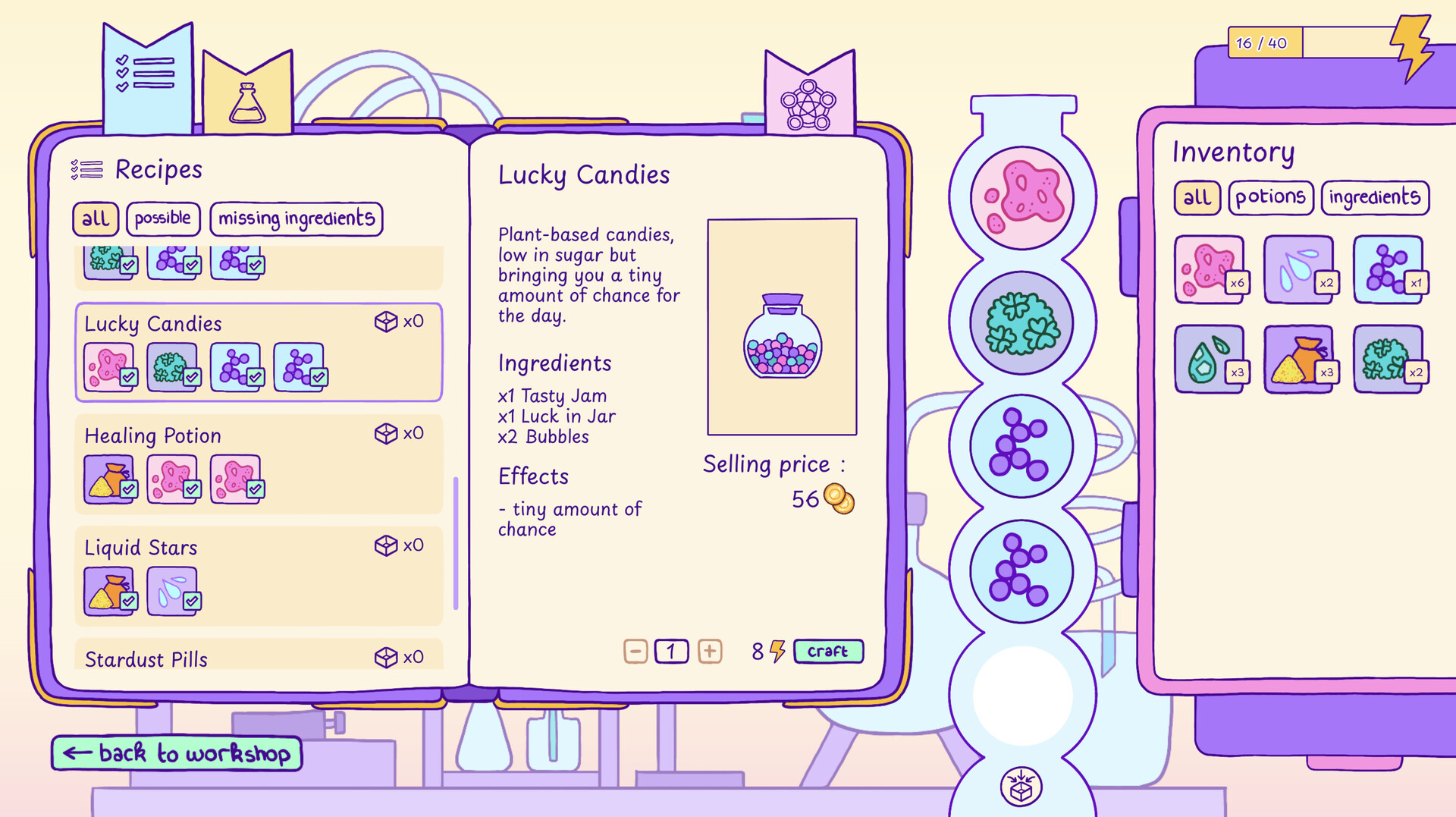
The recipe book lets players browse known potions or experiment with ingredients on handMgtt Studio -
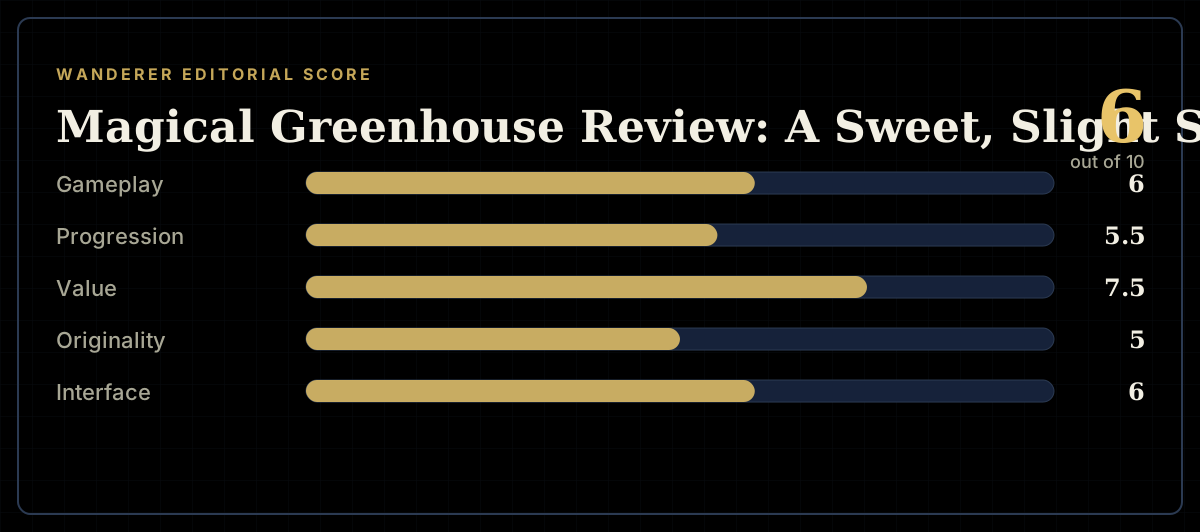
How the review scores each part of the gameWanderer Editorial -
The short versionWanderer Editorial