Game review
Mad Television Tycoon
6.6 / 10
- Developer
- Eggcode
- Publisher
- Eggcode
- Released
- 9 April 2026
- Platforms
- [Windows]
- Genre
- Simulation
- Monetisation
- $20.99
- Players
- true
The short version
Mad Television Tycoon is a loving, mechanically competent nostalgia trip for fans of the original Mad TV and Eggcode's own Mad Games Tycoon series, hampered right now by a missing tutorial, a strategy space that flattens out fast, and the usual growing pains of an actively-updated Early Access build.
Biggest strengths
- Genuine nostalgia payoff for fans of the original Mad TV, with reviewers describing the flair and structure of the classic as faithfully recaptured
- Competitive multiplayer for up to three players is repeatedly singled out as the mode where the game truly comes alive
- An active developer with a near-daily Early Access update cadence, addressing bugs and adding content since launch
Biggest weaknesses
- No real tutorial, leaving new players dropped into a large building full of unexplained rooms and systems — a complaint repeated across English, French, and Spanish reviews
- The scheduling strategy space flattens quickly: once players find the optimal show-and-timeslot formula, there's little incentive to experiment further
- Several reviewers specifically call out low-quality, AI-generated show and movie cover art as a jarring weak point in an otherwise solid presentation
Who it's for: Longtime fans of Mad TV, M.U.D. TV, or Mad Games Tycoon who want a broadcasting-empire management sim, especially with two or three friends, and who are comfortable buying into an evolving Early Access title.
Our recommendation: Try it on sale
6.6 / 10
The office lights are staying on, for now
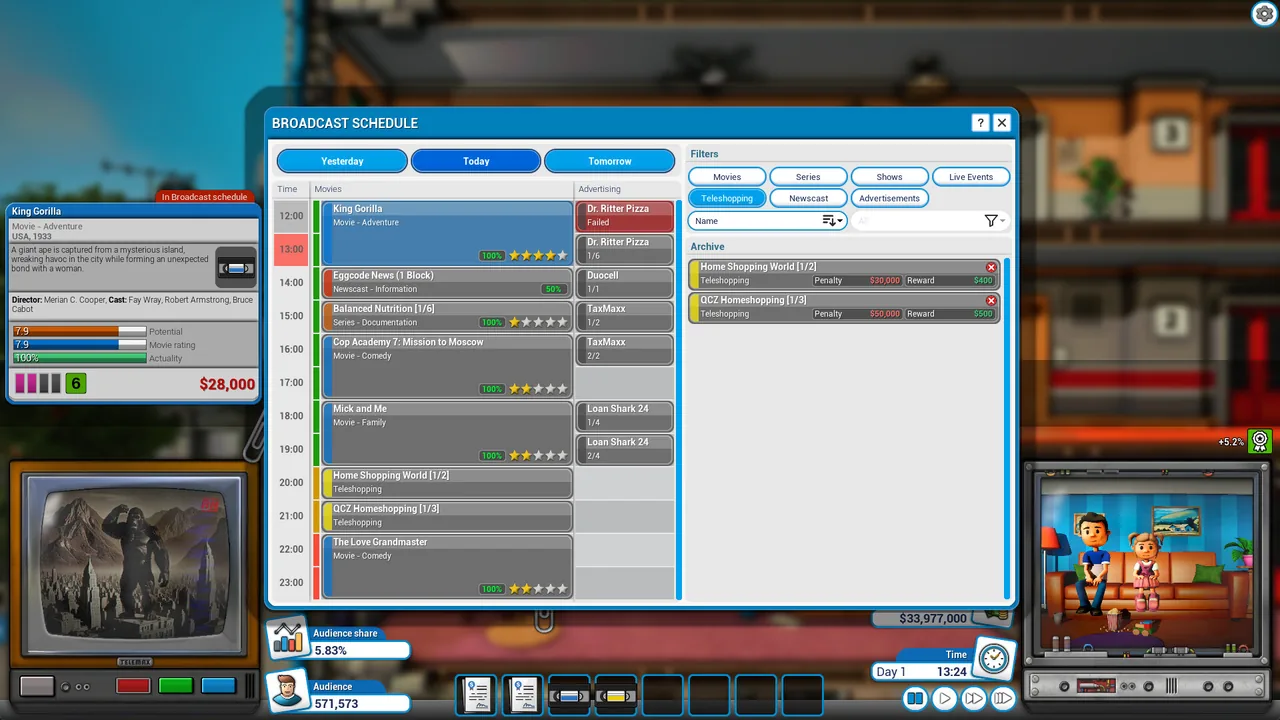
Mad Television Tycoon is a broadcasting-empire management sim from Eggcode, the studio behind the Mad Games Tycoon series, released into Early Access on April 9, 2026 for $20.99 on Windows. It's explicitly positioned as a spiritual successor to the 1990s cult classic Mad TV — you take over a struggling TV station, schedule movies, series, and news programs, chase advertising contracts, and sabotage rival networks on the way to building the country's top channel. It landed to a Very Positive reception (298 reviews, roughly 85% positive) from an overwhelmingly German-speaking sample, many of whom explicitly frame their reviews around decades-old memories of the original.
Nostalgia that mostly lands
The dominant thread running through the review sample, especially the German-language reviews, is nostalgia, and it's largely paying off. Reviewers repeatedly describe recognizing the "flair" of the original Mad TV almost immediately, citing specific systems — the archive, the broadcasting towers, the rival stations — as faithful callbacks rather than surface-level references. Several longtime fans, some citing decades of history with the original going back to the Amiga era, describe the game as the remake or spiritual sequel they'd always wanted. That said, it's not universal affection: a handful of reviewers, including some direct comparisons to the older, free M.U.D. TV, argue the underlying formula hasn't evolved much beyond the source material, and one negative review explicitly frames Eggcode as coasting on a proven format rather than innovating.
Multiplayer is where it comes alive
One of the most consistent positive threads across the sample is multiplayer. The game supports competitive PvP for up to three players, and reviewers who've played it that way describe it as the mode where the whole concept finally clicks — direct competition for viewers, advertisers, and reputation against real opponents rather than AI rivals. One German reviewer specifically cites 261 hours logged, mostly in multiplayer, as evidence of how much replay value the competitive mode offers on its own, separate from anything the solo campaign provides.
A strategy space that narrows fast
The most substantive gameplay criticism in the sample, echoed independently by both English and German reviewers, is that the scheduling metagame flattens out once players find an efficient formula. Multiple reviewers describe reaching a point where they're repeating the same handful of optimal show-and-timeslot combinations rather than continuing to experiment, and more than one explicitly contrasts this with Eggcode's own Mad Games Tycoon 2, which they felt offered deeper long-term variety. This isn't a universal complaint — many reviewers are still finding new goals and systems to chase, particularly in multiplayer — but it's a real and specific one from players who've put real time in.
No hand-holding for new players
A second recurring complaint, spread across English, French, and Spanish-language reviews, is the complete absence of a tutorial. Reviewers describe being dropped into a large, multi-room facility with no explanation of which systems matter first, and several compare the experience unfavorably to starting a new job with zero onboarding. This lands hardest on players unfamiliar with the Mad TV format; several reviewers who know the original from decades ago report finding their footing quickly regardless, which suggests the missing tutorial disproportionately hurts new players rather than returning fans.
AI-generated art draws real criticism
Unlike some accusations elsewhere in the genre that turn out to be unverified minority claims, the complaints about Mad Television Tycoon's AI-generated show and movie cover art are specific, corroborated, and about quality rather than ethics. Multiple independent reviewers flag the in-game poster and cover art as noticeably low-quality and inconsistent with the rest of the presentation, with one reviewer explicitly asking for the "AI vomit" to be replaced with human-made assets and another questioning why the developer didn't simply license stock art instead. It's a narrow complaint — the core UI and building visuals draw no similar criticism — but a real and repeated one.
Early Access growing pains
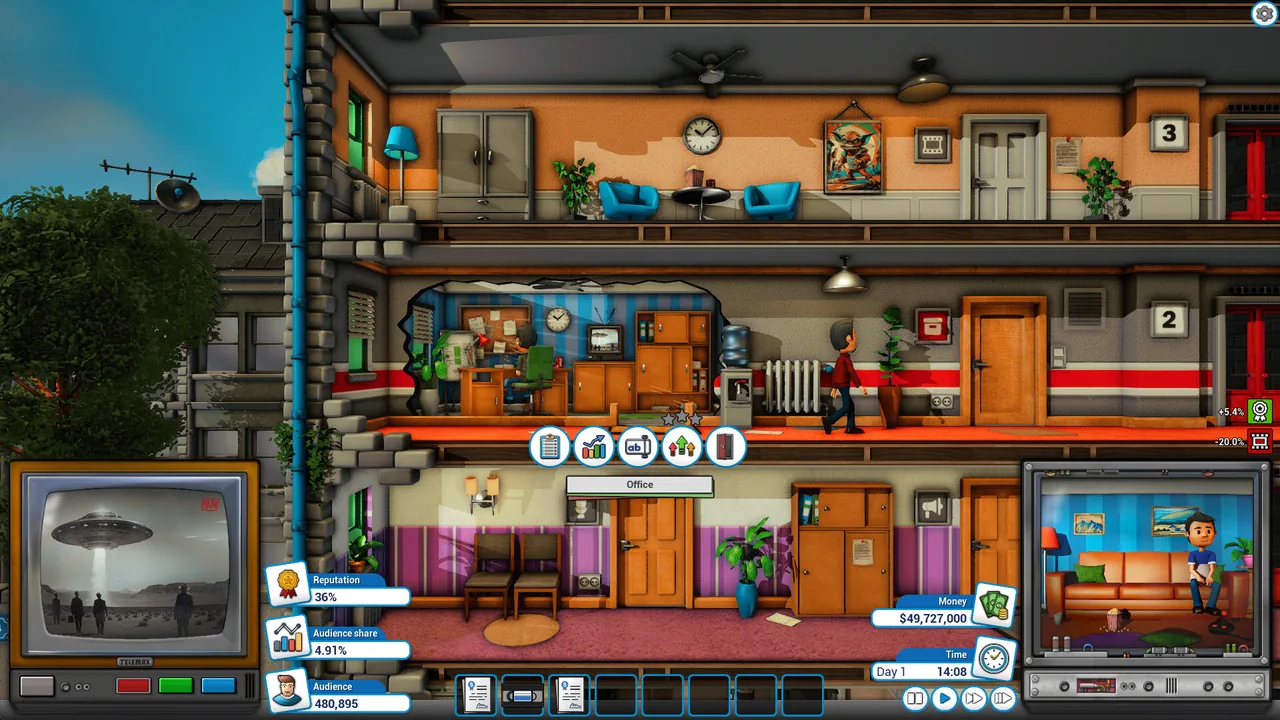
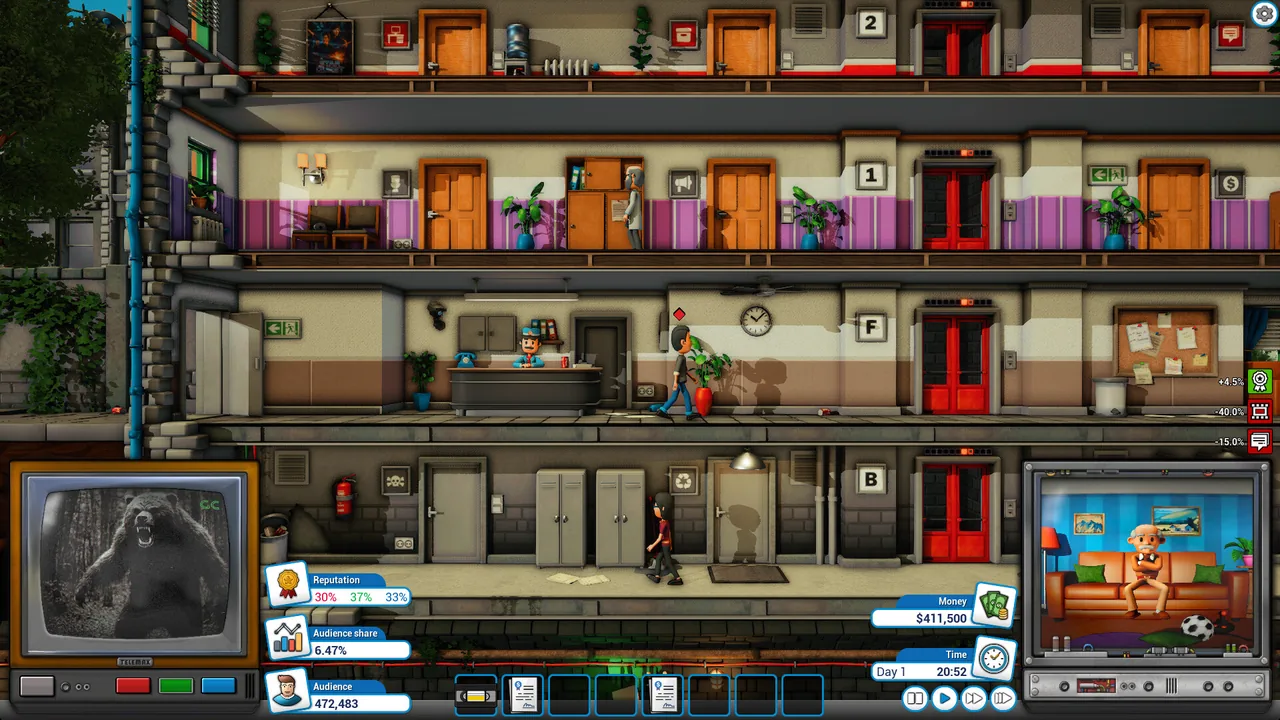
Eggcode has kept up a near-daily patch cadence since launch, and a large share of the sample explicitly credits the studio's responsiveness and update frequency as a reason to buy in now rather than wait. Even so, this is unmistakably an in-progress build: several rooms and systems referenced in the game's own marketing aren't fully implemented yet, a few reviewers report notable performance drops that feel disproportionate to the game's visual complexity, and one recurring minor bug has players' characters getting stuck oscillating in an elevator. None of these are described as dealbreakers by the sample, but they're worth knowing about before buying at full, non-Early-Access pricing.
Who should tune in now
Mad Television Tycoon is easiest to recommend to players with real history with the original Mad TV, or Eggcode's other tycoon games, who want a broadcasting-empire sim to play solo or — ideally — with a couple of friends chasing the same advertisers. It's a harder sell for players who want a polished, tutorial-guided onboarding experience or a management sim with a strategy space deep enough to resist an optimal solution; both of those are real, corroborated gaps in the current build.
The verdict
Mad Television Tycoon delivers real, well-earned nostalgia and a genuinely fun competitive multiplayer mode, built on a management framework that Eggcode's fans will recognize and mostly enjoy. A missing tutorial, an AI-art quality problem, and a scheduling metagame that narrows faster than ideal keep it from being an easy full-price recommendation while it's still finding its Early Access footing, but the update cadence suggests there's a stronger game still coming.
Pros and cons
Pros
- Genuine nostalgia payoff for fans of the original Mad TV, with reviewers describing the flair and structure of the classic as faithfully recaptured
- Competitive multiplayer for up to three players is repeatedly singled out as the mode where the game truly comes alive
- An active developer with a near-daily Early Access update cadence, addressing bugs and adding content since launch
- A deep well of management systems — scheduling, advertising, production, sabotage — that reviewers say genuinely rewards planning ahead
Cons
- No real tutorial, leaving new players dropped into a large building full of unexplained rooms and systems — a complaint repeated across English, French, and Spanish reviews
- The scheduling strategy space flattens quickly: once players find the optimal show-and-timeslot formula, there's little incentive to experiment further
- Several reviewers specifically call out low-quality, AI-generated show and movie cover art as a jarring weak point in an otherwise solid presentation
- As an Early Access build, several systems and rooms remain unfinished, and a few reviewers report performance issues and movement/elevator bugs
Screenshots
-
Mad Television TycoonImage: Eggcode via Steam -
Mad Television TycoonImage: Eggcode via Steam -
Mad Television TycoonImage: Eggcode via Steam -
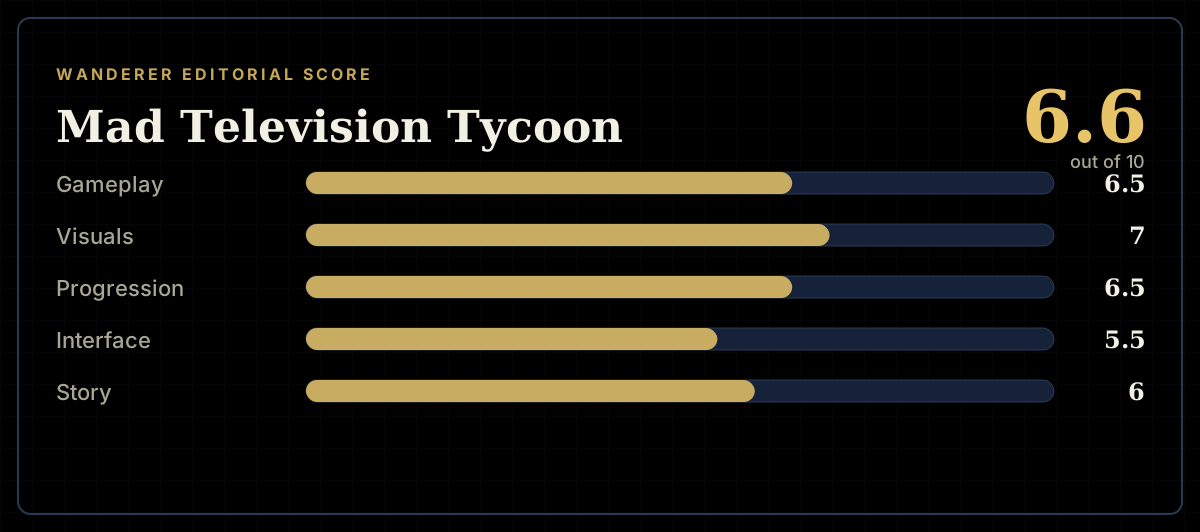
How the review scores each part of the gameWanderer Editorial -
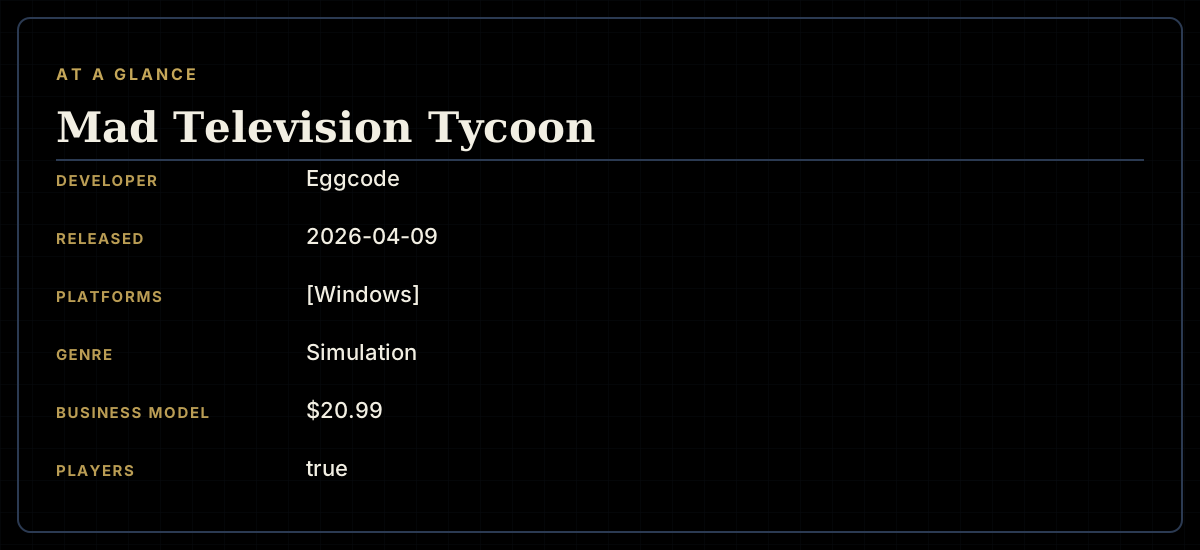
Key facts at a glanceWanderer Editorial -
The short versionWanderer Editorial