
Game review
Kamikaze Empire Review
7.5 / 10
- Developer
- Kamikaze Kobo
- Publisher
- Henteko Doujin, Sanuk Inc.
- Released
- 8 June 2026
- Platforms
- ["Windows"]
- Genre
- Action
A Shoot 'Em Up Where Dying Is the Point
Kamikaze Empire, released June 8, 2026 from Japanese doujin developer Kamikaze Kobo and published by Henteko Doujin and Sanuk Inc., builds its entire identity around a single inversion of shmup logic: instead of avoiding death, you weaponize it. After softening up enemies with a small arsenal of oddball historical weapons, you launch your own ship straight into the wreckage as a final, explosive attack, then respawn and do it again. It's a tiny release by any measure, 21 all-language reviews and 7 English-language ones at review time, every single one of them positive, but the review pool that exists is unusually detailed and consistent for a title this size, and worth taking seriously rather than dismissing as too small to say anything meaningful. "Very interesting little doujin. True to the description, it's a very different type of shmup, survival isn't the goal, and death is just another tool in the toolbox," one reviewer wrote, a framing nearly every other review in the pool echoes in its own words.
The Loop: Combos Built on Controlled Self-Destruction
The mechanical hook is straightforward to describe but reviewers agreed it takes real practice to use well: shoot enemies and terrain to build a combo chain, then time a kamikaze dive into the wreckage to extend or cash in that chain before your next life spawns in. "It's all about building combos for score. The game is very fun just played for survival though too. Many strats available with weapon choice and when to kamikaze, or not (if you have the choice!)," one reviewer explained, noting that the design supports both a pure scoring playstyle and a more relaxed survival approach. Another reviewer broke down the appeal in more technical terms: missions are short and dense, survival isn't the goal, and there's real depth in optimizing routes around destructible environment pieces, checkpoints, and the ability to continue a combo chain immediately after dying. That combination, short bite-sized levels with a genuinely deep scoring system underneath, came up as the game's central strength across nearly every review in the pool.
Recurring Praise: Presentation, Theme, and a Demo That Sold the Concept
Several reviewers singled out how well the game's tone and presentation sell an inherently silly premise. "Imagine if Nier Automata was a series of military girl comedy sketches, with all kinds of deep cut military hardware for you military otaku to laugh about. The main character is named after the kamikaze human-guided bomb, the Yokosuka MXY-7 Ohka. Consider that this weapon was called the 'Baka Bomb' by the Allied forces. It is a delightful game," one reviewer wrote, pointing to the specific, researched military-history references woven through the character and weapon designs as a genuine strength rather than set dressing. A separate reviewer credited the game's free demo directly with converting initial skepticism into a purchase: "I was a bit dubious at first with the idea of kamikazes and infinite lives but the demo convinced me so I bought it... Great graphical style, soundtrack too." A third reviewer called the writing "surprisingly intelligent" and the underlying idea "just brilliant," closing with a note to watch the developer going forward, a level of enthusiasm that shows up repeatedly across a review pool where nobody is faking politeness about a game they don't actually like.
A Quieter Thread: Chill Pacing for a Genre That's Usually Punishing
Not every reviewer approached the game as a pure score-chasing challenge, and a few specifically praised how low-pressure it feels compared to the shmup genre's reputation for brutal difficulty. "True hidden gem, really chill vibe. You don't really lose, you just get better times, vibe to the soundtrack. It's great," one reviewer wrote, a sentiment that lines up with the game's built-in kamikaze respawn loop effectively removing the traditional shmup fear of permanent failure. That accessibility angle is worth flagging for genre newcomers specifically, since Kamikaze Empire's central mechanic doubles as a safety net: dying is baked into the scoring system rather than treated as a run-ending punishment, which several reviewers seemed to appreciate as a deliberate, welcoming design choice rather than a compromise.
Where the Praise Gets Qualified: Rough Edges Under the Polish
Even the review that called Kamikaze Empire a "game of the year candidate" didn't stop at pure praise, and its specific critiques are worth taking at face value given how much that same reviewer clearly liked the game overall. "The graphics are a bit ropey, mainly the anti-aliasing on sprite rotation, and the backgrounds could have done with another parallax layer and a bit more dynamism. I also felt like the levels could have been arranged into a more coherent structure, and a couple of the music tracks were a bit grating," they wrote. No other reviewer in the small pool raised the same points directly, so this reads as a single detailed account rather than a corroborated pattern, but it's a specific and credible one: jagged sprite rotation and thin backgrounds are the kind of technical shortfall a small doujin team would plausibly ship with, and level-to-level structure is a fair thing to want polished in a game this focused on chaining combos across missions.
Verdict
Kamikaze Empire is a small, confidently weird shmup that turns its central gimmick, dying on purpose as a scoring tool, into a genuinely deep combo system rather than a one-note joke, and it backs that mechanic up with sharp, specific writing and character design that reviewers keep singling out by name. Its review pool is tiny, but every account in it is detailed, plays through a meaningful chunk of the game before writing, and lands on the same conclusions independently: a fun, chill-but-deep loop wrapped in presentation that's rougher around the edges than its ambitions. At $12.99, with a free demo available to try the core mechanic before buying, it's an easy recommendation for shmup fans looking for something that plays with genre convention rather than repeating it, even if its level structure and visual polish haven't quite caught up to its central idea yet.
Screenshots
-
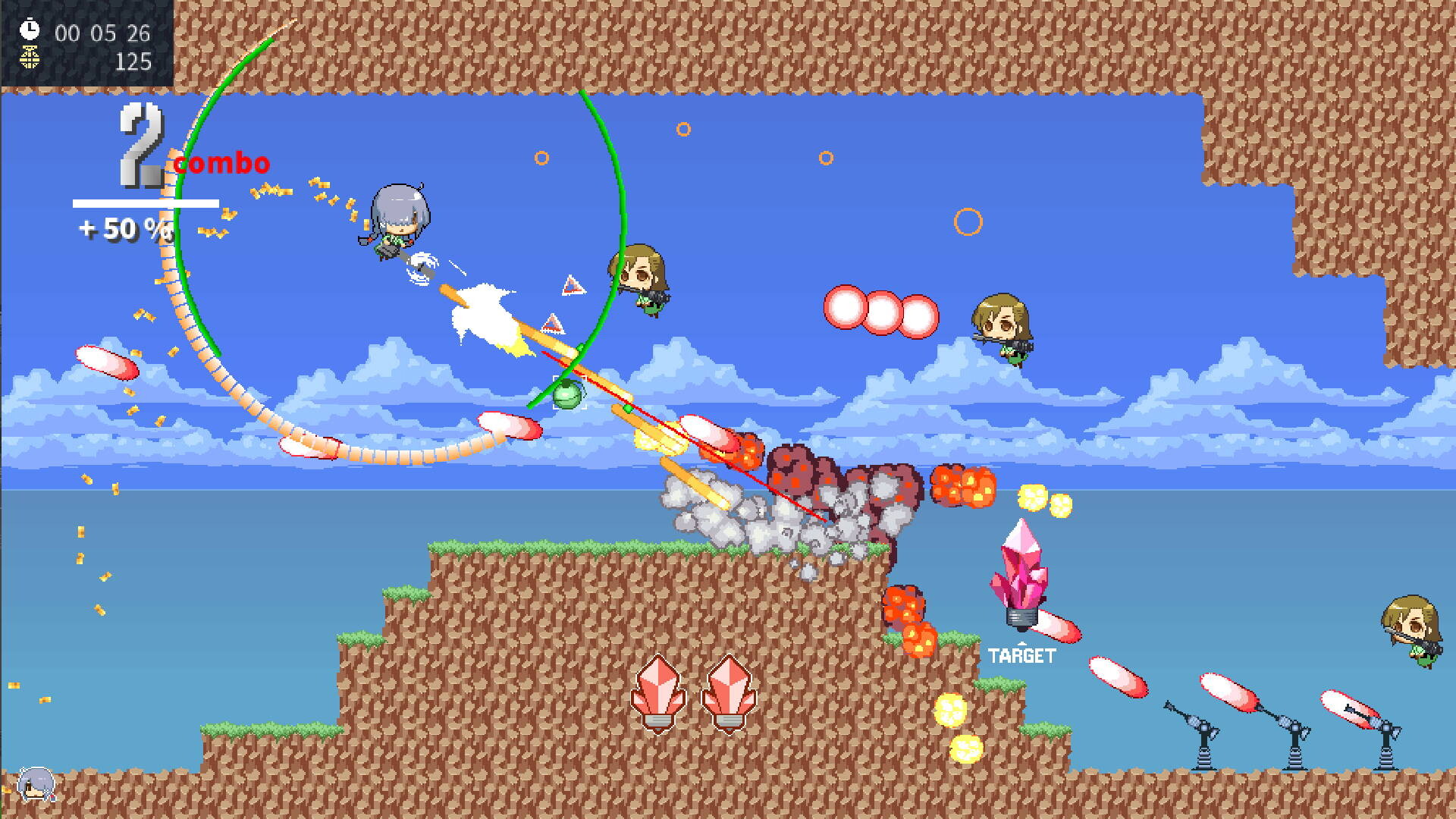
Chaining a kamikaze dive into a combo arc across the game's destructible platforms.Image: Henteko Doujin via Steam -
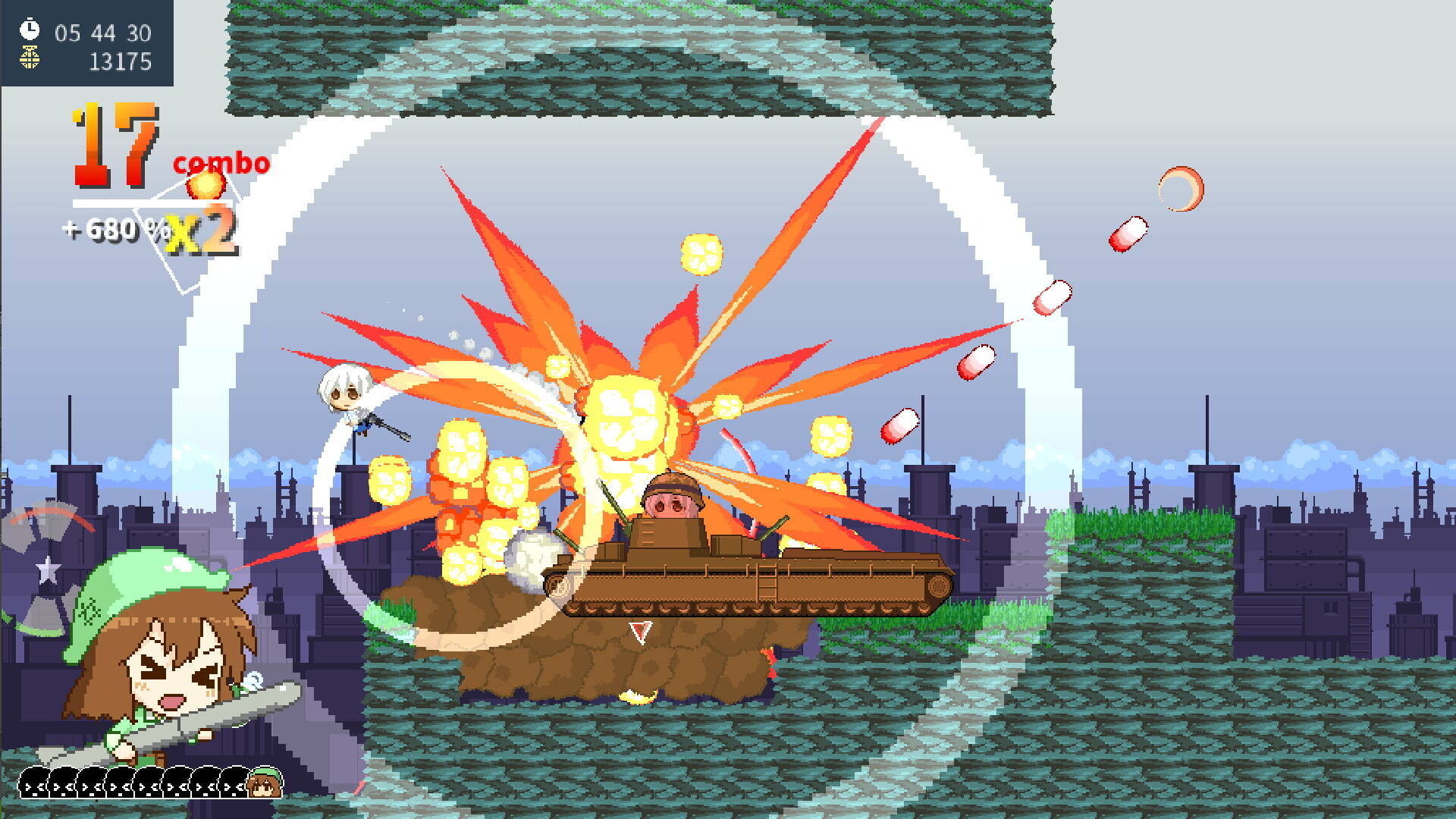
A kamikaze strike detonates against an enemy tank, racking up a combo multiplier.Image: Henteko Doujin via Steam -
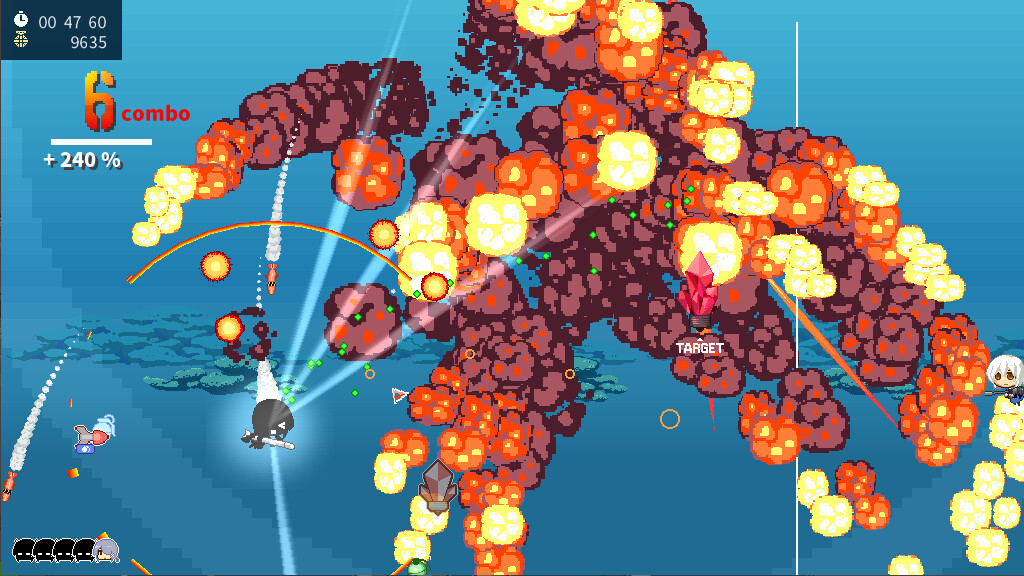
A high-combo chain turns the screen into a wall of explosions.Image: Henteko Doujin via Steam