Game review
Idle Game x100
2 / 10
- Developer
- PaulArt
- Publisher
- PaulArt
- Released
- 26 December 2022
- Platforms
- Windows
- Genre
- Idle, Clicker, Incremental
- Monetisation
- One-time purchase. No advertisements, no microtransactions.
- Players
- Single-player
The short version
Idle Game x100 pitches itself directly at a specific complaint about its own genre: its store description promises relief for players "tired of boring and infinite idle games." Released 26 December 2022 by PaulArt — whose catalogue this library has now examined three times this session — it instead sits at a lifetime Mostly Negative, just 8 positive reviews against 19 negative out of 27 total, and the negative reviews describe, in remarkably consistent detail, exactly the boring, structureless grind the game claims to have solved. The prestige system that should provide strategic depth is, by multiple independent accounts, purely random: resetting assigns an arbitrary multiplier with no player choice involved at all, removing the one layer of decision-making the genre's better entries are built around.
Biggest strengths
- The core click-and-upgrade loop is understandable within seconds, with no barrier to entry for anyone unfamiliar with the genre
- Two early reviewers credit the developer with responding quickly to specific complaints, adding a "buy max" button and fixing a multiplier-assignment bug shortly after launch
- It's cheap, at a one-time price under two dollars with no advertisements or microtransactions layered on top
Biggest weaknesses
- The game's own store description promises a cure for "boring and infinite idle games," and multiple reviewers state directly that it is exactly that problem rather than a solution to it, with one summarising the entire experience as "buy, wait, restart, buy, wait, restart"
- The prestige system that should provide the genre's usual strategic layer is, according to a detailed independent breakdown, purely random: resetting your progress assigns an arbitrary multiplier to a randomly chosen upgrade, with no way to influence which one, removing player choice from the mechanic almost entirely
- Steam's own achievement data corroborates the reviews describing progress as effectively unreachable: even the single easiest of the game's three achievements is earned by only 6.3% of tracked players, a dramatically lower first-tier completion rate than every other idle game this library has reviewed this session
Who it's for: Only PaulArt-catalogue completionists; even fans of extremely minimal idle games are better served elsewhere in the genre.
Our recommendation: Skip it. Its own marketing promise is directly contradicted by its own review corpus, and Steam's own achievement data suggests almost nobody who buys it sees meaningful progress.
2 / 10
Introduction
Idle Game x100 opens with an unusually direct promise on its own store page: relief for players "tired of boring and infinite idle games." Released 26 December 2022 by PaulArt — a developer this library has now examined across three separate releases this session — it's a fittingly ironic premise for a game that its own review corpus, with remarkable consistency, says fails to deliver on. It sits at a lifetime Mostly Negative, just 8 positive reviews against 19 negative out of 27 total, and reading through that small sample turns up a specific, well-corroborated case against the game's central marketing claim.
The problem it claims to solve, in its own reviews
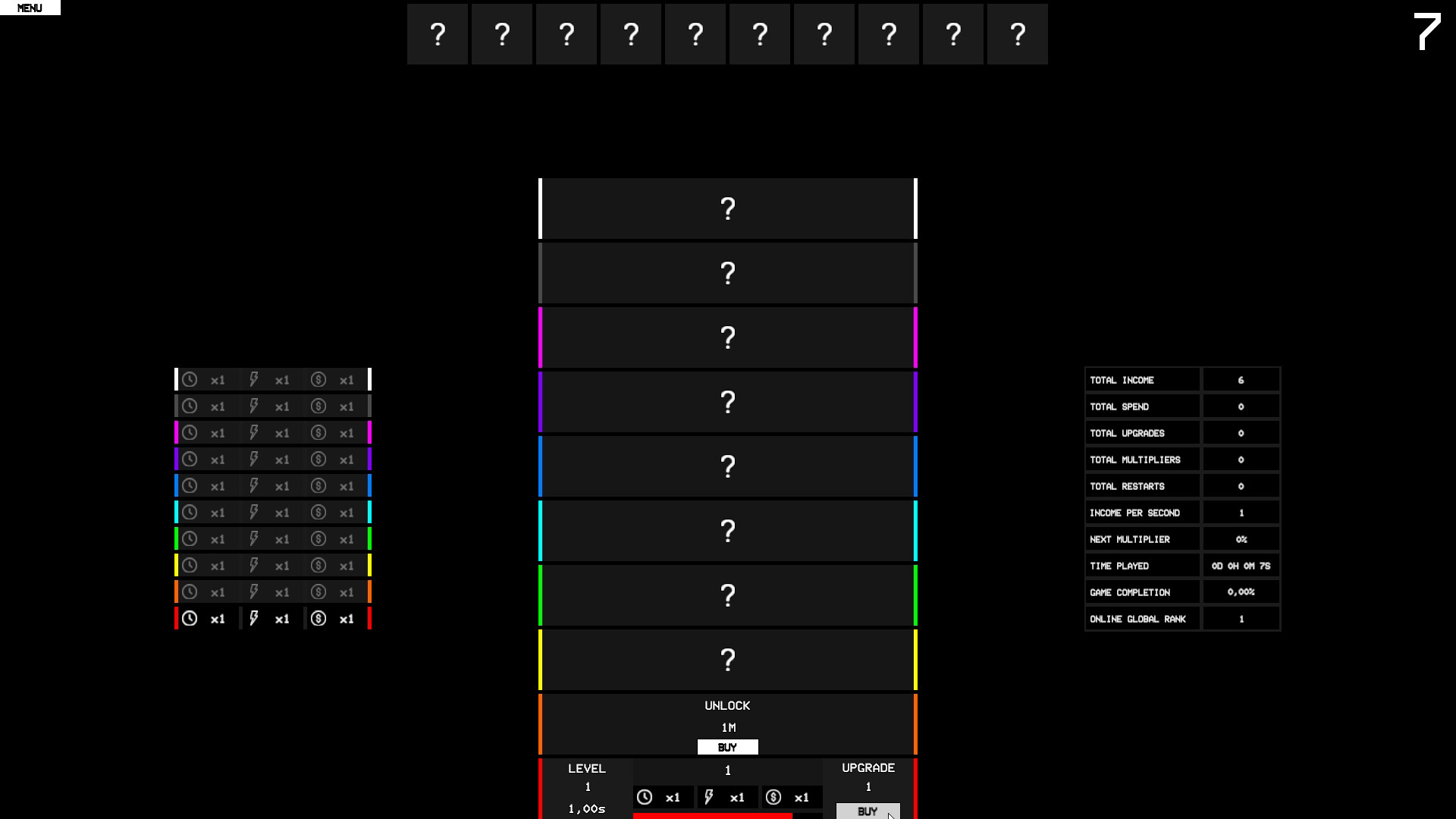
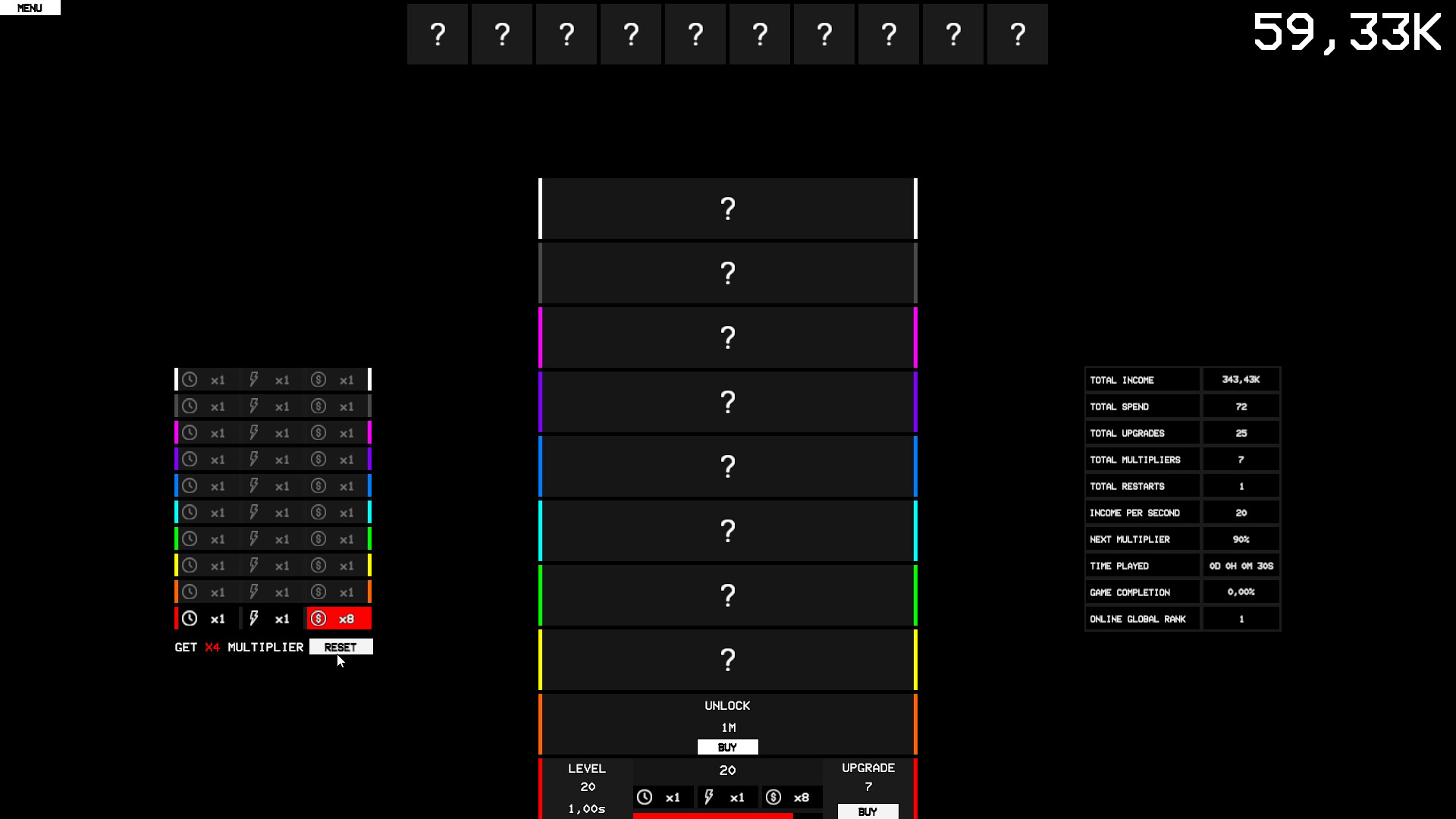
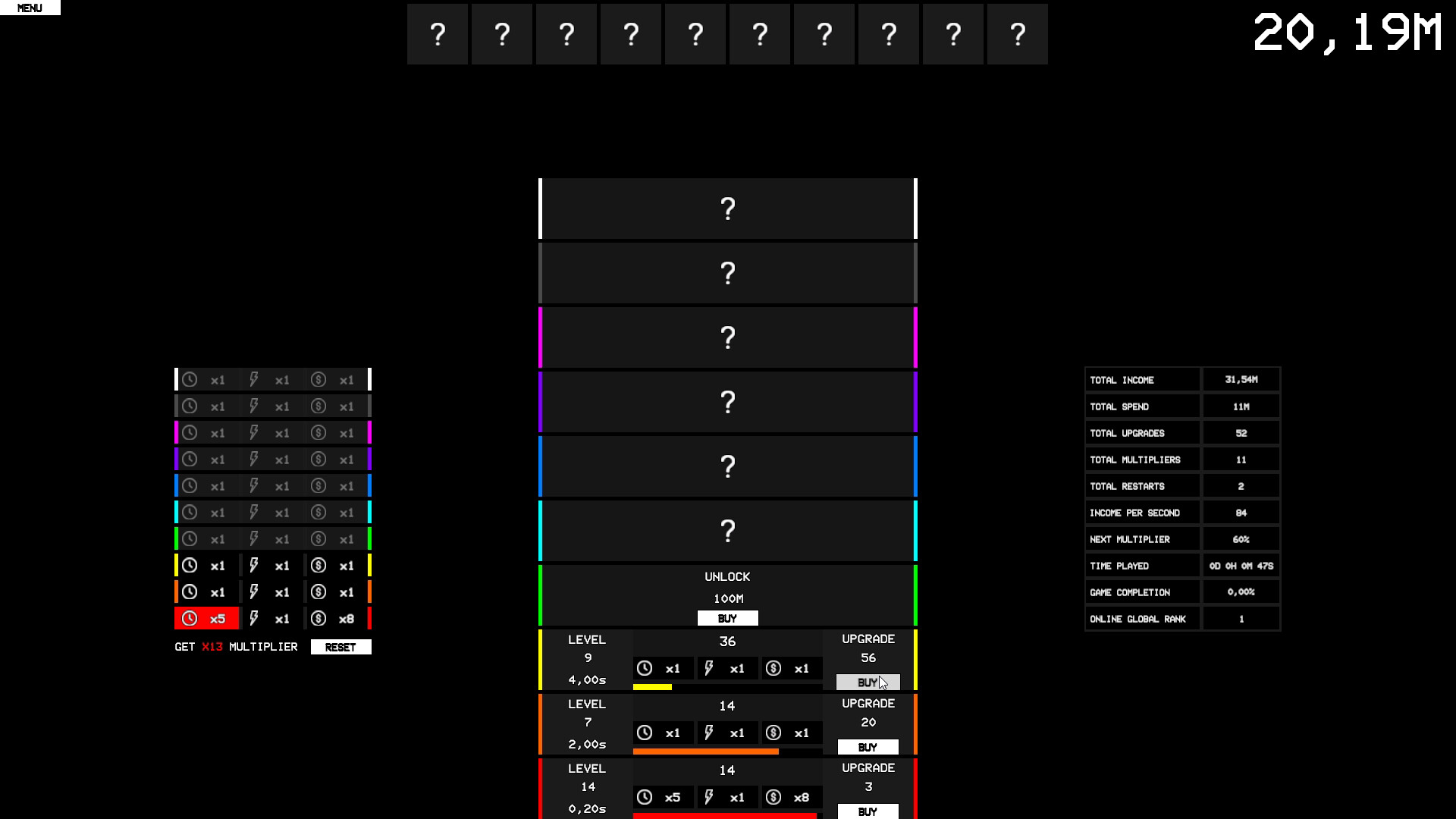
Several reviewers directly quote or paraphrase the store page's promise before explaining why they feel misled by it. One summarises the entire play experience in six words: "buy, wait, restart, buy, wait, restart." Another, after nearly five hours logged, states there's "no real point to the game," describing repeated attempts to hit visible milestones in the hope some new mechanic would appear, only to find nothing ever changed. A third reviewer specifically calls out the small question-mark icons shown at the top of the screen, which visually imply hidden content or bonus systems waiting to be unlocked — investigating them, that reviewer found they track nothing more than arbitrary point totals, with no new mechanic, upgrade or content attached to reaching any of them.
A prestige system with no strategy
The sharpest, most specific criticism in this review's sample concerns the prestige mechanic that should, in a well-designed idle game, be the genre's central strategic layer. One detailed breakdown explains exactly how it works here: resetting your progress assigns a random multiplier to an upgrade chosen by the game, not the player, with the size of that multiplier increasing only as your prior score doubles. There is no way to target a specific upgrade, no way to plan around which multiplier you're hoping for, and no secondary system layered underneath the milestones to compensate — that reviewer specifically notes the question-mark milestones reset along with your score, offering no permanent progress of their own. The genre's better entries typically use prestige resets to introduce meaningful choice; by this account, this one removes choice from the system almost entirely, leaving pure chance in its place.
Numbers that back the complaints up
Steam's own achievement data gives this review a harder, independent measure of how the sample's complaints translate into actual player experience. With only three tracked achievements total, even the easiest of them sits at just 6.3% of the player base — a dramatically lower first-tier completion rate than every other idle or incremental game this library has reviewed this session, several of which cleared 60-90% on their equivalent easiest milestone. One reviewer states directly that even running an auto-clicker continuously, reaching the game's stated victory condition would take "hundreds of years" — an extreme claim, but one the achievement data doesn't contradict.
A developer who moved on
To PaulArt's credit, two of the earliest reviews describe a responsive developer: one specifically thanks the developer for a fast fix, and another notes a "buy max" button and a multiplier bug were both addressed shortly after launch. That responsiveness doesn't appear to have lasted. A review posted roughly three months after launch states plainly, "i think the dev quit this game," and no review after that point describes any further changes addressing the achievement grind or the prestige system's lack of strategy — the two complaints that define the negative side of this review's entire sample.
Where this sits against the same developer's other releases
This library has now reviewed three separate PaulArt titles in one sitting — Idle Hero, Merge Hero, and this one — and the comparison is genuinely instructive rather than repetitive. Idle Hero landed at an evenly split Mixed reception and, unusually for the genre, backed up its own "fully completable" marketing claim with achievement data showing a genuine majority of players reaching its first completion tier. Merge Hero landed considerably worse, at a lopsided Negative, undone by specific, reproducible save-corruption bugs. Idle Game x100 sits at the bottom of all three: not because of bugs or data loss, but because the one system meant to give the loop long-term shape — the prestige reset — removes player agency almost entirely by handing multiplier assignment to chance rather than choice. Read all together, these three separate results argue strongly against treating one small developer's entire catalogue as a single, predictable quantity: within that same small studio's output, outcomes for players range from a fair, honestly-scoped success to a design that actively works against what made the earlier releases worth recommending at all.
Final Verdict
Idle Game x100 sets itself an unusually specific, self-imposed standard — fixing what's boring about infinite idle games — and its own Mostly Negative review corpus says, in detail, that it fails that standard rather than meeting it. A purely random prestige system removes the genre's usual strategic layer, Steam's own achievement data shows a first-tier completion rate far below every comparable game this library has covered this session, and early developer responsiveness appears to have stopped well before the game's core complaints were addressed. There is very little reason to choose this specific release over any of PaulArt's other, considerably better-received titles, let alone the much wider idle-clicker genre it sits within.
Pros and cons
Pros
- The core click-and-upgrade loop is understandable within seconds, with no barrier to entry for anyone unfamiliar with the genre
- Two early reviewers credit the developer with responding quickly to specific complaints, adding a "buy max" button and fixing a multiplier-assignment bug shortly after launch
- It's cheap, at a one-time price under two dollars with no advertisements or microtransactions layered on top
Cons
- The game's own store description promises a cure for "boring and infinite idle games," and multiple reviewers state directly that it is exactly that problem rather than a solution to it, with one summarising the entire experience as "buy, wait, restart, buy, wait, restart"
- The prestige system that should provide the genre's usual strategic layer is, according to a detailed independent breakdown, purely random: resetting your progress assigns an arbitrary multiplier to a randomly chosen upgrade, with no way to influence which one, removing player choice from the mechanic almost entirely
- Steam's own achievement data corroborates the reviews describing progress as effectively unreachable: even the single easiest of the game's three achievements is earned by only 6.3% of tracked players, a dramatically lower first-tier completion rate than every other idle game this library has reviewed this session
- One reviewer describes the milestone markers shown at the top of the screen — which visually suggest hidden content — as entirely cosmetic, tracking arbitrary point totals with no new mechanic, upgrade, or content unlocked at any of them
- At least one reviewer reports meaningful technical problems, including lag spikes and freezing specifically while the game is left idle, undermining the one thing an idle game most needs to do reliably
- A separate reviewer, checking back roughly three months after launch, concludes the developer had already moved on from the project, consistent with the absence of any further fixes addressing the achievement or prestige complaints in the reviews that follow
Screenshots
-
Idle Game x100Image: PaulArt via Steam -
Idle Game x100Image: PaulArt via Steam -
Idle Game x100Image: PaulArt via Steam -
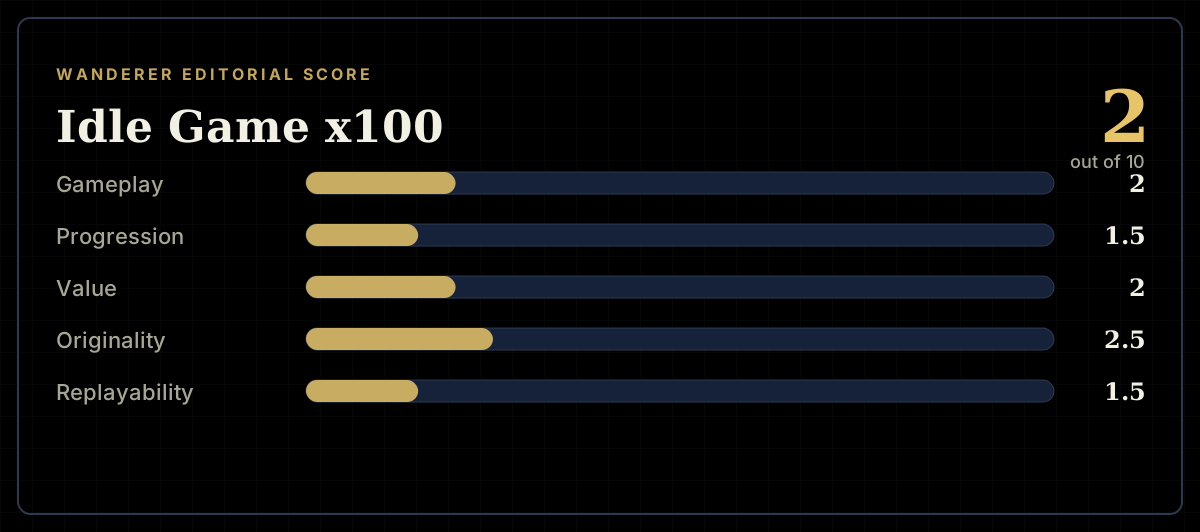
How the review scores each part of the gameWanderer Editorial -
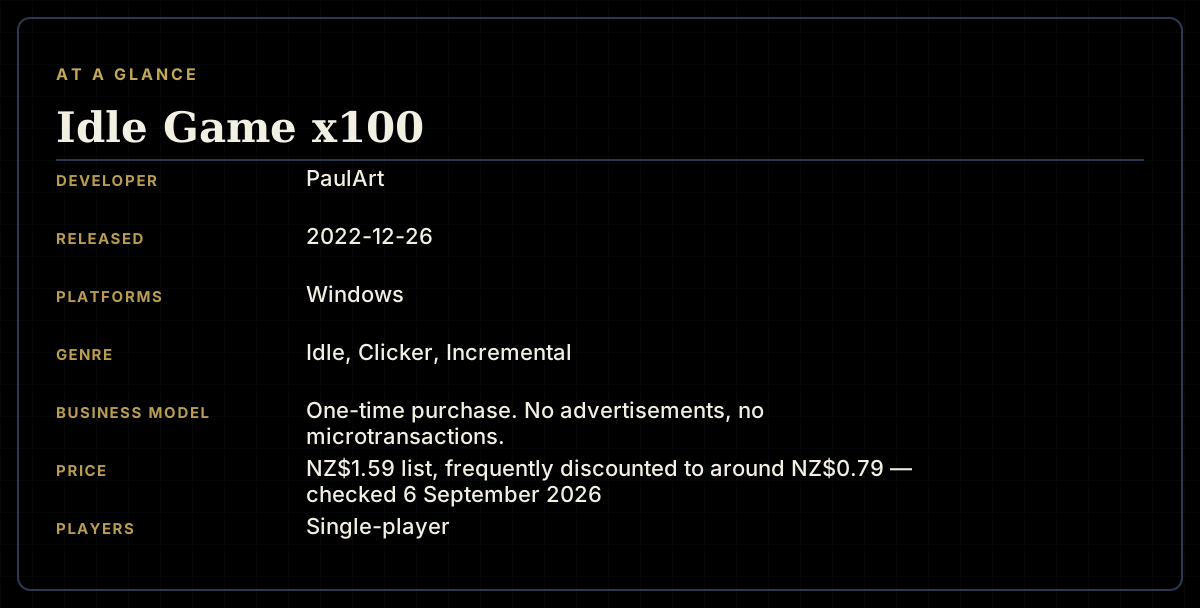
The essentials at a glanceWanderer Editorial -
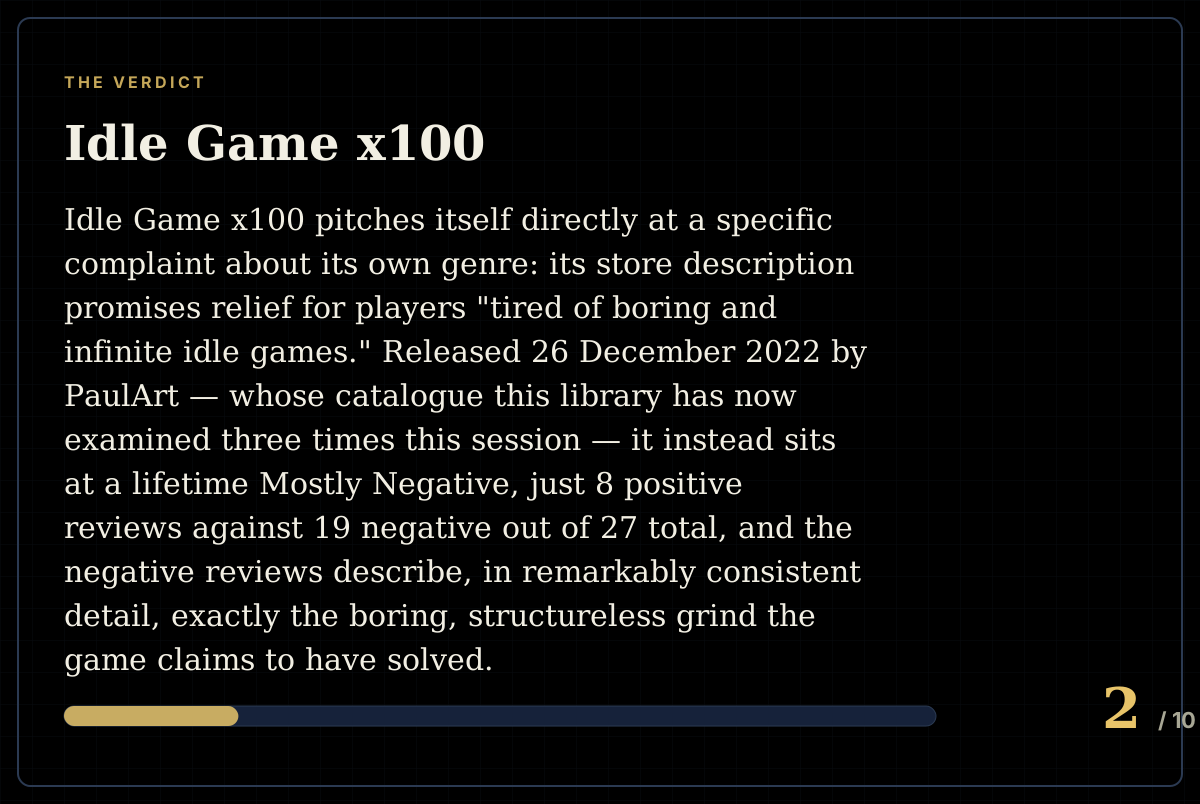
The short versionWanderer Editorial