Game review
Friendly Steps Review
5.8 / 10
- Developer
- KORO.GAMES
- Publisher
- Ytopia
- Released
- 3 September 2026
- Platforms
- ["Windows"]
- Genre
- Simulation
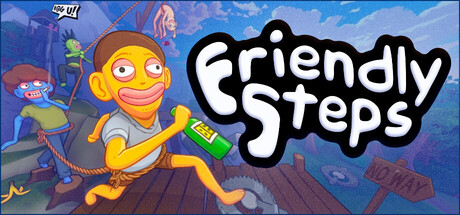
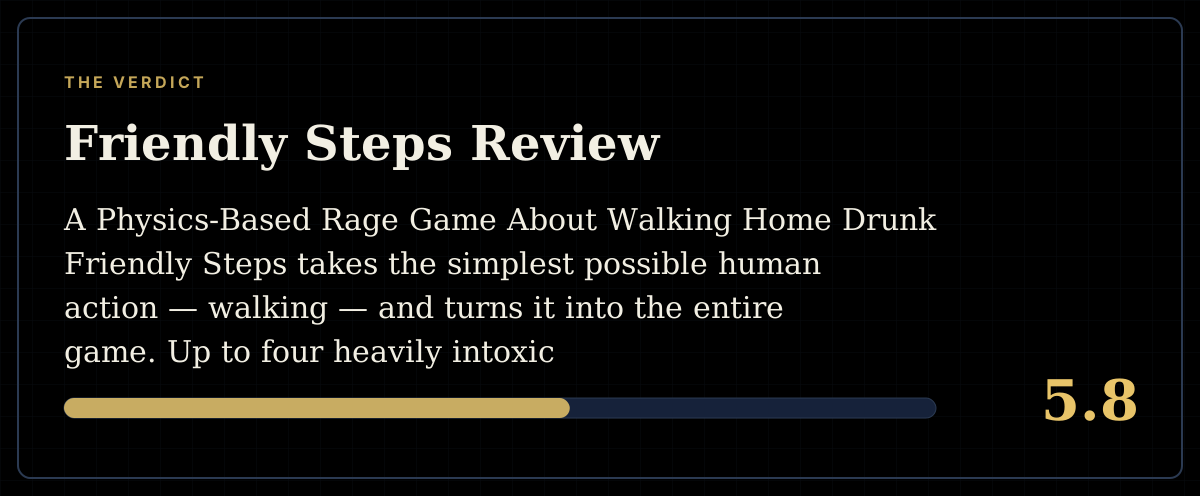
A Physics-Based Rage Game About Walking Home Drunk
Friendly Steps takes the simplest possible human action — walking — and turns it into the entire game. Up to four heavily intoxicated friends have to make it home after a night out, and the only thing standing between them and their beds is a body that barely cooperates: each leg is controlled independently, balance has to be actively maintained, and a rope physically ties every player together for most of the campaign. One reviewer sums up the resulting genre lineage succinctly, describing it as "a physics-driven cooperative game for up to four players in which a group of heavily intoxicated characters attempts to make its way home after a long night," while others reach for more direct comparisons, calling it "basically Baby Steps but co-op" or "QWOP meets Chained Together." Those touchstones aren't incidental — Friendly Steps is explicitly building on a lineage of deliberately clumsy, physics-based locomotion games, and its main twist is doing it as a tethered group rather than a solo player.
That premise produces a very specific, very consistent kind of review: nearly every account of the game, positive or negative, centers on the same core loop of falling down, dragging teammates down with you, and laughing or raging depending on the company. One reviewer captures the tone plainly: "For the first five minutes, you're laughing your ass off because you can't even move your legs properly, and half an hour later, you're yelling at your buddy because he dragged the whole squad into the abyss again." The rope mechanic in particular draws constant comment — it's simultaneously the game's best comedy engine and its single biggest point of frustration, since one player's mistake instantly becomes everyone's problem.
Chaos Is the Point — And With the Right Friends, It Works
The reviewers who land firmly positive are consistent about what makes Friendly Steps click: it isn't really a game about skillful walking, it's a game about the social chaos that skillful walking's absence creates. One review frames the entire pitch as a social experiment more than a mechanical one, joking that "friend slop" critics "have none," while another calls it "the game where walking home becomes a full-time job and a relationship test... someone always falls, someone always gets blamed, and somehow it's still hilarious." Several reviewers explicitly credit the developer with listening to community feedback during this period, with one longtime player noting that a ropeless co-op mode was added after players requested it, writing "I hope there will eventually be a co-op mode without the rope... (Edit: It got added, ty devs!)" — a specific, verifiable instance of post-launch responsiveness that shows up more than once in the review pool.
Beyond the core walking loop, reviewers mention a reasonable amount of surrounding content for a game built around one joke: character skins and cosmetic customization, in-game quests, emotes, a speedrun mode for players who want to master the movement rather than just survive it, and Steam achievements and leaderboards for the completionist crowd. One reviewer specifically calls out the level design and cosmetic variety as stronger than expected for the price, writing that "the map design is amazing and the amount of cosmetics you can collect is so cool," while acknowledging the game had "only been out 6 days" and still had room to smooth out its rougher edges. Solo play is available too, though multiple reviewers describe it as comparatively flat — doable, but missing the social stakes that make the multiplayer version of the same mechanics land.
A Steep, Divisive Difficulty Curve Splits the Review Pool
Difficulty is where Friendly Steps' review pool splits most sharply, and it splits along a very direct line: is the clumsy, resistant control scheme a deliberate design choice worth defending, or is it just bad controls dressed up as intentional friction? A large, vocal contingent falls firmly on the "defend it" side, with multiple reviewers explicitly pleading with the developer not to patch the difficulty away — "Dev please don't listen to the people crying about the difficulty. Don't make it easier, just give us more levels" appears in close to identical phrasing from more than one reviewer, suggesting an organized community response to complaints elsewhere in the pool. Others frame any criticism of the controls as a skill issue outright: "Good game. Bad reviews = skill issue" and "dont trust the mixed reviews this game is really good and honestly not that hard" are typical of a strand of reviews that treat the game's Mixed aggregate score as a badge of honor rather than a warning sign.
The negative reviews, however, describe a different experience — not intentional difficulty but broken or inconsistent physics. One detailed negative review is blunt about the distinction: "the core mechanics kinda confusing, although they are fun, after a bit i realise that i have to do this for like 10 hours when the game itself is something i wouldnt spend more than 4 hours on." Others report falling over with no apparent cause, unresponsive stepping that doesn't track to where the player aims, and — in a handful of cases — describe the controls as simply unplayable rather than challenging. This isn't a small minority opinion tucked into an otherwise glowing pool; it's a real, roughly one-in-four presence across the reviews pulled for this piece, enough to make "your mileage may vary" a genuinely necessary caveat rather than boilerplate hedging.
Bugs, Thin Content, and a Game That Knows Its Audience
Setting aside the difficulty debate, the review pool's more concrete technical complaints are worth taking seriously on their own terms. Multiple reviewers report performance issues and lag, particularly in group sessions, and more than one specifically flags random, seemingly causeless falls — stumbling over nothing, tripping without hitting an obstacle — as a distinct problem from the game's intentional difficulty. One reviewer describes a camera that fights the player as often as the physics does, writing "bad camera meets bad controls," while another reports the game "made my pc act weird" outright. These aren't reviewers rejecting the concept of a deliberately clumsy walking game; they're reviewers describing bugs layered on top of a concept that's already asking a lot of its control scheme.
Content volume is the other recurring soft spot. Several reviewers who otherwise enjoyed the game note that the campaign is short enough to clear in a handful of sessions, and that solo play in particular runs out of things to offer once its core trick has been seen a few times. One reviewer's math is fairly representative of the skeptical camp: they estimated roughly four hours of genuine content stretched, by the difficulty curve, into a much longer completion time — a distinction between "challenging" and "padded" that a portion of the negative reviews draw explicitly. None of this reads as a broken or abandoned product — the developer's visible post-launch patching, including the community-requested ropeless mode, suggests active ongoing support — but it does mean buyers should calibrate expectations around a tight, focused package rather than a sprawling one.
Friendly Steps is, more than most games, a product that succeeds or fails almost entirely on the strength of who's playing it with you. Nearly every glowing review in the pool centers the same detail — a good group of friends, ideally a slightly tipsy one, turning a frustrating physics puzzle into a genuinely memorable shared joke — and nearly every negative review centers the inverse: a solo session, a mismatched group, or bugs that undercut the comedy before it had a chance to land. The developer's evident willingness to patch based on community feedback, including preserving the difficulty that its most devoted fans specifically asked to keep, suggests a studio with a clear read on what its audience actually wants, even if that audience doesn't include everyone who picks the game up.
At $7.99, the ask is modest enough that the game's narrower appeal is easier to forgive than it would be at a higher price point — this reads as a party game bought for a specific Friday night with specific people, not a long-term solo investment. Reviewers drawn to physics-comedy party games in the Chained Together and Baby Steps mold are consistently, enthusiastically served; reviewers hoping for tight, consistent controls or a meaty solo campaign are consistently, specifically let down. Both groups are represented clearly and repeatedly across the review pool, and the Mixed aggregate score is less a sign of a broken game than an accurate reflection of just how sharply that split runs.
Verdict
Friendly Steps commits fully to a single, well-worn but well-executed idea — deliberately clumsy, rope-tied co-op locomotion as comedy engine — and its most enthusiastic reviewers describe genuinely memorable nights built entirely around watching friends fall over. It's held back by real, specific problems that go beyond intentional difficulty: reported random falls and camera fights that read as bugs rather than design, performance complaints in group sessions, and a content volume some reviewers feel doesn't match the time the difficulty curve demands to finish it. The developer's visible responsiveness — including adding a community-requested ropeless co-op mode — is a genuine point in its favor, and at $7.99 the price matches its scope as a focused party game rather than a long-haul solo experience. It's an easy recommendation for a specific use case — three or four willing, patient friends and an evening to spare — and a much harder sell for anyone hoping to play it alone or expecting rock-solid, frustration-free controls.
Pros:
- A distinctive, genuinely funny co-op premise built around rope-tied, individually-controlled legs
- Strong social chaos factor that reviewers consistently describe as the highlight of playing with friends
- Visible post-launch developer responsiveness, including a community-requested ropeless co-op mode
- A reasonable amount of surrounding content — cosmetics, quests, speedrun mode, leaderboards — for a $7.99 asking price
- Level and character design praised even by several critical reviewers
Cons:
- Reported random falls, camera issues, and performance problems that read as bugs rather than intentional difficulty
- A sharply divisive difficulty curve that a meaningful share of reviewers describe as broken rather than challenging
- Solo play is widely described as flat and comparatively unrewarding next to the multiplayer experience
- Some reviewers feel the amount of real content doesn't match the time the difficulty demands to finish it
- Mixed aggregate reception means outcomes vary heavily depending on who you play it with
Screenshots
-
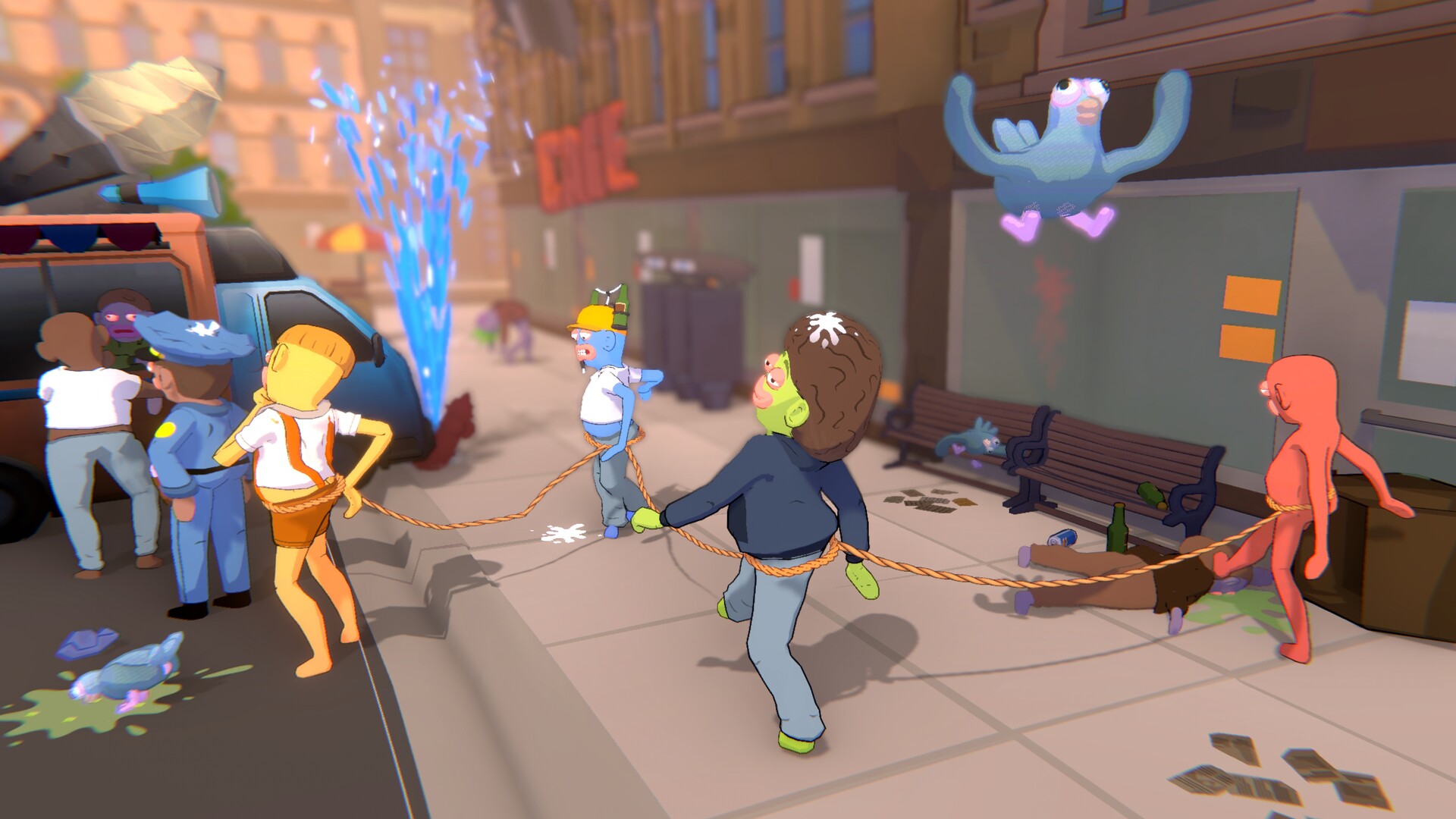
Every player is physically roped together, so one person's stumble drags the whole group off courseImage: Ytopia via Steam -
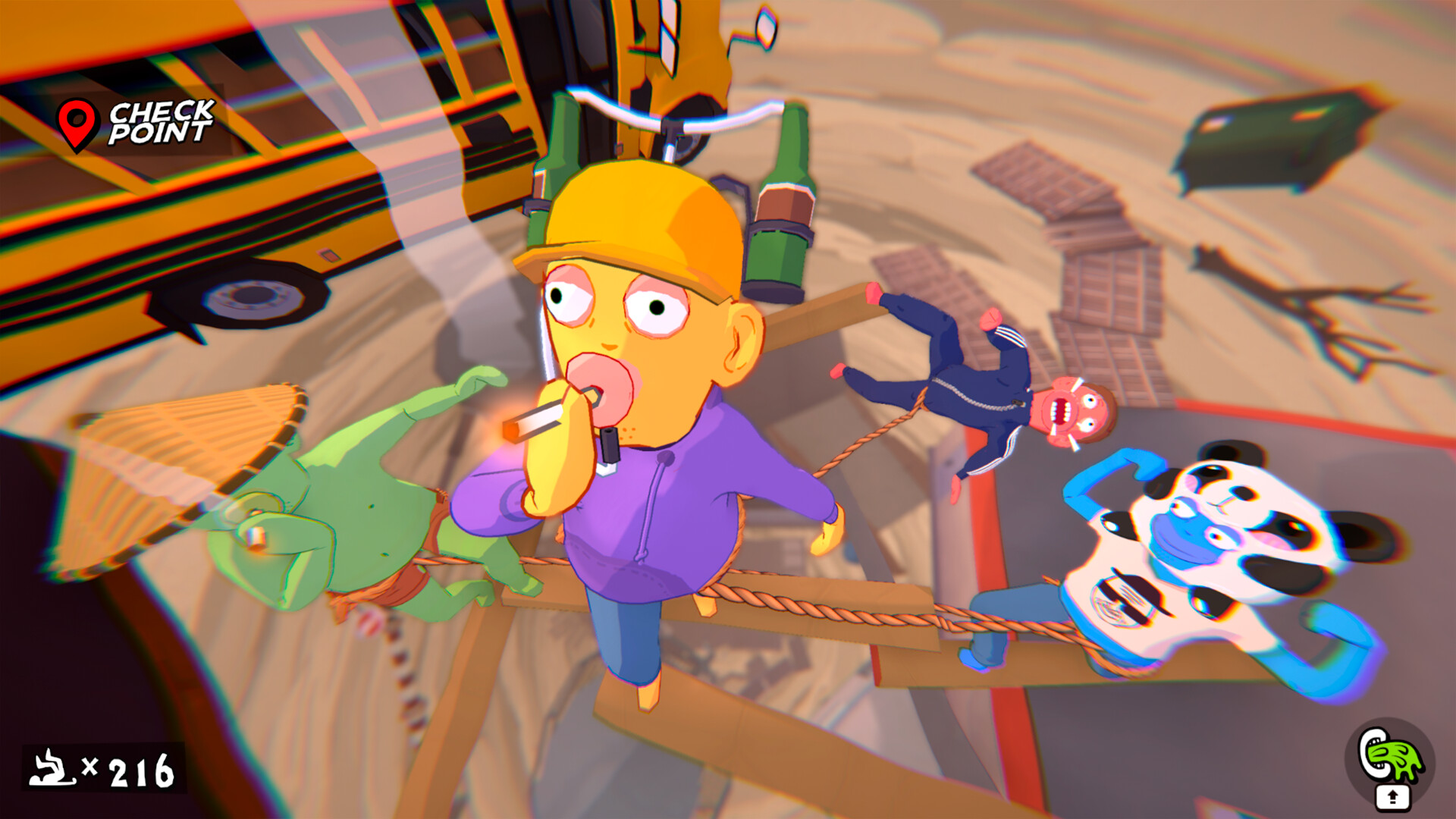
Checkpoints mark progress along precarious rope-and-plank crossings that punish any one player's misstepImage: Ytopia via Steam -
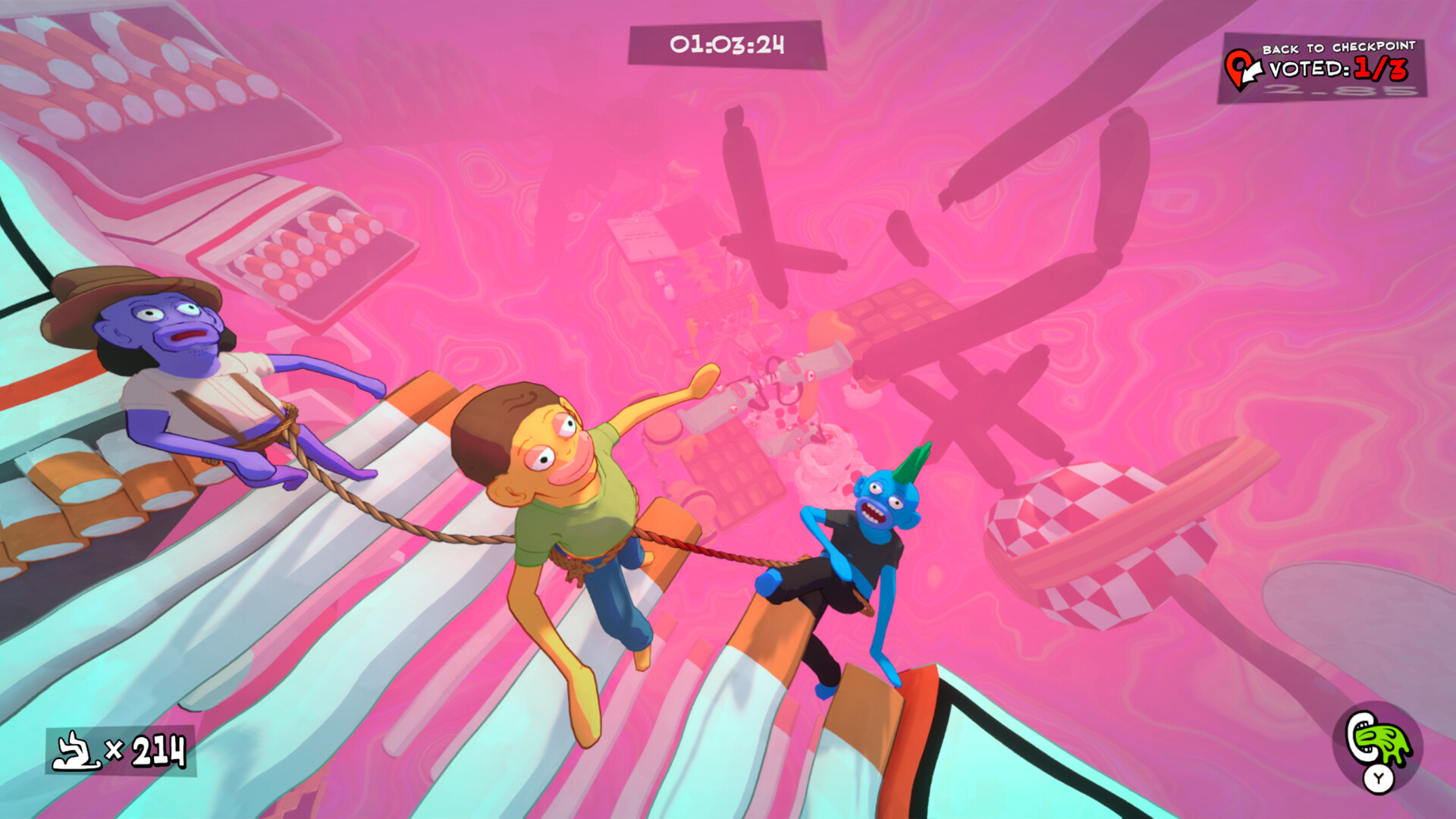
Later sections lean into surreal, hallucinatory set dressing to match the group's drunken hazeImage: Ytopia via Steam -
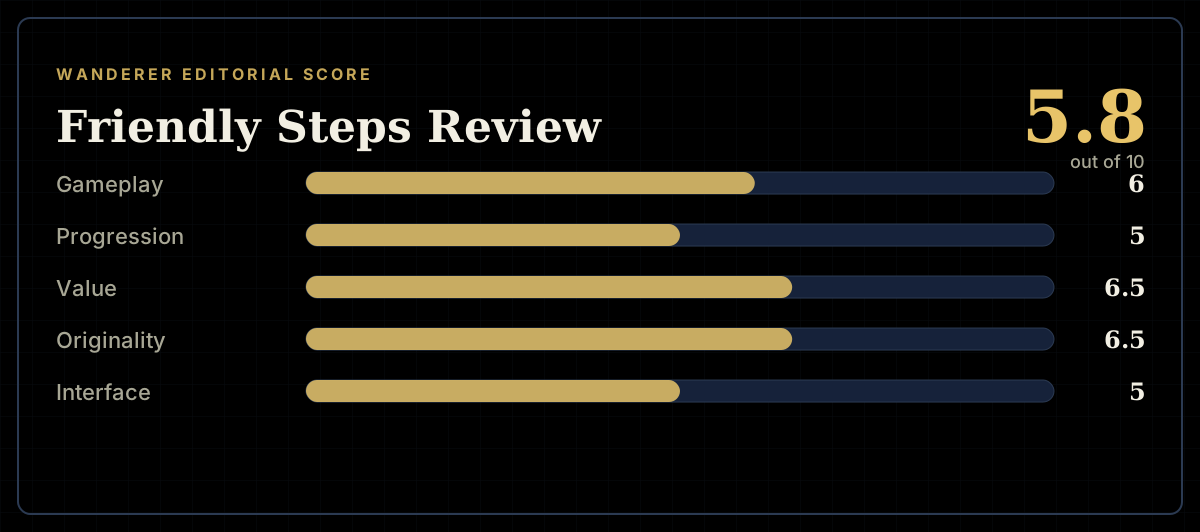
How the review scores each part of the gameWanderer Editorial -
The short versionWanderer Editorial