
Reading the road
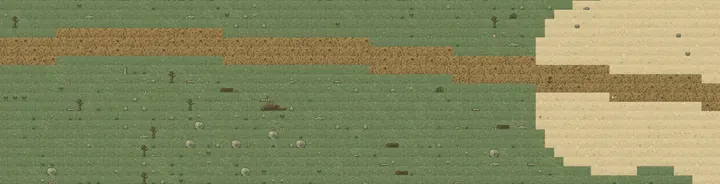
The gold road runs the world west to east. Walk it and you'll pass through every region in order — meadow, forest, hills, mist, fen, frost, ash, the dead Hollow Crown, and beyond it the frontier country of the old empire, ending at the Forgotten Sanctum. Each region announces itself: the ground changes, the music changes, the monsters change. The World Atlas documents every region on the route.
Safe ground and wild ground
Towns and their surroundings are safe — nothing attacks you there, your hit points recover, and you walk noticeably faster, so hugging safe ground is never wasted time. The wilds on either side of the road are not safe. The strip of walkable land is generous, and the edges of it hide things: camps, shrines, pools, and stranger finds tucked at the margins for travellers who look sideways.
Ways to travel
Point-and-tap Manual movement is always available, but the travel modes do the walking for you: Explore presses east and takes the fights that come, Hunt goes looking for them, Return walks you back toward safety, and Rest stays put on safe ground to recover. For long hops backward along road you've already won, town stores sell teleport scrolls to settlements you've unlocked — the road only has to be walked the hard way once. The movement modes guide covers the full set, including the working modes.
Landmarks
Every region keeps two or three landmarks — the Elderheart tree, the wreck of the Dawnbreaker, the Frozen Titan, the Sword of the Fallen, the rib-cage road of the Titanfall Barrens. They're on the world map once you've been near them, and they're the fastest way to describe where you are to another player. The landmark directory catalogues the notable ones.
The world map
Open the World Map from the menu to see the whole surveyed corridor as a drawn map — regions, towns, and how far east your journey has taken you so far. Town coordinates on the map plus the distance readout under your compass make it easy to judge how far the next milestone is.
Discovery pays
New places tick up your Locations count, and the leaderboards track the road's great travellers. But mostly: the map is handmade end to end, and the reward for wandering off the centre line is finding the things nobody told you about. A hermit's cold camp above a gorge. A fairy ring deep in the elder woods. Whatever's inside that glacier.
Common mistakes
- Never leaving the road. The corridor is over twenty tiles wide and the interesting finds sit at its edges. The road is for travelling; the margins are for exploring.
- Exploring at your limit. Discovery runs are best done in country a little below your level — you're there to look around, not to grind defence the hard way.
- Walking back west by hand. That's what teleport scrolls and the Return mode are for.
- Passing towns without touching them. Brushing a town unlocks it as a recovery point and teleport destination — even if you don't stop to shop.
FAQ
How big is the world?
One continuous handmade corridor, dozens of regions long, from Wanderer's Rest at level 1 to endgame country at level 400. There are no loading screens or instanced maps — it's all one road.
Can I fall off or get lost?
No. The walkable land is bounded, and the road always leads home. Worst case, set Return and watch your wanderer sort it out.
Is anything west of the start?
Yes — the first rock fields sit west of Wanderer's Rest, and the western fringe has its own corners worth a look. East is progress; west is not empty.
Do discoveries do anything?
They count toward your Locations statistic and its leaderboard, and landmarks become reference points on your world map.
Can other players see me exploring?
Yes — it's one shared world, and other wanderers are visible on the road. They can't take your finds, and they can't touch you on safe ground; outside safe zones a duel is possible, but only as a deliberate tap on both sides, not something exploring exposes you to passively.