Game review
The Ferryman's Trial
7 / 10
- Developer
- Viridino Studios
- Publisher
- Viridino Studios
- Released
- 25 June 2026
- Platforms
- Windows, macOS, Linux
- Genre
- Indie
- Monetisation
- paid
- Players
- false
The short version
Biggest strengths
- Genuinely ambiguous, well-written character judgments that several reviewers said made them reconsider their own choices after the fact
- A striking dithered visual style and a dark, immersive soundtrack that reviewers consistently praised as outstanding for the price
- A deeply personal creative premise, reportedly a tribute to a developer's late family member, that reviewers said added real emotional weight
Biggest weaknesses
- A very short runtime, often 20 to 50 minutes, that some reviewers felt left the concept underdeveloped
- A structural tension several reviewers flagged: the game frames choices as neither right nor wrong, yet still tracks objectively "correct" answers toward its ending
- No apparent option to revisit the opening text or menu without restarting the game
Who it's for: Fans of short, dialogue-heavy narrative games and visual novels built around morally ambiguous decisions, who value atmosphere and writing over length
Our recommendation: recommended
7 / 10
The Ferryman's Trial released on Steam on June 25, 2026, from Viridino Studios, a short narrative game in which the player, a soul recruited by Death himself, must interview and judge ten dead individuals to determine whether they deserve heaven or hell, all as an unusual audition for the role of Ferryman. Priced at just $0.99, its 29-review English pool lands at Positive (26 up, 3 down, 90%), a reception defined less by disagreement over quality than by a genuine, thoughtful split over whether the game's brief length and rigid underlying answer key undercut the moral ambiguity it promises.
The writing and characterization draw the pool's most consistent praise. One reviewer described being pulled in by the game's realism, writing that "the dialogue is so realistic" and praising a specific narrative detail about how people's self-perception can be shaped by their own delusions, adding "I feel like a lot of these types of games don't think of details like that, or at least don't put as much care into it." Another reviewer framed the entire experience as a mirror turned back on the player, writing that the game leaves you "wondering if you're truly judging these lost souls or if you are the one being judged yourself," and that "the people you meet and judge as a Ferryman are portrayed with honest words, they lie, sure, however what they don't say reveals just as much." A third reviewer praised how the cast resists easy caricature, noting "the game does a good job of making everyone feel morally gray without turning them into caricatures," while another added that "several conversations had me changing my opinion of people multiple times."
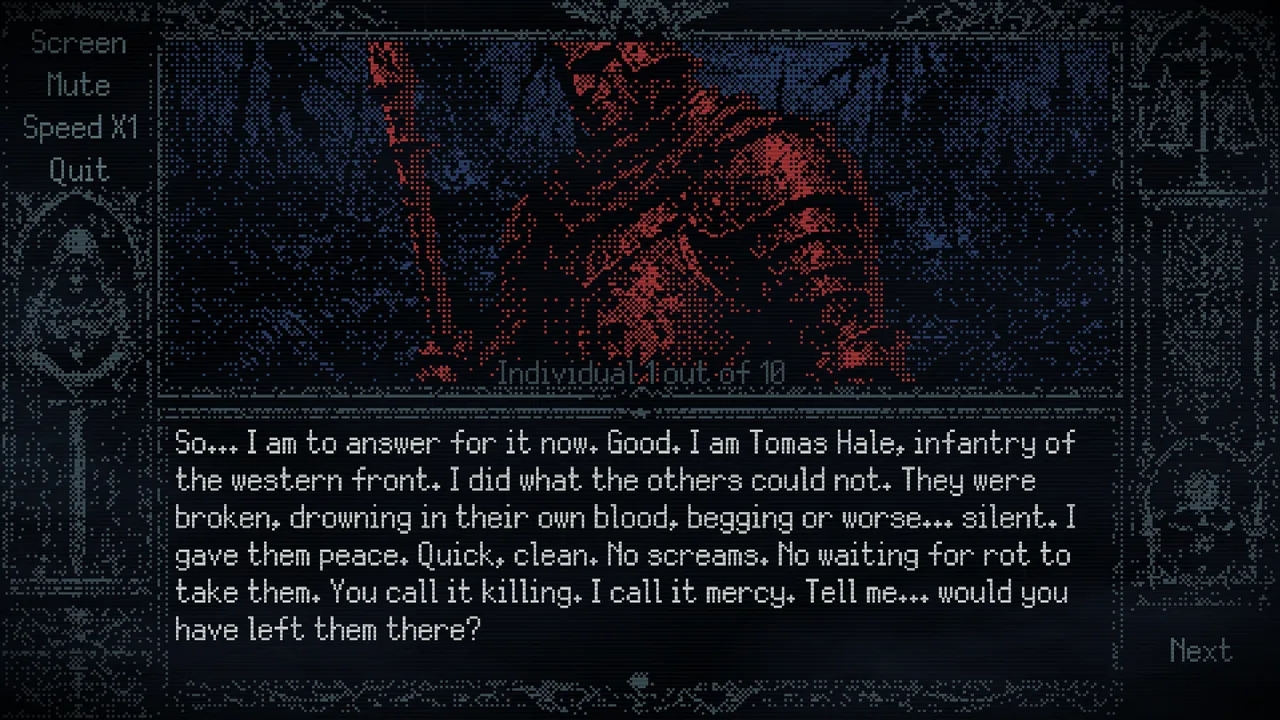
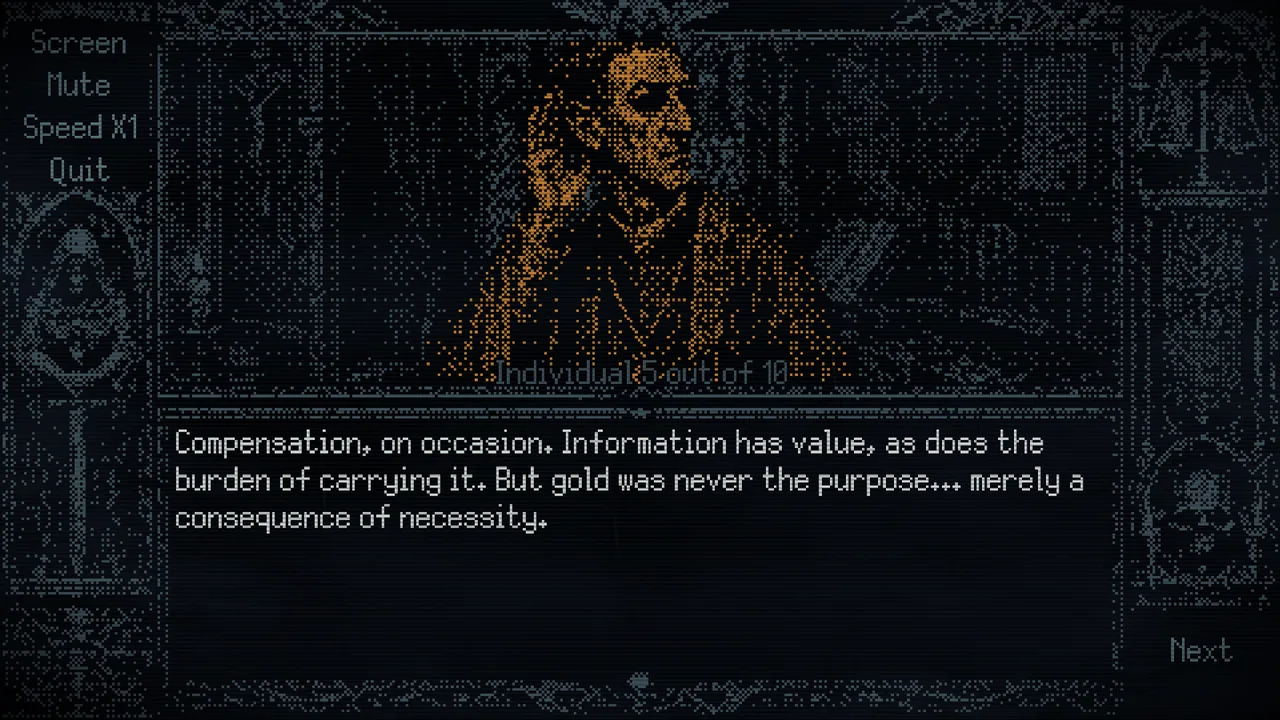
Presentation was almost universally praised alongside the writing. One reviewer called the visual style "outstanding," specifically highlighting "the dithering effect combined with the color palette," which they said "looks gorgeous," and praised a soundtrack that creates "a dark, tense atmosphere that perfectly complements the experience," comparing the overall polish favorably to "Viridino's previous games." Another described the "thunder and lightning sounds and the soundtrack" as immersive, evoking "games in the 90's." That same reviewer, who described the game as resonating with them because it was reportedly made as "a tribute from one of the developers to a beloved family member who has passed away," said that knowledge "gave the experience much more emotional weight and made me want to make the best possible decisions in every situation," a framing several other reviewers echoed even without knowing the specific personal context, describing the atmosphere as "somber," "eerie," and "unsettling" in ways that felt intentional rather than accidental.
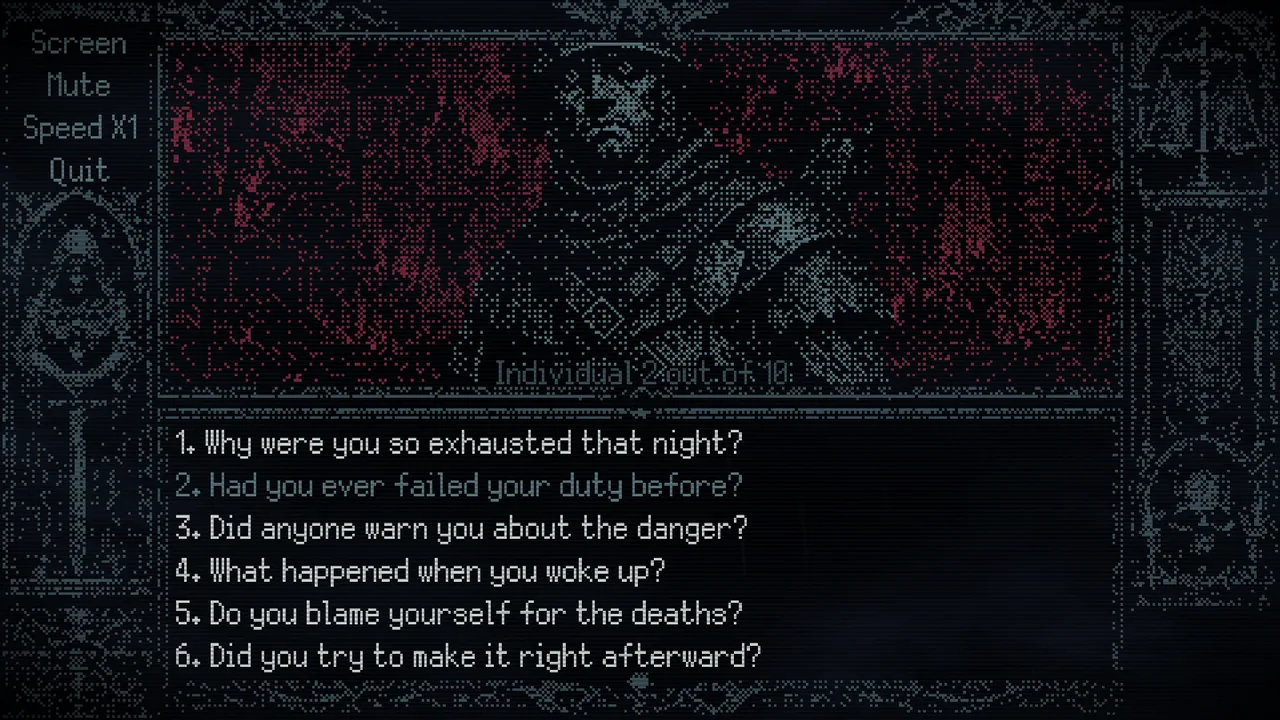
The most substantial and consistent critical thread concerns the tension between the game's stated premise and its actual structure. One reviewer, who rated the game negatively despite calling it "OK," laid the concern out in detail: the game "begins with prefacing the entire experience as personal decisions that are neither right or wrong," yet "there certainly is a good or bad ending depending on your choices," which they said "diminishes the experience as a whole" once discovered, especially since "there is not enough information the first time through to make informed decisions on what is 'correct.'" That reviewer ultimately settled on "50/100," framing the game as a pleasant but thin diversion "equivalent to a can of soda or candy bar." Another negative reviewer was harsher and more concise, calling it "barely a game," describing it as "a short questionnaire with a bit of moral ambiguity sprinkled in," and concluding "this is all too thin." A more sympathetic reviewer nonetheless flagged a related, milder version of the same friction, writing that choices are "bordrline impossible" and require "trial and error" to align with the developer's own moral framework.
Runtime length is the other recurring theme, though it splits the pool more evenly between complaint and non-issue. Several reviewers reported finishing in well under an hour, one in as little as six minutes, and reactions varied sharply based on price expectations. One reviewer pushed back directly on runtime complaints, writing, "if you are complaining about and refunding a $1 game like this, purely because you finished it in half an hour, you evidently didn't question your own morality enough inside or outside of the game." Others agreed the price justified the length outright: one called it "a neat little experience" that was "very worth it," while another, who played the game twice, wrote "it is also just $1 dollar US...so cannot complain much." A handful of reviewers wanted more regardless of price, with one writing simply that after finishing in under 30 minutes they "kind of wished there was more," and another suggesting the developer add language support and a way to revisit the opening text without restarting the game entirely.
Taken together, The Ferryman's Trial is a small, confident piece of narrative design that mostly succeeds at what it sets out to do: use a handful of morally gray character studies, striking dithered art, and a genuinely tense soundtrack to make players sit with uncomfortable judgments for a few minutes each. The friction between its stated moral relativism and its actual right-answer structure is a real, fair critique, one worth taking seriously rather than dismissing as pedantic griping, but it did not stop the large majority of reviewers from finding the experience memorable well past its short runtime. At under a dollar, it's an easy, low-risk recommendation for anyone drawn to dialogue-heavy, atmosphere-first storytelling.
Pros and cons
Pros
- Genuinely ambiguous, well-written character judgments that several reviewers said made them reconsider their own choices after the fact
- A striking dithered visual style and a dark, immersive soundtrack that reviewers consistently praised as outstanding for the price
- A deeply personal creative premise, reportedly a tribute to a developer's late family member, that reviewers said added real emotional weight
- Extremely accessible pricing that most reviewers felt matched the experience even at its very short length
Cons
- A very short runtime, often 20 to 50 minutes, that some reviewers felt left the concept underdeveloped
- A structural tension several reviewers flagged: the game frames choices as neither right nor wrong, yet still tracks objectively "correct" answers toward its ending
- No apparent option to revisit the opening text or menu without restarting the game
- Limited language support, with at least one non-native English speaker finding some phrasing difficult to parse
Screenshots
-
The Ferryman's TrialImage: Viridino Studios via Steam -
The Ferryman's TrialImage: Viridino Studios via Steam -
The Ferryman's TrialImage: Viridino Studios via Steam