
Game review
Rift Riff
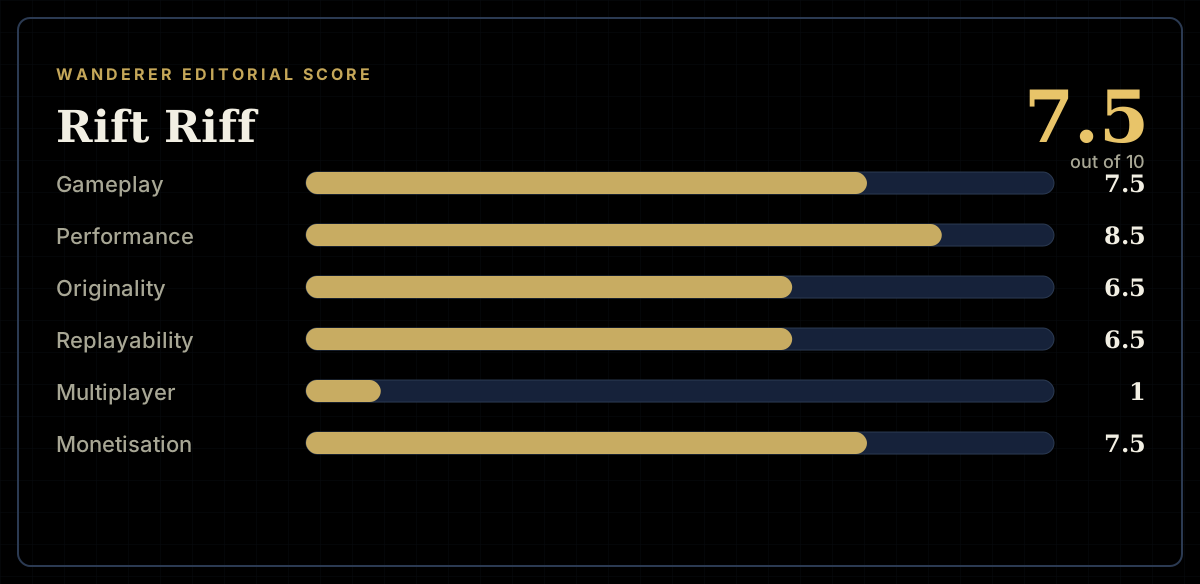
7.5 / 10
- Developer
- Adriaan de Jongh, Sim Kaart, Matthijs Koster, Franz LaZerte, Professional Panda
- Publisher
- Adriaan de Jongh
- Released
- 9 May 2025
- Platforms
- Windows, macOS, Linux
- Genre
- Action, Indie, Strategy
- Monetisation
- Premium, one-time purchase. No microtransactions.
- Players
- Single-player only.
The short version
Rift Riff, from a small team led by Bounden and Fingle creator Adriaan de Jongh, is a old-school tower- defense game about jumping between rifts, fighting off monsters, and plundering their worlds using a focused roster of roughly ten distinct tower types. It earns Very Positive reviews built on real, specific praise for its forgiving refund-and-replace tower system, its standout sound design, and its deliberate return to placement-focused strategy in a genre that has increasingly drifted toward roguelite power-up chains, though a smaller but consistent minority of reviewers argue several of its levels are so tightly designed around one intended solution that they play more like puzzles than open strategic sandboxes.
Biggest strengths
- Praised repeatedly for its forgiving tower-refund system, with one reviewer with over 27 hours logged calling it "the only tower defense game that I love," crediting how "allowing you to refund and replace all towers between waves" removes the anxiety of a wrong early placement ruining a run.
- Praised for standout audio and presentation, with multiple reviewers highlighting "amazing audio design and the pixel art style," and another describing the different sounds towers and enemies make as central to why "the music and the sound design are another aspect where this game shines."
- Praised for its old-school focus on tower placement over roguelite power-up chains, with one reviewer stating "it seems like most tower defense games these days are going roguelite and putting all the strategy into the 'pick the power up' part," crediting Rift Riff with returning focus to "why and where you should place towers."
Biggest weaknesses
- A corroborated complaint from a vocal minority argues several levels are too rigidly designed around one intended solution, with one reviewer stating "many levels require you to play with the exact towers and exact set up the developer designed them for to survive," concluding the game plays more like a puzzle than a tower-defense game "on most levels."
- A related complaint concerns the game punishing experimentation on some maps, with one reviewer describing towers that "do not complement each other well enough" and locations "not suited to do much of anything," concluding "the game punishes experimentation or makes it unbearable to even try."
- A smaller but specific complaint concerns the player character's frequent vocalised sound effects, with one reviewer reporting the noises became so grating over time that they "ruined the game," and a separate reviewer noting the lack of adjustable game speed made higher-difficulty levels feel closer to a twitch-reflex arcade game than a considered strategic one.
Who it's for: Tower-defense fans who want a return to placement-and-planning fundamentals over roguelite power creep, especially anyone who enjoyed Thronefall's compact, story-light approach to the genre; players who want freeform experimentation on every level should expect some maps to feel more prescriptive than that.
Our recommendation: A polished, charming, and genre-respecting tower-defense game let down only by a handful of levels that feel more like scripted puzzles than open strategic challenges.
7.5 / 10
Tower defense stripped back to fundamentals
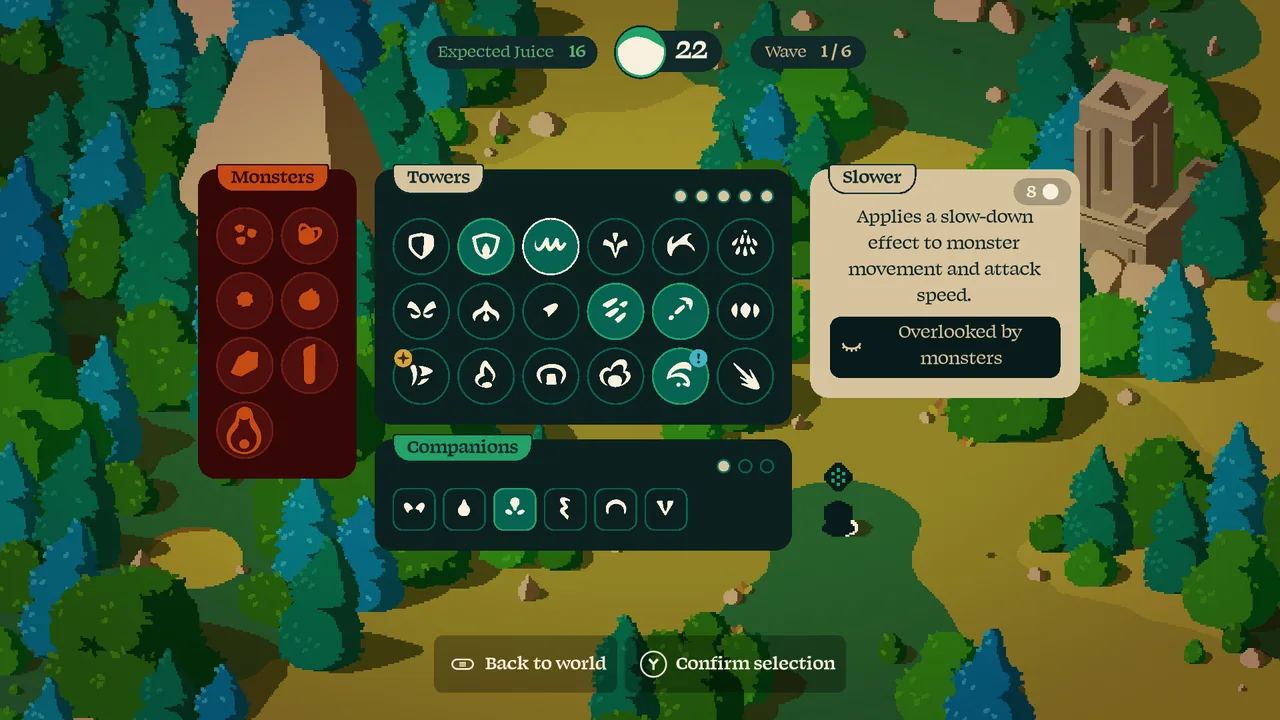
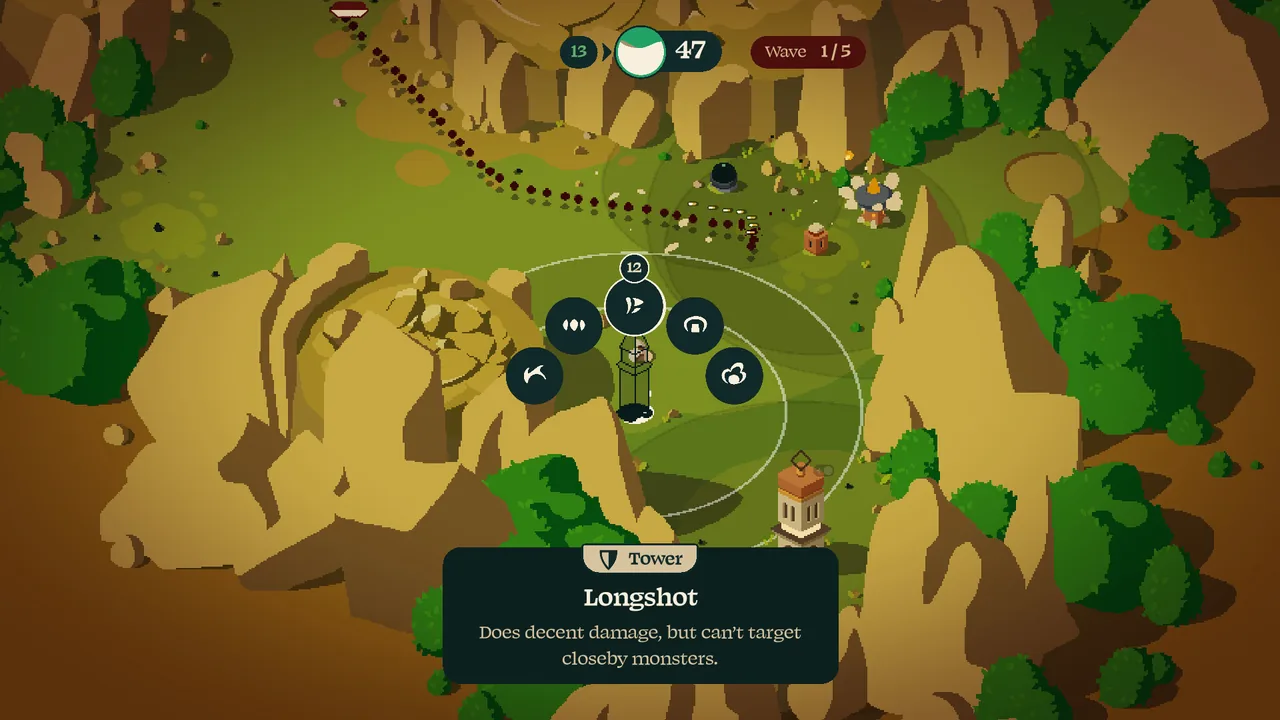
Rift Riff, released 9 May 2025, comes from a small team led by Adriaan de Jongh, best known for the tactile, unconventional Bounden and Fingle, working alongside Sim Kaart, Matthijs Koster, Franz LaZerte, and Professional Panda. Its premise is simple: jump a rift into a monster-infested world, fight them off with a roster of roughly ten distinct towers, and plunder what remains before moving on. What sets it apart in a genre currently dominated by roguelite hybrids, according to a strong majority of the review sample, is a deliberate return to placement-and-planning fundamentals. One reviewer puts this directly: "it seems like most tower defense games these days are going roguelite and putting all the strategy into the 'pick the power up' part. Thankfully Rift Riff is going back to focus on the tower portion of tower defense," crediting the game's roughly ten towers with each serving "a distinct purpose," forcing genuine consideration of "why and where" to place them given the game's varied, constrained level geometry.
That focus on considered planning is reinforced by what reviewers repeatedly single out as the game's most forgiving, experimentation-friendly system: the ability to refund and replace any placed tower between waves. One reviewer with over 27 hours logged calls Rift Riff "the only tower defense game that I love," attributing that almost entirely to how the refund system "allows for greater freedom to experiment while also eliminating the worry that a tower you place to deal with an earlier wave is now obsolete and does nothing for you in the current wave." Multiple reviewers separately praise small design touches built around that same philosophy, including one who highlights how "when you enter a new world you first get to take a short walk from where the enemies spawn to the place you have to defend," giving players a natural moment to survey the battlefield and form a plan before committing resources.
Presentation that repeatedly wins reviewers over
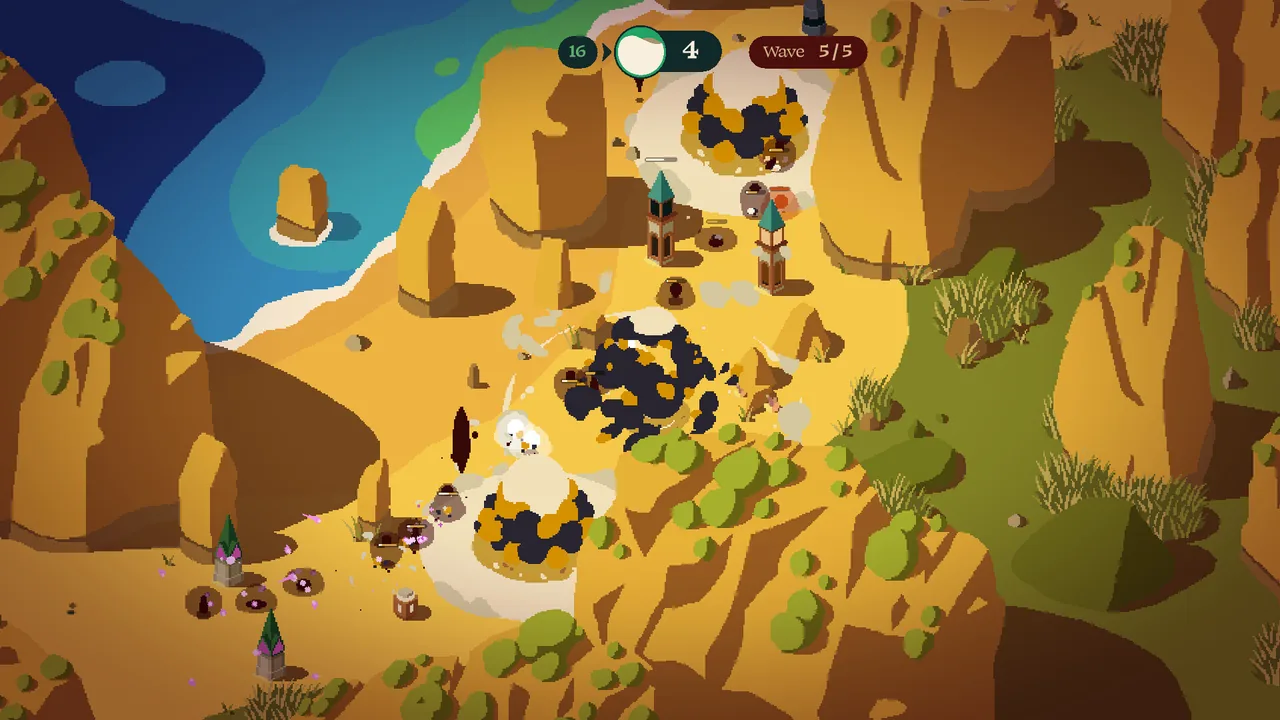
Beyond its mechanical design, Rift Riff's presentation draws consistent, specific praise across the review sample, with sound design mentioned almost as often as gameplay itself. One reviewer credits "amazing audio design and the pixel art style" with adding "a lot of charm to the game," while another goes further, describing "the different sounds made by the enemies when hit, the towers when firing, the background music and even the whimsical sounds your character makes" as central to the game's appeal. A third reviewer frames the whole package evocatively: "Rift Riff is like finding an old Game Boy cartridge you forgot you loved… except it's secretly the best tower defense game I've played in years," crediting "the retro vibe, the quirky characters, the music" with making a familiar genre feel fresh again.
The game's frequent, favourable comparisons to Thronefall, another recent minimalist tower-defense-adjacent hit, appear repeatedly throughout the sample, with several reviewers discovering Rift Riff specifically while looking for something to fill a Thronefall-shaped gap. That comparison cuts both ways, however: while most reviewers who invoke Thronefall do so approvingly, at least one reviewer who struggled with Rift Riff's harder difficulty tiers explicitly prefers Thronefall's tighter design, questioning "why would you bother buying this game" when the comparison exists, a genuinely mixed signal buried within an otherwise overwhelmingly positive review sample.
When strategy becomes a puzzle with one answer
The review sample's most consistent and specific criticism concerns a subset of levels that reviewers argue are designed around a single correct solution rather than open strategic possibility space. The most upvoted negative review in the sample states this directly: "many levels require you to play with the exact towers and exact set up the developer designed them for to survive," arguing the game is "just a puzzle game, not a Tower Defense game, at least on most levels," and concluding it is "so constrained by the rails it is placed on that I cannot recommend it." A second reviewer echoes a similar frustration from a different angle, reporting that on certain maps "the towers do not complement each other well enough, nor are the locations suited to do much of anything," concluding "the game punishes experimentation or makes it unbearable to even try," a direct tension with the refund-and-replace system's stated goal of encouraging exactly that kind of experimentation.
A smaller, more idiosyncratic complaint concerns the player character's audio design specifically, the same sound design broadly praised elsewhere in the sample. One reviewer reports the character's frequent vocalised noises became progressively more "obnoxious" and "infantile" as the game continued, stating bluntly it "ruined the game" for them despite otherwise liking what they played, a reminder that even a widely praised design choice can land very differently depending on a given player's tolerance. A separate reviewer raises a related, more mechanical complaint about the absence of adjustable game speed, arguing that combined with imprecise mouse-pointer sizing at higher resolutions, harder difficulty levels can feel closer to "an arcade" test of reflexes than the considered strategic challenge the base game otherwise delivers.
Verdict
Rift Riff earns its Very Positive reception through genuine strengths: a forgiving, experimentation-friendly tower system, distinctive and well-loved sound design, and a deliberate, mostly successful return to tower-defense fundamentals in a genre that has drifted toward roguelite power creep. The corroborated criticism that several levels are more rigidly scripted than the game's own refund system implies is a fair, specific complaint rather than a vague one, and worth taking seriously if open-ended strategic freedom is what you're chiefly looking for from the genre. But for players drawn to old-school placement-focused tower defense with real charm behind it, Rift Riff delivers on that promise for the large majority of its runtime.
Pros and cons
Pros
- Praised repeatedly for its forgiving tower-refund system, with one reviewer with over 27 hours logged calling it "the only tower defense game that I love," crediting how "allowing you to refund and replace all towers between waves" removes the anxiety of a wrong early placement ruining a run.
- Praised for standout audio and presentation, with multiple reviewers highlighting "amazing audio design and the pixel art style," and another describing the different sounds towers and enemies make as central to why "the music and the sound design are another aspect where this game shines."
- Praised for its old-school focus on tower placement over roguelite power-up chains, with one reviewer stating "it seems like most tower defense games these days are going roguelite and putting all the strategy into the 'pick the power up' part," crediting Rift Riff with returning focus to "why and where you should place towers."
Cons
- A corroborated complaint from a vocal minority argues several levels are too rigidly designed around one intended solution, with one reviewer stating "many levels require you to play with the exact towers and exact set up the developer designed them for to survive," concluding the game plays more like a puzzle than a tower-defense game "on most levels."
- A related complaint concerns the game punishing experimentation on some maps, with one reviewer describing towers that "do not complement each other well enough" and locations "not suited to do much of anything," concluding "the game punishes experimentation or makes it unbearable to even try."
- A smaller but specific complaint concerns the player character's frequent vocalised sound effects, with one reviewer reporting the noises became so grating over time that they "ruined the game," and a separate reviewer noting the lack of adjustable game speed made higher-difficulty levels feel closer to a twitch-reflex arcade game than a considered strategic one.
Screenshots
-
Rift RiffImage: Adriaan de Jongh via Steam -
Rift RiffImage: Adriaan de Jongh via Steam -
Rift RiffImage: Adriaan de Jongh via Steam -
How the review scores each part of the gameWanderer Editorial -

Key facts at a glanceWanderer Editorial -
The short versionWanderer Editorial