Game review
Little Incrementisle
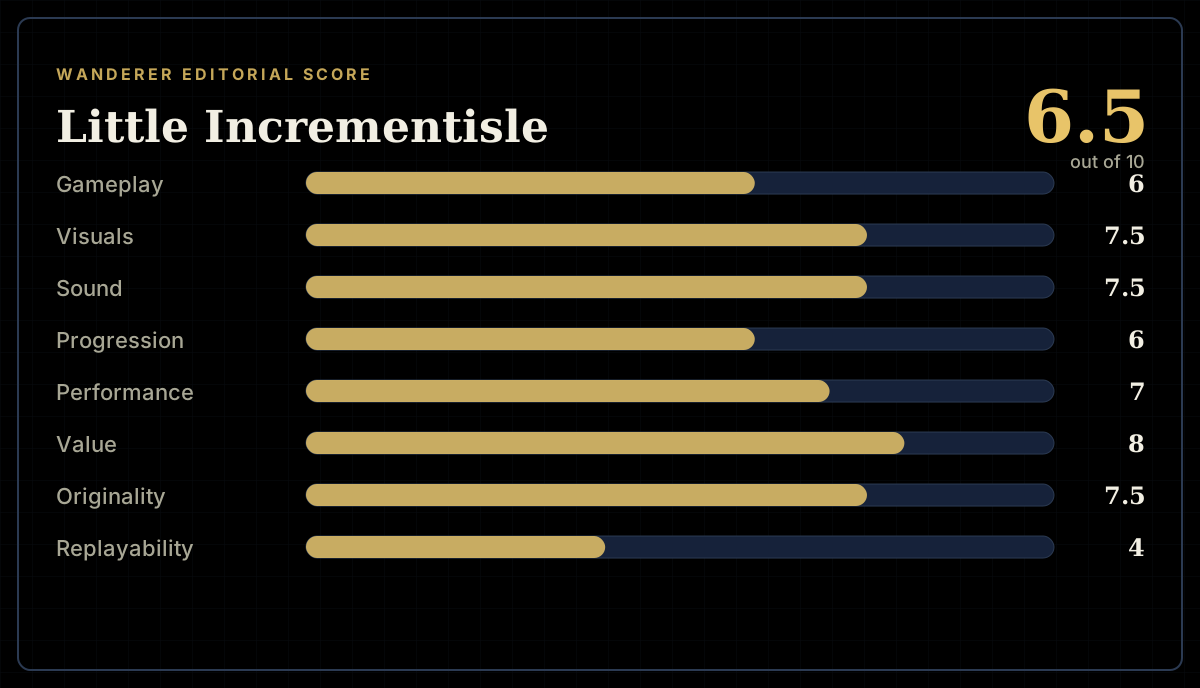
6.5 / 10
- Developer
- AM TEAM
- Publisher
- Unexpected
- Released
- 13 July 2026
- Platforms
- Windows
- Genre
- Incremental colony builder
- Monetisation
- Free to play with no in-game purchases, no adverts and no DLC (checked 29 July 2026)
- Players
- Single-player
The short version
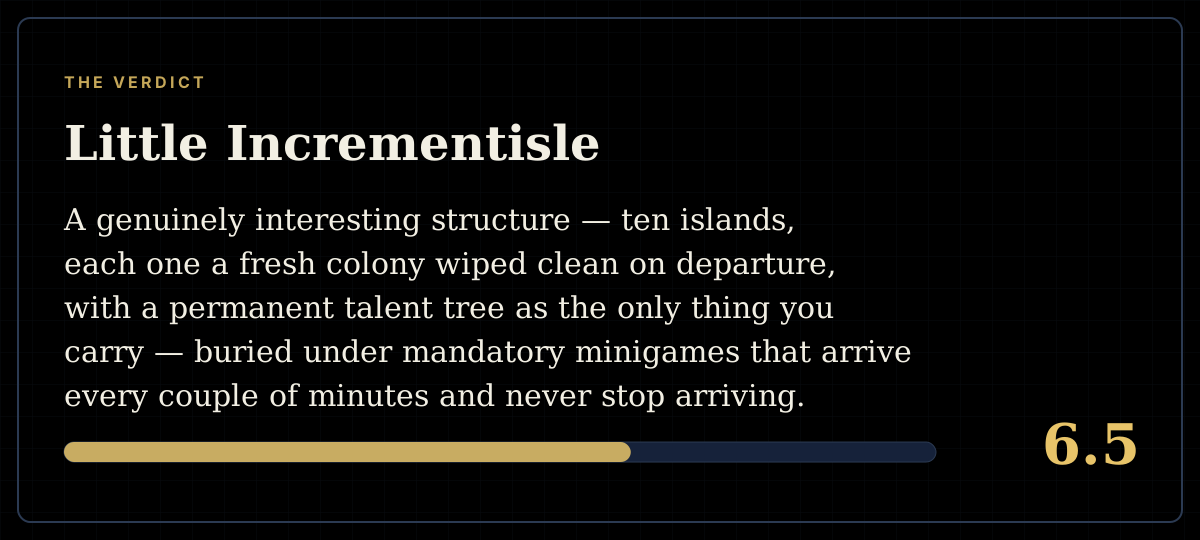
A genuinely interesting structure — ten islands, each one a fresh colony wiped clean on departure, with a permanent talent tree as the only thing you carry — buried under mandatory minigames that arrive every couple of minutes and never stop arriving.
It costs nothing, it takes an evening or two, and the first three islands are good. The trouble starts when the game's answer to "keep the player engaged" turns out to be sorting marbles into bins while a raid drains the stockpile you spent forty minutes filling.
Biggest strengths
- The island reset is a real structural idea — each landing is a clean optimisation problem, not a bigger version of the last one
- Modifiers picked on departure let you dial the next island's difficulty up or down yourself
- Art and music are calm and legible, and the whole thing runs on 2 GB of RAM
Biggest weaknesses
- Interruptive minigames are mandatory, repeat on a timer and can't be failed out of
- Escalation is keyed to thresholds the interface never shows you, so the early game punishes reasonable decisions
- Hunting and fishing are traps — only the farm takes repeatable upgrades, yet leaving a food building unstaffed penalises all food
Who it's for: Players who want an active, tight resource-management crunch and don't mind losing an island to learn a rule. Anyone shopping for something to leave running should keep walking.
Our recommendation: Free, short and worth an evening if the description of the minigames doesn't already put you off. If it does, that instinct is correct — they get more frequent, not less.
6.5 / 10
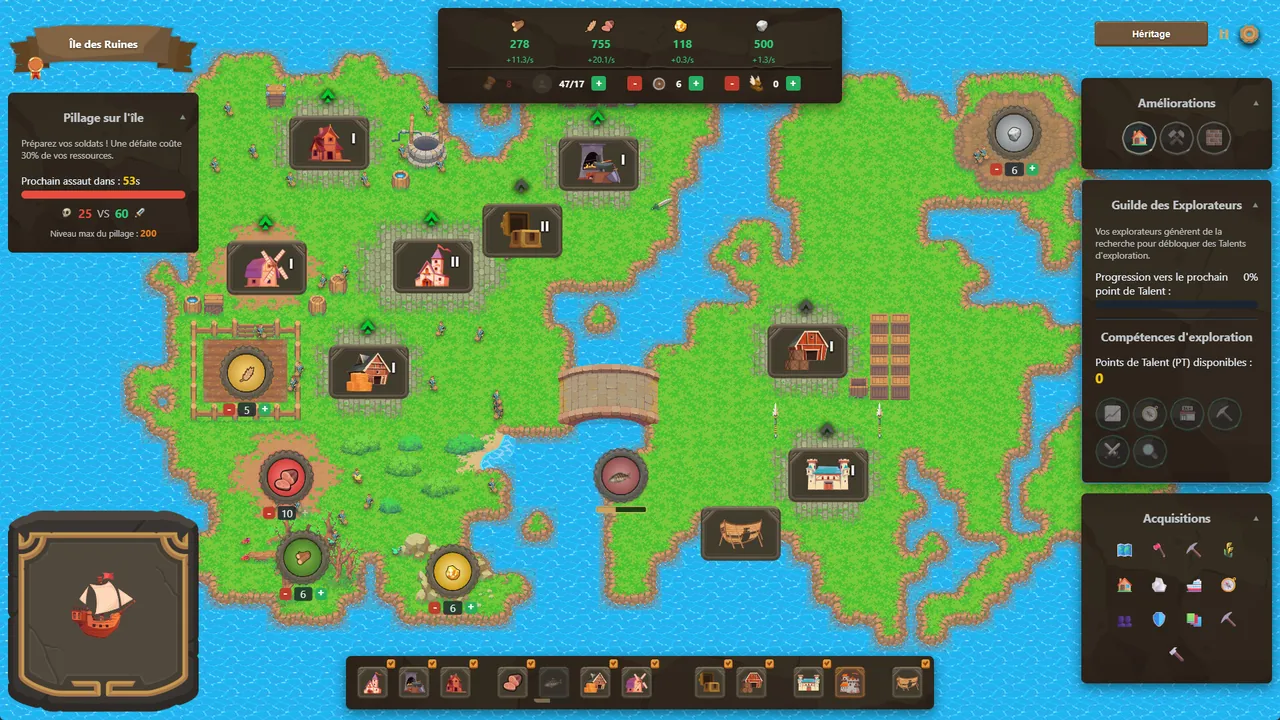
Little Incrementisle is filed under Incremental on its own store page, and that one word has probably cost it more goodwill than anything in the code. Arrive expecting the genre's standard deal — pick a task, close the window, come back to bigger numbers — and inside twenty minutes you're shuffling villagers between the farm, the barracks and the infirmary every thirty seconds while a raid quietly eats the stockpile you just built. This is a small real-time colony manager wearing an incremental's clothes. Once you stop waiting for it to start playing itself, it gets considerably more interesting, and considerably more annoying, at roughly the same rate.
The frame is strong. You land on a wild island with nothing, put people on wood, food and stone, unlock buildings as the resource chains deepen, survive whatever that island has been assigned — an earthquake, a flood, pirates — and then build a ship and leave. Everything you constructed stays behind. What travels is prestige, spent on a permanent talent tree that shapes every future landing. Ten islands and a cave finale, which the achievement list lays out plainly; most people who reach the end are done inside three to six hours.
The reset is the best thing in it
Wiping the board every island is a smarter decision than it first looks. Incrementals usually grow in one direction — the same colony, bigger, forever — which means the interesting part, the early scarcity where every villager placement matters, lasts about fifteen minutes and never returns. Little Incrementisle hands you that scarcity ten times over and changes the rules each time.
The modifiers do real work here. On departure you choose your next island's conditions: cheaper buildings but slower research, faster production but earlier raids, and so on. That's a difficulty slider disguised as a decision, and it's an elegant one, because you're setting the terms based on what your talent tree currently does well. When it clicks — a build oriented around fast expansion meeting an island that rewards exactly that — the game is genuinely sharp.
What blunts it is that the islands themselves stop introducing new ideas well before the tenth. Past the middle of the run you're solving a familiar problem with worse numbers, and the scaling does the work that new mechanics should be doing. The last few landings are longer rather than different.
The minigames are the argument
Every few minutes, the colony screen is taken over by a minigame. Sort fifty marbles into the right bins. Click the targets. Work the shapes. They're tied to the island's threats — pirate raids, tides, earthquakes — and they are the developer's answer to the question of what an "incremental" player should be doing with their hands.
It's the wrong answer, and it's the thing that will decide whether you finish. Three problems stack up. They're mandatory, so there's no option to accept a penalty and keep managing the colony. They repeat on a timer that doesn't slow down or scale away — nothing in the talent tree buys you fewer of them. And they don't develop, so the fiftieth marble sort is the first one again with more fatigue attached. Meanwhile the colony keeps running underneath, which means the minigame isn't a break from the pressure, it's a blindfold worn during it.
There's a version of this design that works: make the interruptions rarer as the colony matures, or let a well-built settlement handle a raid without your hands on it. Automation as a reward is the oldest idea in this genre. Little Incrementisle goes the other way — the further you get, the more of your attention it demands — and the store page's "Playable without Timed Input" accessibility tag sits oddly beside it.
Rules you can only learn by losing
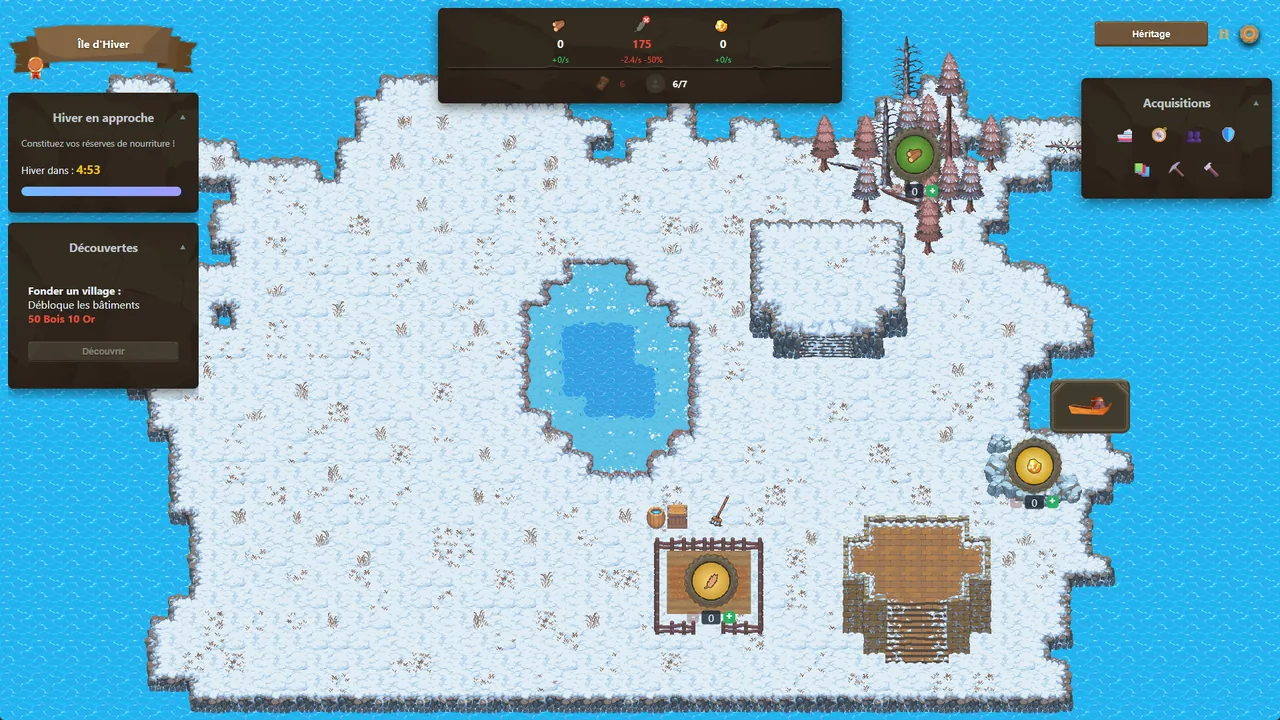
The other recurring frustration is informational. The game escalates on thresholds it never shows you, so a sensible plan can be the thing that triggers the disaster: bank enough gold for the barracks and the raid tends to arrive before the barracks does. Winter and epidemics land the same way, as sudden step-changes on islands that gave no indication they were coming.
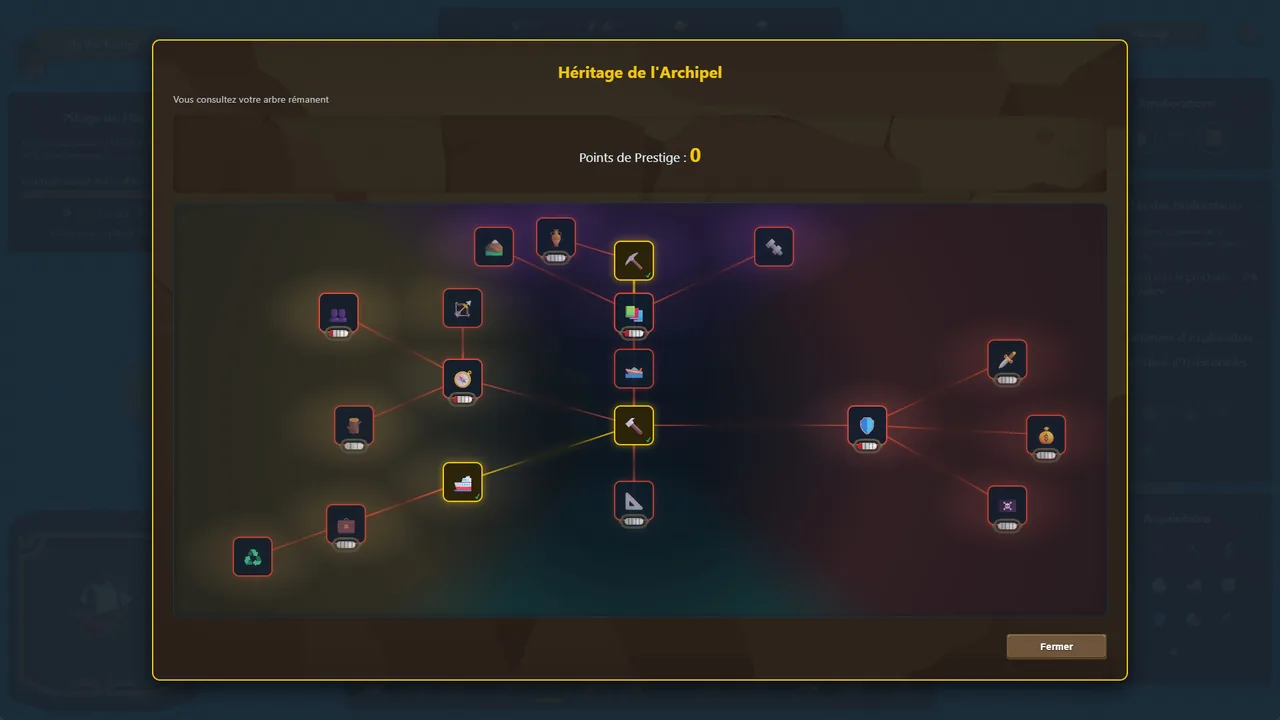
Two design faults make that worse than it needs to be. Hunting and fishing look like alternative food sources, but only the farm takes repeatable upgrades — and because unstaffed food buildings carry a production penalty, building them at all costs you a villager for nothing. That's not a difficulty curve, it's a trap laid in a build menu. And the talent tree, which is permanent and has no respec, means a run spent on the wrong upgrades can leave you unable to clear the island in front of you. The fix at that point is to erase the journey and start again from the first landing, better informed.
Roguelites get away with hidden rules because a run costs twenty minutes and the meta-layer is built to absorb failure. Here a run is the whole game, and the meta-layer is the thing that can be spent wrong.
What the completion numbers say
The public achievement data draws the curve better than any complaint could. Around 78% of players hold the tutorial achievement, and 78% have cleared island one. Island three holds 55%. Island four — the point where the game starts stacking its threats — drops to 40%. By island eight it's under a quarter, and 17% see the ending.
For a free game with no financial commitment, some drop-off is meaningless: people install anything that costs nothing. But shedding more than a quarter of your remaining players between islands three and four, in a game that takes an evening to finish, points at a place where design turns on the player rather than at general indifference.
There's a second split worth noting. Across all languages the Steam score is Very Positive at 83% of 821 reviews; filter to English and it's 73% of 205. The game is French-first — the achievements are still French-only in the English build, and stray untranslated strings turn up in play — so the audience getting the polished version of it is rating a different product to the one English-speaking players installed.
Free, and honestly free
Credit where it's earned: this is free in the plain sense of the word. No purchases, no premium currency, no adverts, no energy meter, no DLC, no upsell of any kind (checked 29 July 2026). For a genre where the standard move is to sell offline hours or ad-skips back to you, a small team shipping a complete five-hour game with nothing attached deserves to be said out loud.
The technical side is modest and well-judged. Windows only, mouse only, 2 GB of RAM and half a gigabyte of disk, Steam Cloud and 17 achievements. The launch week saw a rapid run of fixes — performance passes on the raid, tide and earthquake minigames, a village rendering fix for large populations, and a colourblind-readable rework of the marble sorter within two days of release. That last one matters more than its size suggests: an accessibility fix shipped that fast says the team is reading its feedback. Whether the frequency of those minigames gets the same attention is the question that decides this game's second month.
Should you install it?
If you want an active, fiddly resource crunch that punishes inattention, yes — it costs nothing, it's over in an evening or two, and its island-reset structure is a better idea than most paid games in this space have had recently. Go in knowing you'll probably lose an island to a rule nobody told you, and treat the first run as reconnaissance.
If you came looking for something to leave running while you do something else, this is the opposite of that, and no amount of goodwill about the price changes it. The 6.5 is for a promising structure carrying too much friction it didn't need: the minigames, the hidden triggers, the build-menu traps and the unrespeccable tree are all fixable, and none of them are fixed yet. A team that patched a colourblind accessibility issue in 48 hours could turn this into a 7.5 with a single balance update. As it stands, most people who install it won't see the cave.
Pricing, monetisation and store details checked 29 July 2026.
Readers who want the calmer, leave-it-alone version of this itch are better served by Idle Iktah or Dwarf Eats Mountain — or by Wanderer, which puts its colony-sized ambitions on one long road and keeps moving while you're not looking.
Pros and cons
Pros
- The island reset is a real structural idea — each landing is a clean optimisation problem, not a bigger version of the last one
- Modifiers picked on departure let you dial the next island's difficulty up or down yourself
- Art and music are calm and legible, and the whole thing runs on 2 GB of RAM
- Completely free, with no purchases, currencies, adverts or DLC attached
- The developer patched hard through launch week, including colourblind readability for the marble minigame
Cons
- Interruptive minigames are mandatory, repeat on a timer and can't be failed out of
- Escalation is keyed to thresholds the interface never shows you, so the early game punishes reasonable decisions
- Hunting and fishing are traps — only the farm takes repeatable upgrades, yet leaving a food building unstaffed penalises all food
- The permanent talent tree has no respec, so a bad build can soft-lock a run and force a restart from island one
- Only partly localised — the English build still throws French at you, and the achievements are French-only
- Fixed island order and no post-completion content mean effectively zero reason to replay
Screenshots
-
Little IncrementisleImage: Unexpected via Steam -
Little IncrementisleImage: Unexpected via Steam -
Little IncrementisleImage: Unexpected via Steam -
How the review scores each part of the gameWanderer Editorial -
The short versionWanderer Editorial